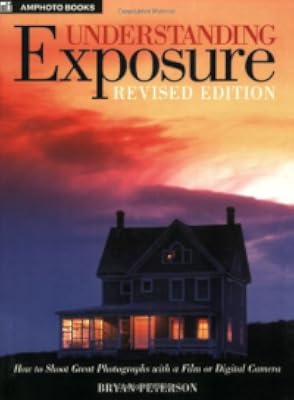
Understanding Exposure
by Bryan Peterson
On This Page
Description
Veteran photographer Bryan Peterson demystifies complex concepts of exposure in photography by explaining the fundamentals of light, aperture, shutter speed, and how they interact with and influence one another. This book explains how to get or lose sharpness and contrast in images, freeze in action, and take the best meter readings while also exploring filters, flash, and light. This forth edition includes all new images as well as an expanded section on flash, tips for using colored gels, show more and advice on shooting star trails. show lessTags
Recommendations





Member Reviews
After just having read "The Photographer's Eye", a book so dense I couldn't consume more than four pages or so per day, I started "Understanding Exposure"—and read it in just a couple of days. Not because I liked it so much, but because it just didn't contain that much information.
The author is implicitly assuming that your main goal is slow-paced, methodical landscape photography. He literally scoffs at you for not carrying your tripod everywhere, for not using a full-frame camera, or for using any kind of automation. If you're not shooting everything in manual, at base ISO, you are not a real photographer, he seems to say.
So take out your light meter, go to manual exposure, and switch off your autofocus, or this book is probably not show more for you. It was certainly not for me. As an amateur, I don't have infinite time to set up the perfect shot, and wait for the perfect dawn light. I even like to—gasp—use auto-ISO, -focus, and -white balance.
There is a lot of good information, and practical wisdom in this book, if you can read between the lines, ignore scores of irrelevant descriptions of camera settings, and generally translate knowledge from the film days to your modern camera. I just wish it were updated to account for modern technology, and didn't come off quite as condescendingly as it does. show less
The author is implicitly assuming that your main goal is slow-paced, methodical landscape photography. He literally scoffs at you for not carrying your tripod everywhere, for not using a full-frame camera, or for using any kind of automation. If you're not shooting everything in manual, at base ISO, you are not a real photographer, he seems to say.
So take out your light meter, go to manual exposure, and switch off your autofocus, or this book is probably not show more for you. It was certainly not for me. As an amateur, I don't have infinite time to set up the perfect shot, and wait for the perfect dawn light. I even like to—gasp—use auto-ISO, -focus, and -white balance.
There is a lot of good information, and practical wisdom in this book, if you can read between the lines, ignore scores of irrelevant descriptions of camera settings, and generally translate knowledge from the film days to your modern camera. I just wish it were updated to account for modern technology, and didn't come off quite as condescendingly as it does. show less
This is the best photography book I've ever read. I've read several books over the years about photography, but most have been three times as thick and one-tenth as practical as this one. This is a very down-to-earth guide on what effects exposure and how to use it creatively. The author doesn't bore you with a lot of technical rubbish you never wanted to know (that bores even a tech-head like me) and he doesn't lecture you on what makes a good photograph(er). He simply tells you how to manipulate film, shutter speed, and aperture to achieve what you want and shows you comparative samples of what happens as you manipulate each element.
This was recommended to me in an online photography course I'm taking. Very clear explanations of the "triangle" of exposure (aperture, shutter speed, ISO) and how to use them together (along with light and metering) to get not just correct but also creative photos. Offers occasional exercises as well as explanations of the included photos.
So far, very useful, helpful, inspiring.
So far, very useful, helpful, inspiring.
One of the shortest and best photography books i have ever read. I lend it to people all the time, because it so simply states the relationship between exposure, aperature and shutter and explains how to get the best result in bad lighting situations without a complicated light meter.
I'm putting this onto my "read" shelf, but I don't think I'll ever be done reading it. Somehow he makes all the confusing exposure stuff make sense. It's brilliant, really... He opened my eyes to a whole different kind of art, and helped me to see photography very differently. If I ever make a lot of money off my work, I'll have Bryan Peterson to thank...
Before cameras became automated, photographers needed to understand their camera's controls, and the way they interacted, in order to take pictures with any pretense to sophistication. While modern cameras offer programs which can control these interactions, many photographers would benefit by investing a few hours in this book.
This is not exactly a beginner's text. The expected reader has some familiarity with photography and wants to better understand and master their camera. Advanced users may find the book useful as a review, and may find a tip or two they'd not previously seen, but may find some of the explanations annoying. That's OK, as they're not the intended audience.
This book does not get into great technical detail, but does show more explain the controls and their relationships, and makes suggestions about ways the photographer can benefit from their interactions. The author advocates a specific photographic manner (style, perhaps, is too strong a word) which readers can use for a practical foundation until they develop their own habits and preferences.
Finally: The author assumes your camera gives you full manual control of exposure--that you can set ISO, aperture, and shutter speed. If you own a camera which doesn't give you that much control, you may find this book frustrating.
This review is also available on a dabbler's journal. show less
This is not exactly a beginner's text. The expected reader has some familiarity with photography and wants to better understand and master their camera. Advanced users may find the book useful as a review, and may find a tip or two they'd not previously seen, but may find some of the explanations annoying. That's OK, as they're not the intended audience.
This book does not get into great technical detail, but does show more explain the controls and their relationships, and makes suggestions about ways the photographer can benefit from their interactions. The author advocates a specific photographic manner (style, perhaps, is too strong a word) which readers can use for a practical foundation until they develop their own habits and preferences.
Finally: The author assumes your camera gives you full manual control of exposure--that you can set ISO, aperture, and shutter speed. If you own a camera which doesn't give you that much control, you may find this book frustrating.
This review is also available on a dabbler's journal. show less
Like many readers I already knew about 70% of this book. Still...I was mostly interested in metering and the zone theory. The zone theory isn't discussed in detail but is covered somewhat in the more advanced parts of exposure. I thought he had a lot of great tips. I had heard them mentioned but his explanation and examples have help me understand better how to do them and I have been able to put them into practice quickly.
Members
- Recently Added By
Lists

Photography Guides
15 works; 1 member
Author Information

37 Works 3,408 Members
Common Knowledge
- Canonical title
- Understanding Exposure
- Original publication date
- 1990; 2004 (2nd edition) (2nd edition); 2010 (3rd edition) (3rd edition)
Classifications
Statistics
- Members
- 1,749
- Popularity
- 12,679
- Reviews
- 18
- Rating
- (4.19)
- Languages
- 9 — Czech, English, Finnish, French, German, Italian, Polish, Spanish, Swedish
- Media
- Paper, Ebook
- ISBNs
- 22
- UPCs
- 1
- ASINs
- 5