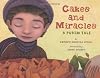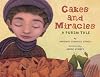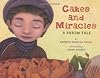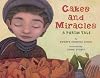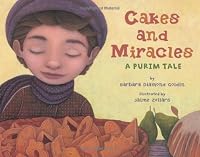
Cakes and Miracles: A Purim Tale
by Barbara Diamond Goldin
On This Page
Description
Young, blind Hershel finds that he has special gifts he can use to help his mother during the Jewish holiday of Purim. Features a recipe for hamantashen.Tags
Recommendations




Member Reviews
Cakes and Miracles (1991 edition), illustrated by Erika Weihs.
As mentioned in my review of the 2010 reprint of this title, illustrated by Jaime Zollars, when a picture-book is repackaged in this way - new artwork, edited text - I tend to want to find the original as well, and compare and contrast the different editions. Even when there's no textual difference (as with Jane Yolen's The Seeing Stick, for example), I still enjoy comparing illustrative interpretation. Oddly enough, I read the newer version of Cakes and Miracles first, before realizing that there even was a difference in text, so I was on the lookout, with this 1991 edition, for any pieces of narrative that weren't included in the 2010 reprint.
What I discovered, to my show more surprise, was that the differences were not insignificant, and while the newer edition does preserve the basic storyline and meaning of the original, a lot of the nuance - particularly the more poignant and/or disturbing elements of the tale - were omitted. The scene in which Hershel makes mischief in school, for instance, setting a frog loose in Reb Shimmel's class; or the one in which his mother says: "If you had eyes you could..." (something Hershel didn't like to hear), were deleted from the 2010 text. I'm sure the intention was to make a simpler story, suitable for the youngest readers, but the result was a much "sweeter" (and flatter) tale, with all the bite missing.
In the end, although I preferred the new illustrations, by Jaime Zollars - Erika Weihs' work is also appealing, in a stylized folk-art way, but isn't as warm and inviting - I liked the original text better. Four stars for the Zollars art, and four for Goldin's original narrative - I ended up giving both editions a three-star rating. show less
As mentioned in my review of the 2010 reprint of this title, illustrated by Jaime Zollars, when a picture-book is repackaged in this way - new artwork, edited text - I tend to want to find the original as well, and compare and contrast the different editions. Even when there's no textual difference (as with Jane Yolen's The Seeing Stick, for example), I still enjoy comparing illustrative interpretation. Oddly enough, I read the newer version of Cakes and Miracles first, before realizing that there even was a difference in text, so I was on the lookout, with this 1991 edition, for any pieces of narrative that weren't included in the 2010 reprint.
What I discovered, to my show more surprise, was that the differences were not insignificant, and while the newer edition does preserve the basic storyline and meaning of the original, a lot of the nuance - particularly the more poignant and/or disturbing elements of the tale - were omitted. The scene in which Hershel makes mischief in school, for instance, setting a frog loose in Reb Shimmel's class; or the one in which his mother says: "If you had eyes you could..." (something Hershel didn't like to hear), were deleted from the 2010 text. I'm sure the intention was to make a simpler story, suitable for the youngest readers, but the result was a much "sweeter" (and flatter) tale, with all the bite missing.
In the end, although I preferred the new illustrations, by Jaime Zollars - Erika Weihs' work is also appealing, in a stylized folk-art way, but isn't as warm and inviting - I liked the original text better. Four stars for the Zollars art, and four for Goldin's original narrative - I ended up giving both editions a three-star rating. show less
Cakes and Miracles (2010 edition), illustrated by Jaime Zollars.
I'm a big fan of Purim - a Jewish holiday celebrating the biblical story of Esther, in which children dress up in costumes, plays are given, and sweets (like Hamantaschen) are eaten - so when I learned that a new Purim picture-book was due out this coming November, I was quite excited. As it turns out, Barbara Diamond Goldin's Cakes and Miracles is a 2010 reissue of a picture-book first released in 1991, with new illustrations, and a shorter text. As always, in a case like this, I decided to read the two editions in tandem, in order to compare and contrast.
The tale of Hershel, a young blind boy who wants to participate in the Purim baking, as a means of helping his show more hard-working mother, this is a holiday story that incorporates a number of themes, from learning to live with a disability, to following one's dreams, no matter the obstacle. The text is simple and engaging, and the collage and acrylic illustrations appealing. I loved the colors Zollars used here, from her warm golden hues to her melancholy purples. All in all, a lovely Purim tale, one I might have given four stars. Unfortunately, after comparing this 2010 version with the original, from 1991, I found that while I prefer the newer artwork, I also prefer the original, unexpurgated text. In the end, I settled on three stars for each. show less
I'm a big fan of Purim - a Jewish holiday celebrating the biblical story of Esther, in which children dress up in costumes, plays are given, and sweets (like Hamantaschen) are eaten - so when I learned that a new Purim picture-book was due out this coming November, I was quite excited. As it turns out, Barbara Diamond Goldin's Cakes and Miracles is a 2010 reissue of a picture-book first released in 1991, with new illustrations, and a shorter text. As always, in a case like this, I decided to read the two editions in tandem, in order to compare and contrast.
The tale of Hershel, a young blind boy who wants to participate in the Purim baking, as a means of helping his show more hard-working mother, this is a holiday story that incorporates a number of themes, from learning to live with a disability, to following one's dreams, no matter the obstacle. The text is simple and engaging, and the collage and acrylic illustrations appealing. I loved the colors Zollars used here, from her warm golden hues to her melancholy purples. All in all, a lovely Purim tale, one I might have given four stars. Unfortunately, after comparing this 2010 version with the original, from 1991, I found that while I prefer the newer artwork, I also prefer the original, unexpurgated text. In the end, I settled on three stars for each. show less
A young blind boy who lives with his mother wants to help her bake Purim treats; he sees them in his mind and brings them to life with his hands, impressing the other villagers with his creations and possibly paving a path for himself to be a baker's apprentice.
"Cakes and Miracles" is about a little boy who is blind, but can bake magnificently. Overall, this is a great story about a little boy who is blind, but shows his mother and his village that he can still see when he closes his eyes! On the first page in this book it refers to Hershel as "blind boy", which does not sit well with me. He is a person, not a disability. I really also didn't like how his mother says "if you had eyes". It is not great to see a parent unaccepting of their child's disabilities. I do like the overall purpose of the book to show that even though Hershel is blind, he can still do things just like every one else.
Hershel is the only blind kid in the village and is constantly reminded of it often. I shrugged when his mother said "if you had eyes" to him, but I liked seeing how although this bothered Hershel, he did not let those words diminish his abilities. He was very aware of everything he was capable like doing chores around the house, catching frogs in the river and shaking pears to fall from the neighbor's tree. The Purim is coming and Hershel who is not allowed to help cooking surprises his mother with beautiful and delicious pastries he has made with what he sees in his mind. this was a beautiful story that represented both blind culture and Jewish culture and festivities in a nice way
Cakes and Miracles is about a blind boy, Hershel, who wants nothing more than to help his mother during Purim. His mother doesn’t think he is able to help her make hamantashen, a traditional cake made for the Jewish holiday. Hershel wasn’t born blind, he became blind after an illness fell upon him and he never gained his sight back. In this story Hershel’s mother, Basha, always said that he couldn’t help her because he was blind. Until one night Hershel saw an angel in his dream, who tells him to make cookies, make them with the images he sees when he closes his eyes. Hershel now has hope and attempts to make cookies, which all come out beautifully. His mother in this story, to me, was not very supportive of her son’s show more blindness. She should have encouraged him more, not tell him what he wasn’t able to do. The moral of this story would be to envision what you want, no matter the disability that others say is holding you back, and go for it. show less
This story does a nice job, I think, of weaving the story and holiday of Purim with the plight of a young blind Jewish boy and his single mom. My impression of the mom is that she's kinda stressed by the day-to-day life of raising a blind child on her own, but the boy seems to be pretty happy and self-sufficient, able to help around the house and find his way down to the river to play in the mud. His muddy experiences end up coming in handy when he is able to help his mom do the baking for Purim. To find out what happens, read the book. You'll be glad you did! Nice illustrations, too!
Members
- Recently Added By
Author Information

35+ Works 2,791 Members
Barbara Diamond Goldin grew up in New York and Pennsylvania, and lived in the Northwest for fourteen years, where she owned a children's bookstore and worked in the children's section of a public library. She was also a teacher for twenty years, and now lives in Massachusetts where she is the youth librarian in a small public library. In 1997, she show more received the Sydney Taylor Body-of-Work Award from the Association of Jewish Libraries for her significant contribution to Jewish children's literature show less
Some Editions
Awards and Honors
Awards
Notable Lists
Series
Belongs to Publisher Series
Common Knowledge
- Canonical title
- Cakes and Miracles: A Purim Tale
Classifications
Statistics
- Members
- 380
- Popularity
- 82,009
- Reviews
- 29
- Rating
- (3.91)
- Languages
- English
- Media
- Paper, Ebook
- ISBNs
- 5
- ASINs
- 6