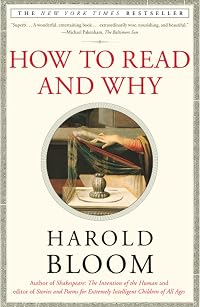
How to Read and Why
by Harold Bloom
On This Page
Description
Harold Bloom is Sterling Professor of Humanities at Yale University, Berg Professor of English at New York University, and a former Charles Eliot Norton Professor at Harvard. He has written more than 20 books of literary criticism. From a lifetime of writing and teaching about literature, this great scholar exhorts readers to consider the pleasures and benefits of reading well. Beginning with a basic question, "Why read?" Bloom offers his thoughts on works that form the canon of great show more literature. Short stories, poems, novels, and plays are held up to the light of Bloom's considerable intellect. Here are the authors that bear reading again and again, including Turgenev and Tennyson, Cervantes and Shakespeare. Harold Bloom's many honors include a MacArthur Prize, membership in the American Academy of Arts and Letters, and the Academy's Gold Medal for Criticism. As he shares his passion for literature, his discussion is made even more enthralling through John McDonough's warm narration. show lessTags
Recommendations



Member Recommendations

Member Reviews
He, the [old] man carbuncular, arrives,
A small house agent’s clerk, with one bold stare,
One of the low on whom assurance sits
As a silk hat on a Bradford millionaire.
— T.S. Eliot The Wasteland
Is Literature "Plausible"
The Past always has the appearance of what economists, euphemistically, term an "emerging market." An enormous opportunity (strange beast) is lying fallow in cultivated fields, awaiting alienation (In the legal sense of "transfer of title"). At the turn of the 19th century, Freud, who is writing adequate-to-very-good essays on human psychology, comes to dominate the field for three generations, whereas a man of similar talents today might hope to achieve an associate professorship at the University of Minnesota. show more Perhaps it's worth considering the career of Harold Bloom in light of a such a process. He spent his tenure sowing the academic Canon — a fait accompli we alternatively view as both "chthonic treasure," and (per Jon Franzen), "sowing salt in the fields of the financially unrighteous." Though such a contribution has also been called, with equal veracity, (per Sheila Heti) "Putting a lot of shit in the [field]," a more equivocal association which suggests, in the future, we might unexpectedly find some strange Wheat slouching toward Bethlehem to be born. (Beware Olipo's Curse: The extended metaphor is only half as clever as you think it is.)
James Wood, in his elegy for Bloom in The New Yorker writes, "Bloom loved Emerson’s (very Freudian) line about how, in the great writers, we recognize our own rejected thoughts—'they come back to us with a certain alienated majesty.' That’s true of Bloom, too, at his best—both the inspired analyst and the eloquent returner of those rejected thoughts" (2019). Bloom is reflecting these thoughts in his tentative answers to the questions posed by title of this book: Literature is, "idiosyncratic excess," "a candle which the love and desire of all men will light," or simply, "a form of the good." I would contrast these propositions with the answer supplied by Eileen Myles, "I think literature is wasted time, I don’t think there’s anything good about it. It’s not a moral project except in this profound aspect of wasting time. It’s the great adventure of our time [. . .] rolling in the shit of time." (Myles, Why I Write). Though Myles isn't so easily pigeonholed into the "Feminist" camp, this contrast demonstrates some of the "threat" motivating Bloom's invective against "Feminism" throughout the text. (Though Bloom's repudiation of Marxist/Feminist/Historicist/Deconstructivism criticism is more or less an oblique, sensitized, response to what's simply a different kind of reading, among the many you can do, to open and experience the text a little more (per Eileen Myles), "The Vagina of my [text] is so stretched out" (With a good connotation.).)
The tension between the Bloom & Myles is exemplified more succinctly in two competing phrases from Keats: The well-known phrase, "A thing of Beauty is a Joy Forever," suggests the "Eternal Book" that Sontag once wrote about in her diaries, a work that's always as good or better than the first time you read it, and which Bloom appears to have found in Shakespeare. We contrast this with Nabokov's humorous (mis)translation of the same phrase in Pale Fire, "A pretty bauble always gladdens us," which is intended to be a howler of a mistake, since it inverts the tone of the phrase from Grand to Petty and therefore appears to lie in Myles's aesthetic camp, but which actually conforms much closer to Bloom's modest claims about literature as a Carver-esque "small, good thing." (Perhaps Freud would have appreciated this inversion.) This commonality between camps suggests Kierkegaard's phrase, "Orthodoxy and Heterodoxy both want the same thing: to make [Literature] 'plausible.'" (SK, The Book on Adler). "Plausibility" is the quality that still makes us believe the words written on a page. Bloom despises the bad writing of clichés, explicitly because they don't possess the "idiosyncratic excess by which meaning gets started," but also because clichéd writing is "implausible." Myles's semi-autobiographical constructions are also destroyed by this, and so the question of "how" and "why" we read literature appears to be, in part, answered by the fact that, "We believe it."
That the reader must remain open to the "plausibility" of literature, appears to be an alternative formulation of the thesis of Bloom's project, and explains his exasperation with a "historical/feminist" analysis that he perceives to flatten the text to a machine that "does" something. There's not much "close reading" in this collection, but Bloom does take care to elaborate on Henry James's characterization of Osmond in The Portrait of a Lady:
His conscious, curious eyes, however, eyes at once vague and penetrating, intelligent and hard, expressive of the observer as well as of the dreamer, would have assured you that he studied it only within well-chosen limits, and that in so far as he sought it he found it.Per Bloom, the description of Osmond, who thinks himself completed, "tells the reader how narrow and dubious [he] is." My abuse of this phrase for my impending argument is a cheap turn, and to be generous, there's something to be said about the difference between Osmond's "well-chosen limits" and Bloom's dedication to Shakespearean scholarship, but I would press my case here. Rather than fortify a position around Shakespeare as the wellspring of human sensibility, such that to remain "plausible" every generation must be brought into relation with The Bard (i.e. adapting the Human to the Canon), would it not be just as good to adapt the Canon to the Human at any given point in time, and might there not come a time when the Human (as social/biological being) is so far removed from the 17th century that the salt goes out of Shakespeare. There's something horrifying in the assertion: "Shakespeare will be performed on Mars in the year 3000." Just as we are already despising the characteristic misogyny of Hitchcock's "eternal" films while also continuing to enjoy them, not much is lost by reading Shakespeare against-the-grain in this way, and yet crying out and demanding something better, even as we continue to perform him. Surely there will be something better to perform by 3000, and possibly Humans will be so different so as not to take interest in Iago anymore (in the good sense). A certain mind, circumscribed within "well-chosen limits," cannot comprehend this. He would do well to recall the words from Rabbi Hillel with which he closes his own collection, "It is not necessary for you to complete the work, but neither are you free to desist from it [. . .] If not now, when?" show less
I heard Bloom interviewed by Charlie Rose on youtube and he made it sound as if this book might be more accessible than The Anxiety of Influence, which I found interesting but difficult. I thought the difficulty was my fault, though I also thought his arguments were more like assertions than syllogisms. Coming from a family obsessed with the arts and who agonized, not only over influence, but everything else as well, I decided not to let my family influence me so much and to agonize less. If Harold (same name as my father) could talk to good old Charlie (they seemed to have a relationship outside the 4th wall of the interview frame) maybe he could talk to me. (I always felt excluded when my father and older brother, not named Charlie, show more conversed about literature.)
I'd never wondered why to read beyond the ultimate questions of why be alive and what are other people for anyway. As to how, though years of schooling tried to tell me I was doing it wrong, I decided that the years of schooling were the wrongness and I'd read any way I liked, thank you. Over the intervening years I further decided that people tended to talk at each other more than to each other and one reason to read is that authors often tried to talk to you, even if it was merely to increase their sales. Harold (I'll continue to call him that in the interest of humanizing him) likened reading to relationships with people worth having relationships with, whom we might otherwise never get to know. I like this idea but wonder a bit about the those people not worth having relationships with and whether Shakespeare didn't in fact include some of those people in his plays as well as have them attend performances (the groundlings, perhaps?).
The problem is, Harold didn't speak to me in this book. He seemed to be speaking to people who were very much the same as he was--younger or less well read versions of himself who needed a little push (or would appreciate one) along the road to becoming more Harold. I wanted to be one of those people because Harold made it sound like they were who one should be, and who wants to be who one shouldn't be?
Well, it turns out I want to. Though he did convince me I should probably read more Shakespeare, he also convinced me I should read less Harold. show less
I'd never wondered why to read beyond the ultimate questions of why be alive and what are other people for anyway. As to how, though years of schooling tried to tell me I was doing it wrong, I decided that the years of schooling were the wrongness and I'd read any way I liked, thank you. Over the intervening years I further decided that people tended to talk at each other more than to each other and one reason to read is that authors often tried to talk to you, even if it was merely to increase their sales. Harold (I'll continue to call him that in the interest of humanizing him) likened reading to relationships with people worth having relationships with, whom we might otherwise never get to know. I like this idea but wonder a bit about the those people not worth having relationships with and whether Shakespeare didn't in fact include some of those people in his plays as well as have them attend performances (the groundlings, perhaps?).
The problem is, Harold didn't speak to me in this book. He seemed to be speaking to people who were very much the same as he was--younger or less well read versions of himself who needed a little push (or would appreciate one) along the road to becoming more Harold. I wanted to be one of those people because Harold made it sound like they were who one should be, and who wants to be who one shouldn't be?
Well, it turns out I want to. Though he did convince me I should probably read more Shakespeare, he also convinced me I should read less Harold. show less
"How to Read and Why" should be called "In Praise of Books I Love." It is not a manual for becoming a better reader, or a gloss of important works and themes, or a defense of the Western Canon. It's a loving letter to readers from a man who has spent his whole life studying, rereading, and lecturing on the world's finest literature, and is still in awe of and profoundly moved by these works. He not only convinces you that these works are worth reading (even many times), but also why you should reread them, even if you have already read them many times. I'm embarrassed to say that about half of them I've never read even once, but I'm eager to start (re)reading them all.
I remember my thesis director making a face when I chose comparative literature as a framework. Now I understand why: how reductive and limiting!
And yet, this is exactly what Bloom does: comparing almost everything to Shaespeare regardless of genre, epoch or nationality. Add to this a firm fuddy duddy mustiness asserting that no great book will ever be written again due to television - it was most tiresome.
Which is too bad, because Bloom does have a passion for literature and it shines through. The passage on poetry was inspiring and he brought some interesting points that had me think about some works in a new way: for that I am grateful.
Otherwise it's a long lecture from an old man who rambles and occasionally remembers he has two show more questions to answer: the how and the why of literature. Overall tedious and disappointing. show less
And yet, this is exactly what Bloom does: comparing almost everything to Shaespeare regardless of genre, epoch or nationality. Add to this a firm fuddy duddy mustiness asserting that no great book will ever be written again due to television - it was most tiresome.
Which is too bad, because Bloom does have a passion for literature and it shines through. The passage on poetry was inspiring and he brought some interesting points that had me think about some works in a new way: for that I am grateful.
Otherwise it's a long lecture from an old man who rambles and occasionally remembers he has two show more questions to answer: the how and the why of literature. Overall tedious and disappointing. show less
Real Rating: 4.1
(note as for the calculated rating for this book in particular; while it was non-fiction, it is different from the non-fiction I usually read, with less of an argument/thesis and more of an informative goal in mind, therefore the objective rating might not be fully accurate)
A very enjoyable read indeed.
Some here argue the book should rather be titled: "What to Read and Why", not "How to Read and Why"... I disagree.
While it is true the book doesn't go into the technical how-to, similar to Adler & van Doren's "How to Read a Book" it goes into the soul's how; how to enjoy a book, use it for the growth of the soul, rather than the intellect. But 'how' nonetheless. This doesn't make it any less valuable than the other, in show more fact, it complements it. Additionally, the book gives some superb recommendations and primarily goes into fiction rather than non-fiction. Therefore, it is a different scope, and has a different function, altogether than Adler & van Doren's.
Despite this, the book could have a dedicated chapter summarizing its argument as to why reading is important and how to read for the growth of the soul, its lack thereof leaves us, the readers, scouring throughout the book to find its arguments and points. Obviously, because I use a Zettelkasten and have the arguments on my bib-card, it's not a problem but for the general reader, it is annoying.
I guess one of the lesser points can be the missing of a bibliography, although this is partly remedied by the extensive references by author and title of work throughout its writing. Still, a complete bibliography with references to actual editions would be appreciated.
Bloom's "How to Read and Why" actually motivated me to buy and read poems, something I was never interested in prior to this.
The Table of Contents is appropriate, more than appropriate actually; the organization is excellent. No index, but I think it's not that necessary for a book with this purpose. Still, it would have some marginal benefits.
I think the greatest two observations I had while reading this, not necessarily what the author intended to teach, are the following:
1) Reading is more social than the social; in the sense that you get to know characters much more intimately than any actual person could be, including your wife. I guess you could say it's not social, strictly speaking, but it has to do with the social, and this sounds a lot more eloquent, hence my choice of phrasing.
2) One of the core traits of the intellectual, if not the entire essence of being an intellectual, is to prefer the difficult pleasure over the easy pleasure. Thus preferring the material and substance that demands meditative contemplation over the easily digestible works.
This proposes a conundrum for me, as the principles described by Rob Fitzpatrick's "Write Useful Books" result in easily digestible works for maximum value-per-page in a practical sense; to design for recommendability. However, if I am following this advice, am I not contradicting the essence of the subject I want to write about; which is intellectualism? I suppose I could use Fitzpatrick's as a guide rather than a strict ruleset in formulating my writing.
All in all, I would recommend this enjoyable read to anyone who seeks either recommendations for more classical works or avid readers in general. Enjoyable. Useful. show less
(note as for the calculated rating for this book in particular; while it was non-fiction, it is different from the non-fiction I usually read, with less of an argument/thesis and more of an informative goal in mind, therefore the objective rating might not be fully accurate)
A very enjoyable read indeed.
Some here argue the book should rather be titled: "What to Read and Why", not "How to Read and Why"... I disagree.
While it is true the book doesn't go into the technical how-to, similar to Adler & van Doren's "How to Read a Book" it goes into the soul's how; how to enjoy a book, use it for the growth of the soul, rather than the intellect. But 'how' nonetheless. This doesn't make it any less valuable than the other, in show more fact, it complements it. Additionally, the book gives some superb recommendations and primarily goes into fiction rather than non-fiction. Therefore, it is a different scope, and has a different function, altogether than Adler & van Doren's.
Despite this, the book could have a dedicated chapter summarizing its argument as to why reading is important and how to read for the growth of the soul, its lack thereof leaves us, the readers, scouring throughout the book to find its arguments and points. Obviously, because I use a Zettelkasten and have the arguments on my bib-card, it's not a problem but for the general reader, it is annoying.
I guess one of the lesser points can be the missing of a bibliography, although this is partly remedied by the extensive references by author and title of work throughout its writing. Still, a complete bibliography with references to actual editions would be appreciated.
Bloom's "How to Read and Why" actually motivated me to buy and read poems, something I was never interested in prior to this.
The Table of Contents is appropriate, more than appropriate actually; the organization is excellent. No index, but I think it's not that necessary for a book with this purpose. Still, it would have some marginal benefits.
I think the greatest two observations I had while reading this, not necessarily what the author intended to teach, are the following:
1) Reading is more social than the social; in the sense that you get to know characters much more intimately than any actual person could be, including your wife. I guess you could say it's not social, strictly speaking, but it has to do with the social, and this sounds a lot more eloquent, hence my choice of phrasing.
2) One of the core traits of the intellectual, if not the entire essence of being an intellectual, is to prefer the difficult pleasure over the easy pleasure. Thus preferring the material and substance that demands meditative contemplation over the easily digestible works.
This proposes a conundrum for me, as the principles described by Rob Fitzpatrick's "Write Useful Books" result in easily digestible works for maximum value-per-page in a practical sense; to design for recommendability. However, if I am following this advice, am I not contradicting the essence of the subject I want to write about; which is intellectualism? I suppose I could use Fitzpatrick's as a guide rather than a strict ruleset in formulating my writing.
All in all, I would recommend this enjoyable read to anyone who seeks either recommendations for more classical works or avid readers in general. Enjoyable. Useful. show less
I'm going to be honest with you. Despite the 1-star, I didn't hate this book.
Why the 1-star then? Because I thought the title of the book was vastly misleading. When I picked this up, I thought that it was going to be how to read, improve media literacy, connect the classic with the modern, and how to delve into text to find hidden meaning within or evaluate a story based on its merits and how it was put together, rather than just how much I enjoyed it.
Essentially just another version of "How To Read A Book" but perhaps more concise, or with information inside that the older one didn't have.
Instead, what I got was mainly essays by Harold Bloom on what stories, authors, and works of fiction he liked and why he liked them. This isn't bad show more per se; in fact, I read them, and I found a lot of what he said about those authors interesting and looked at a few in a new light. But that's not what I picked up the book for. Had the book been titled something like "Classic to the Modern Authors - Literary Stories that Shaped Modern Storytelling," I'd have still picked it up and at least given it a 4-star rating.
So for those looking for something that'll help make you a better, more understanding and observant reader... skip this one. If you do want a collection of essays by Harold Bloom on why his favorite picks have shaped how stories are told today and what makes their writing so compelling and interesting, pick this up. As is, I'm marking it 1-star till the title changes to reflect what its really about. show less
Why the 1-star then? Because I thought the title of the book was vastly misleading. When I picked this up, I thought that it was going to be how to read, improve media literacy, connect the classic with the modern, and how to delve into text to find hidden meaning within or evaluate a story based on its merits and how it was put together, rather than just how much I enjoyed it.
Essentially just another version of "How To Read A Book" but perhaps more concise, or with information inside that the older one didn't have.
Instead, what I got was mainly essays by Harold Bloom on what stories, authors, and works of fiction he liked and why he liked them. This isn't bad show more per se; in fact, I read them, and I found a lot of what he said about those authors interesting and looked at a few in a new light. But that's not what I picked up the book for. Had the book been titled something like "Classic to the Modern Authors - Literary Stories that Shaped Modern Storytelling," I'd have still picked it up and at least given it a 4-star rating.
So for those looking for something that'll help make you a better, more understanding and observant reader... skip this one. If you do want a collection of essays by Harold Bloom on why his favorite picks have shaped how stories are told today and what makes their writing so compelling and interesting, pick this up. As is, I'm marking it 1-star till the title changes to reflect what its really about. show less
When I bought this book, How to read and why by Harold Bloom, I mistook the author for Allan Bloom, whose The closing of the American mind I had so much enjoyed reading many years ago.
Discovering the confusion over authorship was not what subsequently upset me, upset being an understatement. Like many other reviewers, I am simply angry about the deceptive title. How to read and why purports to be a book which might give some guidance on HOW to approach world-class literature, and discuss WHY literacy is of value. However, these questions are barely dealt with, other than an 8.5-page section consisting of the most obvious platitudes why reading is important.
Instead, the book consists of listings of all novels, story collections, poems, show more etc which the author deems essential reading. Some of his choices are questionable, and apparently made only upon his eminent authority as an expert. show less
Discovering the confusion over authorship was not what subsequently upset me, upset being an understatement. Like many other reviewers, I am simply angry about the deceptive title. How to read and why purports to be a book which might give some guidance on HOW to approach world-class literature, and discuss WHY literacy is of value. However, these questions are barely dealt with, other than an 8.5-page section consisting of the most obvious platitudes why reading is important.
Instead, the book consists of listings of all novels, story collections, poems, show more etc which the author deems essential reading. Some of his choices are questionable, and apparently made only upon his eminent authority as an expert. show less
Members
- Recently Added By
Published Reviews
Trotz Blooms' altmodischer und eigensinniger Art an Texte heranzugehen, weckt er im Leser den Wunsch, sich noch unbekanntes Terrain zu erschließen oder bereits Vertrautes neu zu lesen. Während es Bloom versteht, vom Reiz des Lesens zu erzählen, so vermag sein Kanon, der materiale ebenso wie der interpretatorische, nicht ganz zu überzeugen. Die Gültigkeit seiner Auswahl und teils auch show more seiner Analyse bleibt fraglich, gerade weil Bloom selbst sich gegen jene Institutionen ausspricht, die dem Leser eine obligatorische Leseliste und eine unfehlbare Analyse zu diktieren suchen. Sein Plädoyer für das Lesen von Literatur ist zweifelsohne leidenschaftlich und gerade im Hinblick auf die ständige Bedrohung durch das Triviale sicher nötig, aber "Die Kunst der Lektüre" könnte ohne weiteres auch den Titel "Lieblingswerke von Harold Bloom" tragen. Auch Blooms Gestus, "volksnah" zu sein, kann nicht wirklich überzeugen - dafür kommen seine Ausführungen zu belehrend daher.
So kann dieses Buch, trotz der zur Schau getragenen Anspruchslosigkeit, den Ehrgeiz seines Verfassers nicht verhehlen, und ist am Ende doch nicht mehr als eine Anregung. Man möchte Bloom auf ein Zitat Virginia Woolfs aus seinem eigenen Vorwort hinweisen: "Der einzige Rat nämlich, den ein Mensch einem anderen in puncto Lesen geben kann, ist der, auf keinen Rat zu hören." show less
So kann dieses Buch, trotz der zur Schau getragenen Anspruchslosigkeit, den Ehrgeiz seines Verfassers nicht verhehlen, und ist am Ende doch nicht mehr als eine Anregung. Man möchte Bloom auf ein Zitat Virginia Woolfs aus seinem eigenen Vorwort hinweisen: "Der einzige Rat nämlich, den ein Mensch einem anderen in puncto Lesen geben kann, ist der, auf keinen Rat zu hören." show less
added by Indy133
Lists

Books about Books
149 works; 24 members

Craft Books
41 works; 1 member
Author Information

1,225+ Works 38,178 Members
Harold Bloom was born on July 11, 1930 in New York City. He earned his Bachelor of Arts from Cornell in 1951 and his Doctorate from Yale in 1955. After graduating from Yale, Bloom remained there as a teacher, and was made Sterling Professor of Humanities in 1983. Bloom's theories have changed the way that critics think of literary tradition and show more has also focused his attentions on history and the Bible. He has written over twenty books and edited countless others. He is one of the most famous critics in the world and considered an expert in many fields. In 2010 he became a founding patron of Ralston College, a new institution in Savannah, Georgia, that focuses on primary texts. His works include Fallen Angels, Till I End My Song: A Gathering of Last Poems, Anatomy of Influence: Literature as a Way of Life and The Shadow of a Great Rock: A Literary Appreciation of The King James Bible. Harold Bloom passed away on October 14, 2019 in New Haven, at the age of 89. (Bowker Author Biography) show less
Some Editions
Awards and Honors
Distinctions
Common Knowledge
- Canonical title
- How to Read and Why
- Original title
- How to Read and Why
- Original publication date
- 2000
- People/Characters
- William Shakespeare
- Epigraph
- "The reader became the book; and summer night
Was like the conscious being of the book."
-Wallace Stevens - Dedication
- Miriam Bratu Hansen
- First words
- There is no single way to read well, though there is a prime reason why we should read.
- Last words
- (Click to show. Warning: May contain spoilers.)And yet, though the moral decision cannot be made merely by reading well, the questions of how to read an why are more than every essential to help us decides whose work to perform.
- Blurbers
- Sutherland, John; Banville, John; Pakenham, Michael
- Original language
- English
- Canonical DDC/MDS
- 801.9
Classifications
Statistics
- Members
- 3,235
- Popularity
- 5,350
- Reviews
- 42
- Rating
- (3.45)
- Languages
- 14 — Catalan, Danish, Dutch, English, Finnish, French, German, Greek, Italian, Polish, Portuguese, Spanish, Swedish, Turkish
- Media
- Paper, Audiobook
- ISBNs
- 35
- ASINs
- 8