
On This Page
Description
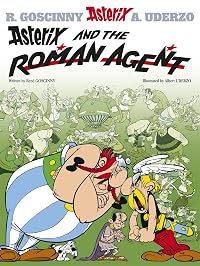
Julius Caesar resorts to psychological warfare to defeat the little Gaulish village: he's sent expert troublemaker Tortuous Convolulus to set friend against friend. Jealousy soon spreads as the Gauls become suspicious of each other. Somehow, Asterix must outwit the wily Convolulus.Tags
Recommendations




















Member Recommendations
memeweaver The White Iris inverts the earlier and more successful comic narrative of Goscinny. Where the Roman Agent has a provocateur sowing discord in the village, the White Iris has another Roman seeking to upset things with positive thinking.
Member Reviews
A better-than-average Asterix story in which a Roman agent succeeds in bringing discord and strife to the Gaulish village, nearly bringing about their downfall. The magic potion for once plays a very limited role.
The fifteenth episode of the Gaulish tales is an interesting tale of what can happen when a bad apple falls into the cart, so to speak.
Julius Caesar still has issues with the indominatable Gauls with the magic potion and is under pressure from the Senate to deal with them. Someone introduces him to a felon, Tortuous Convolvulus who has a knack for stirring up trouble within the ranks which impresses Caesar to get him to infiltrate the village.
Soon there is disharmony amongst the villagers as everyone distrusts everyone else and chaos reigns supreme. Meanwhile the surrounding Roman camps feel the time is ripe to invade when it is assumed that there is no more potion thus denying the Gauls their one defence...however Asterix and Getafix show more has conspired against everyone to have them believe this which teaches the villagers a lesson while dealing to the Romans quite sufficiently...
This is one of the more enjoyable volumes loaded with more puns than a comic relief, and of course names fire in one after the other. show less
Julius Caesar still has issues with the indominatable Gauls with the magic potion and is under pressure from the Senate to deal with them. Someone introduces him to a felon, Tortuous Convolvulus who has a knack for stirring up trouble within the ranks which impresses Caesar to get him to infiltrate the village.
Soon there is disharmony amongst the villagers as everyone distrusts everyone else and chaos reigns supreme. Meanwhile the surrounding Roman camps feel the time is ripe to invade when it is assumed that there is no more potion thus denying the Gauls their one defence...however Asterix and Getafix show more has conspired against everyone to have them believe this which teaches the villagers a lesson while dealing to the Romans quite sufficiently...
This is one of the more enjoyable volumes loaded with more puns than a comic relief, and of course names fire in one after the other. show less
Ceaser is trying to raise more money and troops to go and fight some more foreign campaigns however is having some trouble with the Senate (don't we all?). Basically they don't want to approve any more wars until Ceaser gets Rome's house in order, which basically means subduing the rebellious village in Northern Gaul that we all know so well. However, as has become clear by now, because they have a magic potion, defeating them by shear force of arms simply will not work, so they need another plan – thus enters Convulvulus, a guy whose presence simply sets people at each other's throats, and a simple word can send people into a frenzy of anger.
The idea is to divide the village so that they are too busy fighting amongst themselves to show more worry about fighting Rome. The problem is that when left to their own devices they generally fight among themselves anyway, it is just when the Romans decide to pay them a visit, then they will all get together, put aside their differences, to bash the Romans, which obviously makes this task somewhat more difficult.
I am feeling that by part of the series the Asterix books are not really doing anything new. In a way they are not like the Tintin albums, which simply got better and better the more I read them (and I am not sure if I actually read them in order this time, but I know that I now have the complete collection). In a way I find Herge's writing to be a lot more engaging, and substantially funnier, than the Asterix albums, simply because, in the end, they always drink the magic potion, and always end up beating up the Romans.
One interesting thing that I note is the question that is raised in this comic of the fact that Asterix does not have a wife. Then we see Asterix and Obelix fighting, and then running back into each others arms because they can't be angry at each other for too long. It does raise some eyebrows, however I do notice that at least twice Obelix has fallen in love with a woman (or was that only one comic, and I am getting mixed up with one of the movies), though poor Obelix lucks out. I'm not sure why the writers chose not to give Asterix a wife, but maybe it is because they didn't feel that he needed one.
It is also interesting that the Senate refer to this village in Gaul as being rebellious but it is not as if they are actually trying to expand their territory – they are pretty content simply to live their own lives in their own self sufficient village (which does not need money) and let the world drift on behind. I suspect the problem with this though is the fact that they are not paying taxes to Ceaser (and this has been indicated an a previous comic that tax collectors have pretty much learnt not to attempt to collect taxes from this village). However, I suspect that it is because they do stand up to Rome that they are seen as a threat that must be subdued because if they stand up to Rome, then that will only encourage others. show less
The idea is to divide the village so that they are too busy fighting amongst themselves to show more worry about fighting Rome. The problem is that when left to their own devices they generally fight among themselves anyway, it is just when the Romans decide to pay them a visit, then they will all get together, put aside their differences, to bash the Romans, which obviously makes this task somewhat more difficult.
I am feeling that by part of the series the Asterix books are not really doing anything new. In a way they are not like the Tintin albums, which simply got better and better the more I read them (and I am not sure if I actually read them in order this time, but I know that I now have the complete collection). In a way I find Herge's writing to be a lot more engaging, and substantially funnier, than the Asterix albums, simply because, in the end, they always drink the magic potion, and always end up beating up the Romans.
One interesting thing that I note is the question that is raised in this comic of the fact that Asterix does not have a wife. Then we see Asterix and Obelix fighting, and then running back into each others arms because they can't be angry at each other for too long. It does raise some eyebrows, however I do notice that at least twice Obelix has fallen in love with a woman (or was that only one comic, and I am getting mixed up with one of the movies), though poor Obelix lucks out. I'm not sure why the writers chose not to give Asterix a wife, but maybe it is because they didn't feel that he needed one.
It is also interesting that the Senate refer to this village in Gaul as being rebellious but it is not as if they are actually trying to expand their territory – they are pretty content simply to live their own lives in their own self sufficient village (which does not need money) and let the world drift on behind. I suspect the problem with this though is the fact that they are not paying taxes to Ceaser (and this has been indicated an a previous comic that tax collectors have pretty much learnt not to attempt to collect taxes from this village). However, I suspect that it is because they do stand up to Rome that they are seen as a threat that must be subdued because if they stand up to Rome, then that will only encourage others. show less
There is no way to properly enjoy this book as an adult, but I give it my best shot every couple of years or so. I could probably write the exact same review for each of the Asterix books: reading stuff like this when I was younger is what made my brain the way it is.
Seven out of ten. CBR format.
Julius Caesar sends an expert troublemaker to defeat the Gauls by setting friend against friend. As the jealousy spreads Asterix must outwit the roman.
Tout le monde n'aime pas la zizanie.
Oh those devious Romans!
Members
- Recently Added By
Lists

Recommended Comics / Graphic Novels
595 works; 122 members

1970s
657 works; 23 members

Published in 1970
58 works; 7 members

books read in 2019
50 works; 1 member

1970 Club
85 works; 2 members
Talk Discussions
Past Discussions
Can't combine book with the correct work in Combiners! (November 2015)
Author Information


Albert Uderzo was born on April 25, 1927 in Fismes, France as Alberto Aleondro Uderzo. In 1940, when he was just 13, he worked for Paris Publishing Society where he learned the basics for his profession - designing text and letters and editing photos. During World War II he worked on a farm and later as a furniture maker with his father. His show more drawing skills were put aside until 1945 when he entered a comic strip competition and later worked on a cartoon film titled Clic Clac. In the mean time he moved to Paris and worked on the magazine O.K. where he created several comics such as Arys Buck and Belloy. It was then that he met Rene Goscinny and the two worked on new comic book characters like Ompah-pah, Jehan Pistolet and Luc Junior. In 1959 they started a magazine called Pilote aimed at older children. It was the first issue that introduced the character Asterix and it was a big hit. By 1967 the comic became so popular that they decided to devote all their time to the series. Albert Uderzo was the illustator of all thirty Asterix adventures and the writer of the last eight adventures. show less
Some Editions
Series

Belongs to Publisher Series
Work Relationships
Is contained in
Asterix, Triumphant!: " Asterix and the Big Fight " , " Asterix and the Roman Agent " (Asterix) by Goscinny
Asterix and Obelix ; Asterix and Cleopatra - Asterix and the Roman Agent - Asterix and the Banquet by Goscinny
Asterix Omnibus 05: Asterix and the Cauldron #13, Asterix in Spain #14, and Asterix and the Roman Agent #15 by René Goscinny
De avonturen van Asterix de Galliër. [4]: Asterix en de koperen ketel ; Asterix in Hispania ; Asterix en de intrigant ; ASterix en de Helvetiërs by René Goscinny
Has the adaptation
Common Knowledge
- Canonical title
- Asterix and the Roman Agent
- Original title
- La Zizanie
- Alternate titles*
- Asterix: Streit um Asterix; Zoff im Pott; Graffd wead!; Was e Gefuddel!; Kööch uman Asterix
- Original publication date
- 1970; 1973 (dt. Ausgabe) (dt. Ausgabe)
- People/Characters
- Obelix; Asterix; Dogmatix; Julius Caesar; Tortuous Convolvulus; Vitalstatistix (show all 11); Impedimenta; Fulliautomatix; Geriatrix; Unhygienix; Centurion Platypus
- Important places*
- Gallien
- Important events
- Roman Empire
- First words*
- In dem kleinen, uns wohlbekannten gallischen Dorf herrscht Frieden, und wie immer sind seine Bewohner freundlich und guter Dinge...
Inne uns allemang bekannte kreplige gallische Kollenie isset wie sonz auch: Nix wie Friede, Freude, Eierkuchen bei die Pohlbörgers. - Quotations*
- ¡ls sont fous ces romains!
- Last words*
- (Click to show. Warning: May contain spoilers.)Mir fehlen die Worte ... meine lieben Freunde ... zu dieser wundervollen Überraschung ...
(Click to show. Warning: May contain spoilers.)Mich fehlen die Wörters ... meine lieben Kumpels ... sowat von schöne Überraschung ... - Original language*
- Französisch
*Some information comes from Common Knowledge in other languages. Click "Edit" for more information.
Classifications
Statistics
- Members
- 1,707
- Popularity
- 12,961
- Reviews
- 11
- Rating
- (4.11)
- Languages
- 21 — Catalan, Czech, Danish, Dutch, English, Estonian, Finnish, French, Germanic (Other), German, Scottish Gaelic, Greek, Hungarian, Italian, Norwegian (Bokmål), Polish, Portuguese, Spanish, Swedish, Turkish, Welsh
- Media
- Paper, Ebook
- ISBNs
- 83
- ASINs
- 21