On This Page
Description
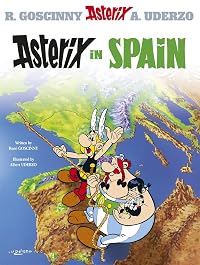
Asterix and his friends are holding out against Julius Caesar, but when the son of Chief Huevos y Bacon is taken hostage, the Gauls jump to the rescue to bring him home to Hispania where they get wrapped up with the tourist industry and flamenco.Tags
Recommendations

















Member Reviews
A fun Asterix romp. I'd read this as a kid, and this time around I noticed a lot of Spanish jokes. Travellers from various parts of the Roman Empire made comments about holidays there, and how cheap the food was. Don Quixote made an appearance. There was flamenco dancing. And of course the chief's name was Huevos Y Bacon!
Well, finally the first Asterix album where they have a fish fight, and it took up to number 14 for these fish fights to begin. In fact, I am thinking that this is the first album that introduces Unhygenix the fish monger and Bacteria his wife. The reason I make this statement is because one of the many things I remember about the Asterix albums from when I was a kid was the fish fights, particularly since they tended to begin with somebody throwing a fish and the fish hitting Fullyautomatix.
I could actually go on and on about this particular fish fight, and in fact this particular fish fight is probably the best part of this album. Basically after the fight everything sort of begins to go down hill. Okay, they are still making show more references to actual events in Ancient Rome, and in this one we have the part of the civil war that was fought in Spain, though the album begins after Ceaser had defeated his opponents there. However, as it is not surprising with the Asterix albums, there happens to be one village in Spain that is holding out against Ceaser, though they don't happen to have a magic potion.
Basically, Ceaser kidnaps the chieftain's boy and sends him to Gaul for safe keeping. However the boy is a real handful, especially since he happens to be the Chieftain's boy. Unfortunately, sending the boy to Gaul poses some problems because when the Romans run into Asterix and Obelix, they pretty quickly lose the boy, and when Asterix and Obelix realise that the boy is a real handfull, they decide to return him to Spain.
The album deals more with the journey to the village, and there is only one page where they are actually at the village, however there is a lot of humour that is particular to Spain. For instance, when they arrive they discover that there is a traffic jam because everybody is coming from the north to holiday in Spain (as is very common in Europe). Also, the roads are in terrible condition, which was probably the case back then, and may still be the case today. If Spain is anything like Greece, then it would not be the easiest of places to drive (and I have driven in both Italy and Greece, but I have never been to Spain). Also, we have quite a lot of Goths (Germans) frequenting the hotels there.
Then there is the ubiquitous festivals and bull fights. Okay, I really didn't get the fact that there was a druidic festival in every town, but Asterix does tend to take the modern Christian festivals and gives them a pre-Christian twist (though it is obvious that they are poking fun at the modern festival, in the same way that they are poking fun at modernity). However the bullfight scene is probably more suggesting of how the bull fight came about, and of course it involves Asterix being centre stage.
As I mentioned, it is not my favourite of the albums, and I suspect that the albums will start going down hill from here, though I am still keen to try and get the rest of them and read through them. I believe that the last one that I read as a kid was Asterix and Son (or Asterix in the Land of the Black Gold) however more have been produced since then, and I will probably also get my hands on them as well. show less
I could actually go on and on about this particular fish fight, and in fact this particular fish fight is probably the best part of this album. Basically after the fight everything sort of begins to go down hill. Okay, they are still making show more references to actual events in Ancient Rome, and in this one we have the part of the civil war that was fought in Spain, though the album begins after Ceaser had defeated his opponents there. However, as it is not surprising with the Asterix albums, there happens to be one village in Spain that is holding out against Ceaser, though they don't happen to have a magic potion.
Basically, Ceaser kidnaps the chieftain's boy and sends him to Gaul for safe keeping. However the boy is a real handful, especially since he happens to be the Chieftain's boy. Unfortunately, sending the boy to Gaul poses some problems because when the Romans run into Asterix and Obelix, they pretty quickly lose the boy, and when Asterix and Obelix realise that the boy is a real handfull, they decide to return him to Spain.
The album deals more with the journey to the village, and there is only one page where they are actually at the village, however there is a lot of humour that is particular to Spain. For instance, when they arrive they discover that there is a traffic jam because everybody is coming from the north to holiday in Spain (as is very common in Europe). Also, the roads are in terrible condition, which was probably the case back then, and may still be the case today. If Spain is anything like Greece, then it would not be the easiest of places to drive (and I have driven in both Italy and Greece, but I have never been to Spain). Also, we have quite a lot of Goths (Germans) frequenting the hotels there.
Then there is the ubiquitous festivals and bull fights. Okay, I really didn't get the fact that there was a druidic festival in every town, but Asterix does tend to take the modern Christian festivals and gives them a pre-Christian twist (though it is obvious that they are poking fun at the modern festival, in the same way that they are poking fun at modernity). However the bullfight scene is probably more suggesting of how the bull fight came about, and of course it involves Asterix being centre stage.
As I mentioned, it is not my favourite of the albums, and I suspect that the albums will start going down hill from here, though I am still keen to try and get the rest of them and read through them. I believe that the last one that I read as a kid was Asterix and Son (or Asterix in the Land of the Black Gold) however more have been produced since then, and I will probably also get my hands on them as well. show less
Our boys travel to Spain to help a holdout village resist Caesar's advances. Typical stuff, although at least Asterix is deprived of the magic potion and forced to fight in the arena.
- Yup, I read this one in French -
I read all of these as a kid, in Dutch, of course, but they remain funny.
Asterix and Obelix undertake a dangerous journey to Spain, to return a child to his native village.
I read all of these as a kid, in Dutch, of course, but they remain funny.
Asterix and Obelix undertake a dangerous journey to Spain, to return a child to his native village.
Five out of ten. CBR format.
When the Romans kidnap the son of a Spanish chief it is upto Asterix and Obelix to get him back.
ASTERIX ET OBELIX
The funniest of the series.
Members
- Recently Added By
Lists

1960s, Best books published therein
254 works; 22 members

A Child's Book Tour of Spain
26 works; 2 members

The Books I've Read 2018
143 works; 1 member

Books Read in 2018
4,360 works; 110 members
Author Information


Albert Uderzo was born on April 25, 1927 in Fismes, France as Alberto Aleondro Uderzo. In 1940, when he was just 13, he worked for Paris Publishing Society where he learned the basics for his profession - designing text and letters and editing photos. During World War II he worked on a farm and later as a furniture maker with his father. His show more drawing skills were put aside until 1945 when he entered a comic strip competition and later worked on a cartoon film titled Clic Clac. In the mean time he moved to Paris and worked on the magazine O.K. where he created several comics such as Arys Buck and Belloy. It was then that he met Rene Goscinny and the two worked on new comic book characters like Ompah-pah, Jehan Pistolet and Luc Junior. In 1959 they started a magazine called Pilote aimed at older children. It was the first issue that introduced the character Asterix and it was a big hit. By 1967 the comic became so popular that they decided to devote all their time to the series. Albert Uderzo was the illustator of all thirty Asterix adventures and the writer of the last eight adventures. show less
Some Editions
Series

Belongs to Publisher Series
Work Relationships
Is contained in
Asterix Omnibus 05: Asterix and the Cauldron #13, Asterix in Spain #14, and Asterix and the Roman Agent #15 by René Goscinny
De avonturen van Asterix de Galliër. [4]: Asterix en de koperen ketel ; Asterix in Hispania ; Asterix en de intrigant ; ASterix en de Helvetiërs by René Goscinny
Has the adaptation
Common Knowledge
- Canonical title
- Asterix in Spain
- Original title
- Astérix en Hispanie
- Alternate titles*
- Astérix : Astérix en Hispanie
- Original publication date
- 1969
- People/Characters*
- Astérix; Obélix; Idefix; Jules César; Soupalognon y Crouton; Claudius Nonpossumus (show all 10); Majestix; Ordralfabétix; Pepe; Assurancetourix
- Important places
- Spain
- Important events
- Roman Empire
- Epigraph*
- Nous sommes en 50 avant Jésus-Christ. Toute la Gaule est occupée par les Romains... Toute? Non! Un village peuplé d'irréductibles Gaulois résiste encore et toujours à l'envahisseur. Et la vie n'est pas facile pour les g... (show all)arnisons de légionnaires romains des camps retranchés de Babaorum, Aquarium, Laudanum et Petibonum...
- First words*
- Ce matin du 17 Mars, 45 av. J.C., tout est paisible dans le petit village gaulois que nous connaissons bien.
- Last words*
- (Click to show. Warning: May contain spoilers.)Un poisson! Mon règne pour un poisson!
- Original language
- French
- Disambiguation notice
- latin edition, do not combine with the main work. See dead languages rule.
*Some information comes from Common Knowledge in other languages. Click "Edit" for more information.
Classifications
- Genre
- Graphic Novels & Comics
- DDC/MDS
- 741.5944 — Arts & recreation Drawing & decorative arts Drawing Comic books, graphic novels, fotonovelas, cartoons, caricatures, comic strips History, geographic treatment, biography European France & Monaco
- LCC
- NC1499 — Fine Arts Drawing. Design. Illustration Drawing. Design. Illustration Pictorial humor, caricature, etc.
- BISAC
Statistics
- Members
- 1,800
- Popularity
- 12,213
- Reviews
- 16
- Rating
- (4.02)
- Languages
- 19 — Basque, Catalan, Czech, Danish, Dutch, English, Finnish, French, German, Greek, Hungarian, Italian, Latin, Norwegian (Bokmål), Polish, Portuguese, Croatian, Spanish, Swedish
- Media
- Paper, Ebook
- ISBNs
- 90
- ASINs
- 26