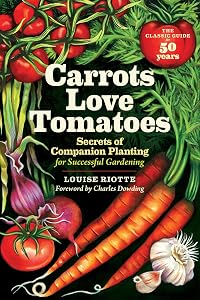
Carrots Love Tomatoes: Secrets of Companion Planting for Successful Gardening
by Louise Riotte
On This Page
Description
Plant parsley and asparagus together and you'll have more of each, but keep broccoli and tomato plants far apart if you want them to thrive. Utilize the natural properties of plants to nourish the soil, repel pests, and secure a greater harvest. With plenty of insightful advice and suggestions for planting schemes, Louise Riotte will inspire you to turn your garden into a naturally nurturing ecosystem..
Tags
Recommendations








Member Reviews
I'm accumulating quite a number of gardening books and if I'm not careful, someone is going to start thinking I know what I'm doing when I'm outside digging in the dirt.
When MT and I started building our garden/back yard (there's no grass - just plants everywhere) we started from scratch and chemical free. One of the first things I learned was to plant basil and marigolds with your tomatoes to control nematodes and aphids. I don't know about the nematodes, but do you know, our tomatoes never have aphids. My strawberries, planted in another section of the garden were covered in them this year, but not the tomatoes.
So I'm all about learning more about companion planting. Carrots Love Tomatoes is a pretty good reference for just that. show more The author provides a comprehensive list of plants divided into sections (vegetables, herbs, wild plants, fruit trees, etc.) and lists plants that will not only make beneficial companions but also plants to avoid pairing together if you want to avoid the botanical equivalent of the Capulets and the Montagues.
The back of the book includes suggested garden plans that take full advantage of companion planting and there are plans for all size gardens, including window boxes, balconies and children's gardens. I especially liked that he had a suggested garden layout for those that have to take physiological restrictions into account. He even includes a plan for a "spirit garden" which is not a garden to attract paranormal visitors, but rather a garden of plants used to make the spirits that haunt your bar drinks.
A source list at the back will be handy for those that live in the USA. show less
When MT and I started building our garden/back yard (there's no grass - just plants everywhere) we started from scratch and chemical free. One of the first things I learned was to plant basil and marigolds with your tomatoes to control nematodes and aphids. I don't know about the nematodes, but do you know, our tomatoes never have aphids. My strawberries, planted in another section of the garden were covered in them this year, but not the tomatoes.
So I'm all about learning more about companion planting. Carrots Love Tomatoes is a pretty good reference for just that. show more The author provides a comprehensive list of plants divided into sections (vegetables, herbs, wild plants, fruit trees, etc.) and lists plants that will not only make beneficial companions but also plants to avoid pairing together if you want to avoid the botanical equivalent of the Capulets and the Montagues.
The back of the book includes suggested garden plans that take full advantage of companion planting and there are plans for all size gardens, including window boxes, balconies and children's gardens. I especially liked that he had a suggested garden layout for those that have to take physiological restrictions into account. He even includes a plan for a "spirit garden" which is not a garden to attract paranormal visitors, but rather a garden of plants used to make the spirits that haunt your bar drinks.
A source list at the back will be handy for those that live in the USA. show less
Great reference. This works sort of like a dictionary. There are entries for various plants with short blurbs about what or what not to plant together. Riotte also covers a variety of topics like pests and planning. Definitely worth the read and the space on your shelf if you are hoping to make the most of your vegetable garden.
Loved it. Opened the book and before I knew it my pen was in hand marking it up, lots to remember. It does become repetitive in places with items being reused in their companion entries but it is tolerable. It is a fast read and I look forward to the rereading of it to finalize the layout for this springs plantings.
This book is useful if you are interested in planting a variety of items in your garden. It tells which plants benefit each other if you plant them beside each other and explains the benefits. It also tells which plants to avoid planting together and why they should not be side by side. This book will remain on our shelf permanently because it is a wonderful reference for any gardener.
This book is a classic and chock full of humor-filled advice about organic gardening and companion planting.
Went out and bought this book. Great tips for companion plantings in gardens. There's some great design tips and maps and the author covers pests, herbs, flowers, vegetables, berries, fruit trees. Very extensive.
An absolutely essential book if you garden at all.
Members
- Recently Added By
Lists

Florida's Book Bans and Challenges
311 works; 4 members
Author Information

21+ Works 1,980 Members
Louise Riotte (1909-1998) was one of America's most beloved gardeners. Riotte wrote 12 books in her lifetime, She lived on a small farm in Ardmore, Oklahoma.
Common Knowledge
- Original title
- Secrets of Companion Planting for Successful Gardening
- Alternate titles
- Carrots Love Tomatoes
- Original publication date
- 1975 ; 1998 (2nd edition) (2nd edition)
- First words
- The magic and mystery of companion planting have intrigued and fascinated humans for centuries, yet it is a part of the gardening world that has never been fully explored.
- Last words
- (Click to show. Warning: May contain spoilers.)(image)
A model companion garden, very much like the author's own (though smaller), has walkways around the fence inside for easy use of tiller. Note, too, how protective fence is used for such climbing plants as beans, cucumbers, peas and grapes.
Flowers add beauty to the garden but are chosen as well for their beneficial influences on crop vegetables and fruits. Note vegetable interplantings, too, in most of the rows. Perennials such as asparagus and horseradish are placed at the outsides to make tilling of the full garden easier.
Classifications
Statistics
- Members
- 1,194
- Popularity
- 20,994
- Reviews
- 10
- Rating
- (3.87)
- Languages
- Danish, English, French, Swedish
- Media
- Paper, Ebook
- ISBNs
- 11
- UPCs
- 1
- ASINs
- 7