On This Page
Description
"Recounts the life and work of 19th century English naturalist Charles Darwin and includes related activities for the reader"--Provided by publisher.Tags
Recommendations


















Member Reviews
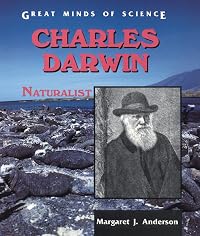
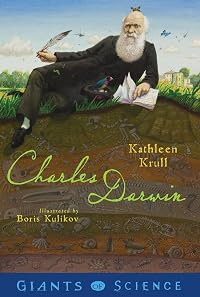
Summary: "Charles Darwin: Naturalist" gives readers a formidable look into the life of one of science's biggest influences. As a child, Charles Darwin was considered a "mischievous" child, often getting into trouble and failing to learn his lesson. Charles's father had high hopes for his son (doctor or minister), but that never fell through. After his stint with the "Beagle" ship as a naturalist, Charles developed the theory of evolution. Today, he still considered one of the major contributors to the field of science.
Review: For a biography, I thought this was a great read. Children who are in the middle grades (5-6) will benefit most from the book, due to its length and academic language. Each chapter felt connected and the author did show more a good job of molding a story. show less
Review: For a biography, I thought this was a great read. Children who are in the middle grades (5-6) will benefit most from the book, due to its length and academic language. Each chapter felt connected and the author did show more a good job of molding a story. show less
Charles Darwin: Naturalist is an easy read for students who want a general idea of Darwin and his theories. The book is arranged chronologically with the exception of the first chapter which provides a brief summary of Darwin's life as well as hihglights some theories that will be broached later in the book. There is one seemingly out of place connection attempted when the author mentions that Darwin and Abraham Lincoln are born on the same day. The same birthdate is of little relevance and no other connections between the two men are mentioned again throughout the book. The first chapter does address the mystery as to why Charles Darwin waited so long to publish his book stating, "Whole books have been written on why Darwin did not show more want to share his ideas with the world," indirectly asserting that there are still uncertainties regarding this famous figure.
The book paints Darwin as a kind, thoughtful man concerned with how others view him. This idea of Darwin is demonstarted through examples of his bowing to his sisters' desires for young Charles to behave merciful towards creatures, as well as his thoughts about slavery and cruelty of gauchos witnessed while he traveling aboard the Beagle. The book includes a large section about the indigenous people of Tierra del Fuego which is intersting and subtly addresses the idea of how humans have adapted to live in the most inhospitable environs. This would be an interesting compairison to make in a classroom: cultural vs. biological evolution.
All of the photographs, diagrams and charts are black and white and some are less than clear. While sketches of Darwin's house and field guide of finches and map routes of his journey feel authentic in simple pen/pencil sketches, the photographs are difficult to see. Another fault with the book is its terse, choppy prose. For example "The job was not in the church, but as a naturalist. And it was not in Engalid. It was on board a sailing boat called the Beagle. The captain of the Beagle was named Robert FitzRoy. He was a young man, only twenty-six years old. He was going to map the coast of South America." The langugae is very bleak, simple, and is lacking colorful vocabulary, an inviting voice or tone and complex sentence structure.
The book, despite the elementary tone of this 123-paged book, it is well documented. Quotes that may seem like blatent opinion or are controversial are cited, as the sources are in the back of the book. Many of the quotes have been taken from Darwin's own books. The book is mediocre and would not spark my interest in reading further. show less
The book paints Darwin as a kind, thoughtful man concerned with how others view him. This idea of Darwin is demonstarted through examples of his bowing to his sisters' desires for young Charles to behave merciful towards creatures, as well as his thoughts about slavery and cruelty of gauchos witnessed while he traveling aboard the Beagle. The book includes a large section about the indigenous people of Tierra del Fuego which is intersting and subtly addresses the idea of how humans have adapted to live in the most inhospitable environs. This would be an interesting compairison to make in a classroom: cultural vs. biological evolution.
All of the photographs, diagrams and charts are black and white and some are less than clear. While sketches of Darwin's house and field guide of finches and map routes of his journey feel authentic in simple pen/pencil sketches, the photographs are difficult to see. Another fault with the book is its terse, choppy prose. For example "The job was not in the church, but as a naturalist. And it was not in Engalid. It was on board a sailing boat called the Beagle. The captain of the Beagle was named Robert FitzRoy. He was a young man, only twenty-six years old. He was going to map the coast of South America." The langugae is very bleak, simple, and is lacking colorful vocabulary, an inviting voice or tone and complex sentence structure.
The book, despite the elementary tone of this 123-paged book, it is well documented. Quotes that may seem like blatent opinion or are controversial are cited, as the sources are in the back of the book. Many of the quotes have been taken from Darwin's own books. The book is mediocre and would not spark my interest in reading further. show less
Members
- Recently Added By
Author Information

28 Works 947 Members
Series

Classifications
Statistics
- Members
- 29
- Popularity
- 955,796
- Reviews
- 2
- Rating
- (3.75)
- Languages
- English
- Media
- Paper
- ISBNs
- 3