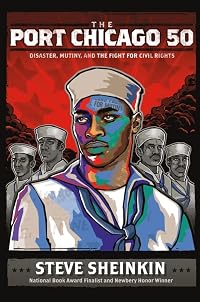
The Port Chicago 50: Disaster, Mutiny, and the Fight for Civil Rights
by Steve Sheinkin
On This Page
Description
History. Sociology. Geography. Young Adult Nonfiction. HTML:An astonishing civil rights story from Newbery Honor winner and National Book Award finalist Steve Sheinkin.On July 17, 1944, a massive explosion rocked the segregated Navy base at Port Chicago, California, killing more than 300 sailors who were at the docks, critically injuring off-duty men in their bunks, and shattering windows up to a mile away. On August 9th, 244 men refused to go back to work until unsafe and unfair show more conditions at the docks were addressed. When the dust settled, fifty were charged with mutiny, facing decades in jail and even execution. This is a fascinating story of the prejudice that faced black men and women in America's armed forces during World War II, and a nuanced look at those who gave their lives in service of a country where they lacked the most basic rights. show less
Tags
Recommendations







Member Reviews
“The Port Chicago 50” by Steve Sheinkin provides a valuable tool in engaging young readers in the fraught racial past of the United States. With clarity, consistency, and directness, Sheinkin retells the story of 50 sailors who, after being traumatized by a horrific explosion which led to the death of more than 300 of their shipmates, decided not to follow orders to return to their dangerous job of loading ammunition. The men who refused where all black, and in fact all of the sailors who handled the dangerous cargo in unsafe conditions were black as well. The story told is one of racial injustice, but also of perseverance and conviction and the foundations of the American Civil Rights movement. The book itself is written in a show more narrative style which keeps the reader engaged and does not get bogged down by unnecessary details. As a tool for teachers, it offers so many different ideas which could be discussed in class, from the importance of character and determination to the wrongs so brazenly and even legally committed on the black people of this country. And the author makes appoint to pull the reader in, to make them consider what they would do. “Think about that. Robinson felt he had to prove himself in combat in order to “win” the rights already guaranteed to all citizens in the United States of America.” Sheinkin also paints a clear picture of the extent of prejudice in this country. In one harrowing account, a black sailor recounts how, in a restaurant in the south at which his military convoy had stopped, he was forced to eat in the kitchen standing up, while German prisoners where seated and served alongside the white sailors in the convoy. The epilogue does a great job of tying in the story of the Port Chicago 50 with the beginning of the civil rights movement in America, and the entire book is full of adventure, suspense, and even the superhero-like appearance at trial of Thurgood Marshall. The layout was easy to read and the use of illustrations was helpful, although a number of photographs were heavily pixilated. Nonetheless, it was an exciting, enjoyable, engaging read. What a great book to use in teaching the history of race in the United States. show less
The Port Chicago Fifty tells the story of fifty Navy enlisted African American sailors who stood up for equality and safer working conditions during World War II. By opening this book with the attention-grabbing tale of Dorie Miller’s heroic deeds during the attack on Pearl Harbor, Sheinkin sets the stage for the challenges the Port Chicago men would face. Miller worked as a mess attendant, saved several people and took down an enemy plane with no training, was awarded the Navy Cross, but then went back to being a mess attendant simply because he was African American. The Port Chicago Fifty expands upon the story of several of the African American servicemen, explaining their motivations and background within Port Chicago. Sheinkin show more clearly relates the unsafe working conditions that destroyed Port Chicago instantly killing several hundred people. Throughout this historical non-fiction book, readers share the patriotism, then anger at injustice faced by these extraordinary men. Sheinkin is a master storyteller and historian, weaving key quotes and primary source documents to relate a chapter of America’s history in an engrossing manner. Even through the uncertainties of collective memory and time lapsed, Sheinkin navigates different perspectives of key events to shed light on a lesser-known story of World War II while placing them in the broader context of what would become the Civil Rights Movement. The Port Chicago Fifty is highly recommended for ages twelve and up. show less
Hands down the best nonfiction book I've read all year, maybe even in a few years! I was soo enamored with this book that I finished it in under two hours. I simply could not put it down! The Port Chicago 50 talked about an event in history that I literally had no idea about, the largest mutiny trial in naval history and at the time one of the largest man made explosions history. The tagline for the novel sums it up, "Disaster, Mutiny, and the fight for Civil Rights."
During the first half of the twentieth century all the United States armed forces units were segregated, including the Navy. Black men could join but they generally could not fight, they were relegated to doing all the cooking cleaning, loading, etc., because they were show more considered "unfit" for combat. At the start of WWII many black men signed up only to be disappointed that German POW's got better treatment then they did. This book focuses on a few units of all black Navy sailors who had the task of loading ammunition onto Naval ships. They had no training handling bombs, incendiary devices, and ammunition and it was only a matter of time before something disastrous happened. The higher ranked white sailors had all received several weeks worth of training but they weren't the ones handling the millions of pounds of bombs, their version of monitoring safety and supervising the black sailors included placing bets on which team could load the fastest. In this unsafe environment it came as no surprise that disaster inevitably struck. One night two explosions went off; sinking two massive Navy tankers and killing nearly 400 people (most of whom were black), the blast was soo massive that over a mile away windows were blown out and nearly 700 people were injured by flying glass and debris. Instead of learning from their mistakes, the Navy sent the remaining black sailors to another port to learn ammunition.... still with no training. Joe Small and 49 other black men refused to go back to work until they were given training and safety precautions, the Navy refused and tried all men with mutiny. This is their story and it needs to be heard. Before Rosa Parks, Dr. Martin Luther King, and other Civil Rights heroes, there were these men who stood up to injustice and helped change the course of history.
An absolute must read, I can't recommend this book enough! show less
During the first half of the twentieth century all the United States armed forces units were segregated, including the Navy. Black men could join but they generally could not fight, they were relegated to doing all the cooking cleaning, loading, etc., because they were show more considered "unfit" for combat. At the start of WWII many black men signed up only to be disappointed that German POW's got better treatment then they did. This book focuses on a few units of all black Navy sailors who had the task of loading ammunition onto Naval ships. They had no training handling bombs, incendiary devices, and ammunition and it was only a matter of time before something disastrous happened. The higher ranked white sailors had all received several weeks worth of training but they weren't the ones handling the millions of pounds of bombs, their version of monitoring safety and supervising the black sailors included placing bets on which team could load the fastest. In this unsafe environment it came as no surprise that disaster inevitably struck. One night two explosions went off; sinking two massive Navy tankers and killing nearly 400 people (most of whom were black), the blast was soo massive that over a mile away windows were blown out and nearly 700 people were injured by flying glass and debris. Instead of learning from their mistakes, the Navy sent the remaining black sailors to another port to learn ammunition.... still with no training. Joe Small and 49 other black men refused to go back to work until they were given training and safety precautions, the Navy refused and tried all men with mutiny. This is their story and it needs to be heard. Before Rosa Parks, Dr. Martin Luther King, and other Civil Rights heroes, there were these men who stood up to injustice and helped change the course of history.
An absolute must read, I can't recommend this book enough! show less
Although they had been given no training on handling explosives, the sailors, all African Americans, at the Port Chicago naval base just north of San Francisco, had only one job: move 500-pound bombs from railroad freight cars, roll them down to the pier into a cargo net. The net would then be lifted by a motorized winch into the hold of a waiting cargo ship. Inside the hold the men would then stack up the bombs.
"At the very top, they loaded the “hot cargo,” as the men called it—650-pound incendiary bombs. Unlike the other explosive stacked in the ship, these had their fuses already attached."
"The men at Port Chicago described the scene on the loading pier as frantic, stressful, loud, chaotic—bombs rolling and clanking show more together, winch engines chugging and smoking, nets swinging through the air, sailors shouting and cursing, officers urging the men on."
On July 17, 1944, at 10:18 p.m. the men of Division Four who had finished work at 3 in the afternoon, and turned the loading over to another shift, were startled out of sleep by a thunder clap. Then the sky lit up like daylight. Their worst nightmare had come true. The shock wave from the explosion blew the windows of their barracks apart. The incoming shards lacerated them. One man was blinded. Then the barracks began to collapse.
In the morning they discovered that the loading pier had disintegrated. There was nothing left of the munitions train that was being unloaded, nothing left of one of the two liberty ships that was being loaded, and just the stern of the other one sticking out of the water. Also in the water were bits of clothing, bodies, and bits of bodies. 320 men had been killed in “one of the biggest man-made explosions in history to that point.”
At first the survivors, including the 390 injured but not killed by the blast were treated by the Navy as heroes. They were the ones that put out the fires caused by the explosion, and had the grisly task of fishing the bodies and parts of bodies out of the water. But when the official inquiry began, racism surfaced. The testimony of witnesses, all white officers, was summarized as “colored enlisted personnel are neither temperamentally nor intellectually capable of handling high explosives…” The report also stated that “unsafe practices and speed were not permitted by anyone on authority.” This was the official report, in spite of the fact that these same officers had a betting pool on which Division could load the most in the shortest time. These same incapable enlisted seamen were then transferred to another California base to load ammunition. When, just a few weeks later, they balked at returning to loading ammunition on another ship they were charged with mutiny, and threatened with the death penalty.
Sheinkin’s short, powerful, and well documented study of segregation and institutional racism is worthy of the accolades that it has received including the 2014 Boston Globe-Horn Book Award for Excellence in Nonfiction and the 2015 Carter G. Woodson Book Award, as well as being a finalist for the National Book Award and the 2015 Young Adult Library Services Association Nonfiction Award Finalist. show less
"At the very top, they loaded the “hot cargo,” as the men called it—650-pound incendiary bombs. Unlike the other explosive stacked in the ship, these had their fuses already attached."
"The men at Port Chicago described the scene on the loading pier as frantic, stressful, loud, chaotic—bombs rolling and clanking show more together, winch engines chugging and smoking, nets swinging through the air, sailors shouting and cursing, officers urging the men on."
On July 17, 1944, at 10:18 p.m. the men of Division Four who had finished work at 3 in the afternoon, and turned the loading over to another shift, were startled out of sleep by a thunder clap. Then the sky lit up like daylight. Their worst nightmare had come true. The shock wave from the explosion blew the windows of their barracks apart. The incoming shards lacerated them. One man was blinded. Then the barracks began to collapse.
In the morning they discovered that the loading pier had disintegrated. There was nothing left of the munitions train that was being unloaded, nothing left of one of the two liberty ships that was being loaded, and just the stern of the other one sticking out of the water. Also in the water were bits of clothing, bodies, and bits of bodies. 320 men had been killed in “one of the biggest man-made explosions in history to that point.”
At first the survivors, including the 390 injured but not killed by the blast were treated by the Navy as heroes. They were the ones that put out the fires caused by the explosion, and had the grisly task of fishing the bodies and parts of bodies out of the water. But when the official inquiry began, racism surfaced. The testimony of witnesses, all white officers, was summarized as “colored enlisted personnel are neither temperamentally nor intellectually capable of handling high explosives…” The report also stated that “unsafe practices and speed were not permitted by anyone on authority.” This was the official report, in spite of the fact that these same officers had a betting pool on which Division could load the most in the shortest time. These same incapable enlisted seamen were then transferred to another California base to load ammunition. When, just a few weeks later, they balked at returning to loading ammunition on another ship they were charged with mutiny, and threatened with the death penalty.
Sheinkin’s short, powerful, and well documented study of segregation and institutional racism is worthy of the accolades that it has received including the 2014 Boston Globe-Horn Book Award for Excellence in Nonfiction and the 2015 Carter G. Woodson Book Award, as well as being a finalist for the National Book Award and the 2015 Young Adult Library Services Association Nonfiction Award Finalist. show less
In 1941 American joined War War II to fight for freedom. But there wasn't much freedom in America for African-Americans, even in the army. Black soldiers were restricted to cleaning, cooking and other menial and often dangerous chores; like loading ammunition. In 1944, a partially-loaded ship exploded. 320 sailors and civilians were killed and close to 400 were injured. 202 of the dead were black sailors. A few weeks later, the survivors were ordered to continue loading ammunition, with no additional safety measures or training. They refused and sparked a controversy that ended with 50 sailors being convicted of mutiny and the eventual desegregation of the Navy.
Sheinkin doesn't shy away from the grim reality of life for black soldiers, show more prefacing his story with a context of segregation, discrimination, and even murder. However, he doesn't push the reader to a specific conclusion. Sheinkin offers a compelling narrative from the stories and memories of the survivors and other protagonists but lets the reader make up their own mind about what really happened and civil disobedience in the military and during war.
In children's books especially, World War II is often portrayed as the "good war." Yes, horrible things happened, but the "good guys" and the "bad guys" were clear-cut and the good guys won. This isn't how I was taught history and I was shocked when I discovered last year a representative sample of adults and kids I was talking to knew nothing about the internment of Japanese-Americans. I was talking about this to our head of circulation, who to put it in perspective is a little younger than my mom, and she said they weren't taught the Holocaust in school when she was a kid.
I think it's important to have a balanced view of historical events and get kids to read beyond the "good guys vs bad guys" type of histories, especially for this age group. These are difficult conversations to have and parents and teachers need to think carefully about when kids are ready to deal with the harsh realities of history, but at some point, history in all its warts and horrors should be taught.
Verdict: This isn't an easy story to read, and there is some harsh language and harsh realities in the historical record, but Steve Sheinkin does an excellent job of writing his research in a way that's readable but not sensationalized. I usually booktalk Sheinkin's work to 6th graders, and while I wouldn't go with the publisher's age level of 9-11, since I think most kids that young wouldn't be able to understand the story, I think middle school is a good time to introduce kids to the complexity of history and I would give them this book, even if it's a difficult read. Due to the language, I will be putting this in our teen area.
ISBN: 9781596437968; Published January 2014 by Roaring Brook; ARC provided by publisher at ALA annual 2013; Ordered for the library show less
Sheinkin doesn't shy away from the grim reality of life for black soldiers, show more prefacing his story with a context of segregation, discrimination, and even murder. However, he doesn't push the reader to a specific conclusion. Sheinkin offers a compelling narrative from the stories and memories of the survivors and other protagonists but lets the reader make up their own mind about what really happened and civil disobedience in the military and during war.
In children's books especially, World War II is often portrayed as the "good war." Yes, horrible things happened, but the "good guys" and the "bad guys" were clear-cut and the good guys won. This isn't how I was taught history and I was shocked when I discovered last year a representative sample of adults and kids I was talking to knew nothing about the internment of Japanese-Americans. I was talking about this to our head of circulation, who to put it in perspective is a little younger than my mom, and she said they weren't taught the Holocaust in school when she was a kid.
I think it's important to have a balanced view of historical events and get kids to read beyond the "good guys vs bad guys" type of histories, especially for this age group. These are difficult conversations to have and parents and teachers need to think carefully about when kids are ready to deal with the harsh realities of history, but at some point, history in all its warts and horrors should be taught.
Verdict: This isn't an easy story to read, and there is some harsh language and harsh realities in the historical record, but Steve Sheinkin does an excellent job of writing his research in a way that's readable but not sensationalized. I usually booktalk Sheinkin's work to 6th graders, and while I wouldn't go with the publisher's age level of 9-11, since I think most kids that young wouldn't be able to understand the story, I think middle school is a good time to introduce kids to the complexity of history and I would give them this book, even if it's a difficult read. Due to the language, I will be putting this in our teen area.
ISBN: 9781596437968; Published January 2014 by Roaring Brook; ARC provided by publisher at ALA annual 2013; Ordered for the library show less
Once again the multiple award-winning author Steve Sheinkin excels at reporting an important (but not widely known) moment in history in a format friendly to younger readers as well as to adults. In this case, the moment he records changed the course of race relations in the U.S.
Port Chicago was a U.S. Navy base in the San Francisco Bay where, during World War II, black sailers were assigned to load bombs and ammunition into ships headed for American troops in the Pacific. All the officers were white, but all the men loading the bombs were black. In addition, the whites (who were not actually doing the work) received training in safe handling of warheads and incendiary bombs, but no such training was given to the blacks.
At that time, show more the military, like most of the country, was very segregated; even the blood supply was separated by color. Black men in uniform were not treated any better for serving the country; in fact, in parts of the country, they were considered even more offensive for presuming that their uniforms entitled them to any sort of respect or equal treatment. One white corporal reported a scene in Louisiana in which his black soldiers could not get served a meal in a single restaurant during a train stop, but a group of German prisoners of war, also at the train station, could walk right in to the station lunchroom and get served.
In another instance in Louisiana, a black soldier on a bus was ordered to get out of the white section, and he replied he would rather get off the bus. He did so, but the bus driver stopped the bus, got out, and shot the soldier to death. The driver was not prosecuted. Nor were any of the other whites in southern cities who attacked black soldiers; rather, it was the victims who got charged with assault. Repeated instances like this kept the future Supreme Court Justice Thurgood Marshall busy as he travelled around the country for the NAACP trying to help fight the “avalanche of abuses reported by African American soldiers and sailors.”
At Port Chicago, the soldiers were pushed to load as many bombs as possible, with officers pitting one division against the other and placing bets on whose division could load the fastest. Safety was not a concern. On July 17, 1944, there was a huge explosion, killing 320 and injuring another 390.
A Navy Board of Inquiry decided that the way the explosives were being handled had no impact on safety; rather, according to the official report and based on only the testimony of the white officers:
"The consensus of opinion of the witnesses…is that the colored enlisted personnel are neither temperamentally nor intellectually capable of handling high explosives…”
Following this incident, a large number of black sailors refused to load ammunition again. But after the commandant of the Twelfth Naval District threatened them with a firing squad, all but fifty reported for work. These fifty were put on trial for mutiny. Their defense team was good, and worked hard to show that there were no witnesses to the white officers’ allegations of a conspiracy; that the sailors were just afraid; and that the men had no interest in "usurping, subverting, or overriding superior military authority," a part of the Navy’s definition of mutiny. But ultimately, as Joe Small, one of the Fifty, realized after the trial (summarized by Sheinkin):
"The defense lawyers were all naval officers - they weren’t going to bring out details that would be embarrassing to the Navy. And even if they’d wanted to, the judges wouldn’t have let them.”
But the fact remained that many of the so-called mutineers were not capable of working with the munitions, and not for reasons of “mental inadequacy,” as came out at the trial. One sailor, who weighed just 104 pounds, said he was specifically told by a Navy doctor he wasn’t strong enough. Another suffered dizzy spells and also been declared unfit for loading. One still had a fractured wrist from the explosion. One mentioned that because the officers were racing for money, he was afraid another explosion would happen. Another testified that the prosecutor threatened that if he didn’t “come clean” about a conspiracy, he would be shot. (Thurgood Marshall released a statement charging that the prosecutor was prejudiced and that it was impossible for the sailors to get a fair trial.) And so on.
It was all to no avail. All fifty men were found guilty of mutiny. (Decades after the trial, the defense attorney revealed that he had overhead Rear Admiral Hugh Osterhaus of the court say, while the trial was still in progress, “We’re going to find them guilty.”) All fifty sentences were identical: fifteen years of hard labor in prison, and a dishonorable discharge from the Navy. A few of the younger sailors had some years knocked off of the sentences.
Thurgood Marshall didn’t give up, writing directly to the Secretary of the Navy, James Forrestal, arguing about the absurdity of the court’s proceedings and findings. Behind the scenes, Navy lawyers agreed with Marshall.
Meanwhile, the abuses of black soldiers both on and off bases continued. The Navy finally decided that segregation was actually hampering the war effort, and instituted gradual integration. But there was no diminution in the sentences of the Port Chicago men.
In May 1945, Secretary Forrestal’s office told Admiral Wright the court had made a mistake and the judges needed to reconsider their decision. The judges, however, voted to uphold all fifty convictions and prison sentences, claiming:
"The trials were conducted fairly and impartially.”
After the war was over, the public wouldn’t let go of the case, and even Eleanor Roosevelt got involved. Forrestal would not admit the Navy made a mistake, but wanted to make the case go away. In January, 1946, he ordered the Port Chicago prisoners transferred to a Navy ship and returned to active duty for service at sea (not, however, changing their status from “convicted mutineers”).
The Fifty had to deal with prejudice on the ship, and Joe Small was forced to duke it out with one Alabama boy, Alex, who eventually became his close friend. When Small later asked Alex what it was that caused him to change his mind about befriending a black man, Alex replied:
"I found out something. … A man is a man.”
An Epilogue gives a brief recounting of Civil Rights advances following the events at Port Chicago, and extensive source notes. Throughout the text, there are many photos of both the people and documents described in the book.
Evaluation: History doesn’t get much better or more readable than this. The author has done an outstanding job reporting an occurrence about which every American should be aware. show less
Port Chicago was a U.S. Navy base in the San Francisco Bay where, during World War II, black sailers were assigned to load bombs and ammunition into ships headed for American troops in the Pacific. All the officers were white, but all the men loading the bombs were black. In addition, the whites (who were not actually doing the work) received training in safe handling of warheads and incendiary bombs, but no such training was given to the blacks.
At that time, show more the military, like most of the country, was very segregated; even the blood supply was separated by color. Black men in uniform were not treated any better for serving the country; in fact, in parts of the country, they were considered even more offensive for presuming that their uniforms entitled them to any sort of respect or equal treatment. One white corporal reported a scene in Louisiana in which his black soldiers could not get served a meal in a single restaurant during a train stop, but a group of German prisoners of war, also at the train station, could walk right in to the station lunchroom and get served.
In another instance in Louisiana, a black soldier on a bus was ordered to get out of the white section, and he replied he would rather get off the bus. He did so, but the bus driver stopped the bus, got out, and shot the soldier to death. The driver was not prosecuted. Nor were any of the other whites in southern cities who attacked black soldiers; rather, it was the victims who got charged with assault. Repeated instances like this kept the future Supreme Court Justice Thurgood Marshall busy as he travelled around the country for the NAACP trying to help fight the “avalanche of abuses reported by African American soldiers and sailors.”
At Port Chicago, the soldiers were pushed to load as many bombs as possible, with officers pitting one division against the other and placing bets on whose division could load the fastest. Safety was not a concern. On July 17, 1944, there was a huge explosion, killing 320 and injuring another 390.
A Navy Board of Inquiry decided that the way the explosives were being handled had no impact on safety; rather, according to the official report and based on only the testimony of the white officers:
"The consensus of opinion of the witnesses…is that the colored enlisted personnel are neither temperamentally nor intellectually capable of handling high explosives…”
Following this incident, a large number of black sailors refused to load ammunition again. But after the commandant of the Twelfth Naval District threatened them with a firing squad, all but fifty reported for work. These fifty were put on trial for mutiny. Their defense team was good, and worked hard to show that there were no witnesses to the white officers’ allegations of a conspiracy; that the sailors were just afraid; and that the men had no interest in "usurping, subverting, or overriding superior military authority," a part of the Navy’s definition of mutiny. But ultimately, as Joe Small, one of the Fifty, realized after the trial (summarized by Sheinkin):
"The defense lawyers were all naval officers - they weren’t going to bring out details that would be embarrassing to the Navy. And even if they’d wanted to, the judges wouldn’t have let them.”
But the fact remained that many of the so-called mutineers were not capable of working with the munitions, and not for reasons of “mental inadequacy,” as came out at the trial. One sailor, who weighed just 104 pounds, said he was specifically told by a Navy doctor he wasn’t strong enough. Another suffered dizzy spells and also been declared unfit for loading. One still had a fractured wrist from the explosion. One mentioned that because the officers were racing for money, he was afraid another explosion would happen. Another testified that the prosecutor threatened that if he didn’t “come clean” about a conspiracy, he would be shot. (Thurgood Marshall released a statement charging that the prosecutor was prejudiced and that it was impossible for the sailors to get a fair trial.) And so on.
It was all to no avail. All fifty men were found guilty of mutiny. (Decades after the trial, the defense attorney revealed that he had overhead Rear Admiral Hugh Osterhaus of the court say, while the trial was still in progress, “We’re going to find them guilty.”) All fifty sentences were identical: fifteen years of hard labor in prison, and a dishonorable discharge from the Navy. A few of the younger sailors had some years knocked off of the sentences.
Thurgood Marshall didn’t give up, writing directly to the Secretary of the Navy, James Forrestal, arguing about the absurdity of the court’s proceedings and findings. Behind the scenes, Navy lawyers agreed with Marshall.
Meanwhile, the abuses of black soldiers both on and off bases continued. The Navy finally decided that segregation was actually hampering the war effort, and instituted gradual integration. But there was no diminution in the sentences of the Port Chicago men.
In May 1945, Secretary Forrestal’s office told Admiral Wright the court had made a mistake and the judges needed to reconsider their decision. The judges, however, voted to uphold all fifty convictions and prison sentences, claiming:
"The trials were conducted fairly and impartially.”
After the war was over, the public wouldn’t let go of the case, and even Eleanor Roosevelt got involved. Forrestal would not admit the Navy made a mistake, but wanted to make the case go away. In January, 1946, he ordered the Port Chicago prisoners transferred to a Navy ship and returned to active duty for service at sea (not, however, changing their status from “convicted mutineers”).
The Fifty had to deal with prejudice on the ship, and Joe Small was forced to duke it out with one Alabama boy, Alex, who eventually became his close friend. When Small later asked Alex what it was that caused him to change his mind about befriending a black man, Alex replied:
"I found out something. … A man is a man.”
An Epilogue gives a brief recounting of Civil Rights advances following the events at Port Chicago, and extensive source notes. Throughout the text, there are many photos of both the people and documents described in the book.
Evaluation: History doesn’t get much better or more readable than this. The author has done an outstanding job reporting an occurrence about which every American should be aware. show less
Reads like a story -- elements of courtroom drama (exciting!), civil rights struggle injustice and the fact that the Navy STILL won't exonerate the 50 men from the mutiny charges is monstrous. I can see teens getting caught up in the drama and the unfairness of the soldiers' stories. Many of them were teenagers themselves! Also thought it was a good length. 200 pages of non-fiction is completely do-able.
Members
- Recently Added By
Lists

National Book Award Finalists 2014
20 works; 16 members
Author Information

31+ Works 8,524 Members
Some Editions
Awards and Honors
Awards
Distinctions
Notable Lists
Common Knowledge
- Important events
- World War II; Port Chicago Mutiny
Classifications
Statistics
- Members
- 609
- Popularity
- 47,973
- Reviews
- 41
- Rating
- (4.21)
- Languages
- English
- Media
- Paper, Audiobook, Ebook
- ISBNs
- 11
- ASINs
- 2