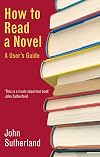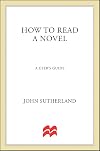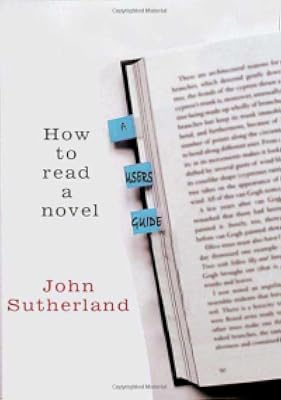
How to Read a Novel: A User's Guide
by John Sutherland
On This Page
Description
In a book that is as humorous as it is learned, author Sutherland tells you how to read fiction better than you do now. He reminds readers how the delicate charms of fiction can be at once wonderful and inspired and infuriating. On one level this is about novels: how they work, what they're about, what makes them good or bad, and how to talk about them. At a deeper level, this book describes what happens when a reader meets a novel. Will a great love affair begin? Will the rendezvous end in show more disappointment? Taking his readers to the bookshop, Sutherland helps them judge a book by its cover, wondering aloud what genre might be best, even going so far as to analyze one of the latest American bestsellers, all to help the reader choose the novel that is right for him or her.--From publisher description. show lessTags
Recommendations





Member Recommendations

Member Reviews
"Do we still know how to read a novel?" John Sutherland, Chairman of the 2005 Booker Prize Committee, asks. His disheartened answer is an unequivocal, "No." But Sutherland has not given up hope. With acerbic wit and intellect, he traces the history of what it used to mean to be well-read and tells readers what it still means today. Using this delightful book as a means to an end, he reminds readers how the delicate charms of fiction can be at once wonderful and inspired and infuriating.
On one level this is a book about novels: how they work, what they're about, what makes them good or bad, and how to talk about them. At a deeper level, this is a book in which one of the most intimate tête-à-têtes is described--one in which a reader show more meets a novel. Will a great love affair begin? Will the rendezvous end in disappointment? Who can say? In order for the relationship to take its appropriate course all the details must be clearly acknowledged and understood for their complexities: plot, point of view, character, style, pace, first and last sentences, and even beauty.
Still, Sutherland knows a true understanding of fiction is more than a flirtation with text and style--it is a business. Taking his readers on a trip to the bookshop, he helps them judge a book by its cover based on design and color, wondering aloud what genre might be best, even going so far as to analyze one of the latest American bestsellers to further help the buying reader choose the novel that is right for him or her.
In a book that is as wry and humorous as it is learned and opinionated, John Sutherland tells you everything you always wanted to know about how to read fiction better than you do now (but, were afraid to ask). show less
On one level this is a book about novels: how they work, what they're about, what makes them good or bad, and how to talk about them. At a deeper level, this is a book in which one of the most intimate tête-à-têtes is described--one in which a reader show more meets a novel. Will a great love affair begin? Will the rendezvous end in disappointment? Who can say? In order for the relationship to take its appropriate course all the details must be clearly acknowledged and understood for their complexities: plot, point of view, character, style, pace, first and last sentences, and even beauty.
Still, Sutherland knows a true understanding of fiction is more than a flirtation with text and style--it is a business. Taking his readers on a trip to the bookshop, he helps them judge a book by its cover based on design and color, wondering aloud what genre might be best, even going so far as to analyze one of the latest American bestsellers to further help the buying reader choose the novel that is right for him or her.
In a book that is as wry and humorous as it is learned and opinionated, John Sutherland tells you everything you always wanted to know about how to read fiction better than you do now (but, were afraid to ask). show less
I'm not sure that this book really does what it says on the tin, as it doesn't tell you how to read a novel at all! What it does do is to give the reader suggestions on how to get the most out of their novel reading. While the author John Sutherland was a Professor of English this is a book aimed more at the general reader than students of literature but most thoughtful readers would get something out of it. It's a wide ranging book dealing with a diverse range of topics, including: the mechanics of choosing your novel; what can be gleaned from reviews and prize lists; getting clues from the title, chapter headings and epigraph; and the physical aspects of the novel. One of those books which is full of interesting snippets of show more information such as this comment on margins:
But from the first printed books onward, generous white margins were left as they had been in the codex's manuscript predecessor. It would have been easy for compositors, then and now, to print flush against all four page edges. Instead, some 10 per cent of the page surface is left temptingly white. For what? Marginalia of course. Commentary. Nota benes. The four-sided, flush, verso-recto-balanced margin, standard in very novel, is a hangover from the age of manuscript, when they were there for the 'commentator' - a contributor who would add in marginalia, running heads, footnotes, corrections, embellishments. Now they are great white empty spaces - the result of cultural inertia.
I knew that 'marginalia' were things written in margins but it has honestly never occurred to me that that's what the margins were for, or now that we don't do that we didn't need margins.
One thing I should mention is that this book was published in 2006 and so predates the explosion in ereaders. Things have moved on so much in those eight years that even though the book looks at digital reading as well as physical books, it can't help but sound a little dated. But notwithstanding that, still an interesting read for all book lovers. show less
But from the first printed books onward, generous white margins were left as they had been in the codex's manuscript predecessor. It would have been easy for compositors, then and now, to print flush against all four page edges. Instead, some 10 per cent of the page surface is left temptingly white. For what? Marginalia of course. Commentary. Nota benes. The four-sided, flush, verso-recto-balanced margin, standard in very novel, is a hangover from the age of manuscript, when they were there for the 'commentator' - a contributor who would add in marginalia, running heads, footnotes, corrections, embellishments. Now they are great white empty spaces - the result of cultural inertia.
I knew that 'marginalia' were things written in margins but it has honestly never occurred to me that that's what the margins were for, or now that we don't do that we didn't need margins.
One thing I should mention is that this book was published in 2006 and so predates the explosion in ereaders. Things have moved on so much in those eight years that even though the book looks at digital reading as well as physical books, it can't help but sound a little dated. But notwithstanding that, still an interesting read for all book lovers. show less
I'd thought this book to be an exploration of the innards of a novel - plot, structure, etc - which it's not. But I found it no less enjoyable for being instead an extended love letter to the form, with such discourses as the history of the novel, the use of genres, critical receptions, celebrity authors, the hidden secrets to be gleaned from the copyright page, what to think of film adaptations or book reviews or bestseller lists, and a hell of a lot more. Some of these subjects are just 3 or 4 pages in length; some of them come closer to a dozen. It's light and breezy and - for any bibliophile, at least - fun and fascinating to boot.
From the first page this book spoke to me about my just discovered anxiety about becoming well read in a time where there are just too many good books to read and not enough hours in a lifetime!
Good fun, opinionated and very contemporary references make it interesting reading.
Good fun, opinionated and very contemporary references make it interesting reading.
Very slight. This reads like a mildly diverting essay one might find in the Sunday supplements puffed into book length to meet some publisher’s demand. And no, it isn’t, as the title avers, a book about how to read novel. Rather it is a book about how to choose a novel to read. Perhaps the reading bit comes later. Of course there are plenty of anecdotal and spurious tales to tell about the book trade. Sutherland is good at that. Also good at the cutting aside. Point scoring is such fun. But there is not much of real worth here.
Not recommended.
Not recommended.
Not a thought provoking work, but an amusing and enjoyable read (although I was annoyed by the occasional repetition). You also have to appreciate that it was published in 2006 and discusses a lot of novels published in 2005 (this was good for me, as I have now (five years later) read a lot of these novels).
I will remember this for when I said to my daughter that this book was fun as it referenced other works. My daughter said, yes, but is annoying when you know something is referential, but you do not know what it is referencing - it would be useful if books provided the references at the back. I then showed her the ten pages of novels cited, quoted or discussed in the text, that are detailed at the back of the book.
Of course, the show more other good thing of reading a book about books, is that it always makes me want to go back and re-read works or, even better, read new novels, show less
I will remember this for when I said to my daughter that this book was fun as it referenced other works. My daughter said, yes, but is annoying when you know something is referential, but you do not know what it is referencing - it would be useful if books provided the references at the back. I then showed her the ten pages of novels cited, quoted or discussed in the text, that are detailed at the back of the book.
Of course, the show more other good thing of reading a book about books, is that it always makes me want to go back and re-read works or, even better, read new novels, show less
"How to Read a Novel" is perhaps a misnomer for "All About Novels". In a discovery tour of what novels are about, Sutherland guides the reader through the history, industry and intricacies of novels. It is full of fun and interesting tit bits, but it woefully lacks structure. I was hoping for a more in-depth look at "intertextuality" or "genres" for example, and I'm not sure that judging a book by its cover and 69th page is a fair criteria. Sutherland's humor however makes this piece very readable, the bibliography lists a wide variety of material for all tastes and there are a few nuggets that definitely makes this book worth a read.
Members
- Recently Added By
Published Reviews
ThingScore 25
It's nearly as difficult, maintains John Sutherland, "to read a novel well as to write one well". As someone who does both - though I accept the "well" may be open to question - I maintain this is rubbish. And this handsome but rather hollow little book does nothing to convince us of its truth.
added by danielx
Author Information

133+ Works 5,096 Members
John Sutherland was born on October 9, 1938. After graduating from the University of Leicester in 1964, he began his academic career as an assistant lecturer in Edinburgh. He specializes in Victorian fiction, 20th century literature, and the history of publishing. He is Lord Northcliffe Professor Emeritus of Modern English Literature at University show more College, London and is currently teaching at the California Institute of Technology. He writes for The Guardian and is a well-known literary reviewer. He is the author of more than 20 books including Stephen Spender: The Authorized Biography, How to Read a Novel: A User's Guide, The Boy Who Loved Books, Curiosities of Literature, 50 Literature Ideas You Really Need to Know, Lives of the Novelists: A History of Fiction in 294 Lives, and Magic Moments: Life-Changing Encounters with Books, Film, Music. He is also the co-author, with Stephen Fender, of Love, Sex, Death and Words: Tales from a Year in Literature. (Bowker Author Biography) show less
Common Knowledge
- First words
- I recall one evening walking to the underground with A. S. Byatt, after a day's teaching. We were both then lecturers in the same English Department. Why, I asked, did she publish so much higher journalism ...?
- Quotations
- A clever engagement with a novel is, in my opinion, one of the more noble functions of human intelligence. ... It is, I would maintain, almost as difficult to read a novel well as to write one well.
Reading, done well, is an act of self-definition. - Last words
- (Click to show. Warning: May contain spoilers.)They are, I believe, well worth it.
Classifications
Statistics
- Members
- 404
- Popularity
- 76,449
- Reviews
- 22
- Rating
- (3.20)
- Languages
- English
- Media
- Paper, Ebook
- ISBNs
- 6
- ASINs
- 1