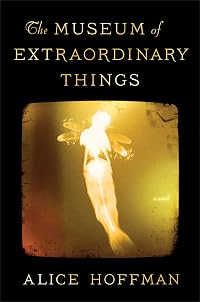
The Museum of Extraordinary Things
by Alice Hoffman
On This Page
Description
The daughter of a Coney Island boardwalk curiosities museum's front man pursues an impassioned love affair with a Russian immigrant photographer who after fleeing his Lower East Side Orthodox community has captured poignant images of the infamous Triangle Shirtwaist Factory fire.Tags
Recommendations


Member Recommendations
charlie68 Will illumine parts of the book.
Member Reviews
I found the book a bit slow going and even repetitious, but there were several things I liked.
First, I like the way Ms. Hoffman uses historical events like the Triangle Shirtwaist Factory fire to build her story around. Her description of the fire was so well done and moving -- I felt I was there.
I liked Ed' story better than the main story of Cora. I was frustrated that it took so long for them to meet! Ed's relationship with his father is well developed and heartbreaking.
I like the way Ms. Hoffman turns things inside out: We have a "wolf man" (an extremely hairy person) who is taught to growl as part of his employment in a freak show, but is actually a very gentle and cultured man. And we have a real wolf who has been domesticated and show more behaves like a dog. Many things that appear to be magical are not -- the private investigator "seer" who employs young boys to investigate on his behalf; the exhibits in the title museum that are fabricated. And things portrayed as normal turn magical and both Cora and her nanny find love. show less
First, I like the way Ms. Hoffman uses historical events like the Triangle Shirtwaist Factory fire to build her story around. Her description of the fire was so well done and moving -- I felt I was there.
I liked Ed' story better than the main story of Cora. I was frustrated that it took so long for them to meet! Ed's relationship with his father is well developed and heartbreaking.
I like the way Ms. Hoffman turns things inside out: We have a "wolf man" (an extremely hairy person) who is taught to growl as part of his employment in a freak show, but is actually a very gentle and cultured man. And we have a real wolf who has been domesticated and show more behaves like a dog. Many things that appear to be magical are not -- the private investigator "seer" who employs young boys to investigate on his behalf; the exhibits in the title museum that are fabricated. And things portrayed as normal turn magical and both Cora and her nanny find love. show less
Infrequently, there is a book so great it is difficult to follow with another. Such is the case of The Museum of Extraordinary Things. I wanted to finish it to see what happened, yet did not want it to end. And, when trying to follow with another book, I opened five different ones, but none grabbed me in the beginning like this one did.
I haven't read Alice Hoffman in awhile. She's written three books since I last read one of hers. Reading this book reinforced why she is one of my favorite authors.
Magical realism is how I would define her books. They contain a mystical, dreamlike feeling, while dealing with difficult subjects. Hoffman hasn't lost her touch and ability to continue to pull the reader into the pages, while holding them to show more continue page after page of beautiful phrases and vivid images.
In The Museum of Extraordinary Things, the focus is on the year 1911. The setting is New York City, and in particular Coney Island. Two major historical events occurred that year. The Triangle Shirtwaist Factory burned, killing many young girls who, because the owner bolted the doors, could not escape, taking their lives in a ghastly conflagration, and, just as a major renovation costing millions, The Coney Island Dreamland amusement park caught fire. Destroying all newly built spectacular rides and killing rare, exotic animals, hundreds watched as lions, elephants and tigers were set free as they ran into the fire and were either burnt or killed by a bullet to contain them. The flames shot hundreds of feet into the air when a bucket of hot tar sparked and destroyed everything, including surrounding structures.
One other major non historical event occurred, Coralie Sardie began to look at her father in a totally different way. Now 18, and used as a freak in her father's house of extraordinary things, she began to rebel. Her webbed hand deformities kept her bound to him as he attached a fin-like apparatus to her body, hid a breathing tube behind some fake scenery, allowing her a daily existence in a tank of cold water, captivating those who would pay .40 to see her and various other "freaks" of her father's making.
The outside world called to Coralie as she, with her gloved hands, ventured over the rooftop each night and wandered down the board walk where she envisioned freedom.
As the Dreamland pier was building, her father's freak show was ending. The promise of the Dreamland experience drew her and many others who wanted more than looking at formaldehyde glass jars containing oddities. As Dreamland expansion began, his fortunes collapsed, leaving him increasingly desperate to find new sources of income, one of which exploited Coralie's body and soul.
This book is Alice Hoffman at her best. The images are so crisp and clear that the fuse in the readers mind. This is a story of longing, freedom, hope, determination and love. At the time when workers demanded a union for better working conditions, Coralie too demands what is rightfully hers -- a life free of soul numbing consequences.
As each of the wonderfully drawn characters present themselves on the pages, the reader identifies with every one of them in a magical way.
Deserving a high recommendation, this is a must read of Five Stars! show less
I haven't read Alice Hoffman in awhile. She's written three books since I last read one of hers. Reading this book reinforced why she is one of my favorite authors.
Magical realism is how I would define her books. They contain a mystical, dreamlike feeling, while dealing with difficult subjects. Hoffman hasn't lost her touch and ability to continue to pull the reader into the pages, while holding them to show more continue page after page of beautiful phrases and vivid images.
In The Museum of Extraordinary Things, the focus is on the year 1911. The setting is New York City, and in particular Coney Island. Two major historical events occurred that year. The Triangle Shirtwaist Factory burned, killing many young girls who, because the owner bolted the doors, could not escape, taking their lives in a ghastly conflagration, and, just as a major renovation costing millions, The Coney Island Dreamland amusement park caught fire. Destroying all newly built spectacular rides and killing rare, exotic animals, hundreds watched as lions, elephants and tigers were set free as they ran into the fire and were either burnt or killed by a bullet to contain them. The flames shot hundreds of feet into the air when a bucket of hot tar sparked and destroyed everything, including surrounding structures.
One other major non historical event occurred, Coralie Sardie began to look at her father in a totally different way. Now 18, and used as a freak in her father's house of extraordinary things, she began to rebel. Her webbed hand deformities kept her bound to him as he attached a fin-like apparatus to her body, hid a breathing tube behind some fake scenery, allowing her a daily existence in a tank of cold water, captivating those who would pay .40 to see her and various other "freaks" of her father's making.
The outside world called to Coralie as she, with her gloved hands, ventured over the rooftop each night and wandered down the board walk where she envisioned freedom.
As the Dreamland pier was building, her father's freak show was ending. The promise of the Dreamland experience drew her and many others who wanted more than looking at formaldehyde glass jars containing oddities. As Dreamland expansion began, his fortunes collapsed, leaving him increasingly desperate to find new sources of income, one of which exploited Coralie's body and soul.
This book is Alice Hoffman at her best. The images are so crisp and clear that the fuse in the readers mind. This is a story of longing, freedom, hope, determination and love. At the time when workers demanded a union for better working conditions, Coralie too demands what is rightfully hers -- a life free of soul numbing consequences.
As each of the wonderfully drawn characters present themselves on the pages, the reader identifies with every one of them in a magical way.
Deserving a high recommendation, this is a must read of Five Stars! show less
I was a bit apprehensive about reading another novel by Alice Hoffman, because Practical Magic was a big let down for me (the film adaptation was far better!), but this my favourite kind of story, combining historical fact and fiction.
Written around the events of two tragic fires in New York, at the Triangle Shirtwaist Factory and Coney Island Dreamland amusement park in 1911, Hoffman has created a magical romance between a mermaid and a budding photographer on the run from his past who are drawn together over a missing girl. Coralie, raised by the shady owner of the Museum of the title and forced to become a living exhibit herself, is fighting against the constraints of her young life when she chances across Eddie Cohen in the woods show more outside Manhattan, a young man who has left behind his father and his religion to make a life of his own, on his own. They naturally fall instantly in love, but without the hope of meeting again - until Coralie's father takes advantage of a gruesome discovery in the woods, which leads Eddie to the Museum of Extraordinary Things.
After a slow start - the opening of each chapter is written from the perspective of either Coralie or Eddie (in italics, which drives me nuts), documenting their separate lives - the characters come to life and the mystery of Hannah Weiss, who should have perished in the Triangle Factory but disappeared without a trace, takes a sinister turn. I loved the atmosphere of early twentieth century New York - the stark injustice of rich versus poor, high rise Manhattan slowly edging nature out of existence, human beings treated as exhibits to gawk at in the tacky sideshows of Coney Island. Obviously well researched, each chapter could have footnotes, but Hoffman never takes her readers out of the story. Every line is a treasure of information and emotion. show less
Written around the events of two tragic fires in New York, at the Triangle Shirtwaist Factory and Coney Island Dreamland amusement park in 1911, Hoffman has created a magical romance between a mermaid and a budding photographer on the run from his past who are drawn together over a missing girl. Coralie, raised by the shady owner of the Museum of the title and forced to become a living exhibit herself, is fighting against the constraints of her young life when she chances across Eddie Cohen in the woods show more outside Manhattan, a young man who has left behind his father and his religion to make a life of his own, on his own. They naturally fall instantly in love, but without the hope of meeting again - until Coralie's father takes advantage of a gruesome discovery in the woods, which leads Eddie to the Museum of Extraordinary Things.
After a slow start - the opening of each chapter is written from the perspective of either Coralie or Eddie (in italics, which drives me nuts), documenting their separate lives - the characters come to life and the mystery of Hannah Weiss, who should have perished in the Triangle Factory but disappeared without a trace, takes a sinister turn. I loved the atmosphere of early twentieth century New York - the stark injustice of rich versus poor, high rise Manhattan slowly edging nature out of existence, human beings treated as exhibits to gawk at in the tacky sideshows of Coney Island. Obviously well researched, each chapter could have footnotes, but Hoffman never takes her readers out of the story. Every line is a treasure of information and emotion. show less
“Men did such things as this in dreams: approached a dark house filled with treasure, sank into a sea of true love, traveled with wolves and wonders on a warm night.” — Alice Hoffman, “The Museum of Extraordinary Things”
The magic in her use of language has always been practical for Alice Hoffman, as demonstrated by the above line from “The Museum of Extraordinary Things” (2014). It makes so many of her books irresistible.
Coralie has grown up in The Museum of Extraordinary Things on Coney Island early in the 20th century. Born with webbed fingers and with an ability to hold her breath for long periods of time, she becomes one of the "freaks" put on display by her father, Professor Sardie.
Sadie searches during the off-season show more for new freaks and oddities. Sometimes he manufactures his own, as when he finds the body of a girl that he hopes to turn into a mermaid, after using Coralie to create mermaid sightings in the river.
As she gets older the girl begins to discover her father's secrets, and they are not pretty. Eventually she develops secrets of her own, as when on one of her river swims she spies a young man on the shore and falls instantly in love.
Eddie, too, has a troubled relationship with his father. He works partly as a photographer and partly as a finder of missing persons. His estranged father surprises him by recommending him to a man searching for his daughter, missing since a tragic factory fire. Was she lost in the fire or not? If she's dead, where is her body?
His search, of course, leads him to the museum and to Coralie, while Hoffman's novel turns briefly from a love story into a murder mystery. At the dramatic end to the story, there's another tragic fire that destroys many of the Coney Island amusements. Both fires really happened, even though the rest of the novel is fiction.
My only complaint about this fine book is that nearly half of it is printed in italics, not comfortable to read in large portions. Still it is not all that hard to read and does not seriously hamper the overall appeal of this novel of extraordinary things. show less
The magic in her use of language has always been practical for Alice Hoffman, as demonstrated by the above line from “The Museum of Extraordinary Things” (2014). It makes so many of her books irresistible.
Coralie has grown up in The Museum of Extraordinary Things on Coney Island early in the 20th century. Born with webbed fingers and with an ability to hold her breath for long periods of time, she becomes one of the "freaks" put on display by her father, Professor Sardie.
Sadie searches during the off-season show more for new freaks and oddities. Sometimes he manufactures his own, as when he finds the body of a girl that he hopes to turn into a mermaid, after using Coralie to create mermaid sightings in the river.
As she gets older the girl begins to discover her father's secrets, and they are not pretty. Eventually she develops secrets of her own, as when on one of her river swims she spies a young man on the shore and falls instantly in love.
Eddie, too, has a troubled relationship with his father. He works partly as a photographer and partly as a finder of missing persons. His estranged father surprises him by recommending him to a man searching for his daughter, missing since a tragic factory fire. Was she lost in the fire or not? If she's dead, where is her body?
His search, of course, leads him to the museum and to Coralie, while Hoffman's novel turns briefly from a love story into a murder mystery. At the dramatic end to the story, there's another tragic fire that destroys many of the Coney Island amusements. Both fires really happened, even though the rest of the novel is fiction.
My only complaint about this fine book is that nearly half of it is printed in italics, not comfortable to read in large portions. Still it is not all that hard to read and does not seriously hamper the overall appeal of this novel of extraordinary things. show less
I am a sucker for a book that begins and ends with true historical events, in this case the Triangle Factory fire and the Dreamland park fire. Add to that the fact that Hoffman tells the story from the perspectives of two complex, likable, flawed chapters, and I found it a striking winner. This novel is a brilliant work that can be described most succinctly as a study in the way people can be surprising in both their cruelty and kindness. In this, Hoffman has created a true work of beauty.
1911 Brooklyn is the perfect backdrop for this beautifully twisted tale. It has romance, mystery and those wonderful historical facts. It's also a story of extraordinary people in extraordinary times. Hoffman has created in this novel the most diverse show more groups of characters I've read in a novel in years. (There is someone interesting for nearly every reader's taste. There is a tortoise I somehow even came to care about. Lastly but certainly not least, New York is a major character upon which all the others are hinged.).
I love the alternating perspectives of Coralie and Eddie, both lost souls with special gifts. She has amazing abilities in water and he has the gift to find people. I also love the building sense of unease as the plot develops. I wouldn't call this suspense or thriller, but there's a definite momentum moving this story. Mostly I love Hoffman's attention to detail. She never disappoints. And did I mention the human "oddities"? I'm a sucker for those too.
Most characters suffer in quiet desperation and are not always likable but it doesn't matter because they are compelling and believable. Few characters in this novel live a normal existence. Hoffman even manages to make this possible without sounding angst-ridden.
I can't even find critical flaws except that the dialogue is almost too perfect. The italicized thoughts are poetic and have deep meaning- everyone feels profoundly but somehow it still doesn't seem overdone. Hoffman is a marvelous mystery. Sort of like the best scenes in TV or movies...you wish you could be that sharp and witty in real life, always ready with a quick reply.
I recommend the crap out of this book, for all the aforementioned reasons as well as it's a truly entertaining and well-plotted story with excellent pacing. And one brilliant ending. 5 stars. show less
I loved the sense of place and time of this book. I also loved Eddie's journey and his struggle to define himself in a rapidly changing world. I loved Hoffman's use of imagery, especially fire and water. What I didn't love was the fact that Eddie and Coralie's stories didn't cross until two-thirds of the way through the book and that Coralie was such a passive heroine. I'm also not a big fan of Hoffman's version of romantic love, but if you follow her work you have to accept that people fall in love at first sight and have mystical connections that can't be broken. Romances don't really develop, they just are. Still, this is one of my favorite Hoffman novels since Practical Magic. Highly recommended.
Turn of the 20th Century Coney Island. A young woman trained to impersonate a mermaid. A Jewish photographer, refugee from Ukrainian pograms, fleeing his own cultural heritage. A former mob boss turned horse-whisperer. A highly cultivated wolf-man, whose life has been transformed by Jane Eyre. A hermit with a pet wolf. The Triangle Shirtwaist fire. A mysterious disappearance. What more do I have to tell you to get you to reach for this book?
Alice Hoffman's The Museum of Extraordinary Things is an extraordinary thing itself. Yes, it has all of the above elements, any one of which would make me pick it up in a bookstore and think about making a purchase. What it also has is a rich storyline, with engaging, complicated characters, and a show more trio of narrative voices that leave one hungry for more.
The first two characters I mentioned, the mermaid and the photographer, provide two of the narrative voices. The third is a traditional omniscient narrator. Each chapter opens in one of the two character voices, then transitions to the omniscient narrator. In odd-numbered chapters we get the mermaid. In even-numbered chapters we get the photographer. And each of the three voices sings, distinct and true, creating a story that lets us move in and out of the hearts of its characters, seeing events from multiple perspectives.
The Museum of Extraordinary Things balances dark and light. It's full of menace, but never becomes hopeless. This is one of those novels that's worth purchasing while it's still only available in hardback. show less
Alice Hoffman's The Museum of Extraordinary Things is an extraordinary thing itself. Yes, it has all of the above elements, any one of which would make me pick it up in a bookstore and think about making a purchase. What it also has is a rich storyline, with engaging, complicated characters, and a show more trio of narrative voices that leave one hungry for more.
The first two characters I mentioned, the mermaid and the photographer, provide two of the narrative voices. The third is a traditional omniscient narrator. Each chapter opens in one of the two character voices, then transitions to the omniscient narrator. In odd-numbered chapters we get the mermaid. In even-numbered chapters we get the photographer. And each of the three voices sings, distinct and true, creating a story that lets us move in and out of the hearts of its characters, seeing events from multiple perspectives.
The Museum of Extraordinary Things balances dark and light. It's full of menace, but never becomes hopeless. This is one of those novels that's worth purchasing while it's still only available in hardback. show less
Members
- Recently Added By
Lists

Top Five Books of 2014
1,064 works; 398 members

Top Five Books of 2021
604 works; 181 members

Books Read in 2014
2,343 works; 89 members

Summer Reads 2014
207 works; 69 members

Book Riot's 100 must-read works of Jewish Fiction
100 works; 8 members

To Read
6 works; 1 member

Carole's List
445 works; 13 members

History: Eastern Europe
97 works; 2 members

Books Read in 2019
4,052 works; 110 members

Books recommended by Calgary Public Library staff
1,588 works; 4 members
Author Information

74+ Works 61,270 Members
Alice Hoffman, an American novelist and screenwriter, was born in New York City on March 16, 1952. She earned a B.A. from Adelphi University in 1973 and an M.A. in creative writing from Stanford University in 1975 before publishing her first novel, Property Of, in 1977. Known for blending realism and fantasy in her fiction, she often creates show more richly detailed characters who live on society's margins and places them in extraordinary situations as she did with At Risk, her 1988 novel about the AIDS crisis. Her other works include The Drowning Season, Seventh Heaven, The River King, Blue Diary, The Probable Future, The Ice Queen, and The Dovekeepers. Her book, The Third Angel, won the 2008 New England Booksellers' Award for fiction. Two of her novels, Practical Magic and Aquamarine, were made into films. She has also written numerous screenplays, including adaptations of her own novels and the original screenplay, Independence Day. Her title's The Museum of Exteaordinary Things, The Marriage of Opposites, Seventh Heaven, and The Rules of Magic made The New York Times Best Seller List. (Bowker Author Biography) show less
Some Editions
Awards and Honors
Awards
Common Knowledge
- Canonical title
- The Museum of Extraordinary Things
- Original publication date
- 2014-02-18
- People/Characters
- Coralie Sardie; Ezekiel Cohen 'Ed'; Professor Sardie; Maureen Higgins; Moses Levy; Samuel Weiss (show all 15); Hannah Weiss; Abraham Hochman; Ella Weiss; Jacob Van der Beck; Raymond Morris 'the Wolfman'; Edward Osterman 'Eastman'; Harry Block; Juliet Block; Joseph Cohen 'Yoysef'
- Important places
- Coney Island, Brooklyn, New York, New York, USA; Lower East Side, Manhattan, New York, New York, USA
- Important events
- Triangle Shirtwaist Factory Fire (1911-03-25)
- Epigraph
- I have heard what the talkers were talking, the talk of the beginning and the end. But I do not talk of the beginning or the end. Walt Whitman, Song of Myself
- First words
- You would think it would be impossible to find anything new in the world, creatures no man has ever seen before, one-of-a-kind oddities in which nature has taken a backseat to the coursing pulse of the fantastical and marvelo... (show all)us.
- Quotations
- Perhaps it was as Hochman had once said to me, that a man had many lives. Each day we choose the path we would take by our own actions.
Hochman had been right, the past was what we carried with us, threaded to the future, and we decided whether to keep it close or let it go. Fate was both what we were given and what we made for ourselves. - Last words
- (Click to show. Warning: May contain spoilers.)For that, and for a thousand other things, I send my gratitude.
Classifications
Statistics
- Members
- 2,475
- Popularity
- 7,806
- Reviews
- 130
- Rating
- (3.74)
- Languages
- 5 — English, Finnish, Hungarian, Polish, Serbian
- Media
- Paper, Audiobook, Ebook
- ISBNs
- 23
- ASINs
- 10