On This Page
Description
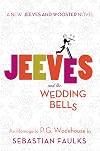
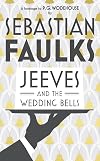
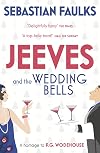
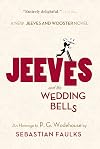
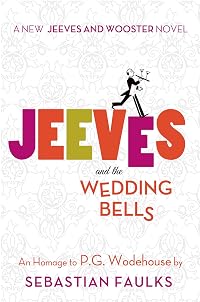
"Bertie Wooster (a young man about town) and his butler Jeeves (the very model of the modern manservant)--return in their first new novel in nearly forty years: Jeeves and the Wedding Bells by Sebastian Faulks. P.G. Wodehouse documented the lives of the inimitable Jeeves and Wooster for nearly sixty years, from their first appearance in 1915 ("Extricating Young Gussie") to the his final completed novel (Aunts Aren't Gentlemen) in 1974. These two were the finest creations of a novelist widely show more proclaimed to be the finest comic English writer by critics and fans alike. With the approval of the Wodehouse estate, acclaimed novelist Sebastian Faulks brings Bertie and Jeeves back to life in a hilarious affair of mix-ups and mishaps. Bertie, nursing a bit of heartbreak over the recent engagement of one Georgiana Meadowes to someone not named Wooster, agrees to "help" his old friend Peregrine "Woody" Beeching, whose own romance is foundering. Almost immediately, things go awry and the simple plan quickly becomes complicated. Jeeves ends up having to impersonate one Lord Etringham, while Bertie plays the part of Jeeves' manservant "Wilberforce"--and this all happens under the same roof as the now affianced Ms. Meadowes. From there the plot becomes even more hilarious and convoluted, in a brilliantly conceived, seamlessly written comic work worthy of the master himself"-- show lessTags
Recommendations















Member Reviews
Rating: 3.9* of five
The Publisher Says: Bertie Wooster (a young man about town) and his butler Jeeves (the very model of the modern manservant)—return in their first new novel in nearly forty years: Jeeves and the Wedding Bells by Sebastian Faulks.
P.G. Wodehouse documented the lives of the inimitable Jeeves and Wooster for nearly sixty years, from their first appearance in 1915 (“Extricating Young Gussie”) to his final completed novel (Aunts Aren’t Gentlemen) in 1974. These two were the finest creations of a novelist widely proclaimed to be the finest comic English writer by critics and fans alike.
Now, forty years later, Bertie and Jeeves return in a hilarious affair of mix-ups and mishaps. With the approval of the Wodehouse show more estate, acclaimed novelist Sebastian Faulks brings these two back to life for their legion of fans. Bertie, nursing a bit of heartbreak over the recent engagement of one Georgina Meadowes to someone not named Wooster, agrees to “help” his old friend Peregrine “Woody” Beeching, whose own romance is foundering. That this means an outing to Dorset, away from an impending visit from Aunt Agatha, is merely an extra benefit. Almost immediately, things go awry and the simple plan quickly becomes complicated. Jeeves ends up impersonating one Lord Etringham, while Bertie pretends to be Jeeves’ manservant “Wilberforce,”—and this all happens under the same roof as the now affianced Ms. Meadowes. From there the plot becomes even more hilarious and convoluted, in a brilliantly conceived, seamlessly written comic work worthy of the master himself.
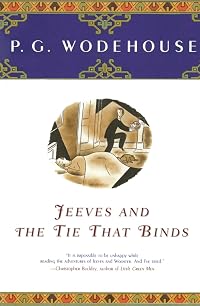
My Review: I first encountered Bertie Wooster and his fantasy England in 1972. My sister's bookstore, located on a weird little corner near the old-money part of Austin, stocked a good deal of then-living P.G. Wodehouse's books because the older ladies who patronized the place loved him. I was sitting around there one day, a little bored, and picked up [Jeeves and the Tie That Binds], then the most recent book in the series. Came time for me to leave, I begged and pleaded and promised to do actual work if I was allowed to take it with me.
And thus began what is, to date, an unabated addiction. Jeeves and his endless fund of arcane knowledge became my hero immediately. Clearly he loves dimwitted Bertie...now that's not fair of me, Bertie isn't dim. Bertie is...limited...yes, that's better, Bertie has a limited intellectual scope. He's utterly dependent on Jeeves because he's never going to be able to keep up with the crowd, and he's got such a loving and generous nature that it's impossible not to see which way that parade is headed, and it's not a nice part of town.
A co-dependent relationship? Yes, probably so. Is that a problem? For whom, might I inquire? It suits Jeeves down to the ground and it's survival for Bertie. Need one's manner of living pass any other test?
Of course it raises the question of the future of each of these men. Are they locked in an eternal stasis, doomed to be each other's closest living companion? That could get claustrophobic. But hell, these are silly fantasy novels!
I see from the delights of Jeeves and the Wedding Bells that I was not alone in having these vaguely disquieting thoughts. Bertie and Jeeves are, through a combination of Bertie's yearning for his vacation romantic entanglement and Aunt Agatha's threatening to invade Berkeley Mansions' sacred precincts, compelled to quit London's fleshpots and rusticate in Melbury-cum-Kingston in aid of Bertie's pal "Woody" Beeching's romantic designs on one Amelia Hackwood, presently gone awry. it is, of course, the merest chance that Amelia Hackwood's best friend and her father's ward happens to be Georgiana Meadowes, Bertie's erstwhile vacation romance....
And we're OFF! Let the slamming door sex-farce, without the sex, commence. It is a delight to return to the world of commodious country houses staffed by efficient and tolerant worker-bees, owned by irascible, kind-hearted curmudgeons, generous if financially precarious, in need of a certain ward to make a monetarily advantageous marriage to a bland, unpleasantly parented drip so the family manse won't be sold to make a private school....
The formula is, for those susceptible to its music-box intricacies, still robust, and in Sebastian Faulks's capable hands, burnished to a new and warming glow.
Faulks has chosen, by placing Bertie in the (rather incredible) role of Jeeves' valet, to emphasize the Upstairs, Downstairs qualities inherent in the Woosterverse ab initio, but left almost entirely alone by Sir Plum Wodehouse in the original stories. We hear of the General Strike, a development that anchors the series in a specific year...1926...which Wodehouse never did. It also gives a small insight into Bertie's and Jeeves' characters, in that Bertie is utterly oblivious to the existence of the Strike and Jeeves' précis of the events is wholly favorably received by Bertie. The plot twist involving Bertie in the belowstairs world is, well, unbelievable in the extreme...Bertie wouldn't know the first thing about how to behave or what to do while waiting at table!...but all is, as usual with a Wodehousian plot, brought into satisfying retrospective focus by Jeeves' summation of the actual events, seen from a nuts-and-bolts perspective.
It is this that defines the appeal of Wodehouse's novels and stories for me: Like music boxes or magic illusions, it's all a matter of perspective as to what one sees of events. From the front of the house, there is an illusion of seamless and inevitable progress from set-up to resolution; at the end, the illusionist allows us to see the mechanics of how he fooled us into seeing only what sustains the seamlessness.
That said, there are areas of story development that are sadly deficient in this effort. I found the Venables family, in particular, received short shrift. As Venables junior is Bertie's romantic rival, it seems to me that the odious swine should be developed to be more odious so that the audience may fully despise him. Promising starts are made with his *ghastly* book-writing career, but not used nearly enough. Venables senior and mater are underdeveloped for the freight they must carry, too.
I know that, when a book is billed as an homage, it must nod frequently to the preceding works on whose developmental shoulders it stands. The many mentions of the inhabitants of the Woosterverse are inevitable. The cameos and walk-ons are as well (loved the brief appearance of Esmond Haddock, for example). A few fewer of these, given more substance, would possibly have worked more to spice and enliven the Woosterverse; as it was, the sheer bulk of the passing references gave the book a slight feel of the soap-opera farewell after a beloved actor dies and the character must be retired. Many poignant memories are evoked, but the effect can be to bring the reader out of the present book, which is the place one wants to be. After all, I paid my twenty-some dollars to be in this exact spot, didn't I?
And I love it. I batten on it. I've missed the deft and skilled application of wit and humor to novels of manners, morals, and fun. Thank you, Sebastian Faulks, thank you, Estate of Pelham Grenville Wodehouse, and thank you, Saint Martin's Press. I am refreshed and uplifted and very grateful. show less
The Publisher Says: Bertie Wooster (a young man about town) and his butler Jeeves (the very model of the modern manservant)—return in their first new novel in nearly forty years: Jeeves and the Wedding Bells by Sebastian Faulks.
P.G. Wodehouse documented the lives of the inimitable Jeeves and Wooster for nearly sixty years, from their first appearance in 1915 (“Extricating Young Gussie”) to his final completed novel (Aunts Aren’t Gentlemen) in 1974. These two were the finest creations of a novelist widely proclaimed to be the finest comic English writer by critics and fans alike.
Now, forty years later, Bertie and Jeeves return in a hilarious affair of mix-ups and mishaps. With the approval of the Wodehouse show more estate, acclaimed novelist Sebastian Faulks brings these two back to life for their legion of fans. Bertie, nursing a bit of heartbreak over the recent engagement of one Georgina Meadowes to someone not named Wooster, agrees to “help” his old friend Peregrine “Woody” Beeching, whose own romance is foundering. That this means an outing to Dorset, away from an impending visit from Aunt Agatha, is merely an extra benefit. Almost immediately, things go awry and the simple plan quickly becomes complicated. Jeeves ends up impersonating one Lord Etringham, while Bertie pretends to be Jeeves’ manservant “Wilberforce,”—and this all happens under the same roof as the now affianced Ms. Meadowes. From there the plot becomes even more hilarious and convoluted, in a brilliantly conceived, seamlessly written comic work worthy of the master himself.
My Review: I first encountered Bertie Wooster and his fantasy England in 1972. My sister's bookstore, located on a weird little corner near the old-money part of Austin, stocked a good deal of then-living P.G. Wodehouse's books because the older ladies who patronized the place loved him. I was sitting around there one day, a little bored, and picked up [Jeeves and the Tie That Binds], then the most recent book in the series. Came time for me to leave, I begged and pleaded and promised to do actual work if I was allowed to take it with me.
And thus began what is, to date, an unabated addiction. Jeeves and his endless fund of arcane knowledge became my hero immediately. Clearly he loves dimwitted Bertie...now that's not fair of me, Bertie isn't dim. Bertie is...limited...yes, that's better, Bertie has a limited intellectual scope. He's utterly dependent on Jeeves because he's never going to be able to keep up with the crowd, and he's got such a loving and generous nature that it's impossible not to see which way that parade is headed, and it's not a nice part of town.
A co-dependent relationship? Yes, probably so. Is that a problem? For whom, might I inquire? It suits Jeeves down to the ground and it's survival for Bertie. Need one's manner of living pass any other test?
Of course it raises the question of the future of each of these men. Are they locked in an eternal stasis, doomed to be each other's closest living companion? That could get claustrophobic. But hell, these are silly fantasy novels!
I see from the delights of Jeeves and the Wedding Bells that I was not alone in having these vaguely disquieting thoughts. Bertie and Jeeves are, through a combination of Bertie's yearning for his vacation romantic entanglement and Aunt Agatha's threatening to invade Berkeley Mansions' sacred precincts, compelled to quit London's fleshpots and rusticate in Melbury-cum-Kingston in aid of Bertie's pal "Woody" Beeching's romantic designs on one Amelia Hackwood, presently gone awry. it is, of course, the merest chance that Amelia Hackwood's best friend and her father's ward happens to be Georgiana Meadowes, Bertie's erstwhile vacation romance....
And we're OFF! Let the slamming door sex-farce, without the sex, commence. It is a delight to return to the world of commodious country houses staffed by efficient and tolerant worker-bees, owned by irascible, kind-hearted curmudgeons, generous if financially precarious, in need of a certain ward to make a monetarily advantageous marriage to a bland, unpleasantly parented drip so the family manse won't be sold to make a private school....
The formula is, for those susceptible to its music-box intricacies, still robust, and in Sebastian Faulks's capable hands, burnished to a new and warming glow.
Faulks has chosen, by placing Bertie in the (rather incredible) role of Jeeves' valet, to emphasize the Upstairs, Downstairs qualities inherent in the Woosterverse ab initio, but left almost entirely alone by Sir Plum Wodehouse in the original stories. We hear of the General Strike, a development that anchors the series in a specific year...1926...which Wodehouse never did. It also gives a small insight into Bertie's and Jeeves' characters, in that Bertie is utterly oblivious to the existence of the Strike and Jeeves' précis of the events is wholly favorably received by Bertie. The plot twist involving Bertie in the belowstairs world is, well, unbelievable in the extreme...Bertie wouldn't know the first thing about how to behave or what to do while waiting at table!...but all is, as usual with a Wodehousian plot, brought into satisfying retrospective focus by Jeeves' summation of the actual events, seen from a nuts-and-bolts perspective.
It is this that defines the appeal of Wodehouse's novels and stories for me: Like music boxes or magic illusions, it's all a matter of perspective as to what one sees of events. From the front of the house, there is an illusion of seamless and inevitable progress from set-up to resolution; at the end, the illusionist allows us to see the mechanics of how he fooled us into seeing only what sustains the seamlessness.
That said, there are areas of story development that are sadly deficient in this effort. I found the Venables family, in particular, received short shrift. As Venables junior is Bertie's romantic rival, it seems to me that the odious swine should be developed to be more odious so that the audience may fully despise him. Promising starts are made with his *ghastly* book-writing career, but not used nearly enough. Venables senior and mater are underdeveloped for the freight they must carry, too.
I know that, when a book is billed as an homage, it must nod frequently to the preceding works on whose developmental shoulders it stands. The many mentions of the inhabitants of the Woosterverse are inevitable. The cameos and walk-ons are as well (loved the brief appearance of Esmond Haddock, for example). A few fewer of these, given more substance, would possibly have worked more to spice and enliven the Woosterverse; as it was, the sheer bulk of the passing references gave the book a slight feel of the soap-opera farewell after a beloved actor dies and the character must be retired. Many poignant memories are evoked, but the effect can be to bring the reader out of the present book, which is the place one wants to be. After all, I paid my twenty-some dollars to be in this exact spot, didn't I?
And I love it. I batten on it. I've missed the deft and skilled application of wit and humor to novels of manners, morals, and fun. Thank you, Sebastian Faulks, thank you, Estate of Pelham Grenville Wodehouse, and thank you, Saint Martin's Press. I am refreshed and uplifted and very grateful. show less
I know there are die-hard purist fans of Austen, Doyle and Wodehouse who think it sacrilege if any author dare attempt a pastiche of their idolized author, but I am not one of them. I have found several authors who have done a fine job of paying homage to their favorite author, and I think the original author who applaud their work, this being one of the them. Faulks has written this "new" book in the Jeeves and Wooster series in the same style, and spirit as the originals. The language is "spot on on,"(although I don't remember Bertie saying "Golly" as much as this version), and the wild farcical mix- ups and deceits all perfectly plausible in the World of Jeeves & Wooster. I did however, take a little issue in the ending, as I am show more pretty sure Wodehouse would not have tied up the story in quite the same way. It was pure fun to revisit Jeeves and Wooster again, and if you just read it for a bit of fun without trying to nitpick it to death for not being EXACTLY what you think a Wodehouse piece should be, I think you will enjoy it too. show less
Interminable; the bally thing just goes on and on. Wodehouse would never have bored his readers with such tedious cricketing and fete performances and he most certainly would never task Jeeves with such unsolicited manipulation. No fan of Plum's would enjoy this and I'm tempted to throw it in the bin lest it waste the time of a fellow aficionado.
My first thought when I saw the title in the bookstore was, "How in the world did I miss this?! I've read EVERY Jeeves and Wooster in the series!" Looking more closely, of course, I realized that this is an homage to P.G. Wodehouse's beloved characters, written by Sebastian Faulks in 2013. I bought the book (of course I bought it!) feeling equally split between excitement and anxiety. I really wanted to read more Jeeves and Wooster--but I really didn't want someone screwing up something I love so much.
In the author's note, Faulks says he wasn't trying to imitate Wodehouse insomuch as he wanted to try to introduce Jeeves and Wooster to the younger generation. He calls himself not an expert but a fan. I decided to give him a chance, so show more with slitted eye like the chihuahua in the popular meme, I turned the page.
This was better than I had expected! Yes, there are two parts that didn't feel like Wodehouse wrote them, but that's okay because Faulks addressed that issue in his author's note. For the most part, though, he really nailed Jeeves's and Bertie's characters, and that, to my mind, is what matters. The only real issue I had is that he had Bertie use the word "bunged" at least ten times. I mean, it was noticeable, and while I know Bertie would have used "bunged," he wouldn't have used it so many times in one book. Nit picky on my part, perhaps, but there it is. Other than that minor point, Faulks nailed the dialogue, the characters' distinct tones, and he even managed, for the most part, to capture the zaniness of a Jeeves and Wooster adventure.
Was this Wodehouse? No. Was it humorous and enjoyable? Heck yea! I even found myself literally laughing out loud, and I could "hear" Bertie and Jeeves in my head (thanks to Stephen Fry and Hugh Laurie). It was like Faulks brought my two good friends, Reginald Jeeves and Bertram Wilberforce Wooster, back from the dead and gave me the chance to spend just a little more time in their presence. For that, I truly thank him. show less
In the author's note, Faulks says he wasn't trying to imitate Wodehouse insomuch as he wanted to try to introduce Jeeves and Wooster to the younger generation. He calls himself not an expert but a fan. I decided to give him a chance, so show more with slitted eye like the chihuahua in the popular meme, I turned the page.
This was better than I had expected! Yes, there are two parts that didn't feel like Wodehouse wrote them, but that's okay because Faulks addressed that issue in his author's note. For the most part, though, he really nailed Jeeves's and Bertie's characters, and that, to my mind, is what matters. The only real issue I had is that he had Bertie use the word "bunged" at least ten times. I mean, it was noticeable, and while I know Bertie would have used "bunged," he wouldn't have used it so many times in one book. Nit picky on my part, perhaps, but there it is. Other than that minor point, Faulks nailed the dialogue, the characters' distinct tones, and he even managed, for the most part, to capture the zaniness of a Jeeves and Wooster adventure.
Was this Wodehouse? No. Was it humorous and enjoyable? Heck yea! I even found myself literally laughing out loud, and I could "hear" Bertie and Jeeves in my head (thanks to Stephen Fry and Hugh Laurie). It was like Faulks brought my two good friends, Reginald Jeeves and Bertram Wilberforce Wooster, back from the dead and gave me the chance to spend just a little more time in their presence. For that, I truly thank him. show less
Why has Faulks written this?
He doesn't need the fame or money: he's successful in his own right, with his own characters and plots.
Wodehouse was an incredibly prolific writer, so there's no shortage of genuine Jeeves and Wooster stories.
And if he'd waited a few more years, he could have got a chatbot to write it for him (see below)!
It's one thing for novice writers to practise their art by writing fan-fic of authors who didn't write much, but that doesn't apply here.
Jean Rhys wrote an original enough prequel to Jane Eyre to justify The Wide Sargasso Sea. Just. See my reviews HERE and HERE, respectively.
And another thing: Faulks' hijacking seems closer to Eoin Colfer's bad and unnecessary sixth Hitchhiker's, And Another Thing, which show more was, bizarrely, written at the request of Douglas Adams' family. I read and reviewed it, HERE.
I won't read this.
But I have loved and reviewed some genuine Wodehouses:
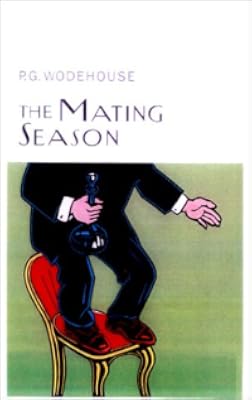
* The Mating Season, HERE
* Mulliner's Buck-U-Uppo, HERE
* Blandings Castle, HERE
* The Great Sermon Handicap, HERE
The next morning
My ire has subsided a little and I found a Guardian review, HERE, that makes this sound not totally awful - except for the fact that Faulks doesn't need to piggyback on Plum's work, even with the consent of the Wodehouse estate. I rather wish I'd bought the book now, as it was a charity shop, so doing so wouldn't have lined Faulks' pocket. I expect it would have made me more indignant, but with more ammunition for it!
A week later
I decided that as long as my money didn't go to Faulks, I would read a little more of the book than when I first spotted it. I went back to the charity shop, but the book had been sold. I'm not going to seek it out again, but if I do spy a second hand copy again, I'll buy it.
And then NigeyB found another good Guardian article, HERE, and discussed in comments below.
ChatGPT's turn
How easy is it to write a Jeeves and Wooster story? I asked the AI chatbot, ChatGPT to outline a story. (For more about this Large Language Model, see my review of Manny Rayner's work, HERE.)
Q: Can you write the outline of a Jeeves and Wooster story. Please include some clever metaphors, as Wodehouse always did.
For some reason, ChatGPT divided it into acts, rather than chapters, but for a first attempt, this has potential, despite American spelling, the fact duelling was a male pursuit, and the lack of witty metaphors. Here's what it wrote, in mere seconds:
Certainly, here's an outline for a Jeeves and Wooster story with some clever metaphors:
Title: Jeeves and the Perilous Potentate
Act 1: Wooster's latest love interest, the fiery and tempestuous Lady Cynthia, has gotten herself into a bit of a pickle. She has made the mistake of flirting with the wrong man, the notoriously jealous and short-tempered Prince Vladimir of Ruritania. The Prince has challenged her to a duel to defend her honor, and she's terrified. Wooster turns to Jeeves for help, hoping that his valet can come up with a solution.
Act 2: Jeeves proposes a plan to save Lady Cynthia from the duel. He suggests that Wooster pretend to be a renowned fencer from South America, come to London to participate in a prestigious tournament. The Prince will be so impressed by Wooster's skill with a sword that he will forget all about Lady Cynthia. Jeeves arranges for Wooster to take fencing lessons from an eccentric old coach named Monsieur Dupont, who has a penchant for comparing swordplay to a tango between two lovers.
Act 3: Wooster participates in the fencing tournament, and despite some mishaps and close calls, manages to make it to the final round. However, in the final match, he faces a formidable opponent, the sinister Count von Klopstock, who is rumored to have killed several men in duels. Von Klopstock uses a ruthless style of fencing, which he compares to a game of chess where the goal is to eliminate your opponent's pieces one by one.
Act 4: In a tense and dramatic climax, Wooster manages to defeat von Klopstock by using a combination of unorthodox moves and sheer luck. He is declared the winner of the tournament and becomes the talk of London society. Lady Cynthia is so impressed by his bravery and skill that she falls madly in love with him. The Prince of Ruritania, meanwhile, is so intimidated by Wooster's fencing prowess that he flees back to his homeland, never to be seen again.
Epilogue: Wooster reflects on his adventure and realizes that he owes everything to Jeeves, who once again saved him from disaster. Jeeves, as always, is modest and self-effacing, but Wooster knows that he could never have succeeded without his valet's brilliant mind and impeccable taste. Wooster muses that life is like a game of fencing, where the key to success is not brute force, but rather finesse, elegance, and a well-timed lunge.
When I asked it to add some witty metaphors, all it did was change the final sentence!
"Wooster muses that life is like a fencing match, where success depends not on brute force, but on the grace and subtlety of a well-executed feint. He compares Jeeves to a master strategist, always one step ahead of his opponents, and himself to a nimble dancer, darting and weaving to avoid the thrusts of fate."
Then I told it women don't fight duels, Wodehouse wrote almost exclusively about British and American people, and it needed metaphors scattered throughout the story. That generated a new story, with more metaphors, and a surprising gay subtext.
Title: Jeeves and the Curious Case of the Foppish Fiancée
Act 1: Bertie Wooster is happily enjoying the company of his latest love interest, the charming and effervescent Miss Georgina Fitzhugh-Smythe. However, things take a turn for the worse when he discovers that Miss Fitzhugh-Smythe is engaged to be married to the insufferably foppish Reginald Cuthbert. Bertie knows that the engagement is a mistake, but Miss Fitzhugh-Smythe is too besotted with Reginald to listen to reason. He turns to Jeeves for help, hoping that his valet can come up with a plan.
Act 2: Jeeves proposes a plan to break up the engagement. He suggests that Bertie pose as a wealthy American businessman, come to England to invest in the local economy. Reginald, who fancies himself a man of the world, will be so impressed by Bertie's wealth and sophistication that he will abandon Miss Fitzhugh-Smythe and pursue Bertie's favor instead. Jeeves arranges for Bertie to take elocution lessons from a crusty old professor, who has a penchant for comparing the English language to a garden that must be tended with care.
Act 3: Bertie puts Jeeves's plan into action and attends a ball hosted by Miss Fitzhugh-Smythe's family, posing as the wealthy American businessman. Reginald, true to form, is immediately drawn to Bertie's supposed wealth and sophistication. However, things become complicated when Bertie realizes that he has developed feelings for Miss Fitzhugh-Smythe. He finds himself in a delicate dance, trying to win her heart while avoiding Reginald's clumsy attempts to woo him.
Act 4: In a witty and charming resolution, Bertie manages to win Miss Fitzhugh-Smythe's heart and break up her engagement to Reginald. He does so by using a combination of eloquent speech, sly humor, and genuine affection. Jeeves, as always, provides the perfect touch of savoir-faire, keeping the entire operation running smoothly behind the scenes. Bertie muses that life is like a garden, full of beauty and variety, but also in need of careful cultivation and pruning. He compares Jeeves to a master gardener, always tending to the needs of his charges with precision and care.
Epilogue: Bertie reflects on his adventure and realizes that he owes everything to Jeeves, who once again saved him from disaster. Jeeves, as always, is modest and self-effacing, but Bertie knows that he could never have succeeded without his valet's brilliant mind and impeccable taste. Bertie compares himself to a delicate flower, in need of protection and guidance, and Jeeves to a sturdy oak tree, providing shelter and support. He resolves to continue relying on Jeeves's wisdom and expertise, knowing that together they can weather any storm.
It would be possible to use either as the basis for composing something more plausibly Wodehousian, but there's no need. This is just messing around with a bot. For Jeeves and Wooster, stick with the Master.
Two years later March 2025
I gave it exactly the same prompt:
Q: Can you write the outline of a Jeeves and Wooster story. Please include some clever metaphors, as Wodehouse always did.
Here's it's immediate response:
Title: Jeeves and the Case of the Mismatched Engagements
I. Introduction: Bertie in a Bind
• Bertie Wooster, the well-meaning but cerebrally underfurnished young gentleman, finds himself ensnared in yet another social imbroglio.
• Aunt Dahlia, as forceful as a general leading troops into battle with a megaphone, summons him to Brinkley Court for what she describes as a “harmless little favor.”
• Bertie, sensing trouble like a sheepdog eyeing a particularly aggressive ram, protests feebly but is overruled.
II. The Problem Unfolds
• Upon arrival, Bertie learns that his friend Gussie Fink-Nottle, the newt-fancying philosopher, is once again wobbling on the precipice of romantic disaster.
• Gussie is engaged to Madeline Bassett, the dreamy-eyed poetess who believes the stars are God’s daisy chain. However, a misunderstanding has led Madeline to think Gussie is in love with Honoria Glossop, a formidable female whose idea of a quiet afternoon involves calisthenics and Nietzsche.
• Meanwhile, Bertie himself has been mistakenly identified as Madeline’s savior, placing him in mortal peril of matrimonial entrapment.
III. Jeeves Steps In
• Enter Jeeves, moving with the serene dignity of a bishop inspecting the cucumber sandwiches.
• He absorbs the situation with his usual impassive expression, as if being informed that the vicarage roof requires mending.
• A plan is required, and Jeeves, whose brainpower makes Einstein look like a man struggling with basic arithmetic, sets about devising one.
IV. The Plan Takes Shape (and Nearly Collapses)
• Step One: Convince Madeline that Gussie is a steadfast lover of poetic sensibilities. This involves Bertie, disguised as a wandering bard, reciting the sappiest poetry known to mankind. The results are distressing.
• Step Two: Engineer a scenario where Honoria, discovering Gussie’s supposed admiration, recoils as one might from a cold kipper on a warm morning.
• Step Three: Restore Gussie to Madeline’s affections while ensuring Bertie emerges as free as a bird that has just received a legal injunction against cage manufacturers.
V. The Glorious Conclusion
• After a series of misadventures involving a vicar’s runaway dachshund, a flowerpot strategically placed on Sir Watkyn Bassett’s cranium, and an ill-advised attempt at extemporaneous Shakespeare, the plan succeeds.
• Gussie and Madeline are reunited, Honoria decides to travel to Patagonia (where, one assumes, there are fewer bewildered suitors), and Bertie is once again spared the shackles of wedlock.
• Aunt Dahlia, gratified, rewards Bertie with a hearty meal, and all seems well—until she drops the next terrifying request upon his plate.
• Jeeves, ever prescient, has already packed their bags. “Perhaps a brief sojourn in the south of France, sir?”
This is more convincing, which is worrying in some ways, but less original, which is worrying in others. show less
He doesn't need the fame or money: he's successful in his own right, with his own characters and plots.
Wodehouse was an incredibly prolific writer, so there's no shortage of genuine Jeeves and Wooster stories.
And if he'd waited a few more years, he could have got a chatbot to write it for him (see below)!
It's one thing for novice writers to practise their art by writing fan-fic of authors who didn't write much, but that doesn't apply here.
Jean Rhys wrote an original enough prequel to Jane Eyre to justify The Wide Sargasso Sea. Just. See my reviews HERE and HERE, respectively.
And another thing: Faulks' hijacking seems closer to Eoin Colfer's bad and unnecessary sixth Hitchhiker's, And Another Thing, which show more was, bizarrely, written at the request of Douglas Adams' family. I read and reviewed it, HERE.
I won't read this.
But I have loved and reviewed some genuine Wodehouses:
* The Mating Season, HERE
* Mulliner's Buck-U-Uppo, HERE
* Blandings Castle, HERE
* The Great Sermon Handicap, HERE
The next morning
My ire has subsided a little and I found a Guardian review, HERE, that makes this sound not totally awful - except for the fact that Faulks doesn't need to piggyback on Plum's work, even with the consent of the Wodehouse estate. I rather wish I'd bought the book now, as it was a charity shop, so doing so wouldn't have lined Faulks' pocket. I expect it would have made me more indignant, but with more ammunition for it!
A week later
I decided that as long as my money didn't go to Faulks, I would read a little more of the book than when I first spotted it. I went back to the charity shop, but the book had been sold. I'm not going to seek it out again, but if I do spy a second hand copy again, I'll buy it.
And then NigeyB found another good Guardian article, HERE, and discussed in comments below.
ChatGPT's turn
How easy is it to write a Jeeves and Wooster story? I asked the AI chatbot, ChatGPT to outline a story. (For more about this Large Language Model, see my review of Manny Rayner's work, HERE.)
Q: Can you write the outline of a Jeeves and Wooster story. Please include some clever metaphors, as Wodehouse always did.
For some reason, ChatGPT divided it into acts, rather than chapters, but for a first attempt, this has potential, despite American spelling, the fact duelling was a male pursuit, and the lack of witty metaphors. Here's what it wrote, in mere seconds:
Certainly, here's an outline for a Jeeves and Wooster story with some clever metaphors:
Title: Jeeves and the Perilous Potentate
Act 2: Jeeves proposes a plan to save Lady Cynthia from the duel. He suggests that Wooster pretend to be a renowned fencer from South America, come to London to participate in a prestigious tournament. The Prince will be so impressed by Wooster's skill with a sword that he will forget all about Lady Cynthia. Jeeves arranges for Wooster to take fencing lessons from an eccentric old coach named Monsieur Dupont, who has a penchant for comparing swordplay to a tango between two lovers.
Act 3: Wooster participates in the fencing tournament, and despite some mishaps and close calls, manages to make it to the final round. However, in the final match, he faces a formidable opponent, the sinister Count von Klopstock, who is rumored to have killed several men in duels. Von Klopstock uses a ruthless style of fencing, which he compares to a game of chess where the goal is to eliminate your opponent's pieces one by one.
Act 4: In a tense and dramatic climax, Wooster manages to defeat von Klopstock by using a combination of unorthodox moves and sheer luck. He is declared the winner of the tournament and becomes the talk of London society. Lady Cynthia is so impressed by his bravery and skill that she falls madly in love with him. The Prince of Ruritania, meanwhile, is so intimidated by Wooster's fencing prowess that he flees back to his homeland, never to be seen again.
Epilogue: Wooster reflects on his adventure and realizes that he owes everything to Jeeves, who once again saved him from disaster. Jeeves, as always, is modest and self-effacing, but Wooster knows that he could never have succeeded without his valet's brilliant mind and impeccable taste. Wooster muses that life is like a game of fencing, where the key to success is not brute force, but rather finesse, elegance, and a well-timed lunge.
When I asked it to add some witty metaphors, all it did was change the final sentence!
"Wooster muses that life is like a fencing match, where success depends not on brute force, but on the grace and subtlety of a well-executed feint. He compares Jeeves to a master strategist, always one step ahead of his opponents, and himself to a nimble dancer, darting and weaving to avoid the thrusts of fate."
Then I told it women don't fight duels, Wodehouse wrote almost exclusively about British and American people, and it needed metaphors scattered throughout the story. That generated a new story, with more metaphors, and a surprising gay subtext.
Title: Jeeves and the Curious Case of the Foppish Fiancée
Act 2: Jeeves proposes a plan to break up the engagement. He suggests that Bertie pose as a wealthy American businessman, come to England to invest in the local economy. Reginald, who fancies himself a man of the world, will be so impressed by Bertie's wealth and sophistication that he will abandon Miss Fitzhugh-Smythe and pursue Bertie's favor instead. Jeeves arranges for Bertie to take elocution lessons from a crusty old professor, who has a penchant for comparing the English language to a garden that must be tended with care.
Act 3: Bertie puts Jeeves's plan into action and attends a ball hosted by Miss Fitzhugh-Smythe's family, posing as the wealthy American businessman. Reginald, true to form, is immediately drawn to Bertie's supposed wealth and sophistication. However, things become complicated when Bertie realizes that he has developed feelings for Miss Fitzhugh-Smythe. He finds himself in a delicate dance, trying to win her heart while avoiding Reginald's clumsy attempts to woo him.
Act 4: In a witty and charming resolution, Bertie manages to win Miss Fitzhugh-Smythe's heart and break up her engagement to Reginald. He does so by using a combination of eloquent speech, sly humor, and genuine affection. Jeeves, as always, provides the perfect touch of savoir-faire, keeping the entire operation running smoothly behind the scenes. Bertie muses that life is like a garden, full of beauty and variety, but also in need of careful cultivation and pruning. He compares Jeeves to a master gardener, always tending to the needs of his charges with precision and care.
Epilogue: Bertie reflects on his adventure and realizes that he owes everything to Jeeves, who once again saved him from disaster. Jeeves, as always, is modest and self-effacing, but Bertie knows that he could never have succeeded without his valet's brilliant mind and impeccable taste. Bertie compares himself to a delicate flower, in need of protection and guidance, and Jeeves to a sturdy oak tree, providing shelter and support. He resolves to continue relying on Jeeves's wisdom and expertise, knowing that together they can weather any storm.
It would be possible to use either as the basis for composing something more plausibly Wodehousian, but there's no need. This is just messing around with a bot. For Jeeves and Wooster, stick with the Master.
Two years later March 2025
I gave it exactly the same prompt:
Q: Can you write the outline of a Jeeves and Wooster story. Please include some clever metaphors, as Wodehouse always did.
Here's it's immediate response:
Title: Jeeves and the Case of the Mismatched Engagements
I. Introduction: Bertie in a Bind
• Bertie Wooster, the well-meaning but cerebrally underfurnished young gentleman, finds himself ensnared in yet another social imbroglio.
• Aunt Dahlia, as forceful as a general leading troops into battle with a megaphone, summons him to Brinkley Court for what she describes as a “harmless little favor.”
• Bertie, sensing trouble like a sheepdog eyeing a particularly aggressive ram, protests feebly but is overruled.
II. The Problem Unfolds
• Upon arrival, Bertie learns that his friend Gussie Fink-Nottle, the newt-fancying philosopher, is once again wobbling on the precipice of romantic disaster.
• Gussie is engaged to Madeline Bassett, the dreamy-eyed poetess who believes the stars are God’s daisy chain. However, a misunderstanding has led Madeline to think Gussie is in love with Honoria Glossop, a formidable female whose idea of a quiet afternoon involves calisthenics and Nietzsche.
• Meanwhile, Bertie himself has been mistakenly identified as Madeline’s savior, placing him in mortal peril of matrimonial entrapment.
III. Jeeves Steps In
• Enter Jeeves, moving with the serene dignity of a bishop inspecting the cucumber sandwiches.
• He absorbs the situation with his usual impassive expression, as if being informed that the vicarage roof requires mending.
• A plan is required, and Jeeves, whose brainpower makes Einstein look like a man struggling with basic arithmetic, sets about devising one.
IV. The Plan Takes Shape (and Nearly Collapses)
• Step One: Convince Madeline that Gussie is a steadfast lover of poetic sensibilities. This involves Bertie, disguised as a wandering bard, reciting the sappiest poetry known to mankind. The results are distressing.
• Step Two: Engineer a scenario where Honoria, discovering Gussie’s supposed admiration, recoils as one might from a cold kipper on a warm morning.
• Step Three: Restore Gussie to Madeline’s affections while ensuring Bertie emerges as free as a bird that has just received a legal injunction against cage manufacturers.
V. The Glorious Conclusion
• After a series of misadventures involving a vicar’s runaway dachshund, a flowerpot strategically placed on Sir Watkyn Bassett’s cranium, and an ill-advised attempt at extemporaneous Shakespeare, the plan succeeds.
• Gussie and Madeline are reunited, Honoria decides to travel to Patagonia (where, one assumes, there are fewer bewildered suitors), and Bertie is once again spared the shackles of wedlock.
• Aunt Dahlia, gratified, rewards Bertie with a hearty meal, and all seems well—until she drops the next terrifying request upon his plate.
• Jeeves, ever prescient, has already packed their bags. “Perhaps a brief sojourn in the south of France, sir?”
This is more convincing, which is worrying in some ways, but less original, which is worrying in others. show less
A very credible attempt at Jeeves and Wooster. Writing style is similar but not a parody, and the plot flows well. Ending is the only thing that doesn't quite fit in the Woosterverse, but it all holds together for a good read.
The joy of reading Wodehouse comes from his brilliant writing. Having read Ben Schott's recent Jeeves book—which did an excellent job at recreating the Wodehouse style, with a few modern twists in the plotting—I decided to give this one a try.
It falls utterly flat. The writing is terrible. Faulks can't get the style right. He tries; crudely, obviously, blundering around. He fails. For one thing, he misses the cadence. He'll spoil a phrase by clonking it into a wall two syllables early. So clunky and artificial. In the second half of the novel, he seems hardly even to try.
And the plot? The plot is bizarre. There is a hashed-up romance that builds from nowhere and is then wrapped up in ten pages. Faulks has a big reveal at the end, show more like in a whodunnit mystery novel. Instead of saving these details till the end, maybe it would have been more fun to put them in during the story, so that it made some sense? show less
It falls utterly flat. The writing is terrible. Faulks can't get the style right. He tries; crudely, obviously, blundering around. He fails. For one thing, he misses the cadence. He'll spoil a phrase by clonking it into a wall two syllables early. So clunky and artificial. In the second half of the novel, he seems hardly even to try.
And the plot? The plot is bizarre. There is a hashed-up romance that builds from nowhere and is then wrapped up in ten pages. Faulks has a big reveal at the end, show more like in a whodunnit mystery novel. Instead of saving these details till the end, maybe it would have been more fun to put them in during the story, so that it made some sense? show less
Members
- Recently Added By
Lists

Best 21st Century Books (So Far)
670 works; 86 members

Kirkus Reviews Best Fiction of 2013
99 works; 6 members
Author Information

37+ Works 21,456 Members
Sebastian Faulks is the author of Where My Heart Used to Beat, which made the New Zealand Best Seller List 2015. (Bowker Author Biography)
All Editions
Some Editions
Awards and Honors
Distinctions
Series

Common Knowledge
- Canonical title
- Jeeves and the Wedding Bells
- Original publication date
- 2013
- People/Characters
- Bertram Wilberforce Wooster; Reginald Jeeves
- Dedication
- To the memory of P. G. Wodehouse - and for all those who have laughed at and treasured his books
Classifications
Statistics
- Members
- 599
- Popularity
- 48,872
- Reviews
- 36
- Rating
- (3.78)
- Languages
- English, Italian
- Media
- Paper, Audiobook, Ebook
- ISBNs
- 19
- ASINs
- 9