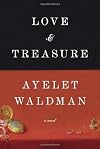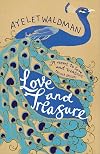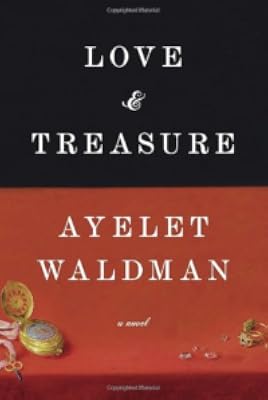
Love and Treasure
by Ayelet Waldman
On This Page
Description
"In 1945 on the outskirts of Salzburg, victorious American soldiers capture a train filled with unspeakable riches: piles of fine gold watches; mountains of fur coats; crates filled with wedding rings, silver picture frames, family heirlooms, and Shabbat candlesticks passed down through generations. Jack Wiseman, a tough, smart New York Jew, is the lieutenant charged with guarding this treasure--a responsibility that grows more complicated when he meets Ilona, a fierce, beautiful Hungarian show more who has lost everything in the ravages of the Holocaust. Seventy years later, amid the shadowy world of art dealers who profit off the sins of previous generations, Jack gives a necklace to his granddaughter, Natalie Stein, and charges her with searching for an unknown woman--a woman whose portrait and fate come to haunt Natalie, a woman whose secret may help Natalie to understand the guilt her grandfather will take to his grave and to find a way out of the mess she has made of her own life" -- show lessTags
Recommendations



Member Reviews
Soon after I’d enjoyed Waldman’s 2009 essay collection, Bad Mother, I heard an interview where she characterized her writing philosophy as not exactly write what you know but write what you want to know. Walking the talk, she then described the genesis of her next writing project -- she'd Googled keywords of topics that interested her: Hungary (she wanted to visit a friend there and liked the excuse of researching a writing project) + the Holocaust (she’s Jewish and hadn’t written about it) + art (she was interested) = a novel about the Hungarian Gold Train at the end of WWII. I was thrilled to learn that she’s seen her idea through to publication as Love and Treasure.
[On the train were] 1,500 cases of watches, jewelry, and show more silver, 5,250 carpets, thousands of coats and stoles and muffs of mink, fox, and ermine, crates of microscopes and cameras, porcelain and glassware, furniture, books and manuscripts and tapestries, gold coins and bullion, the few remaining precious gems, the liturgical objects, the stamp collections and silver-backed hairbrushes, all the items, valuable and less so, that constituted the wealth of the Jews of Hungary, 437,402 of whom had been deported to Auschwitz over the course of just 56 days almost exactly a year before.
A bit like Nicole Krauss’s Great House, this novel is written as a series of novellas linked by a shared item, in this case a jeweled pendant. In the first, the pendant is discovered by an American army officer charged with securing the contents of the Gold Train in 1945 Salzburg amid displaced persons and the aftermath of war. In the second, that officer’s grand-daughter works with a gray-market art dealer in 2013 Budapest to trace ownership of the pendant. And finally, that owner and her life are explored in 1913 Budapest.
I had a couple false starts with this novel; the first section felt wooden and I feared that Waldman’s “Googled” premise wasn’t going to work. But near the end of that section, she captured me and I felt a story begin and then get better and better. She writes well, the material is always intellectually interesting (the aftermath of war, especially regarding Hungarian Jews; art history; feminism and suffrage), and eventually it also becomes emotionally engaging. And enjoyable! -- in the second section there’s a nod to a fairy tale that’s a blatant chuckle between writer and reader, and the third section, narrated by a Freudian analyst, has much amusing satire. And the story is important: in the end, it's clear that the value of the stolen cargo on the Gold Train is insignificant compared with the Holocaust's stolen human potential.
(Review based on an advance reading copy provided by the publisher.) show less
[On the train were] 1,500 cases of watches, jewelry, and show more silver, 5,250 carpets, thousands of coats and stoles and muffs of mink, fox, and ermine, crates of microscopes and cameras, porcelain and glassware, furniture, books and manuscripts and tapestries, gold coins and bullion, the few remaining precious gems, the liturgical objects, the stamp collections and silver-backed hairbrushes, all the items, valuable and less so, that constituted the wealth of the Jews of Hungary, 437,402 of whom had been deported to Auschwitz over the course of just 56 days almost exactly a year before.
A bit like Nicole Krauss’s Great House, this novel is written as a series of novellas linked by a shared item, in this case a jeweled pendant. In the first, the pendant is discovered by an American army officer charged with securing the contents of the Gold Train in 1945 Salzburg amid displaced persons and the aftermath of war. In the second, that officer’s grand-daughter works with a gray-market art dealer in 2013 Budapest to trace ownership of the pendant. And finally, that owner and her life are explored in 1913 Budapest.
I had a couple false starts with this novel; the first section felt wooden and I feared that Waldman’s “Googled” premise wasn’t going to work. But near the end of that section, she captured me and I felt a story begin and then get better and better. She writes well, the material is always intellectually interesting (the aftermath of war, especially regarding Hungarian Jews; art history; feminism and suffrage), and eventually it also becomes emotionally engaging. And enjoyable! -- in the second section there’s a nod to a fairy tale that’s a blatant chuckle between writer and reader, and the third section, narrated by a Freudian analyst, has much amusing satire. And the story is important: in the end, it's clear that the value of the stolen cargo on the Gold Train is insignificant compared with the Holocaust's stolen human potential.
(Review based on an advance reading copy provided by the publisher.) show less
Love and Treasure by Ayelet Waldman is highly recommended for those who enjoy WWII historical fiction based on facts.
Following three different time periods, Love and Treasure opens in the present with a granddaughter, Natalie Stein, caring for her dying grandfather, Jack Wiseman. Then the story jumps back in time, to 1945 at the end of WWII, when then Lt. Jack Wiseman is with the US troops in Austria who seize a train full of treasures that were all originally items confiscated from Hungarian Jews by the Nazis - the so called Hungarian Gold Train. Jack becomes involved with with Ilona, a Holocaust survivor, who eventually breaks his heart and leaves him to go to Palestine. Jack ends up keeping an enamel peacock necklace in remembrance show more of Ilona, but his dying wish is that Natalie returns it to its rightful owner. In the present, Natalie travels to Budapest in hopes of tracking down the rightful owner and discovers the necklace was depicted in a painting, Portrait of Frau E. The last part of Love and Treasure takes another jump back in time to 1913 where we meet Frau E, Nina Schillinger.
Waldman does an exemplary job incorporating history with a richly layered story. The complicated story is told through the perspective of characters based in three different time periods and under very different circumstances. Her characters are finely crafted, multidimensional people, flawed but realistic. She doesn't shy away from some of the less than stellar characteristics of her characters and those around them, like the officers who furnished their quarters with items from the train, or Jack taking the peacock necklace, but Waldman also treats her characters with care and compassion rather than harsh judgement as they try to do the best they can in their circumstances.
This is a perceptive, well written novel that assumes a measure of intelligence on the part of the reader as you follow the three separate stories that combine to make a complete picture of who originally owned the peacock necklace. There is a wonderful sense of time and place captured in the writing of each part of the story, allowing them to separately represent their respective time periods but also making the whole of the story that much richer for the care taken with them.
Disclosure: My Kindle edition was courtesy of Knopf Doubleday for review purposes. show less
Following three different time periods, Love and Treasure opens in the present with a granddaughter, Natalie Stein, caring for her dying grandfather, Jack Wiseman. Then the story jumps back in time, to 1945 at the end of WWII, when then Lt. Jack Wiseman is with the US troops in Austria who seize a train full of treasures that were all originally items confiscated from Hungarian Jews by the Nazis - the so called Hungarian Gold Train. Jack becomes involved with with Ilona, a Holocaust survivor, who eventually breaks his heart and leaves him to go to Palestine. Jack ends up keeping an enamel peacock necklace in remembrance show more of Ilona, but his dying wish is that Natalie returns it to its rightful owner. In the present, Natalie travels to Budapest in hopes of tracking down the rightful owner and discovers the necklace was depicted in a painting, Portrait of Frau E. The last part of Love and Treasure takes another jump back in time to 1913 where we meet Frau E, Nina Schillinger.
Waldman does an exemplary job incorporating history with a richly layered story. The complicated story is told through the perspective of characters based in three different time periods and under very different circumstances. Her characters are finely crafted, multidimensional people, flawed but realistic. She doesn't shy away from some of the less than stellar characteristics of her characters and those around them, like the officers who furnished their quarters with items from the train, or Jack taking the peacock necklace, but Waldman also treats her characters with care and compassion rather than harsh judgement as they try to do the best they can in their circumstances.
This is a perceptive, well written novel that assumes a measure of intelligence on the part of the reader as you follow the three separate stories that combine to make a complete picture of who originally owned the peacock necklace. There is a wonderful sense of time and place captured in the writing of each part of the story, allowing them to separately represent their respective time periods but also making the whole of the story that much richer for the care taken with them.
Disclosure: My Kindle edition was courtesy of Knopf Doubleday for review purposes. show less
This lovely novel opens with a prologue set in 2013, involving elderly Jack Wiseman and his granddaughter Natalie. Her new husband has abandoned her, and she’s just quit her Manhattan attorney’s job to come stay with Jack in Red Hook, Maine, and her beloved grandfather is dying. It’s questionable which of them needs more tender care.
Searching a drawer, Jack runs across a worn black pouch containing a jeweled peacock dangling on a chain. “Whose was it?” Natalie asks, her curiosity aroused. “Well, that’s the thing. I don’t know.” He charges her with the near-impossible task of returning it to its rightful owner, which will require unraveling its history.
The book then reveals how the pendant came into Jack’s hands at show more the close of World War II. It had been one item among thousands and thousands on the Hungarian Gold Train, a 42-car freight train the Germans were using to remove valuables—most of them looted from Hungarian Jews—to Berlin. The train was seized by French troops and finally came under U.S. military control and the contents warehoused in Salzburg, Austria. (The U.S. government kept most details about the Hungarian Gold Train secret for 50 years.)
Items were pilfered from the horde by thieves and the soldiers guarding it; U.S. military commanders used the warehouse as a department store for outfitting their quarters with fine china, silverware, crystal, furniture, and oriental rugs. Jack, in charge of the loot, had to comply with his superiors’ orders and was constantly frustrated at his inability to protect and preserve these treasures, much less return them to their rightful owners. His responsibilities as a soldier and as a Jew are at war within him.
Waldman writes compellingly about Jack’s situation and the treatment of the Displaced Persons flooding Salzburg, many of whom were concentration camp survivors. He meets one, a Hungarian with flame-red hair, Ilona Jakab, and falls in love. Jack keeps the peacock pendant in her memory, but never loses the feeling that taking it was dishonorable.
In her quest to fulfill her grandfather’s charge to find the pendant’s rightful present-day owner, Natalie travels to Budapest and finds much more than she expects. That section of the book is a treasure hunt, a mystery story, and a romance.
The last major section of the book dips back in time to 1913. It’s narrated by a libidinous psychiatrist charged with “treating” Nina S., an early suffragist who wears the pendant, and whom he rapidly concludes is quite sane, just at odds with her repressive father.
Natalie, Ilona, and Nina are interesting, compelling characters in challenging situations. Waldman doesn’t tell a good story once, but three times. Descriptions are vivid, characters’ motivations heartfelt, and conversations witty and spirited. Occasionally, she may be a little heavy-handed, and occasionally a verbal anachronism or clunky love scene sneaks in, but overall, the stories have strong narrative power. I don’t quite understand all the carping about this book in the mainstream media—each reviewer seeming to fixate on some different issue. I found it not only an exploration of conflicting loyalties, identity, and the struggle to be honorable, but also a fascinating historical mystery.
Love & Treasure is certainly timely, given recent renewed attention to the issue of Nazi plunder. The peacock pendant, silent witness to the pain and abuse of history, is the treasure in Waldman’s story, but love is the constant. show less
Searching a drawer, Jack runs across a worn black pouch containing a jeweled peacock dangling on a chain. “Whose was it?” Natalie asks, her curiosity aroused. “Well, that’s the thing. I don’t know.” He charges her with the near-impossible task of returning it to its rightful owner, which will require unraveling its history.
The book then reveals how the pendant came into Jack’s hands at show more the close of World War II. It had been one item among thousands and thousands on the Hungarian Gold Train, a 42-car freight train the Germans were using to remove valuables—most of them looted from Hungarian Jews—to Berlin. The train was seized by French troops and finally came under U.S. military control and the contents warehoused in Salzburg, Austria. (The U.S. government kept most details about the Hungarian Gold Train secret for 50 years.)
Items were pilfered from the horde by thieves and the soldiers guarding it; U.S. military commanders used the warehouse as a department store for outfitting their quarters with fine china, silverware, crystal, furniture, and oriental rugs. Jack, in charge of the loot, had to comply with his superiors’ orders and was constantly frustrated at his inability to protect and preserve these treasures, much less return them to their rightful owners. His responsibilities as a soldier and as a Jew are at war within him.
Waldman writes compellingly about Jack’s situation and the treatment of the Displaced Persons flooding Salzburg, many of whom were concentration camp survivors. He meets one, a Hungarian with flame-red hair, Ilona Jakab, and falls in love. Jack keeps the peacock pendant in her memory, but never loses the feeling that taking it was dishonorable.
In her quest to fulfill her grandfather’s charge to find the pendant’s rightful present-day owner, Natalie travels to Budapest and finds much more than she expects. That section of the book is a treasure hunt, a mystery story, and a romance.
The last major section of the book dips back in time to 1913. It’s narrated by a libidinous psychiatrist charged with “treating” Nina S., an early suffragist who wears the pendant, and whom he rapidly concludes is quite sane, just at odds with her repressive father.
Natalie, Ilona, and Nina are interesting, compelling characters in challenging situations. Waldman doesn’t tell a good story once, but three times. Descriptions are vivid, characters’ motivations heartfelt, and conversations witty and spirited. Occasionally, she may be a little heavy-handed, and occasionally a verbal anachronism or clunky love scene sneaks in, but overall, the stories have strong narrative power. I don’t quite understand all the carping about this book in the mainstream media—each reviewer seeming to fixate on some different issue. I found it not only an exploration of conflicting loyalties, identity, and the struggle to be honorable, but also a fascinating historical mystery.
Love & Treasure is certainly timely, given recent renewed attention to the issue of Nazi plunder. The peacock pendant, silent witness to the pain and abuse of history, is the treasure in Waldman’s story, but love is the constant. show less
When we think of Holocaust books it is rare to see one set in Hungary. This is based on the true Hungarian Gold Train captured by the Allies at the end of the war. The novel is a triptych looking at the impact of the war and the contents of a necklace today, then and earlier in turn of the 20th century Budapest. This earlier part looks at the rise of psychoanalysis, as advertised. However, I found the role of women and the early Progressive Movement absolutely fascinating
As a piece of historical fiction, particularly one that deals with lesser discussed aspects of history related to WWII, this is an impressive book. On the other hand, as a piece of original fiction which simply serves as a worthwhile read in itself, history interests aside, I'm less comfortable recommending it.
My largest concern with the book is that it seems incredibly derivative of The White Hotel, though Waldman's work is far more concerned with art. The structure especially reminds me of Thomas' work, a few large separate parts coming from protagonists and narrators of different genders, backgrounds, interests, and experiences, with Freudian psychology as a centerpiece of one (and coming from the analyst), even though Waldman's work show more is certainly less experimental and sticks to straight prose. Odd as it is, because of that association, the book ended up coming across as formulaic when I reached the third part of the novel where psychology comes in, and I lost considerable interest because of it--and, I suppose I have to say, I lost some amount of respect for the work as well.
As an entertaining read, associations with Thomas aside, there were other issues. Waldman's handle of history and intrigue is admirable, but her writing of romance and familial relationships verged on the sentimental whenever conflict wasn't central to a scene. In fact, the first very short part was so incredibly sentimental that I probably wouldn't have read beyond its brief dozen pages if I hadn't received the book through a first reader program and been expected to write a review. After that first part, the book did pick up, but sentimentality and romance were still serious downfalls within the work, partly because they were simply overly sentimental, and partly because they were just not as well-written as other portions--most portions--of the novel.
And yet. There is material worth admiring here. Waldman's handling of history regarding Hungarian Jews in the aftermath of World War II, and Hungarian women in the years preceding World War I, is graceful and clever, as is the intricate way in which she connected numerous sub-plots and characters across a full century of time. For the most part, the book is well-written, if occasionally over-written (a good example being the first part, which I think the book would be stronger without).
In the end, I don't see myself recommending this book on to any but readers specifically interested in aspects of history dealt with in the novel, such as Hungarian Jews, the Gold Train, and/or the state of Hungary directly following World War II. I truly wanted to like this book, and I'm sure I would have liked it more had I not read and appreciated D.M. Thomas' The White Hotel in the past...but, of course, I did read that work, and the associations are impossible to ignore. show less
My largest concern with the book is that it seems incredibly derivative of The White Hotel, though Waldman's work is far more concerned with art. The structure especially reminds me of Thomas' work, a few large separate parts coming from protagonists and narrators of different genders, backgrounds, interests, and experiences, with Freudian psychology as a centerpiece of one (and coming from the analyst), even though Waldman's work show more is certainly less experimental and sticks to straight prose. Odd as it is, because of that association, the book ended up coming across as formulaic when I reached the third part of the novel where psychology comes in, and I lost considerable interest because of it--and, I suppose I have to say, I lost some amount of respect for the work as well.
As an entertaining read, associations with Thomas aside, there were other issues. Waldman's handle of history and intrigue is admirable, but her writing of romance and familial relationships verged on the sentimental whenever conflict wasn't central to a scene. In fact, the first very short part was so incredibly sentimental that I probably wouldn't have read beyond its brief dozen pages if I hadn't received the book through a first reader program and been expected to write a review. After that first part, the book did pick up, but sentimentality and romance were still serious downfalls within the work, partly because they were simply overly sentimental, and partly because they were just not as well-written as other portions--most portions--of the novel.
And yet. There is material worth admiring here. Waldman's handling of history regarding Hungarian Jews in the aftermath of World War II, and Hungarian women in the years preceding World War I, is graceful and clever, as is the intricate way in which she connected numerous sub-plots and characters across a full century of time. For the most part, the book is well-written, if occasionally over-written (a good example being the first part, which I think the book would be stronger without).
In the end, I don't see myself recommending this book on to any but readers specifically interested in aspects of history dealt with in the novel, such as Hungarian Jews, the Gold Train, and/or the state of Hungary directly following World War II. I truly wanted to like this book, and I'm sure I would have liked it more had I not read and appreciated D.M. Thomas' The White Hotel in the past...but, of course, I did read that work, and the associations are impossible to ignore. show less
An astonishing and surprising story of a special piece of jewelery and the lives it affected throughout it's long journey. After World War II, Lieutenant Jack Wiseman is charged to examine and organize the contents of the Hungarian Gold Train. Filled with the items that made up the lives of Hungary's Jewish population, Jack is left to sift through thousands of dishes, linens, watches, candlesticks and jewelery, hoping that it will find it's way back to the families or any living heirs of the people it once belonged to. Jack meets Ilona, recently released from a concentration camp and is intrigued by her strength and determination. As he attempts to find any of Ilona's belongings among the Gold Train, he comes across a unique peacock show more locket that originated from Ilona's home town of Nagyvarad. Years later, shortly before his death, Jack charges his granddaughter, Natalie to find an ancestor of the owner of his pilfered locket and return it to them.
I found this novel absolutely engaging, heartfelt and bittersweet. It was difficult for me to get my feelings written down for this one, since they were all over the place. Ayelet Waldman has created a band a characters that are real and with raw emotions and actions that made this story resonate within me. Though told from several different points of view, Jack's character is seen through several different points in his life and his quest to return the items from the Gold Train, no matter how feeble a venture it may seems, never waivers.
" 'You guard so conscientiously that treasure train. And for whom?' For the Jews of Hungary, Jack wished he could reply. But of course by now he feared that was no more than the vaguest and most unlikely of hopes."
Bravely, Love and Treasure not only deals with the thieving from the Gold Train and the poor treatment of those liberated from the concentration camps, but through another set of absorbing characters the women's suffrage movement in Budapest is explored, as well as common medical treatment for women's ailments at the time. Nina and Gizella were awe-inspiring; their story adds richness and even more mystery to the peacock necklace. The necklace as a character itself ties the stories of these distinct characters together and I thoroughly enjoyed the the tale it divulged as I learned it's story. I love learning about history through fiction, and Love and Treasure brought to light parts of the past that have long been swept under the rug. show less
I found this novel absolutely engaging, heartfelt and bittersweet. It was difficult for me to get my feelings written down for this one, since they were all over the place. Ayelet Waldman has created a band a characters that are real and with raw emotions and actions that made this story resonate within me. Though told from several different points of view, Jack's character is seen through several different points in his life and his quest to return the items from the Gold Train, no matter how feeble a venture it may seems, never waivers.
" 'You guard so conscientiously that treasure train. And for whom?' For the Jews of Hungary, Jack wished he could reply. But of course by now he feared that was no more than the vaguest and most unlikely of hopes."
Bravely, Love and Treasure not only deals with the thieving from the Gold Train and the poor treatment of those liberated from the concentration camps, but through another set of absorbing characters the women's suffrage movement in Budapest is explored, as well as common medical treatment for women's ailments at the time. Nina and Gizella were awe-inspiring; their story adds richness and even more mystery to the peacock necklace. The necklace as a character itself ties the stories of these distinct characters together and I thoroughly enjoyed the the tale it divulged as I learned it's story. I love learning about history through fiction, and Love and Treasure brought to light parts of the past that have long been swept under the rug. show less
A solid 3-1/2 stars. I found the first two parts engaging and the dialogue believable. I wanted to keep reading. The last part while probably true to the norms of the day fell flat and was tedious and ultimately felt completely engineered. Despite my disappointment with this last part I think the author left enough questions unanswered that I kept wondering about the characters whose stories were unfinished. I keep thinking about the humanism, ethics, morality or perhaps the lack thereof and the justifications that were proffered. The few sentences offering redemption are going to require more questioning and pondering.
Members
- Recently Added By
Lists

Book Riot's 100 must-read works of Jewish Fiction
100 works; 8 members

Judaism & Israel
104 works; 2 members

Folio Prize 2015 Longlist
79 works; 2 members
Author Information

23+ Works 4,369 Members
Ayelet Waldman was born on December 11, 1964. She graduated from Wesleyan University in 1986 and from Harvard Law School in 1991. Before becoming a full-time writer, she worked at a New York law firm and as a federal public defender in California. She is the author of the Mommy-Track Mysteries series, Daughter's Keeper, Love and Other Impossible show more Pursuits, and Red Hook Road. In her essay Motherlove, which was published in Because I Said So: 33 Mothers Write about Children, Sex, Men, Aging, Faith, Race and Themselves, Waldman admitted that she loves her husband more than her children. Her book Bad Mother was written as a result of the negative reaction to her essay. She and Michael Chabon are co-editors of, Kingdom of Olives and Ash: Writers Confront the Occupation. (Bowker Author Biography) show less
Some Editions
Awards and Honors
Distinctions
Series
Belongs to Publisher Series
Common Knowledge
- Original publication date
- 2014
- Dedication
- To Michael, only and always.
- First words
- Jack Wiseman, immersed as ever in the pages of a book, did not notice the arrival of the bus until alerted by the stir among the other people waiging in the overheated station lounge.
- Last words
- (Click to show. Warning: May contain spoilers.)A more impulsive man might have flung the pendant into the briny filth of the East River. Jack returned it to his pocket and walked home.
- Blurbers
- Ondaatje, Michael; Oates, Joyce Carol; Handler, Daniel; Gregory, Philippa
Classifications
Statistics
- Members
- 353
- Popularity
- 89,731
- Reviews
- 21
- Rating
- (3.67)
- Languages
- English, French, Italian, Portuguese
- Media
- Paper, Audiobook, Ebook
- ISBNs
- 18
- ASINs
- 5