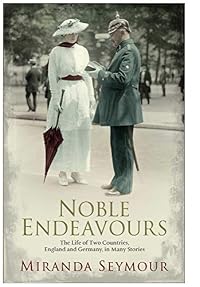
Noble Endeavours: The Life of Two Countries, England and Germany, in Many Stories
by Miranda Seymour
On This Page
Description
In 1613, a beautiful Stuart princess married a handsome young German prince. This was a love match, but it was also an alliance that aimed to meld Europe's two great Protestant powers. Before Elizabeth and Frederick left London for the court in Heidelberg, they watched a performance of The Winter's Tale. In 1943, a group of British POWs gave a performance of that same play to a group of enthusiastic Nazi guards in Bavaria. Nothing about the story of England and Germany, as this remarkable show more book demonstrates, is as simple as we might expect. Miranda Seymour tells the forgotten story of England's centuries of profound connection and increasingly rivalrous friendship with Germany, linked by a shared faith, a shared hunger for power, a shared culture (Germany never doubted that Shakespeare belonged to them, as much as to England), and a shared leadership. German monarchs ruled over England for three hundred years--and only ceased to do so through a change of name. This extraordinary and heart-breaking history--told through the lives of princes and painters, soldiers and sailors, bakers and bankers, charlatans and saints--traces two countries so entwined that one German living in England in 1915 refused to choose where his allegiance lay. It was, he said, as if his parents had quarreled. Germany's connection to the island it loved, patronized, influenced, and fought was unique. Indeed, British soldiers went to war in 1914 against a country to which many of them--as one freely confessed the week before his death on the battlefront--felt more closely connected than to their own. Drawing on a wealth of unpublished papers and personal interviews, the author has uncovered stories that remind us--poignantly, wittily, and tragically--of the powerful bonds many have chosen to forget. show lessTags
Recommendations






















Member Reviews
Here is history of a love affair between Germany and Britain that became a troubled marriage after many centuries with all the passion, anger, tragedy and humour of star-crossed lovers just aching to be reunited. It begins with the marriage of Elizabeth Stuart (the Winter Queen or Queen of Hearts) to the Elector Palatine in February 1613. This union between the Thames and Rhine was celebrated by her father James VI and I with court performances of The Winter's Tale and The Tempest.
Thereafter the histories of the two countries were constantly woven together with Hanoverian monarchs inheriting the British throne and artists, musicians, writers, bankers, industrialists and ordinary people following their example of merging two countries show more and cultures. George Eliot and G.H. Lewes eloped together and spent their unofficial honeymoon in Weimar – she spoke execrable German but wrote it perfectly. The stories told here are stained with the terror and cruelties of war. Families were pulled apart with the Great War and divided loyalties one member declaring: 'I feel as if my mother and father have quarrelled.' For Nazi POWs in Scotland, one man worked hard ensure that they took 'part in the reconciliation of all people and the maintenance of peace.' The Jewish interpreter, who had fought for Britain, Herbert Sulzbach, as Miranda Syemour writes 'never stopped working for reconciliation between England and Germany, the two countries he loved.'
Despite the agony and heartbreak of the Second World War, the stories of compassion, forgiveness and love are what remain with this reader and that this is a union, albeit rather worn and grumpy, should continue and be as happy, and hopefully far more successful, as that as the love-match between Elizabeth and Frederick of Bohemia. show less
Thereafter the histories of the two countries were constantly woven together with Hanoverian monarchs inheriting the British throne and artists, musicians, writers, bankers, industrialists and ordinary people following their example of merging two countries show more and cultures. George Eliot and G.H. Lewes eloped together and spent their unofficial honeymoon in Weimar – she spoke execrable German but wrote it perfectly. The stories told here are stained with the terror and cruelties of war. Families were pulled apart with the Great War and divided loyalties one member declaring: 'I feel as if my mother and father have quarrelled.' For Nazi POWs in Scotland, one man worked hard ensure that they took 'part in the reconciliation of all people and the maintenance of peace.' The Jewish interpreter, who had fought for Britain, Herbert Sulzbach, as Miranda Syemour writes 'never stopped working for reconciliation between England and Germany, the two countries he loved.'
Despite the agony and heartbreak of the Second World War, the stories of compassion, forgiveness and love are what remain with this reader and that this is a union, albeit rather worn and grumpy, should continue and be as happy, and hopefully far more successful, as that as the love-match between Elizabeth and Frederick of Bohemia. show less
Victoria’s offspring, in peace and war
The Pity of War: England and Germany, Bitter Friends, Beloved Foes by Miranda Seymour (Rowman & Littlefield Publishers, $32).
Sometimes, it’s easy to forget that most of the heads of state during World War I—which began a mere century ago—were related. Queen Victoria, only recently passed, was called “the grandmother of Europe,” but her funeral in 1901 brought together powers—including her son, Britain’s Edward VIII, and her eldest grandson, Kaiser Wilhelm II—who would soon be at each other’s throats.
But Miranda Seymour’s examination of the relationship between Britain and Germany, The Pity of War: England and Germany, Bitter Friends, Beloved Foes, goes further, detailing just show more how complex and long the tugs of war and love have been between the two states. Seymour uses narratives of individual lives, both royal and common, to show how closely tied the two nations are; the term “Anglo-Saxon” goes back to the fifth century, when the first merging of the peoples occurred.
The bottom line is that all people are related to each other, though nationalism and tribalism often prevent us from seeing that. Seymour’s work makes clear that the differences between the English and the Germans are superficial and recent; perhaps recognizing our relationships can help us avoid more internecine war.
Reviewed on Lit/Rant: www.litrant.tumblr.com show less
The Pity of War: England and Germany, Bitter Friends, Beloved Foes by Miranda Seymour (Rowman & Littlefield Publishers, $32).
Sometimes, it’s easy to forget that most of the heads of state during World War I—which began a mere century ago—were related. Queen Victoria, only recently passed, was called “the grandmother of Europe,” but her funeral in 1901 brought together powers—including her son, Britain’s Edward VIII, and her eldest grandson, Kaiser Wilhelm II—who would soon be at each other’s throats.
But Miranda Seymour’s examination of the relationship between Britain and Germany, The Pity of War: England and Germany, Bitter Friends, Beloved Foes, goes further, detailing just show more how complex and long the tugs of war and love have been between the two states. Seymour uses narratives of individual lives, both royal and common, to show how closely tied the two nations are; the term “Anglo-Saxon” goes back to the fifth century, when the first merging of the peoples occurred.
The bottom line is that all people are related to each other, though nationalism and tribalism often prevent us from seeing that. Seymour’s work makes clear that the differences between the English and the Germans are superficial and recent; perhaps recognizing our relationships can help us avoid more internecine war.
Reviewed on Lit/Rant: www.litrant.tumblr.com show less
England and Germany have been both close allies and bitter enemies over the past two hundred years. In this book Seymour looks at the parallel histories of two great nations through the lives of a series of interesting and sometimes outrageous characters whose stories encompass this relationship.
I thoroughly enjoyed this book because although the history was known, the experiences made it seem so much more grounded in reality. In particular the sufferings of the German nationals during the Second World War and the antics of the naive youth of the 1930s who visited Germany and became entranced by Hitler.
Little vignettes of extraordinary lives bring history alive!
I thoroughly enjoyed this book because although the history was known, the experiences made it seem so much more grounded in reality. In particular the sufferings of the German nationals during the Second World War and the antics of the naive youth of the 1930s who visited Germany and became entranced by Hitler.
Little vignettes of extraordinary lives bring history alive!
"The life of two countries (England and Germany) in many stories" is an apt sub-title for this book by Miranda Seymour which is rich in anecdotes.
In talking about the relationship between England and Germany, the author set out originally to write about the years between the two world wars, but found herself drawn to a much earlier history with an extraordinary cast of characters from both countries, including Prince Pueckler-Muskau and Lucie, Theodor Fontane, Sir Edward Goschen, Prince Lichnowsky, Margot Asquith, Daisy Pless and Hansel, Tisa Schulenburg, Hubert Herkomer and James Boswell.
We, the readers, are treated to anecdotes about all of these and many other people who influenced and were affected by the relationship between the show more two countries.
Miranda Seymour's book contains new material and surprises on nearly every page. I enjoyed it, and I'm sure that anyone else who is interested in the English view of Germany and the German view of England would come away with a wealth of new knowledge from reading it. show less
In talking about the relationship between England and Germany, the author set out originally to write about the years between the two world wars, but found herself drawn to a much earlier history with an extraordinary cast of characters from both countries, including Prince Pueckler-Muskau and Lucie, Theodor Fontane, Sir Edward Goschen, Prince Lichnowsky, Margot Asquith, Daisy Pless and Hansel, Tisa Schulenburg, Hubert Herkomer and James Boswell.
We, the readers, are treated to anecdotes about all of these and many other people who influenced and were affected by the relationship between the show more two countries.
Miranda Seymour's book contains new material and surprises on nearly every page. I enjoyed it, and I'm sure that anyone else who is interested in the English view of Germany and the German view of England would come away with a wealth of new knowledge from reading it. show less
A lot of history, a lot of interesting people.
The about this book is that I liked some of the chapters and some not so much. The problem I had with some chapters is that the writing style was too much at once. It seemed like the author wanted to put in a lot of information and by doing that she jumped from one interesting person to another one and to another one and to another one, and then back to the first one.
So with those chapters I would have wanted less and more. Less people, and more information about the people in the book. I am like that, I always want more and here there were not enough.
Ok to the chapters I liked then, they were more fleshed out but I would have wanted even more. As I said there are A LOT of people mentioned show more in this book and some interesting ones were about Queen Victoria and her children. And the Winter Queen.
For the historical non-fiction lover this is a true treasure. 300 years of history between Germany and England. A lot of people that were new to me, some I did not know a lot about and all the rest. And they sure wanted to better the relationship between the countries. show less
The about this book is that I liked some of the chapters and some not so much. The problem I had with some chapters is that the writing style was too much at once. It seemed like the author wanted to put in a lot of information and by doing that she jumped from one interesting person to another one and to another one and to another one, and then back to the first one.
So with those chapters I would have wanted less and more. Less people, and more information about the people in the book. I am like that, I always want more and here there were not enough.
Ok to the chapters I liked then, they were more fleshed out but I would have wanted even more. As I said there are A LOT of people mentioned show more in this book and some interesting ones were about Queen Victoria and her children. And the Winter Queen.
For the historical non-fiction lover this is a true treasure. 300 years of history between Germany and England. A lot of people that were new to me, some I did not know a lot about and all the rest. And they sure wanted to better the relationship between the countries. show less
History of Anglo-German relations, told through the stories of individual families
Ratings
Members
- Recently Added By
Author Information

27+ Works 1,246 Members
Miranda Seymour is the author of many acclaimed and bestselling works of fiction and nonfiction, including biographies of Mary Shelley, Robert Graves, Henry James, and, most recently, the pioneer French racing driver Helle Nice. She lives in England.
Common Knowledge
- Original title
- Noble Endeavours: The Life of Two Countries, England and Germany, in Many Stories (UK) (UK); The Pity of War: England and Germany, Bitter Friends, Beloved Foes (USA) (USA)
- Important events*
- Erster Weltkrieg (1914-1918); Zweiter Weltkrieg (1939-1945)
*Some information comes from Common Knowledge in other languages. Click "Edit" for more information.
Classifications
- Genres
- History, Nonfiction, Politics and Government, General Nonfiction
- DDC/MDS
- 327.41043 — Society, government, & culture Political science International Relations: Spies Europe British Isles with Europe
- LCC
- DA47.2 .S496 — History of Europe, Asia, Africa and Oceania Great Britain History of Great Britain England History Political, military, naval, and Air Force history.
- BISAC
Statistics
- Members
- 49
- Popularity
- 602,093
- Reviews
- 6
- Rating
- (3.57)
- Languages
- English
- Media
- Paper, Ebook
- ISBNs
- 6
- ASINs
- 2