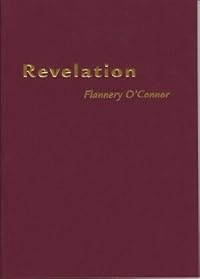
Revelation
by Flannery O'Connor 
On This Page
Tags
Member Reviews
It’s easy to Ms. (n) Turpin: Here's the reveal, no spoilage, stubborn southern lady laments to piggies after surreal episode; some see vision as her coming into the light, others see it for fraulein's fraudulent mind or still not there yet spirituality (for sure). It took me a while (revelation!), but here's the kicker: It's biblical but not so much Revelation as much as Gospels. Even while first reading, I knew it had to tie to casting the legions to the pigs (and I was so so hoping literally so). Well what we have here is a lady with multiple multiple demons (legions), a slightly confusing or confused exorcism: the ugly girl, but consider how many early christians considered Jesus ugly to ordinary at best and isn’t the truth as show more they say ugly, who cleverly cleverly refers to Ms. Turpins demonhood as warthog worthy, and now we're off to the races. Time warp, Ms. T can’t wait to unload her demons vis a vis her “clean” piggies (which she makes sure of first, supersoaker reassurance) in a ‘pigstye’. So this “vision” is actually the reality of her prejudices in their best Sunday suits riding off into the sunset. One could hardly expect such “vision” to be commendable, contrariwise, likely to be quite awful, but isn’t awfulness awfully well concealed in some so called holiness. Whether these internal “demons” will be permanently exorcised is doubtful, but not the concluding subject of her story. So in fact, the subject returns, materially unaffected, to her, similarly unaltered, southern landscape and culture. Pigs fed for a day. show less
7/10
I've struggled with O'Connor's work: while she is an exceptional story teller, she also strikes me as an unrepentant racist, which -- to say the very least -- makes me deeply, deeply uncomfortable. Within the last decade, papers and letters have come to light which allow that perhaps some of us were not so wrong in considering her a racist.
I've had the same struggle, most recently, in reading through Hemingway's stories: there I bristled at his unkindness; here, I've become a veritable porcupine, and I may have to reconsider her value as a writer. To be made uncomfortable is one thing; to feel that she held these as the strength of her convictions, is ugly to the extreme. (It would certainly bear further research into the primary show more documents, for those who have the time, and inclination.)
Something to keep in mind when reading O'Connor.
O’Connor is now as canonical as Faulkner and Welty. More than a great writer, she’s a cultural figure: a funny lady in a straw hat, puttering among peacocks, on crutches she likened to “flying buttresses.” The farmhouse is open for tours; her visage is on a stamp. A recent book of previously unpublished correspondence, “Good Things Out of Nazareth” (Convergent), and a documentary, “Flannery: The Storied Life of the Writer from Georgia,” suggest a completed arc, situating her at the literary center where she might have been all along.
The arc is not complete, however. Those letters and postcards she sent home from the North in 1943 were made available to scholars only in 2014, and they show O’Connor as a bigoted young woman. In Massachusetts, she was disturbed by the presence of an African-American student in her cousin’s class; in Manhattan, she sat between her two cousins on the subway lest she have to sit next to people of color. The sight of white students and black students at Columbia sitting side by side and using the same rest rooms repulsed her.
It’s not fair to judge a writer by her juvenilia. But, as she developed into a keenly self-aware writer, the habit of bigotry persisted in her letters—in jokes, asides, and a steady use of the word “nigger.” For half a century, the particulars have been held close by executors, smoothed over by editors, and justified by exegetes, as if to save O’Connor from herself. Unlike, say, the struggle over Philip Larkin, whose coarse, chauvinistic letters are at odds with his lapidary poetry, it’s not about protecting the work from the author; it’s about protecting an author who is now as beloved as her stories.
from
"How Racist Was Flannery O'Connor?" by Paul Elie, in The New Yorker, June 15, 2020.
https://www.newyorker.com/magazine/2020/06/22/how-racist-was-flannery-oconnor show less
I've struggled with O'Connor's work: while she is an exceptional story teller, she also strikes me as an unrepentant racist, which -- to say the very least -- makes me deeply, deeply uncomfortable. Within the last decade, papers and letters have come to light which allow that perhaps some of us were not so wrong in considering her a racist.
I've had the same struggle, most recently, in reading through Hemingway's stories: there I bristled at his unkindness; here, I've become a veritable porcupine, and I may have to reconsider her value as a writer. To be made uncomfortable is one thing; to feel that she held these as the strength of her convictions, is ugly to the extreme. (It would certainly bear further research into the primary show more documents, for those who have the time, and inclination.)
Something to keep in mind when reading O'Connor.
O’Connor is now as canonical as Faulkner and Welty. More than a great writer, she’s a cultural figure: a funny lady in a straw hat, puttering among peacocks, on crutches she likened to “flying buttresses.” The farmhouse is open for tours; her visage is on a stamp. A recent book of previously unpublished correspondence, “Good Things Out of Nazareth” (Convergent), and a documentary, “Flannery: The Storied Life of the Writer from Georgia,” suggest a completed arc, situating her at the literary center where she might have been all along.
The arc is not complete, however. Those letters and postcards she sent home from the North in 1943 were made available to scholars only in 2014, and they show O’Connor as a bigoted young woman. In Massachusetts, she was disturbed by the presence of an African-American student in her cousin’s class; in Manhattan, she sat between her two cousins on the subway lest she have to sit next to people of color. The sight of white students and black students at Columbia sitting side by side and using the same rest rooms repulsed her.
It’s not fair to judge a writer by her juvenilia. But, as she developed into a keenly self-aware writer, the habit of bigotry persisted in her letters—in jokes, asides, and a steady use of the word “nigger.” For half a century, the particulars have been held close by executors, smoothed over by editors, and justified by exegetes, as if to save O’Connor from herself. Unlike, say, the struggle over Philip Larkin, whose coarse, chauvinistic letters are at odds with his lapidary poetry, it’s not about protecting the work from the author; it’s about protecting an author who is now as beloved as her stories.
from
"How Racist Was Flannery O'Connor?" by Paul Elie, in The New Yorker, June 15, 2020.
https://www.newyorker.com/magazine/2020/06/22/how-racist-was-flannery-oconnor show less
Ratings
Members
- Recently Added By
Lists

Favourite Short Stories
153 works; 9 members
Author Information

181+ Works 29,975 Members
Flannery O'Connor was born in Savannah, Georgia. She had a quiet, bookish life as a child before attending Georgia State College for Women and going on tot he Writers Workshop at the State University of Iowa, where she earned a Master of Fine Arts degree. Her 1949 dissertation consisted of six short stories, one of which she developed into her show more first novel, Wise Blood (1952). Wise Blood is the story of a fanatical, wandering preacher who sets out to found a "church of truth without Jesus Christ crucified." The book introduces some of the religious themes that run throughout O'Connor's later work. Her second novel, The Violent Bear It Away (1960), is the story of murder involving a Tennessee backwoods preacher and a small boy. Once again, O'Connor explores unusual manifestation of religion and human eccentricities. Although O'Connor produced only a small body of work during her relatively brief lifetime, she has received much critical attention. O'Connor suffered from lupus, an inherited disease, which crippled her and cut short her life, and so her creative work was largely compressed within a decade of the 1950's. Her father also dies of Lupus when she was 15 years old. O'Connor is frequently praised as being the most creative and distinctive writer of this period. The two most notable aspects of her fiction are its religious themes and its commentary on the oppressive traditions of the mid-twentieth-century Deep South. (Bowker Author Biography) show less
Flannery O'Connor has a Legacy Library. Legacy libraries are the personal libraries of famous readers, entered by LibraryThing members from the Legacy Libraries group.
Work Relationships
Common Knowledge
- People/Characters
- Mrs. Turpin; Claud Turpin; Mary Grace
Classifications
Statistics
- Members
- 11
- Popularity
- 2,004,691
- Reviews
- 2
- Rating
- (3.00)
- Media
- Paper
- ASINs
- 1