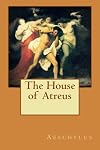
The House of Atreus
by Aeschylus
On This Page
Description
The House of Atreus, adapted by John Lewin was first published in 1966. Minnesota Archive Editions uses digital technology to make long-unavailable books once again accessible, and are published unaltered from the original University of Minnesota Press editions. This adaptation of the classic Greek trilogy is designed for contemporary stage presentation and is the version to be used by the Minnesota Theatre Company or its production of the work at the Tyrone Guthrie Theatre in Minneapolis. show more The volume provides the texts of the three plays, Agamemnon, The Libation Bearers, and The Furies, and, in. show lessTags
Recommendations
























Member Reviews
When I was very young, I was taken to some sort of open house at the Guthrie Theatre in Minneapolis, at which they discussed how they staged plays. One of the most frequently-mentioned was "The House of Atreus" -- the only one described in sufficiently vivid detail that I can still remember them talking about it. I was so young that I thought the "House" was an actual house, not a name for the sons and grandsons of Atreus, but I definitely came away with the impression that it was a really scary place.
I had that part right, because "The House of Atreus" is a translation, or perhaps one should say a re-imagining, of Aeschylus's Oresteia, the only Greek dramatic trilogy to survive to this day -- and perhaps the first true examination of show more what justice ought to mean. This rendering is definitely not a literal version; the title "The House of Atreus" was suggested by Sir Tyrone Guthrie to distinguish it from a more faithful Oresteia, and translator John Lewin admits that "this version is not a faithful and reverent subordination of the adapter's imagination to the letter of the original." He allows the "inescapable question... is it Aeschylus?"
In one sense, it is not. SItting down with the Loeb edition of Aeschylus makes it clear that Lewin's text often is not a direct translation of the Greek. Some of his changes have been suggested by sources; some are his alone. It is paraphrased, occasionally expanded, often shortened, and occasionally flat-out rewritten.
And yet, the purpose of drama is to be dramatic. The Oresteia is the first great work of drama in history. If you want to know exactly what it says, you read it, you don't enact it. To feel it, it has to be brought forward to today -- and, because it is so important a work, it's really important that people be willing to come and see the result. It seems to me that Lewin has succeeded. This adaption allowed the trilogy to be performed on a single stage in a single day. I never saw "The House of Atreus" played, but the translation is clear -- and if a six year old boy could come away scared just from a description of it, then it must have been a dramatic success indeed. show less
I had that part right, because "The House of Atreus" is a translation, or perhaps one should say a re-imagining, of Aeschylus's Oresteia, the only Greek dramatic trilogy to survive to this day -- and perhaps the first true examination of show more what justice ought to mean. This rendering is definitely not a literal version; the title "The House of Atreus" was suggested by Sir Tyrone Guthrie to distinguish it from a more faithful Oresteia, and translator John Lewin admits that "this version is not a faithful and reverent subordination of the adapter's imagination to the letter of the original." He allows the "inescapable question... is it Aeschylus?"
In one sense, it is not. SItting down with the Loeb edition of Aeschylus makes it clear that Lewin's text often is not a direct translation of the Greek. Some of his changes have been suggested by sources; some are his alone. It is paraphrased, occasionally expanded, often shortened, and occasionally flat-out rewritten.
And yet, the purpose of drama is to be dramatic. The Oresteia is the first great work of drama in history. If you want to know exactly what it says, you read it, you don't enact it. To feel it, it has to be brought forward to today -- and, because it is so important a work, it's really important that people be willing to come and see the result. It seems to me that Lewin has succeeded. This adaption allowed the trilogy to be performed on a single stage in a single day. I never saw "The House of Atreus" played, but the translation is clear -- and if a six year old boy could come away scared just from a description of it, then it must have been a dramatic success indeed. show less
Ratings
Members
- Recently Added By
Lists

Recommended Reading : 600 Classics Reviewed, Editors of Salem Press, 2015
634 works; 6 members

Which house?
423 works; 16 members
Author Information

319+ Works 22,960 Members
Aeschylus was born at Eleusis of a noble family. He fought at the Battle of Marathon (490 b.c.), where a small Greek band heroically defeated the invading Persians. At the time of his death in Sicily, Athens was in its golden age. In all of his extant works, his intense love of Greece and Athens finds expression. Of the nearly 90 plays attributed show more to him, only 7 survive. These are The Persians (produced in 472 b.c.), Seven against Thebes (467 b.c.), The Oresteia (458 b.c.)---which includes Agamemnon, Libation Bearers, and Eumenides (or Furies) --- Suppliants (463 b.c.), and Prometheus Bound (c.460 b.c.). Six of the seven present mythological stories. The ornate language creates a mood of tragedy and reinforces the already stylized character of the Greek theater. Aeschylus called his prodigious output "dry scraps from Homer's banquet," because his plots and solemn language are derived from the epic poet. But a more accurate summation of Aeschylus would emphasize his grandeur of mind and spirit and the tragic dignity of his language. Because of his patriotism and belief in divine providence, there is a profound moral order to his plays. Characters such as Clytemnestra, Orestes, and Prometheus personify a great passion or principle. As individuals they conflict with divine will, but, ultimately, justice prevails. Aeschylus's introduction of the second actor made real theater possible, because the two could address each other and act several roles. His successors imitated his costumes, dances, spectacular effects, long descriptions, choral refrains, invocations, and dialogue. Swinburne's (see Vol. 1) enthusiasm for The Oresteia sums up all praises of Aeschylus; he called it simply "the greatest achievement of the human mind." Because of his great achievements, Aeschylus might be considered the "father of tragedy." (Bowker Author Biography) show less
Some Editions
Common Knowledge
- Canonical title
- The House of Atreus
- Original publication date
- c. 524 – c. 455 B.C.E.
- Quotations
- Death is a gentler lord than tyranny.
Classifications
- Genre
- Fiction and Literature
- DDC/MDS
- 882.01 — Literature & rhetoric Classical & modern Greek literatures Classical Greek dramatic poetry and drama standard subdivisions; collections; history, description, critical appraisal; Specific periods Ancient period to ca. 499
- LCC
- PA3827 .A7 .L4 — Language and Literature Greek language and literature. Latin language and literature Greek literature Individual authors Aeschylus
- BISAC
Statistics
- Members
- 48
- Popularity
- 627,134
- Reviews
- 1
- Rating
- (4.21)
- Languages
- English
- Media
- Paper, Ebook
- ISBNs
- 19
- ASINs
- 5