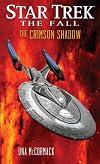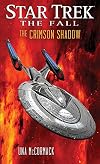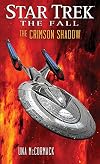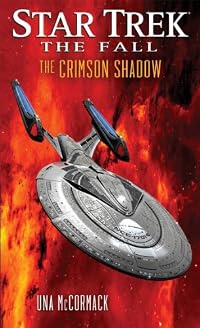
The Fall: The Crimson Shadow
by Una McCormack 
Star Trek: The Fall (2), Star Trek Relaunch (Book 76) (Chronological Order), Star Trek (novels) (2013.09), Star Trek (2013.09)
On This Page
Description
Cardassia Prime is home to a prideful people who, for centuries, forged alliances with those they believed would strengthen them and their place in the Alpha Quadrant, and expanded their empire at great cost to other worlds. For generations, dissenting voices were silenced by either fear or an early grave. When their wartime ally, the Dominion, suddenly turned on them, seeking to transform Cardassia into a tomb for every last member of their race, their old adversary the United Federation of show more Planets put an end to the carnage, and even now works to help rebuild Cardassia Prime. To celebrate this alliance, the Castellan of the Cardassian Union is to welcome the Federation president to Cardassia Prime. As a symbol of this deepening friendship, the U.S.S. Enterprise E is tasked to carry the Cardassian ambassador to the Federation back home. For his part, Ambassador Elim Garak is working with Captain Jean-Luc Picard to oversee the diplomatic reception that will commemorate the last of Starfleets personnel finally leaving the homeworld. However, there are malevolent forces at work, who even now strive to restore Cardassia to its proper place and glory, and are willing to do anything to achieve their goal. show lessTags
Recommendations







Member Reviews
"Make Cardassia great again!"
If this sentence is ever actually uttered in The Crimson Shadow, I missed it; the back cover uses "restore Cardassia to its proper place and glory" which seem a bit unwieldy for a baseball cap. Despite being published in 2013, the book has clear echoes (pre-echoes?) of populist movements like Brexit and Trumpism: a yearning for a better past which was actually not better than the present. Institutions designed for democracy are being co-opted for undemocratic purposes. It would be depressing if it wasn't for the fact that Una McCormack is able to see a way out of it all, but more on that in a bit.
Just as Revelation and Dust was a Deep Space Nine novel de facto if not de jure, The Crimson Shadow has the show more Enterprise-E on the cover, and thus seems to be a Next Generation novel de facto. But like a lot of McCormack books, it actually feels like a novel, not a pale reflection of a tv episode. One of the things I really like about her approach is that she picks and chooses her viewpoint characters based on thematic relevance-- every character who we spend time with doesn't just advance the plot, but the ideas of the novel. This means several Enterprise characters don't really appear; the novel gives us the ones we need for the story being told: Picard, Šmrhová, and (in what turns out to be a great surprise, so don't read on if you mind spoilers) Glinn Dygan. On the other hand, we also get a significant storyline featuring Arati Mhevet, a senior investigator in the Cardassian constabulary. And, of course, Elim Garak. Together these characters create a tapestry of post-Dominion Cardassia, and a story about how to behave ethically in the face of institutional pressures to do otherwise.
I really liked Mhevet. She's a cop in the new postwar Cardassian constabulary, one that tries to be answerable to the people-- not to the interests of power like prewar Cardassian institutions. But though she does her best, her complacency and short-sightedness do her in at first before her investigations kick into gear. I really liked every scene featuring her as she tries to navigate what is the right thing to do in some tricky situations where she is the only person trying to do right at all. But even when it seems like it's just her against the planet, she sees things through.
There's a scene featuring her and Garak near the end that brings the whole novel into focus:
Folding his hands around hers, he [Garak] gave her a steady, sky-blue look. "But you understand, don't you, that the institutions don't matter? The Obsidian Order, Central Command, the True Way, Starfleet, empires, unions, federations-- these are names and names only. They are tools. They count for nothing if the purpose is flawed. That was mistake for a long time-- confusing the purpose with the instrument. It took me a long time to learn the truth."
"What is the truth?"
"The truth?" Garak laughed, softly, as if he had never imagined that he would be asked such a question. "The truth is that the institution flourishes only when the people who comprise it flourish. And if the people are sick, the institution will be sick." He squeezed her hand. "If there's anything I could teach you, I'd teach you that."
"I think I knew that. But I became complacent, or frightened, or something.... Whatever it was, I held myself back from what was going on."
"Yes," he said, nodding, "that was your mistake, Arati. But it doesn't stop, you understand? It doesn't ever stop. We can never hold ourselves back." (267)
Ostensibly this is about Mhevet, but it is also the idea underpinning the strands about Picard and Šmrhová. Cardassia is on the verge of seeing the Federation withdraw whenPresident Bacco is assassinated over in Revelation and Dust, and the new interim Federation president is a Bajoran who is less kindly disposed toward Cardassia. He gives some orders that will cause harm to the planet and its standing: and Picard and Šmrhová both have to find ways to do good within an institution that inhibits their ability to do it. Šmrhová has been a regular character since Destiny, but like with Bowers in McCormack's Brinkmanship, this was the first time I felt she had a personality, as she takes the action she thinks is right-- violating a presidential order-- and in doing so saves the day. There's a great scene between her and Dygan at the end. Dygan is a serious young man, prone to overthinking everything. He has to participate in some awful stuff here, but he and Šmrhová find solace in each other: her being the Starfleet officer who doesn't think, and knows when to bend the rules, him being the career Cardassian officer who learned to know when his institutions were leading him astray.
This is Una McCormack, so on top of all this thematic richness, there's of course Garak and Cardassia. McCormack does a great job of threading the needle with both of those, making them recognizable yet evolved at the same time. I loved a scene where a bunch of Cardassians get discomfited by the idea of peacefully rally. A bunch of people freely stating their opinions in public!? This is a proud people but a stubborn people, too; they are weighed down by their past instead of empowered by it. I also thought McCormack did a good job with the politics of it all, especially in the way Castellan Garan gets pushed into an untenable position.
And yeah, Garak. His letters (picking up from A Stitch in Time) are a constant delight, as is his dialogue. McCormack nails his voice; the idea that he had a long-term friendship with Bacco is a great one, as is the way Garak expresses so much of himself through the discussion of literature. (Garak loving Austen isn't a thing I would have expected but it makes so much sense as soon as you are told it.) She even makes the idea of Garak becoming leader of Cardassia plausible! Well, kinda. I buy it from a character perspective; I don't quite buy that Cardassia would vote for a former Obsidian Order agent. But I think this will open up interesting avenues in the future, and I look forward to seeing its ramifications in future books.
Like I said, this is a book that anticipated Brexit and Trumpism. But it also anticipated a way out: Cardassia cannot be made "great again" through its institutions. But it can be made great if its people are great, as long as a rose grows in the ruins and someone is willing to speak truth to power. This book is a moving, meaningful celebration of the Cardassian (and human) ability to stop, to say what must be done, and in doing so change both one's self and the world
Continuity Notes:
If this sentence is ever actually uttered in The Crimson Shadow, I missed it; the back cover uses "restore Cardassia to its proper place and glory" which seem a bit unwieldy for a baseball cap. Despite being published in 2013, the book has clear echoes (pre-echoes?) of populist movements like Brexit and Trumpism: a yearning for a better past which was actually not better than the present. Institutions designed for democracy are being co-opted for undemocratic purposes. It would be depressing if it wasn't for the fact that Una McCormack is able to see a way out of it all, but more on that in a bit.
Just as Revelation and Dust was a Deep Space Nine novel de facto if not de jure, The Crimson Shadow has the show more Enterprise-E on the cover, and thus seems to be a Next Generation novel de facto. But like a lot of McCormack books, it actually feels like a novel, not a pale reflection of a tv episode. One of the things I really like about her approach is that she picks and chooses her viewpoint characters based on thematic relevance-- every character who we spend time with doesn't just advance the plot, but the ideas of the novel. This means several Enterprise characters don't really appear; the novel gives us the ones we need for the story being told: Picard, Šmrhová, and (in what turns out to be a great surprise, so don't read on if you mind spoilers) Glinn Dygan. On the other hand, we also get a significant storyline featuring Arati Mhevet, a senior investigator in the Cardassian constabulary. And, of course, Elim Garak. Together these characters create a tapestry of post-Dominion Cardassia, and a story about how to behave ethically in the face of institutional pressures to do otherwise.
I really liked Mhevet. She's a cop in the new postwar Cardassian constabulary, one that tries to be answerable to the people-- not to the interests of power like prewar Cardassian institutions. But though she does her best, her complacency and short-sightedness do her in at first before her investigations kick into gear. I really liked every scene featuring her as she tries to navigate what is the right thing to do in some tricky situations where she is the only person trying to do right at all. But even when it seems like it's just her against the planet, she sees things through.
There's a scene featuring her and Garak near the end that brings the whole novel into focus:
Folding his hands around hers, he [Garak] gave her a steady, sky-blue look. "But you understand, don't you, that the institutions don't matter? The Obsidian Order, Central Command, the True Way, Starfleet, empires, unions, federations-- these are names and names only. They are tools. They count for nothing if the purpose is flawed. That was mistake for a long time-- confusing the purpose with the instrument. It took me a long time to learn the truth."
"What is the truth?"
"The truth?" Garak laughed, softly, as if he had never imagined that he would be asked such a question. "The truth is that the institution flourishes only when the people who comprise it flourish. And if the people are sick, the institution will be sick." He squeezed her hand. "If there's anything I could teach you, I'd teach you that."
"I think I knew that. But I became complacent, or frightened, or something.... Whatever it was, I held myself back from what was going on."
"Yes," he said, nodding, "that was your mistake, Arati. But it doesn't stop, you understand? It doesn't ever stop. We can never hold ourselves back." (267)
Ostensibly this is about Mhevet, but it is also the idea underpinning the strands about Picard and Šmrhová. Cardassia is on the verge of seeing the Federation withdraw when
This is Una McCormack, so on top of all this thematic richness, there's of course Garak and Cardassia. McCormack does a great job of threading the needle with both of those, making them recognizable yet evolved at the same time. I loved a scene where a bunch of Cardassians get discomfited by the idea of peacefully rally. A bunch of people freely stating their opinions in public!? This is a proud people but a stubborn people, too; they are weighed down by their past instead of empowered by it. I also thought McCormack did a good job with the politics of it all, especially in the way Castellan Garan gets pushed into an untenable position.
And yeah, Garak. His letters (picking up from A Stitch in Time) are a constant delight, as is his dialogue. McCormack nails his voice; the idea that he had a long-term friendship with Bacco is a great one, as is the way Garak expresses so much of himself through the discussion of literature. (Garak loving Austen isn't a thing I would have expected but it makes so much sense as soon as you are told it.) She even makes the idea of Garak becoming leader of Cardassia plausible! Well, kinda. I buy it from a character perspective; I don't quite buy that Cardassia would vote for a former Obsidian Order agent. But I think this will open up interesting avenues in the future, and I look forward to seeing its ramifications in future books.
Like I said, this is a book that anticipated Brexit and Trumpism. But it also anticipated a way out: Cardassia cannot be made "great again" through its institutions. But it can be made great if its people are great, as long as a rose grows in the ruins and someone is willing to speak truth to power. This book is a moving, meaningful celebration of the Cardassian (and human) ability to stop, to say what must be done, and in doing so change both one's self and the world
Continuity Notes:
- It's not the fault of the book, but my memory of postwar Cardassian history was a bit fuzzy. Specifically, I hadn't realized that "The Calling" from Prophecy and Change had been pinned down chronologically (by The Never-Ending Sacrifice? or maybe A Singular Destiny, going by Memory Beta). That means Alon Ghemor is dead, succeeded by Raken Garan as castellan of the Cardassian Union. And I barely remember The Lotus Flower at all, which is referenced a few times. I did piece it all together eventually.
- If my sums are right, Garak was Cardassian ambassador to the Federation for more than seven years. It's weird to think he would have lived on Earth longer than he lived on Deep Space 9!* But in this case, I do believe it; Garak has been changed by his time on Earth in a way that was not true of O'Brien's time on Cardassia in Revelation and Dust.
- Damar and Dukat had no first names on screen; the fiction has dubbed them Corat Damar and Skrain Dukat, respectively. I get why prose needs to do this, but I always find it a bit jarring. (Plus I hate "Skrain.") What particularly jars here is that every time Damar is mentioned (and he's mentioned at a lot, having become a postwar hero for his resistance to the Dominioin), he's called "Corat Damar." Corat Damar this, Corat Damar that. We got through four years of him on tv without his first name being mentioned, but here we can't go four minutes!
- There are just a lot of nice little touches in this book. The little kid informant with a voracious appetite that Mhevet rescues is one of them; I enjoyed how Šmrhová was punished by Picard with babysitting duty, and how the girl insists she needs to eat breakfast with "the nice old man." And a part where seeing this girl in mortal danger causes Picard to text Crusher to hug René for him was a nice touch, too.
- There is a great bit of comedy where Garak complains that unlike Picard, Sisko would have let him overthrow a democratically elected leader. I would have loved to have seen Patrick Stewart and Andrew Robinson play some of these scenes on screen.
- The thing about how coffee has become so popular on Cardassia is great, as is what its unavailability symbolizes.
- Picard gifts Garak a copy of The Master and Margarita, a book I own but have not yet got around to reading. I must do so!
- I didn't find a place to mention it in the main body of my review, but man can McCormack write. Above and beyond any other working Star Trek writer, her prose has a real sense of voice. I love those scenes where she does something like move outside of the generic third-person limited perspective that dominates Star Trek fiction, especially when she also plays with tense. The end of Part One, where we get a summation of where everyone is at the moment Picard finds out
Nan Bacco is dead (pp. 118-21), for example, is powerful.
This is the kind of undemanding read that's ideal for those times when you're waiting for a delayed flight in an airport—but the picture of Cardassian politics in general, and the manoeuvrings of Elim Garak in particular, that it presented was a little too straightforward for me to really buy.
If you're a fan of Garak from Deep Space Nine, you'll really enjoy this book. I'm a big fan of this character and really liked it. The only thing keeping it from 5 stars for me was the secondary story, which actually became the primary story for a large part of the book, revolving around the murder of a Starfleet officer on Cardassia. While there needed to be 'something' to bring certain players into light, I felt that this story dominated more than it should have and actually took away from the book a little bit.
I'm also a little confused by the whole "The Fall" story arc of novels so far. This one, I thought, would revolve more around the TNG characters, based on the blurb on the back cover and the fact that the Enterprise is on the show more cover. In fact, though, Garak is the principle character in the book. show less
I'm also a little confused by the whole "The Fall" story arc of novels so far. This one, I thought, would revolve more around the TNG characters, based on the blurb on the back cover and the fact that the Enterprise is on the show more cover. In fact, though, Garak is the principle character in the book. show less
Overlapping the 1st book of the Fall in time. This is told from the point of view of Cardassia. I always loved Garak, so it was great to get so much of him and his thoughts. Garak writes to Dr. Bashier. Some letters are not sent, which reveal much more than he could say any other way.
Good story
I enjoyed this story. I need to finish watching DS9. Maybe then I will understand this more. Looking forward to the next one.
I enjoyed this story. I need to finish watching DS9. Maybe then I will understand this more. Looking forward to the next one.
Excellent! I want read more by Una!
Ratings
Members
- Recently Added By
Lists

Star Trek: The Typhon Pact and Beyond
33 works; 1 member
Author Information

62+ Works 3,566 Members
Una McCormack is a LibraryThing Author, an author who lists their personal library on LibraryThing.
Series


Common Knowledge
- Canonical title
- The Fall: The Crimson Shadow
- People/Characters
- Elim Garak; Jean-Luc Picard; Rakena Garan; Worf; Arati Mhevet; Ravel Dygan
- Important places
- Cardassia Prime
- First words
- My dear Doctor,
I was sorry not to see you on your last trip home, but by all accounts it was a hasty visit, and my own availability was also sadly limited at the time.
Classifications
Statistics
- Members
- 175
- Popularity
- 186,218
- Reviews
- 6
- Rating
- (4.16)
- Languages
- English, German
- Media
- Paper, Ebook
- ISBNs
- 5
- ASINs
- 4