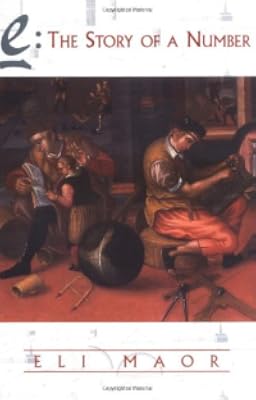
e: The Story of a Number
by Eli Maor
On This Page
Description
The interest earned on a bank account, the arrangement of seeds in a sunflower, and the shape of the Gateway Arch in St. Louis are all intimately connected with the mysterious number e. In this informal and engaging history, Eli Maor portrays the curious characters and the elegant mathematics that lie behind the number. Designed for a reader with only a modest mathematical background, this biography brings out the central importance of e to mathematics and illuminates a golden era in the age show more of science. show lessTags
Recommendations









Member Reviews
Il pi greco lo conoscono tutti o quasi; ma non è il solo numero "molto interessante" per i matematici. Secondo a ben poca distanza c'è infatti il numero e, che vale circa 2,718 e appare anch'esso nei punti più diversi della matematica; dal calcolo dell'area sotto un'iperbole a quello degli interessi composti, dai logaritmi alle funzioni trigonometriche. Nella sua bella collana a basso prezzo che recupera varie opere di storia della matematica, la Princeton University Press ha recuperato questo testo dedicato per l'appunto a e. Il libro è scritto molto bene; richiede qualche competenza matematica ma risulta facilmente leggibile e interessante. La parte storica è molto completa che parte dalla nascita dei logaritmi, con divagazioni show more all'indietro verso Archimede e i problemi della quadratura, per arrivare alla scoperta della trascendenza del numero. I concetti vengono spiegati in maniera molto chiara, oserei dire meglio che quanto viene fatto a scuola da noi. Naturalmente ci sono anche divagazioni su altri numeri famosi, π e i prima di tutti; d'altra parte tutti questi numeri sono (stranamente?) correlati tra loro... show less
I doubt this book appeals to readers with 'modest background in mathematics' as the cover promises. 'e' is the base of the natural logarithm. I vaguely recalled that e was the only number that was its own derivative. This book is at its best describing the discovery of 'e', and its historical import.
As a non-mathematician I had to skip the most complicated moments, but still appreciated the overall story.
As a non-mathematician I had to skip the most complicated moments, but still appreciated the overall story.
Too. Much. Calculus. I was hoping this would be more like [b:The Golden Ratio: The Story of Phi, the World's Most Astonishing Number|24081|The Golden Ratio The Story of Phi, the World's Most Astonishing Number|Mario Livio|https://images.gr-assets.com/books/1428317462s/24081.jpg|1787138], but it wasn't. For one thing, this book has differential equations. A lot of them. As a STEM major, I did study calculus at the university level (but not Dif Eq), but this was still hard going. What really helped get me through the book were the historical anecdotes, and the parts of the book I was able to follow well were also well-done.
Reading this book had me wondering about the mystical properties of numbers, whether there was some elemental truth I could discover. Overall, the book was an enjoyable and illuminating examination of e, and a solid retelling of e's importance in the development of trigonometry.
This book has been very satisfying for me to read so far since I have enough background to understand the math fairly easily, but at the same time the topics are unfamiliar to me.
Detailed Review:
Preface: The author explains his interest in e, identifies himself as a person born long enough ago that he had to make practical use of log tables, and as someone born in Israel.
1. John Napier, 1614
Napier's log tables take over the world! This was a lot history and the math didn't make sense to me. I didn't dig in very deeply, because Napier's logs are now obsolete. They were a revolution, though. There is a basic explanation of the general idea of doing multiplication with logarithms. Then follows a discussion of the fact that in Napier's day show more fractional exponents were unknown and unused and so his choice of base was dictated by this problem: that the powers must change rather slowly wrt. to their integer exponents so that the number must be close to 1 and also the extreme difficulty of manual computation. This makes me think of Babbage, eager to solve the problem of the construction of log tables. Euler's definitions of logarithms, which is not the same as Napier's, is now the canonical one.
2. Recognition
Logarithms are loved and the slide rule and its many cousins are invented, used, and made obsolete by the hand held calculator.
* Computing with Logarithms
A worked example of computation using log tables.
3. Financial Matters
e = the value you would get in a year if you invested a dollar at 100% interested compounded continually = (1 + 1/n)^n.
4. To the Limit: If it Exists
We have problems figuring out the limit, and must do close analysis, if two values tend in the opposite direction. These are the so called "indeterminate forms". We can expand (1 + 1/n)^n using the binomial theorem (Maor does not derive the binomial theorem). It is expanded to 1 + n * 1/n + n (n - 1)/2! * (1/n)^2 + n(n - 1)(n-2)/3! * (1/n)^3 + ... + (1/n)^n. This can be simplified to 1 + n * 1/n + (1 - 1/n)/2! + (1 - 1/n)(1-2/n)/3! + ... + 1/n^n. We want the limit as n approaches inf. That's 1/0! + 1/1! + 1/2! + .... Note how we ignore the last term in the previous expression because n is going to infinity and so there is no last term. This is a good way to compute e because it converges very fast.
* Some Curious Numbers Related to e
A grab bag. Maybe I'll go back to them later.
5. Forefathers of the Calculus
Squaring the circle in Egypt. A circle of diameter d has the same area as a square of side 8/9d. Run the numbers and pi is 256/81, which isn't too bad an approximation. Archimedes pursues the method of exhaustion. The Greeks were a little hindered by their strong inclination toward geometry rather than algebra. They had no x, and they specified line segments via their endpoints. The Greeks did not like the concept of infinity and Archimedes avoided it. The method of exhaustion had an ad-hoc quality to it, it required ingenuity.
6. Prelude to Breakthrough
In the 1500s Francois Viete wrote down an infinite product. Others followed suit and in the 1600 James Gregory wrote down an interesting infinite series. Kepler works with indivisibles, sometimes for practical purposes as in his "New Solid Geometry of Wine Barrels".
* Indivisibles at Work
A discussion of finding the area under the graph of the function f(x) = x^2 from 0 to a by means of the method of indivisibles. Chop the x axis into equal lengths of infinite smallness, d. Intervals are d, 2d, 3d, etc. f(d) = d^2, f(2d) = (2d)^2, etc. Therefore, area is d[d^2 + (2d)^2 + ... + (nd)^2]. But this can be simplified by taking out d, so we get d^3[1 + 2^2 + ... _ n^2]. But there's a formula for the sum of a sequence of squares, so this is: (1 + 1/n)(2 + 1/n)(nd)^3/6. But nd = a, so (1 + 1/n)(2 + 1/n)a^3/6. Now there is no indeterminacy, so as n goes to infinity we get 1*2*a^3/6 = a^3/6. This is obviously correct by the calculus, but we need to know how to find the sum of this series of squares, so it wasn't exactly automatic. show less
Detailed Review:
Preface: The author explains his interest in e, identifies himself as a person born long enough ago that he had to make practical use of log tables, and as someone born in Israel.
1. John Napier, 1614
Napier's log tables take over the world! This was a lot history and the math didn't make sense to me. I didn't dig in very deeply, because Napier's logs are now obsolete. They were a revolution, though. There is a basic explanation of the general idea of doing multiplication with logarithms. Then follows a discussion of the fact that in Napier's day show more fractional exponents were unknown and unused and so his choice of base was dictated by this problem: that the powers must change rather slowly wrt. to their integer exponents so that the number must be close to 1 and also the extreme difficulty of manual computation. This makes me think of Babbage, eager to solve the problem of the construction of log tables. Euler's definitions of logarithms, which is not the same as Napier's, is now the canonical one.
2. Recognition
Logarithms are loved and the slide rule and its many cousins are invented, used, and made obsolete by the hand held calculator.
* Computing with Logarithms
A worked example of computation using log tables.
3. Financial Matters
e = the value you would get in a year if you invested a dollar at 100% interested compounded continually = (1 + 1/n)^n.
4. To the Limit: If it Exists
We have problems figuring out the limit, and must do close analysis, if two values tend in the opposite direction. These are the so called "indeterminate forms". We can expand (1 + 1/n)^n using the binomial theorem (Maor does not derive the binomial theorem). It is expanded to 1 + n * 1/n + n (n - 1)/2! * (1/n)^2 + n(n - 1)(n-2)/3! * (1/n)^3 + ... + (1/n)^n. This can be simplified to 1 + n * 1/n + (1 - 1/n)/2! + (1 - 1/n)(1-2/n)/3! + ... + 1/n^n. We want the limit as n approaches inf. That's 1/0! + 1/1! + 1/2! + .... Note how we ignore the last term in the previous expression because n is going to infinity and so there is no last term. This is a good way to compute e because it converges very fast.
* Some Curious Numbers Related to e
A grab bag. Maybe I'll go back to them later.
5. Forefathers of the Calculus
Squaring the circle in Egypt. A circle of diameter d has the same area as a square of side 8/9d. Run the numbers and pi is 256/81, which isn't too bad an approximation. Archimedes pursues the method of exhaustion. The Greeks were a little hindered by their strong inclination toward geometry rather than algebra. They had no x, and they specified line segments via their endpoints. The Greeks did not like the concept of infinity and Archimedes avoided it. The method of exhaustion had an ad-hoc quality to it, it required ingenuity.
6. Prelude to Breakthrough
In the 1500s Francois Viete wrote down an infinite product. Others followed suit and in the 1600 James Gregory wrote down an interesting infinite series. Kepler works with indivisibles, sometimes for practical purposes as in his "New Solid Geometry of Wine Barrels".
* Indivisibles at Work
A discussion of finding the area under the graph of the function f(x) = x^2 from 0 to a by means of the method of indivisibles. Chop the x axis into equal lengths of infinite smallness, d. Intervals are d, 2d, 3d, etc. f(d) = d^2, f(2d) = (2d)^2, etc. Therefore, area is d[d^2 + (2d)^2 + ... + (nd)^2]. But this can be simplified by taking out d, so we get d^3[1 + 2^2 + ... _ n^2]. But there's a formula for the sum of a sequence of squares, so this is: (1 + 1/n)(2 + 1/n)(nd)^3/6. But nd = a, so (1 + 1/n)(2 + 1/n)a^3/6. Now there is no indeterminacy, so as n goes to infinity we get 1*2*a^3/6 = a^3/6. This is obviously correct by the calculus, but we need to know how to find the sum of this series of squares, so it wasn't exactly automatic. show less
Like its more famous cousin pi, e is an irrational number that shows up in unexpected places all over mathematics. It also has a much more recent history, not appearing on the scene until the 16th century. My favorite parts of this book were the historical anecdotes such as the competitive Bernoullis and the Nerwton-Leibniz cross-Channel calculus feud. Unfortunately, this math history text is much heavier on the math than the history, including detailed descriptions of limits, derivatives, integrals, and imaginary numbers. The trouble with this large number of equationsis that if you’re already familiar with the concepts you’ll be doing a lot of skimming, but if the subject is confusing then reading this book will probably not give show more you any new insights. In short, as much as I normally enjoy books about math and science, this particular one felt too much like a textbook. Recommended only for those folks with a very strong love for the calculus and related topics. show less
This is one of the books that had many interesting sections, not enough to read the whole of it, but still worthwhile to have dipped into here and there. It may be worth another try some day.
Members
- Recently Added By
Lists

HS Mathematics class library
79 works; 6 members

One Letter Titles
31 works; 4 members

In Our Time books
4,934 works; 2 members
Author Information

10 Works 2,270 Members
Eli Maor is a teacher of the history of mathematics who has successfully popularized his subject with the general public through a series of informative and entertaining books. In "E: The Story of a Number," Maor uses anecdotes, excursions and essays to illustrate that number's importance to mathematics. "Trigonometric Delights" brings show more trigonometry to life by blending history, biography, scientific curiosities and mathematics to achieve the goal of showing how trigonometry has contributed to both science and social development. "To Infinity and Beyond: A Cultural History of the Infinite" explores the idea of infinity in mathematics and art through the use of the illustrations of the Dutch artist M.C. Escher. Eli Maor's readable books have made the world of numbers accessible even to those with little or no background in mathematics. (Bowker Author Biography) show less
Awards and Honors
Awards
Series
Belongs to Publisher Series
Common Knowledge
- Canonical title
- e: The Story of a Number
- Original publication date
- 1994
- Dedication
- In memory of my parents, Richard and Luise Metzger
- First words
- Rarely in the history of science has an abstract mathematical idea been received more enthusiastically by the entire scientific community than the invention of logarithms.
- Last words
- (Click to show. Warning: May contain spoilers.)I let the reader decide.
- Blurbers
- Stewart, Ian; King, Jerry P.; Borwein, Peter
Classifications
Statistics
- Members
- 1,093
- Popularity
- 23,333
- Reviews
- 12
- Rating
- (3.69)
- Languages
- English, German, Korean, Portuguese
- Media
- Paper, Ebook
- ISBNs
- 13
- ASINs
- 8