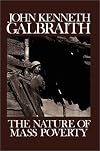
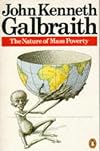
The Nature of Mass Poverty
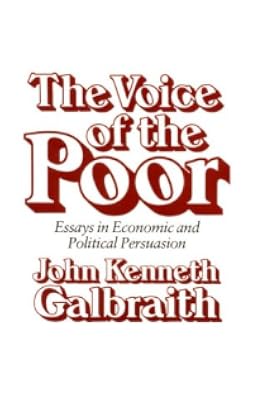
by John Kenneth Galbraith
On This Page
Description
Originally given as lectures at the Graduate Institute of International Studies, University of Geneva and at Radcliffe Institute.Tags
Recommendations





















Member Reviews
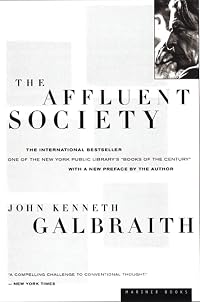
This is an old book, really, and the author by now dead (in 2006, at age 97). But it is more interesting to review than The Affluent Society, or The New Industrial State, which I also read with pleasure, in their time.
My impression now, after relentless economic polarization has taken hold in the USA and most industrialized countries, perhaps with computers making businessmen look smarter and the general populace look dumber, is that Galbraith saw too much difference between mass poverty in India (where he had been ambassador), and "exceptional" poverty in the USA. Frances Fox Piven doesn't describe American poverty that way. Besides, the picture has changed in India, as one can gather from the very discreet report of Nobel Prize winner show more V.S. Naipaul: India - A million mutinies now, and other hints like Indian call centres serving American consumers. Still, Galbraith was a friendly fighter, ahead of his time, even if to some people's concern not very conformist in his personal life. show less
My impression now, after relentless economic polarization has taken hold in the USA and most industrialized countries, perhaps with computers making businessmen look smarter and the general populace look dumber, is that Galbraith saw too much difference between mass poverty in India (where he had been ambassador), and "exceptional" poverty in the USA. Frances Fox Piven doesn't describe American poverty that way. Besides, the picture has changed in India, as one can gather from the very discreet report of Nobel Prize winner show more V.S. Naipaul: India - A million mutinies now, and other hints like Indian call centres serving American consumers. Still, Galbraith was a friendly fighter, ahead of his time, even if to some people's concern not very conformist in his personal life. show less
Eigenzinnige opvattingen van een eminent econoom. John Kenneth Galbraith was fameus in zijn vakgebied. Publicatie uit 1979, 14 bij 21 cm, 135 blz, harde kaft, goede staat. Verzendkosten inbegrepen. Boek van Hessel dus met garantie : Niet wat U verwachtte? Boek terug, geen kosten. Meer boeken in een bestelling? Lagere verzendkosten voor U. Trefw.  : studieboeken, economie
Sep 25, 2011Dutch
Abandonat
May 19, 2020Catalan
Ratings
Members
- Recently Added By
Author Information

77+ Works 11,282 Members
John Kenneth Galbraith is a Canadian-born American economist who is perhaps the most widely read economist in the world. He taught at Harvard from 1934-1939 and then again from 1949-1975. An adviser to President John F. Kennedy, he served from 1961 to 1963 as U.S. ambassador to India. His style and wit in writing and his frequent media appearances show more have contributed greatly to his fame as an economist. Galbraith believes that it is not sufficient for government to manage the level of effective demand; government must manage the market itself. Galbraith stated in American Capitalism (1952) that the market is far from competitive, and governments and labor unions must serve as "countervailing power." He believes that ultimately "producer sovereignty" takes the place of consumer sovereignty and the producer - not the consumer - becomes ruler of the marketplace. (Bowker Author Biography) John Kenneth Galbraith, born in 1908, is the Paul M. Warburg Professor of Economics Emeritus at Harvard University and a past president of both the American Academy of Arts and Letters and the American Economic Association. He is the author of thirty-one books spanning five decades. He has received honorary degrees from, among others, Harvard University, Oxford University, the University of Paris, the University of Toronto, and Moscow State University. He is Commandeur de la Legion d'Honneur in France, and in 1997 he was inducted into the Order of Canada. In 2000, at a White House ceremony, he was given the Presidential Medal of Freedom. He lives in Cambridge, Massachusetts. (Publisher Provided) show less
Classifications
Statistics
- Members
- 93
- Popularity
- 346,948
- Reviews
- 3
- Rating
- (3.25)
- Languages
- 5 — Dutch, English, German, Italian, Spanish
- Media
- Paper, Ebook
- ISBNs
- 12
- ASINs
- 2