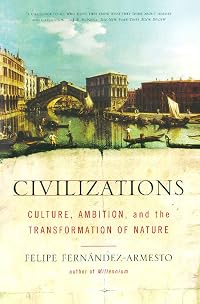
Civilizations : Culture, Ambition, and the Transformation of Nature
by Felipe Fernández-Armesto
On This Page
Description
Erudite, wide-ranging, a work of dazzling scholarship written with extraordinary flair, Civilizations redefines the subject that has fascinated historians from Thucydides to Gibbon to Spengler to Fernand Braudel: the nature of civilization. To the author, Oxford historian Felipe Fernandez-Armesto, a society's relationship to climate, geography, and ecology are paramount in determining its degree of success. "Unlike previous attempts to write the comparative history of civilizations," he show more writes, "it is arranged environment by environment, rather than. By. Or society by society." Thus, for example, tundra civilizations of Ice Age Europe are linked with those of the Inuit of the Pacific Northwest, the Mississippi Mound Builders with the deforesters of 11th-century Europe. Civilizations brilliantly connects the world of ecologist, geologist, and geographer with the panorama of cultural history. - Back cover. show lessTags
Recommendations





















Member Reviews
The subtitle for Felipe Fernandez-Armesto's amazing book references culture, ambition and nature. These ideas are all central to his history of civilizations, but as he states near the end of the book it is a "book of places". That is an overriding theme that is underscored by the many diverse civilizations that he discusses. Thus the book is a history of civilizations, not one civilization; and it is also about the power and ambition of mankind that he uses to tame geography, ecology, climate and other animals to form cities. Although, the author argues in his introduction that cities are not a necessary condition of civilization no matter how frequently they have been associated with the rise of civilization in history. Like all show more history the book presents an empirical argument with examples of civilizations from grasslands and forests, arid and rain-filled climates, highlands and ocean-based areas. It is a tribute to the intelligence and adaptability of man that civilizations can be found in places as disparate as the Andes and the Aegean; the Euphrates and post-glacial European forests; the Indus, Yellow, and Yangtze rivers of Asia; and other places. The result of Civilizations wide-ranging, through time and geography, ruminations and revelations is a book that is informative and thoughtful. Undoubtedly controversial at times, it is an exciting read for anyone interested in the ability of man to create and mold the world into civilizations. show less
Published just after the Millennium as a sort of popular pot boiler, no doubt making excellent use of material derived from editing various Times' historical atlases and his research on his own 'Millennium', the idea behind Fernandez-Armesto's book has some experimental merit.
What the Argentian-born academic tries to do is to limit the chronological bias of history by exploring what civilisation means in terms of human mastery of the environment.
There is a dull introduction for fellow-professionals which the author implies we can freely skip and a speculative final chapter that seems already overtaken by events but the remaining 450 pages of this blockbuster contain a great deal of material that will probably be as new to you as it was show more to me.
The book has to become much more conventional as he moves towards the story of Greece and Rome and then on to the creation and dominance of what he calls Atlantic civilisation but, even here, there are important insights.
His critique of slavery abolitionism is devastating and depressingly true and he reports back on the 1997 500th anniversary academic investigation into Vasco da Gama in a way that suggests that its findings have partially helped to underpin his book.
What we can learn from history is not so much how to predict the future - this is impossible - but how our modern decisions are often wrong because we have not understood what happened in the past (or, equally likely, are in denial of that past).
Even now, in the slavery case, we have eager beaver idealists in the NGOs and amongst the Christian evangelicals causing similar harms on the 'victims' because of their idealistic commitment to issues of 'principle'.
Overall, I like his conservative but humane approach to history as a complex system where good and bad things arise from each other, mostly beyond the control of anyone, rather than a story of inevitable or automatic progress and individual heroism.
What progress there is is incremental and derived from blind luck and necessity as much as any other factors. The mythologies of inevitability and superiority arising from a 'win' in 'life's race' are suggested throughout to be false.
The judgments of the early modern and modern era are mostly sound if necessarily selective in scope. But a book on civilisations that appears to entirely neglect the globalising inter-ocean power of the British Empire in the nineteenth century and over-emphasises the power of the United States since then has to be considered slightly flawed.
As a result, the British Raj is scarcely alluded to (nor the parallel trek across the world of the French) and Australia arises very late and in passing as part of the putative Pacific World where (I think) the author's predictions are too much of the time of his writing.
But the meat of the book - easily two thirds of the whole - is filled with insights on cultures and civilisation that are usually neglected in Western school rooms, covering almost every conceivable human environment excluding space and deep sea exploration (which have not constructed true civilisations as yet).
Here are just some of the peoples that Fernandez-Arnesto introduced to me and which had me searching for more information on Wikipedia - the biarmians, the orang laut, the kutchi, the garamantes, the dawada and the mapuche as well as, more anciently, the hagarites.
Alternatively, you might try looking up some very obscure but interesting kingdoms - Funan, Shatrunjaya, Srivijaya, Rozwi, Mwene Mutapa or the Maroon Kingdoms such as Palmares.
Overall, not a bad entertainment and an excellent guide to how sensible history should be written - conversationally, contingently and evidence-based with a critical attitude to the stories we tell ourselves in the dark. show less
What the Argentian-born academic tries to do is to limit the chronological bias of history by exploring what civilisation means in terms of human mastery of the environment.
There is a dull introduction for fellow-professionals which the author implies we can freely skip and a speculative final chapter that seems already overtaken by events but the remaining 450 pages of this blockbuster contain a great deal of material that will probably be as new to you as it was show more to me.
The book has to become much more conventional as he moves towards the story of Greece and Rome and then on to the creation and dominance of what he calls Atlantic civilisation but, even here, there are important insights.
His critique of slavery abolitionism is devastating and depressingly true and he reports back on the 1997 500th anniversary academic investigation into Vasco da Gama in a way that suggests that its findings have partially helped to underpin his book.
What we can learn from history is not so much how to predict the future - this is impossible - but how our modern decisions are often wrong because we have not understood what happened in the past (or, equally likely, are in denial of that past).
Even now, in the slavery case, we have eager beaver idealists in the NGOs and amongst the Christian evangelicals causing similar harms on the 'victims' because of their idealistic commitment to issues of 'principle'.
Overall, I like his conservative but humane approach to history as a complex system where good and bad things arise from each other, mostly beyond the control of anyone, rather than a story of inevitable or automatic progress and individual heroism.
What progress there is is incremental and derived from blind luck and necessity as much as any other factors. The mythologies of inevitability and superiority arising from a 'win' in 'life's race' are suggested throughout to be false.
The judgments of the early modern and modern era are mostly sound if necessarily selective in scope. But a book on civilisations that appears to entirely neglect the globalising inter-ocean power of the British Empire in the nineteenth century and over-emphasises the power of the United States since then has to be considered slightly flawed.
As a result, the British Raj is scarcely alluded to (nor the parallel trek across the world of the French) and Australia arises very late and in passing as part of the putative Pacific World where (I think) the author's predictions are too much of the time of his writing.
But the meat of the book - easily two thirds of the whole - is filled with insights on cultures and civilisation that are usually neglected in Western school rooms, covering almost every conceivable human environment excluding space and deep sea exploration (which have not constructed true civilisations as yet).
Here are just some of the peoples that Fernandez-Arnesto introduced to me and which had me searching for more information on Wikipedia - the biarmians, the orang laut, the kutchi, the garamantes, the dawada and the mapuche as well as, more anciently, the hagarites.
Alternatively, you might try looking up some very obscure but interesting kingdoms - Funan, Shatrunjaya, Srivijaya, Rozwi, Mwene Mutapa or the Maroon Kingdoms such as Palmares.
Overall, not a bad entertainment and an excellent guide to how sensible history should be written - conversationally, contingently and evidence-based with a critical attitude to the stories we tell ourselves in the dark. show less
This book attempts to define civilisation as the ability for a group of peoples to live within, harness and ultimately transcend the geographic environment in which they find themselves, rather than as the result of any intellectual, spiritual or socio-economic drivers. In support of this argument we are given a whistle-stop tour of pretty much every civilisation across the world and back into time for which historical evidence of some kind exists.
The book examines civilisations in a loosely chronological way grouped by their geographic environments: tundra, desert, prairie, savannah, steppe, tropical lowlands, alluvial soils, highlands, seaboard, maritime and finally oceanic. The examples are so many that even in a book of over 500 show more pages each one is afforded only a handful of pages at most. Eventually this overwhelms the reader (well, this reader) and all these different groups of people start to merge together or overlap in the mind.
Clearly, Fernandez-Armesto is an extraordinarily erudite historian and writer and has produced a book with levels of depth and scope not matched since Toynbee.
For the lay reader this book would benefit enormously from the inclusion of maps. show less
The book examines civilisations in a loosely chronological way grouped by their geographic environments: tundra, desert, prairie, savannah, steppe, tropical lowlands, alluvial soils, highlands, seaboard, maritime and finally oceanic. The examples are so many that even in a book of over 500 show more pages each one is afforded only a handful of pages at most. Eventually this overwhelms the reader (well, this reader) and all these different groups of people start to merge together or overlap in the mind.
Clearly, Fernandez-Armesto is an extraordinarily erudite historian and writer and has produced a book with levels of depth and scope not matched since Toynbee.
For the lay reader this book would benefit enormously from the inclusion of maps. show less
A decent book, but it's just uninspiring. The author has clearly aimed this book for a broad public by adopting a very simple and non-analytical approach to world history, grouping civilizations by climate. His wide range of examples is fairly entertaining but most of his generalizations are completely obvious to any person with a little bit of background in history and geography. Maybe this text would be best suited as an introduction to world history for young students .
This book studies the largish topic of civilizations by the way in which environmental conditions shape its processes. Since in large part civilization is basically a reshaping of nature "in our own image," as the author says, this approach is able to draw interesting comparisons and contrasts between cultures in different times and places which more chronologically or ideologically focused studies are unable to do. Fun to peruse.
A potpourri of insights into what makes a Civilisation, but lacks a unifying theme.
Read Mar 2004
Read Mar 2004
Not a bad book--and a handsome cover for a trade paperback--but the contents don't match the hype/marketing for this book. Printed on super cheap paper, too.
Members
- Recently Added By
Author Information

65+ Works 6,166 Members
Felipe Fernandez-Armesto, a world-renowed scholar and author, is the Principe de Asturias Professor of Spanish Culture and Civilization at Tufts University
Common Knowledge
- Canonical title
- Civilizations : Culture, Ambition, and the Transformation of Nature
- Original publication date
- 2000
Classifications
Statistics
- Members
- 756
- Popularity
- 37,149
- Reviews
- 9
- Rating
- (3.89)
- Languages
- English, Italian, Polish, Spanish
- Media
- Paper, Ebook
- ISBNs
- 10
- UPCs
- 1
- ASINs
- 4