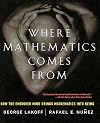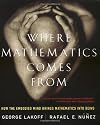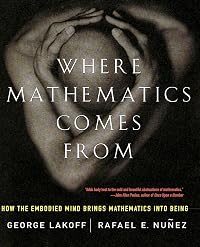
Where Mathematics Comes From: How the Embodied Mind Brings Mathematics into Being
by George Lakoff
On This Page
Description
A study of the cognitive science of mathematical ideas.Tags
Recommendations
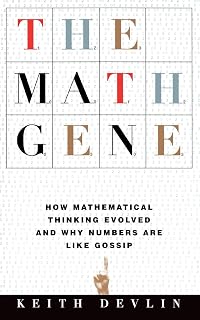
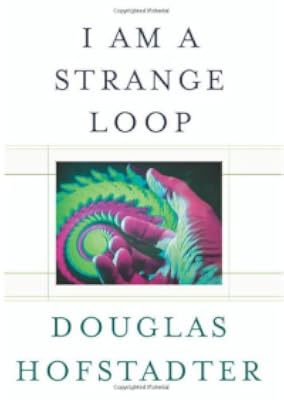
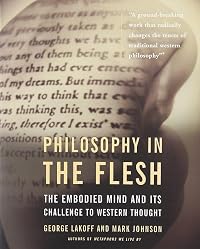
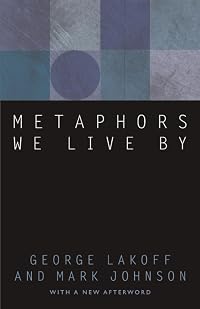


Member Recommendations

Member Reviews
I think it will be very easy to misunderstand what Lakoff and Núñez are attempting to do with this book, and the problem is not helped at all by the book’s provocative title. To call mathematics the product of “embodied minds” suggests that the authors will argue that mathematics is a social construction, but this is not their goal. In fact, the authors explicitly say that “mathematics is not purely subjective” and it “is not a matter of mere social agreement” (365). It is, however, a form of rational expression that reflects embodiment: the experience of how we materially (and socially … I insist) occupy space. It’s the material part that is easy to overlook, but the basic conclusion that Lakoff and Núñez reach is show more that how we experience things in space forms the basis by which we developed and understand math. Math is an expression of the regularities we experience, via our bodies, every day, as containers, with insides and outsides, or how we experience time as a linear progression of events, or numbers existing on a line, or how more of a thing occupying more space than less of the same thing. Math developed to describe the regularity of those experiences and so the brain can map from those experiences to make sense of math. Even infinity and infinitesimals, the authors argue, are based on experience grounded in imperfect verbs of continuous action. For example, the imperfect verb “swimming” implies a continuing action of discrete strokes, and walking is an action of discrete steps. When one no longer makes a stroke they are no longer “swimming,” and when they fail to take a step they are no longer “walking.” Infinity is just a continuous string of these discrete steps just as infinity is a continuous line of discrete numbers. Mathematics is a descriptive tool (378) that depends on embodied experience to understand.
The authors lay out the evidence for the above argument in painstaking and sometimes exceedingly dull detail. They start with the overarching argument that the Platonic view of numbers and mathematics as idealized forms that exist apart from human experience is faulty. Although there are certainly regularities, there can be no scientific proof that the Platonic view of math is correct (4). Working from subitizing (19) and basic arithmetic (67), the authors make a case for some mathematical processing being grounded in innate cognitive functions. And those mathematic cognitive functions are integrated with other cognitive functions, sense making, awareness, and intentional thinking that the brain supports in all areas of our daily lived experience. This is where metaphor comes into the picture, as a mechanism by which Lakoff and Johnson argue that the brain processes abstract ideas (see Metaphors We Live By ). These metaphors allow the brain to process more abstract mathematical concepts like algebra (110) or “the study of mathematical form,” sets (141), infinity (155), infinitesimals (223), and onward to more abstract mathematical formulations, which are all traceable, via the mapping of core metaphoric expressions (e.g., sets, lines, limits, ranges, length, order, space, etc.), to the human experience of self in space. Math never stops being descriptive. Even symbolic logic (133) maps a set of obligatory descriptive relationships based on actual engagement with the world, and in this way seems to lend some support to Wittgenstein’s mapping of logic to an isomorphic representation of the real (in theTractatus).
One point that I was surprised not to see in this book was a discussion of the way that mathematics act as concepts, not as references to sets of things in the world but as ideas with situated meaning in a particular time and semiotic system. Lakoff and Núñez work so hard to separate their arguments from radical social constructionism that they don’t take up how the truth of some mathematical processing and expression is, in fact, grounded within a particular setting of use. Maybe that point is intended to go without saying.
Ultimately, the goal of this book is to introduce a way of doing “mathematical idea analysis […] to explain why theorems are true on the basis of what they mean” (338) which is maybe inclusive of the idea that theorems and products of mathematical operations have sense. The other aim is to dispel the “romantic” notion of math as somehow transcendent but for which there can never be proof of its transcendence (344). Neither, however, does it seem that there can be a scientific way of proving that the mathematics is fully explained by cognitive science and the human predilection to rely on metaphors as concept categories that facilitate cognition (39). Certainly Lakoff and Núñez make a compelling case for why this perspective ALSO explain mathematics but the causal chain of their arguments seems insufficiently supported. show less
The authors lay out the evidence for the above argument in painstaking and sometimes exceedingly dull detail. They start with the overarching argument that the Platonic view of numbers and mathematics as idealized forms that exist apart from human experience is faulty. Although there are certainly regularities, there can be no scientific proof that the Platonic view of math is correct (4). Working from subitizing (19) and basic arithmetic (67), the authors make a case for some mathematical processing being grounded in innate cognitive functions. And those mathematic cognitive functions are integrated with other cognitive functions, sense making, awareness, and intentional thinking that the brain supports in all areas of our daily lived experience. This is where metaphor comes into the picture, as a mechanism by which Lakoff and Johnson argue that the brain processes abstract ideas (see Metaphors We Live By ). These metaphors allow the brain to process more abstract mathematical concepts like algebra (110) or “the study of mathematical form,” sets (141), infinity (155), infinitesimals (223), and onward to more abstract mathematical formulations, which are all traceable, via the mapping of core metaphoric expressions (e.g., sets, lines, limits, ranges, length, order, space, etc.), to the human experience of self in space. Math never stops being descriptive. Even symbolic logic (133) maps a set of obligatory descriptive relationships based on actual engagement with the world, and in this way seems to lend some support to Wittgenstein’s mapping of logic to an isomorphic representation of the real (in theTractatus).
One point that I was surprised not to see in this book was a discussion of the way that mathematics act as concepts, not as references to sets of things in the world but as ideas with situated meaning in a particular time and semiotic system. Lakoff and Núñez work so hard to separate their arguments from radical social constructionism that they don’t take up how the truth of some mathematical processing and expression is, in fact, grounded within a particular setting of use. Maybe that point is intended to go without saying.
Ultimately, the goal of this book is to introduce a way of doing “mathematical idea analysis […] to explain why theorems are true on the basis of what they mean” (338) which is maybe inclusive of the idea that theorems and products of mathematical operations have sense. The other aim is to dispel the “romantic” notion of math as somehow transcendent but for which there can never be proof of its transcendence (344). Neither, however, does it seem that there can be a scientific way of proving that the mathematics is fully explained by cognitive science and the human predilection to rely on metaphors as concept categories that facilitate cognition (39). Certainly Lakoff and Núñez make a compelling case for why this perspective ALSO explain mathematics but the causal chain of their arguments seems insufficiently supported. show less
This book introduces a new sub-discipline of cognitive science called “mathematical idea analysis”. In brief this sub-discipline seeks to provide a more intuitive understanding of many abstract mathematical ideas by tying those ideas to the often unconscious understanding of our physical environment (embodiment). From the preface:
“Human ideas are, to a large extent, grounded in sensory-motor experience. Abstract human ideas make use of precisely formulatable cognitive mechanisms such as conceptual metaphors that import modes of reasoning from sensory-motor experience. [ … ] The central question we ask is this: How can cognitive science bring systematic scientific rigor to the realm of human mathematical ideas, which lies show more outside the rigor of mathematics itself? Our job is to help make precise what mathematics itself cannot—the nature of mathematical ideas.” Pg. XII
The book is creative, ambitious, and well organized. For the most part the writing is good, although I thought it became repetitive at times where the authors would start a new section by repeating several ideas from the last section. Some people may like this style - it’s very structured and “scientific” - but it also gets tiring, especially in a 450 page book.
I think overall the book is a mixed bag. The introductory chapters and the summary chapters (on the theory and philosophy of embodied mathematics) were pretty good and I enjoyed them. But the majority of the books middle chapters are focused on a very detailed construction of all the metaphors needed for mathematical idea analysis. There are countless tables making detailed metaphorical mappings from “source domain” to “target domain”. These often seem trivial or obvious and I kept thinking to myself ”Well, someone’s got to do this but I’m not really interested in reading about it!” (I imagine the same thing has been said of Russell and Whitehead’s “Principia Mathematica”, it was an amazing achievement but not great reading). My feeling is that only specialists in cognitive science or mathematical pedagogy would find these chapters useful.
Overall I wouldn’t recommend this book for a general reader wanting to learn more about mathematics or cognitive science since I think there are better books on these subjects. For instance, if you are interested in cognitive science and the idea of embodiment I highly recommend Lakoff’s earlier book “Women, Fire, and Dangerous Things”. If you already own "Where Mathematics Comes From" then reading chapters 1, 2, 15 and 16 should give you a good feel for the book and whether you want to continue or not. show less
“Human ideas are, to a large extent, grounded in sensory-motor experience. Abstract human ideas make use of precisely formulatable cognitive mechanisms such as conceptual metaphors that import modes of reasoning from sensory-motor experience. [ … ] The central question we ask is this: How can cognitive science bring systematic scientific rigor to the realm of human mathematical ideas, which lies show more outside the rigor of mathematics itself? Our job is to help make precise what mathematics itself cannot—the nature of mathematical ideas.” Pg. XII
The book is creative, ambitious, and well organized. For the most part the writing is good, although I thought it became repetitive at times where the authors would start a new section by repeating several ideas from the last section. Some people may like this style - it’s very structured and “scientific” - but it also gets tiring, especially in a 450 page book.
I think overall the book is a mixed bag. The introductory chapters and the summary chapters (on the theory and philosophy of embodied mathematics) were pretty good and I enjoyed them. But the majority of the books middle chapters are focused on a very detailed construction of all the metaphors needed for mathematical idea analysis. There are countless tables making detailed metaphorical mappings from “source domain” to “target domain”. These often seem trivial or obvious and I kept thinking to myself ”Well, someone’s got to do this but I’m not really interested in reading about it!” (I imagine the same thing has been said of Russell and Whitehead’s “Principia Mathematica”, it was an amazing achievement but not great reading). My feeling is that only specialists in cognitive science or mathematical pedagogy would find these chapters useful.
Overall I wouldn’t recommend this book for a general reader wanting to learn more about mathematics or cognitive science since I think there are better books on these subjects. For instance, if you are interested in cognitive science and the idea of embodiment I highly recommend Lakoff’s earlier book “Women, Fire, and Dangerous Things”. If you already own "Where Mathematics Comes From" then reading chapters 1, 2, 15 and 16 should give you a good feel for the book and whether you want to continue or not. show less
George Lakoff is a national treasure - who through is career and many collaborations has provided that evidence of the inevitability and importance of metaphor. Metaphor structures how we reason - via the entailing logic of the frame, metaphor and narrative. For anyone interested in seeing the invisible metaphors we embody in our systems of logic and mathematics - this is a MUST READ.
Interesting follow-up to Lakoff's Metaphors We Live By.
The thesis here is that all language is metaphorical expression, which is based on conceptual metaphors determined by the brain as well as by society.
Mathematical metaphors are explained within this context, starting with things like the number-line and the Cartesian plane and culminating in the example of Euler's equation where "e to the i pi plus one equals zero".
Quite a ride and well worth skimming through the tables and the chapter summaries in order to get a feel of how concept work from the point of view of our brains.
The thesis here is that all language is metaphorical expression, which is based on conceptual metaphors determined by the brain as well as by society.
Mathematical metaphors are explained within this context, starting with things like the number-line and the Cartesian plane and culminating in the example of Euler's equation where "e to the i pi plus one equals zero".
Quite a ride and well worth skimming through the tables and the chapter summaries in order to get a feel of how concept work from the point of view of our brains.
I've never ready anything about cognitive science and as this book is a look at Mathematics from the Cognitive Scientist point of view it was difficult to start. By the end of the book I was pretty enthralled. Any one that has taken some higher level math courses (analysis, abstract alg) should read this book and really think about what they've learned. Anyone planning on teaching higher level math should read this and think about how they teach.
Can be summarized by the dust-jacket slogans "Mathematics is not built into the universe" and "The portrait of mathematics has a human face." Meaty and quite absorbing, even though it goes against my sometime Platonist sympathies.
Members
- Recently Added By
Author Information

37+ Works 9,775 Members
George Lakoff is distinguished professor of cognitive science and linguistics at the University of California, Berkeley. He is the author or coauthor of numerous books, including Metaphors We Live By and Women, Fire, and Dangerous Things, both also published by the University of Chicago Press.
Common Knowledge
- Original publication date
- 2000
- First words
- This book asks a central question: what is the cognitive structure of sophisticated mathematical ideas?
- Blurbers
- Hersh, Reuben; Browder, Felix; Thurston, Bill; Devlin, Keith
- Canonical DDC/MDS
- 510.1
Classifications
Statistics
- Members
- 492
- Popularity
- 61,752
- Reviews
- 8
- Rating
- (3.90)
- Languages
- English, Italian
- Media
- Paper
- ISBNs
- 3
- ASINs
- 2