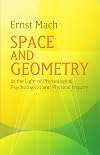
Space and Geometry; In the Light of Physiological, Psychological and Physical Inquiry
by Ernst Mach
On This Page
Description
The Austrian scientist Ernst Mach (1838-1916) carried out work of importance in many fields of enquiry, including physics, physiology, psychology and philosophy. Published in this English translation of 1906, these essays examine geometry from three different perspectives. Mach argues that, as our ideas about space are created by the senses and how we experience our environment, researchers must not consider the subject from a mathematical standpoint alone. In the first essay, he explains show more how humans generate spatial concepts. Next, he discusses the psychology of geometry, its empirical origins, and its development. In the final piece, he writes from the viewpoint of a physicist, outlining how various mathematicians, such as Carl Friedrich Gauss and Bernhard Riemann, have contributed to our geometrical understanding. Also reissued in this series in English translation are Mach's The Science of Mechanics (1893) and Popular Scientific Lectures (1895). show lessTags
Recommendations

























Member Recommendations
Members
- Recently Added By
Author Information

26+ Works 399 Members
Educated by his father, who stressed the importance of carpentry and farming, Ernst Mach received his Ph.D. from the University of Vienna in 1860. Mach made many contributions to science in a variety of fields, but he is best known for his powerful influence on several generations of scientists as a critic of science and as a philosopher. His show more initial research in experimental psychology revealed the function of the semicircular canals of the ear. Mach is best known in physics for his work on shock waves, which led to the mach number being introduced in 1929 as a measure of speed. The mach number is the ratio of the speed of an object in a fluid to the speed of sound in the fluid. Mach is also known to cosmologists for his controversial statement of the principle of inertia, called Mach's principle. The Mach principle rejected the Newtonian notion of absolute space and time. Mach's elimination of absolute space was part of his more general program in which he hoped to eliminate metaphysics (all those purely "thought-things" that cannot be pointed to in experience) from science. His views influenced the important philosophical movement of logical positivism and also had some impact on scientific practice, especially Einstein in formulating his theory of relativity. Despite his influence, Mach was a radical thinker who never accepted the existence of atoms or Einstein's theory of relativity. (Bowker Author Biography) show less
Series
Belongs to Publisher Series
Common Knowledge
- Canonical title
- Space and Geometry; In the Light of Physiological, Psychological and Physical Inquiry
- Original publication date
- 1901-1903 ; 1906 (English translation) (English translation)
Classifications
Statistics
- Members
- 48
- Popularity
- 625,258
- Languages
- English
- Media
- Paper, Ebook
- ISBNs
- 11
- UPCs
- 1
- ASINs
- 1