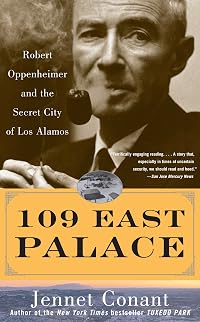
109 East Palace: Robert Oppenheimer and the Secret City of Los Alamos
by Jennet Conant
On This Page
Description
This book captures the drama of 27 perilous months at Los Alamos, a secret city cut off from the rest of society, ringed by barbed wire, where Oppenheimer and his young recruits lived as virtual prisoners of the U.S. government--freshly minted secretaries and worldly scientists contending with living conditions straight out of pioneer days, racing to build the first atomic bomb before Germany could. Oppenheimer was as arrogant as he was inexperienced, and few believed the 38-year-old show more theoretical physicist would succeed. Yet despite the obstacles, he forged a vibrant community through the sheer force of his personality. show lessTags
Recommendations












Member Reviews
Conant tells the story of the Los Alamos "Manhattan Project" from the distaff point of view, based largely on the memories of Office Manager Dorothy McKibbin (who worked out of 109 East Palace Avenue in Santa Fe). The army recruited thousands for the atom bomb project at Los Alamos, but didn't think about such details as families with children, daycare, schooling, laundry, the need for barbers, maids, places of entertainment, garbage, food supplies, cooking, doctors, hospitals, etc. Dorothy McKibbin played a large role in helping people adjust to the new city and vice versa. In addition to McKibbin's materials (including a diary), Conant draws on interviews with and papers by wives, children, and secretaries, as well as memoires from show more physicists who were part of the project. There's very little about physics or the bomb itself - the book can more accurately be described as being about building a city from scratch, instantaneously, all the while having to maintain secrecy for security reasons. In that sense it's very interesting, but fans of Oppenheimer won't be disappointed either. Conant, who is the granddaughter of James B. Conant (himself intimately involved with the Manhattan Project) and author of the very good book Tuxedo Park, is obviously sympathetic to Oppenheimer, but I believe she nevertheless gives a fair accounting of his problems with the Government. (And again she does so not from Oppenheimer's perspective but rather from the perspective of the denizens of Los Alamos.) And Conant begins and ends the book with the birth and death of Dorothy McKibbin, who stays the main focus throughout. After reading McKibbin's story, one feels pleased to see her finally getting the recognition she deserves for her pivotal role in facilitating the Manhattan Project. (JAF) show less
Quite a few books have been published about the once-secret city in north central New Mexico named Los Alamos, now a city of over 13,400 residents. Even today, it is an unusual city. When I drove through the town in the latter part of the 1970s, I was struck by traffic lanes and signals signed as evacuation routes and by the fact that traffic flow can be reversed so that normal inbound lanes are available for outbound traffic. While the system accommodates evacuations from encroaching forest fires, forty years ago I could not help imagining residents also fleeing from some radiation-emitting accident. Of course, if one goes back eighty years, there were no traffic lanes to be signaled at all; in fact, there was no town per se, only a show more boys' school that stressed the benefits of a hardy outdoor lifestyle. That school ended abruptly in 1943 when the Federal government took over the buildings and nearby land to create a secret base for research, design, and construction of the world's first nuclear bomb.
I mentioned that quite a few books on the history of Los Alamos have been published, but 109 East Palace by Jennet Conant is the first of that specific genre that I've read so I cannot compare her book with any others now on the market. I can, however, say that I found Conant's historical narrative to be engaging, possibly even intriguing, and, as far as I can tell, factually accurate. Hers is not a dry recitation of chronological facts because she reveals those facts through the eyes and actions of the scientists and of their spouses whose thoughts and actions created those facts. Hers is very much a human history of the rise of atomic research and production at Los Alamos and of the physical, psychological, and sociological hardships involved in living and working in a frantically thrown-together, isolated, and guarded facility in which security was so tight that spouses were forbidden to even mention their work to each other and where the fear of military wiretaps in the bedroom was omnipresent in residents' consciousness. Throw in inadequate and irregular electricity, crude heating stoves impossible to regulate, and draconian restrictions on communication with the outside world and one gets a glimpse of what life behind the fence was like.
The subtitle of the book implies that this is something of a biography of Robert Oppenheimer, and the reader does indeed come away with a sharp mental image of that remarkable man. However, it would be an error to conclude that the book deals only with him, influential, imaginative, and creative as he was. Numerous other scientists, civilian administrators, family members, and military overseers are also part of this story, not always to their advantage. I found myself greatly amused by the fact that, despite all the rules, regulations, constraints, and inherent suspicions of the army's S-2 (security management, intelligence, counter-intelligence, etc.) personnel swarming Los Alamos, at least one spy, Klaus Fuchs, ensured that the Russian government was kept quite well informed of the Americans' research in nuclear physics.
In brief, I found Conant's book to be readable and informative in equal measure. It is a fine introduction to the birth and growth of the Los Alamos nuclear laboratories and of the scientific community that made those laboratories productive. The worries, fears, jealousies, likes, hatreds, loves, determinations, and moments of despair of the human beings who made Los Alamos work provide strong underpinnings for the story and succeed admirably in keeping this book from containing even a hint of dry history.
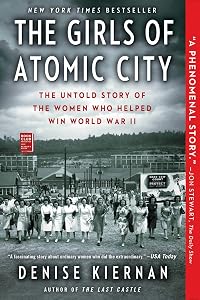
I would bring these musings to a close by recommending two other books to enlarge upon two topics mentioned but not extensively examined in Conant's book. On page 196, the reader is introduced to "Tube Alloys," and the term is explicated much more fully in Denise Kiernan's book The Girls of Atomic City which also gives the story of Oak Ridge, without whose enriched plutonium the bombs of Los Alamos could not have been built. Kiernan's and Conant's books pair richly together. For a perhaps unsurpassed first hand look at the devastating, largely incurable injuries inflicted by the first bomb on those it did not kill until days, weeks, and months after the explosion—injuries from blast, heat, fire, and radiation—by all means, read Hiroshima Diary: The Journal of a Japanese Physician, August 6—September 30, 1945, Fifty Years Later by Michihiko Hachiya, M.D., translated by Warner Wells, M.D. All three of these books tell us of history as it was actually lived and all are fully worthy of the time devoted to their reading. show less
I mentioned that quite a few books on the history of Los Alamos have been published, but 109 East Palace by Jennet Conant is the first of that specific genre that I've read so I cannot compare her book with any others now on the market. I can, however, say that I found Conant's historical narrative to be engaging, possibly even intriguing, and, as far as I can tell, factually accurate. Hers is not a dry recitation of chronological facts because she reveals those facts through the eyes and actions of the scientists and of their spouses whose thoughts and actions created those facts. Hers is very much a human history of the rise of atomic research and production at Los Alamos and of the physical, psychological, and sociological hardships involved in living and working in a frantically thrown-together, isolated, and guarded facility in which security was so tight that spouses were forbidden to even mention their work to each other and where the fear of military wiretaps in the bedroom was omnipresent in residents' consciousness. Throw in inadequate and irregular electricity, crude heating stoves impossible to regulate, and draconian restrictions on communication with the outside world and one gets a glimpse of what life behind the fence was like.
The subtitle of the book implies that this is something of a biography of Robert Oppenheimer, and the reader does indeed come away with a sharp mental image of that remarkable man. However, it would be an error to conclude that the book deals only with him, influential, imaginative, and creative as he was. Numerous other scientists, civilian administrators, family members, and military overseers are also part of this story, not always to their advantage. I found myself greatly amused by the fact that, despite all the rules, regulations, constraints, and inherent suspicions of the army's S-2 (security management, intelligence, counter-intelligence, etc.) personnel swarming Los Alamos, at least one spy, Klaus Fuchs, ensured that the Russian government was kept quite well informed of the Americans' research in nuclear physics.
In brief, I found Conant's book to be readable and informative in equal measure. It is a fine introduction to the birth and growth of the Los Alamos nuclear laboratories and of the scientific community that made those laboratories productive. The worries, fears, jealousies, likes, hatreds, loves, determinations, and moments of despair of the human beings who made Los Alamos work provide strong underpinnings for the story and succeed admirably in keeping this book from containing even a hint of dry history.
I would bring these musings to a close by recommending two other books to enlarge upon two topics mentioned but not extensively examined in Conant's book. On page 196, the reader is introduced to "Tube Alloys," and the term is explicated much more fully in Denise Kiernan's book The Girls of Atomic City which also gives the story of Oak Ridge, without whose enriched plutonium the bombs of Los Alamos could not have been built. Kiernan's and Conant's books pair richly together. For a perhaps unsurpassed first hand look at the devastating, largely incurable injuries inflicted by the first bomb on those it did not kill until days, weeks, and months after the explosion—injuries from blast, heat, fire, and radiation—by all means, read Hiroshima Diary: The Journal of a Japanese Physician, August 6—September 30, 1945, Fifty Years Later by Michihiko Hachiya, M.D., translated by Warner Wells, M.D. All three of these books tell us of history as it was actually lived and all are fully worthy of the time devoted to their reading. show less
This fascinating book by the granddaughter of James B. Conant, who administrated the Manhattan Project, tells the "human story" of the creation of Los Alamos National Laboratory and the development of the nuclear bomb near the end of World War II. Though the story is framed as an account of Dorothy McKibbin, the administrator who ran the "front office" of the secret wartime lab at the Santa Fe address that serves as the book's title, it is clearly an homage to J. Robert Oppenheimer and his leadership of the wartime effort.
Conant creates wonderfully vibrant characters out of what were perhaps the oddest assortment of geniuses ever assembled. It would have been very easy for the book to become little more than a side show of mad show more scientists, but Conant's passion for the story keeps the inevitable quirkiness authentic and, well, lovable. Genius scientists are rarely known for their "people skills" (Oppenheimer being a grand exception), but Conant is exceptionally sympathetic in her portrayal of these often difficult personalities. The one glaring exception is her portrayal of Edward Teller, who she clearly disdains. This is not a book about the A-bomb...it is a book about the community that created the A-bomb under some of the most unusual and strenuous circumstances humans could endure.
I found particularly gratifying her discussion of the immediate aftermath of Los Alamos' success, describing fully the way the various key scientists reacted to the bombing of Hiroshima and Nagasaki. Her portrayal of the moral ambiguity of that moment is a great moment to consider the ever more tangled web of technological advancement, militaristic foreign policy, and political expediency. In her telling, Oppenheimer's exceptionalism is rooted in his early and keen perception of the moral dilemma created by atomic energy, summarized by his famous quote after the successful test of the first atomic bomb: "I am become Death, the destroyer of worlds."
Conant's carrying of the story into the McCarthy era, the revocation of Oppenheimer's security clearance and consultancy at the Atomic Energy Commission feels, to be honest, as if it goes a bit "beyond" where the story could have (perhaps should have) ended. And it is in that final section that her "crusading" for Oppenheimer's reputation as a great scientist and a great American--as well as her most damning remarks about Edward Teller's lack of character--becomes most strident. It's as if she wishes to provide the defense that her grandfather was unable to effectively mount at the height of the "Red Scare" of the 1950s.
I've always been fascinated by biographies of "great minds," so this book was fascinating in its incisive explorations of a COMMUNITY of such minds and how they interacted and reacted to each other. Conant does a tremendous job of drawing the reader into that story and making the reader care more about what happened to the people than about what happened to the project. It was a book long in the finishing, but a book that was worthy of the time. show less
Conant creates wonderfully vibrant characters out of what were perhaps the oddest assortment of geniuses ever assembled. It would have been very easy for the book to become little more than a side show of mad show more scientists, but Conant's passion for the story keeps the inevitable quirkiness authentic and, well, lovable. Genius scientists are rarely known for their "people skills" (Oppenheimer being a grand exception), but Conant is exceptionally sympathetic in her portrayal of these often difficult personalities. The one glaring exception is her portrayal of Edward Teller, who she clearly disdains. This is not a book about the A-bomb...it is a book about the community that created the A-bomb under some of the most unusual and strenuous circumstances humans could endure.
I found particularly gratifying her discussion of the immediate aftermath of Los Alamos' success, describing fully the way the various key scientists reacted to the bombing of Hiroshima and Nagasaki. Her portrayal of the moral ambiguity of that moment is a great moment to consider the ever more tangled web of technological advancement, militaristic foreign policy, and political expediency. In her telling, Oppenheimer's exceptionalism is rooted in his early and keen perception of the moral dilemma created by atomic energy, summarized by his famous quote after the successful test of the first atomic bomb: "I am become Death, the destroyer of worlds."
Conant's carrying of the story into the McCarthy era, the revocation of Oppenheimer's security clearance and consultancy at the Atomic Energy Commission feels, to be honest, as if it goes a bit "beyond" where the story could have (perhaps should have) ended. And it is in that final section that her "crusading" for Oppenheimer's reputation as a great scientist and a great American--as well as her most damning remarks about Edward Teller's lack of character--becomes most strident. It's as if she wishes to provide the defense that her grandfather was unable to effectively mount at the height of the "Red Scare" of the 1950s.
I've always been fascinated by biographies of "great minds," so this book was fascinating in its incisive explorations of a COMMUNITY of such minds and how they interacted and reacted to each other. Conant does a tremendous job of drawing the reader into that story and making the reader care more about what happened to the people than about what happened to the project. It was a book long in the finishing, but a book that was worthy of the time. show less
While this book spends enough time on the history and science of the Manhattan Project to set its place in time and history, the joy for me was in the story of the people involved and their interaction in the remarkable closed community of Los Alamos during the production of the atom bomb. I recently visited Santa Fe and stopped to look at the door to 109 East Palace, where new employees reported after they were told merely...."Come to Santa Fe, your nation needs you." The office was run by Dorothy McKibben, a young widow who devoted herself to the project and to its leader, Robert Oppenheimer, and whose unpublished autobiography is a major source for this book. The project grew and grew till there were thousands of people living at Los show more Alamos; they were isolated and sworn to total secrecy during the course of the project. It is an amazing story and very well told here. show less
This is an in-depth look at the of making the atomic bomb with the terrible knowledge that its creation and use on both Hiroshima and Nagasaki Japan meant we no longer could be safe from world annihilation.
Living in Los Alamos dessert, thirty-nine miles from Santa Fe, New Mexico was a band of scientists that were brilliant in the design and follow through of terrible death and/or sickness to many in Japan. Clothed in rationale that the hydrogen bombs would end the war, all too soon Robert Oppenheimer and his band of scientists recognized that once the bomb was used, there was no turning back.
It took awhile to read this detailed book. And, in the end Oppenheimer believed that the science of, and the use of the bomb which he and his team show more put together, meant that the world was no longer safe.
Highly recommended. show less
Living in Los Alamos dessert, thirty-nine miles from Santa Fe, New Mexico was a band of scientists that were brilliant in the design and follow through of terrible death and/or sickness to many in Japan. Clothed in rationale that the hydrogen bombs would end the war, all too soon Robert Oppenheimer and his band of scientists recognized that once the bomb was used, there was no turning back.
It took awhile to read this detailed book. And, in the end Oppenheimer believed that the science of, and the use of the bomb which he and his team show more put together, meant that the world was no longer safe.
Highly recommended. show less
I'm only about halfway through the book, but this is fascinating stuff. A really great read.
It's not much for the science; it's all about Oppenheimer himself, and Leslie Groves, and the other physicists and machinists and engineers... The personalities. A truly terrific book. I would recommend it for any fan of history.
It's funny; the atomic bomb has been around for some time now. And of course everyone knows at least the general outlines of the story of Los Alamos and Oppenheimer, the Manhattan Project, Nagasaki and Hiroshima, the Enola Gay... Nothing new, right?
But this book puts it all into a different light. It makes the history human. All of these things are part of history; they happened in our fairly recent past. Not only that, show more but they are a significant part of history. No obscure battles in some country that no longer exists, lost in the mists of centuries. This was less than seventy years ago, and these events changed the world in ways that echo even now.
This book shares with you the thoughts and dreams and fears of those who made that history. How they lived, what they hoped for, why they felt compelled to do what they did....
This is an incredible story, and I'm enjoying it immensely. I would really highly recommend this book. show less
It's not much for the science; it's all about Oppenheimer himself, and Leslie Groves, and the other physicists and machinists and engineers... The personalities. A truly terrific book. I would recommend it for any fan of history.
It's funny; the atomic bomb has been around for some time now. And of course everyone knows at least the general outlines of the story of Los Alamos and Oppenheimer, the Manhattan Project, Nagasaki and Hiroshima, the Enola Gay... Nothing new, right?
But this book puts it all into a different light. It makes the history human. All of these things are part of history; they happened in our fairly recent past. Not only that, show more but they are a significant part of history. No obscure battles in some country that no longer exists, lost in the mists of centuries. This was less than seventy years ago, and these events changed the world in ways that echo even now.
This book shares with you the thoughts and dreams and fears of those who made that history. How they lived, what they hoped for, why they felt compelled to do what they did....
This is an incredible story, and I'm enjoying it immensely. I would really highly recommend this book. show less
Loved it! The life of those scientists on "The Hill" was fascinating and primitive. Enjoyed scientists guilt and second guessing after they had tested Tinity and realized the destruction it would cause.
Members
- Recently Added By
Lists

Top Five Books of 2014
1,064 works; 398 members

Book Titles Mentioned In Newberry Medal And Honor Books
884 works; 3 members

In Our Time books
4,934 works; 2 members
Author Information

7 Works 2,784 Members
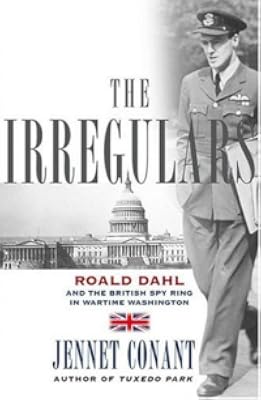
Jennet Conant is the New York Times best-selling author of several books, including Tuxedo Park, 109 East Palace, The Irregulars, and the critically acclaimed Man of the Hour. She lives in Sag Harbor, New York, with her husband, son, and two golden retrievers.
Some Editions
Awards and Honors
Common Knowledge
- Original publication date
- 2005
- People/Characters
- Robert Oppenheimer; Dorothy McKibbin
- Important places
- Los Alamos, New Mexico, USA; Hiroshima, Japan
- Important events
- World War II (1939 | 1945); World War II, American Home Front; Manhattan Project; Atomic Bombings of Hiroshima and Nagasaki (1945)
- Epigraph
- They won't believe you, when the time comes that this can be told.
It is more fantastic than Jules Verne.
—James B. Conant
to the New Tork Times' William L. Laurence
in spring 1945 - Dedication
- For Grandpa
- First words
- There was something about the man, that was all there was to it.
- Last words
- (Click to show. Warning: May contain spoilers.)Men have gone down to death
wearing her love like a rose,
and the tears that her own heart sheds
only her own heart knows. - Publisher's editor
- Mayhew, Alice
Classifications
- Genres
- History, Nonfiction, General Nonfiction, Science & Nature, Biography & Memoir
- DDC/MDS
- 623.451190973 — Applied science & technology Engineering Military Vehicles: Land, Air, & Sea Technology of Weapons and Armaments Explosives, Rockets, and Bombs
- LCC
- QC773 .A1 .C66 — Science Physics Physics Atomic energy.
- BISAC
Statistics
- Members
- 594
- Popularity
- 49,144
- Reviews
- 18
- Rating
- (3.93)
- Languages
- English
- Media
- Paper, Audiobook, Ebook
- ISBNs
- 9
- ASINs
- 9