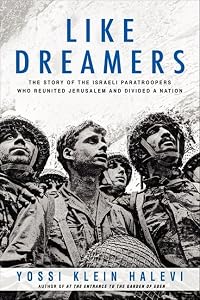
Like Dreamers: The Story of the Israeli Paratroopers Who Reunited Jerusalem and Divided a Nation
by Yossi Klein Halevi
On This Page
Description
In Like Dreamers, acclaimed journalist Yossi Klein Halevi interweaves the stories of a group of 1967 paratroopers who reunited Jerusalem, tracing the history of Israel and the divergent ideologies shaping it from the Six-Day War to the present.Tags
Recommendations





















Member Reviews
A captivating account of the capture of Jerusalem by Israeli paratroopers during the Six Day War in 1967, following a handful of the soldiers who participated throughout their lives in the decades before and after. Briefly united in battle for a common goal, they differed greatly in upbringing, outlook, and politics, running the gamut from left wing extremists to corporate CEOs to right wing settlers.
The stories underscore and provide context for the uniquely Israeli trait of being able to put their differences aside (at least for a little while) to stand shoulder to shoulder in battle, a phenomenon that was repeated this past year with a country as divided as ever responding without hesitation to emergency reserve call-ups.
Along the show more way we get a glimpse into the various forces and demographics of Israeli society and politics, which can at times seem absurd and impossible to follow or explain. The parts from the mid 1990's onwards were generally familiar to me as I lived through them, but it helped to understand the events in a broader historical context, and to flesh out some of the names in the headlines with personalities. I'm therefore probably the best demographic to appreciate the book, knowing enough to know what he's talking about, but still sufficiently ignorant to get a lot out of it. Older readers who lived through the 50's-70's might not learn anything new, and younger readers may struggle to relate to some of the cultural references. As will people not at least partially acquainted with Israeli history and politics. But I think that there's enough that stands on its own to be a useful and interesting read for anyone attempting to understand what's currently going on, and how we got there. show less
The stories underscore and provide context for the uniquely Israeli trait of being able to put their differences aside (at least for a little while) to stand shoulder to shoulder in battle, a phenomenon that was repeated this past year with a country as divided as ever responding without hesitation to emergency reserve call-ups.
Along the show more way we get a glimpse into the various forces and demographics of Israeli society and politics, which can at times seem absurd and impossible to follow or explain. The parts from the mid 1990's onwards were generally familiar to me as I lived through them, but it helped to understand the events in a broader historical context, and to flesh out some of the names in the headlines with personalities. I'm therefore probably the best demographic to appreciate the book, knowing enough to know what he's talking about, but still sufficiently ignorant to get a lot out of it. Older readers who lived through the 50's-70's might not learn anything new, and younger readers may struggle to relate to some of the cultural references. As will people not at least partially acquainted with Israeli history and politics. But I think that there's enough that stands on its own to be a useful and interesting read for anyone attempting to understand what's currently going on, and how we got there. show less
This is not so much a review of this book, but a reaction to it, albeit, from someone I don't think the author intended to read it. I'm neither an Israeli nor even a Jew. While I was once engaged to marry a self-described "Jewish princess" and I once studied Judaism in college, it would be best to discard the first fact -- it turns out it was a big misunderstanding...she didn't really like me -- and the college professor was emphatically biased toward Christianity and against every other religion. In short, I'm not well versed in the day-to-day nuances of modern Israeli history, and this book basically covers Israel for nearly 40 years, starting with 1967. Like the entire book, the author gives extra importance to a particular event, in show more this case the Six-Day War, and then embellishes that particular event to mean much more than it really does. He does this by choosing a handful of the paratroopers in that war, and then makes them represent all of Israeli society for the next few decades. In essence, he interlaces multiple biographies together, but with little of the obvious synchronization that might follow a more conventional history, such as all the cadets at West Point in, say 1846, that ended up fighting with or against each other a few years later in the American Civil War. Moreover, the book took a great many historical dates and religious customs for granted for the reader, going far beyond the handful of Jewish holidays that many Americans are familiar with. At times, it seems that nearly everyday and every location in Israel has some deep significance. And everyone seems to take offense that someone else isn't giving that significance due weight. If there is one aspect of this narrative that caught me most off guard, it was how much Israelis apparently dislike each other. There was only one subject of the mini biographies that struck me as more logical than emotional, and even he was chastised by his wife for not caring enough for others reactions to his actions. I'll offer two quotes from the book that get at the heart of the narrative. Almost inevitably the book draws out this conclusion, "How were Israelis to argue with restraint when both right and left were convinced that their opponents prevailed, the state would be not merely diminished but destroyed?" It's at this point the author tries to make this just two sides of an Israeli issue, when throughout the narrative, he repeatedly points out multiple shades of gray. In short, even if a person was supposedly on one side or other of the left/right line, each person also had multiple reasons for disagreeing with others on their "side" why and how they should be "left" or "right". Somewhat later in the book, the author points out, "...the left had been correct about the dangers of occupation, but the right had been correct about the chances of peace." I found this just a little bit funny that he was giving the "sides" so much credit, since neither "side" would have been willing to do so. And that's not even including the Palestinians or other Arabs into the discussion. In the end, I thought this was unnecessarily difficult to absorb, but, nevertheless, extremely enlightening and worthwhile for me to read. Frankly, I'm a bit disturbed that American news media has not done a better job of pointing out the issues raised in this book. show less
Very disjointed, jumps all over and fails to deliver a cogent narrative. The scenes dealing with the reoccupation of East Jerusalem are the strongest part of the account. Other than that it is mostly a commentary on the theory and life on a kibbutz. Disappointing, good material to work with and failed to deliver.
I listened to this on audiobook and even though the quality (Hoopla) wasn't great, I loved it!
It was so interesting and I loved the way Halevi tied together the personal stories of the various paratroopers.
Definitely recommended.
It was so interesting and I loved the way Halevi tied together the personal stories of the various paratroopers.
Definitely recommended.
Really learned a lot about Israel after 1967. Found this book vivid in it's portrayal of this group of soldiers who represented various shades of political and religious communities.
Really different approach to Israel. Focuses on people in the 1967, Yom Kippur, etc wars. Not so much on the wars themselves. Very interesting to rad about kibbutznick, orthodox, military, civilians, etc. Author folllowed the same people through many parts of the founding of Israel. The varying viewpoints and opinions were really interesting. Good read.
Yossi Klein HaLevi's masterpiece about the movers and shakers of the capture of Jerusalem during the Six Day War and their lives in the ensuing years. Beautifully written and balanced.
Members
- Recently Added By
Lists

The Emergence of the Modern Middle East
289 works; 13 members

THE WAR ROOM
813 works; 24 members
Author Information

6+ Works 779 Members
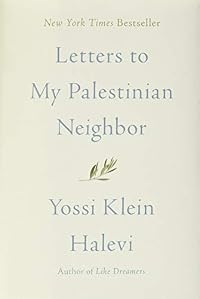
Yossi Klein Halevi is an American-born (1953) journalist, commentator, and author, based in Jerusalem since 1982. His education includes a BA in Jewish Studies from Brooklyn College and a MS in journalism from Northwestern University. He was a senior fellow of the Shalom Hartman Institute in Jerusalem from 2003-2009. He writes op-ed pages of show more American newspapers such as the Wall Street Journal, the New York Times and the Los Angeles Times. His first book was Memoirs of a Jewish Extremist: The Story of a Transformation (1995). His other works include, At the Entrance to the Garden of Eden: A Jew's Search for God with Christians and Muslims in the Holy Land (2001), Like Dreamers: The Story of the Israeli Paratroopers Who Reunited Jerusalem and Divided a Nation (2013), and Letters to My Palestinian Neighbors (2018). (Bowker Author Biography) show less
Awards and Honors
Common Knowledge
- Important places
- Jerusalem; Israel
- Important events
- Six-Day War (1967-06-05 | 1967-06-10)
Classifications
- Genres
- Nonfiction, History, General Nonfiction, Biography & Memoir
- DDC/MDS
- 356.16609569409045 — Society, Government, and Culture Public administration & military science Foot forces and warfare Organization Special infantry troops Paratroopers
- LCC
- UD485 .I8 .K54 — Military Science Infantry Infantry Airborne troops. Parachute troops
- BISAC
Statistics
- Members
- 227
- Popularity
- 142,927
- Reviews
- 10
- Rating
- (4.09)
- Languages
- English
- Media
- Paper, Audiobook, Ebook
- ISBNs
- 9
- ASINs
- 6