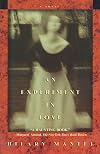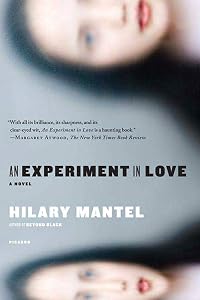
An Experiment in Love
by Hilary Mantel
On This Page
Description
It is London, 1970. Carmel McBain, in her first term at university, has cut free of her childhood roots in the north. Among the gossiping, flirtatious girls of Tonbridge Hall, she begins her experiments in life and love. But the year turns. The mini-skirt falls out of style and an era of concealment begins. Carmel's world darkens, and tragedy waits in the wings.Tags
Recommendations































Member Recommendations
Member Reviews
Mantel's gifts of machete-sharp observation and narration are on view here, and they are enough to make this worth reading. Even though I'm a pretty close contemporary of the girls and young women she portrays, the world of working-class England, suffocating "faith-based" schooling, Catholic religiosity, and the college system is all a foreign country to me (I'm a Yank). It all sounds truly awful. The travails and woes and nastiness of the "girls" were painfully familiar, and I didn't particular enjoy reading about any of them. You can see, though, Mantel's particular skill for the games people play, the ambiguities and paradoxes of character, how people you might mostly despise will surprise you with generosity, or how a core ugliness show more can be managed or overlooked until they leap out and appall you, whether in a girls' college or in the Tudor court or the revolutionary tribunals in France. An early effort, but you can see the brilliance beginning to smolder and flare. show less
This was probably not the ideal way to read this book.I listened to it in the car, but it took most of a month, so there were significant gaps in the listening.
It's told in retrospect, with the adult Carmel returning to her first term at University and how she arrived at that place. She traces her friendship with Corinna & Julianne through primary school, through the 11 plus and into the selective girl's grammar. There is a vividly depicted youth in straightened circumstances, and how she deals with her parents and their deteriorating relationship as she grows further from them.
The other important relationship is that with Corinna. This is longstanding and not healthy. They are thrown together and expected to be friends as they live show more close and are going through the same 11 plus experience. However they are not natural friends. It becomes a form of habit, they've been classed as friends for so long that they can't make the break.
At university, she tries to take control of her life, as those around her do the same, to varying degrees. And with varying degrees of success.
At one stage, Carmel herself says that this is a book about appetite and desire. I think is is about desire for control, and being in control of appetite is one way of appearing to exert control over your life. In Carmel's case this takes a particular form, for her friends it takes different forms and has different effects.
The finale is startling and unexpected.
I felt that the characters were well drawn, and the background entirely believable. The angst of young love and life were vivid and clear. I would have wanted to know how Carmel went on after the events in the book, but it ends quite abruptly after the climax. Good book, I just spread it out too much. show less
It's told in retrospect, with the adult Carmel returning to her first term at University and how she arrived at that place. She traces her friendship with Corinna & Julianne through primary school, through the 11 plus and into the selective girl's grammar. There is a vividly depicted youth in straightened circumstances, and how she deals with her parents and their deteriorating relationship as she grows further from them.
The other important relationship is that with Corinna. This is longstanding and not healthy. They are thrown together and expected to be friends as they live show more close and are going through the same 11 plus experience. However they are not natural friends. It becomes a form of habit, they've been classed as friends for so long that they can't make the break.
At university, she tries to take control of her life, as those around her do the same, to varying degrees. And with varying degrees of success.
At one stage, Carmel herself says that this is a book about appetite and desire. I think is is about desire for control, and being in control of appetite is one way of appearing to exert control over your life. In Carmel's case this takes a particular form, for her friends it takes different forms and has different effects.
The finale is startling and unexpected.
I felt that the characters were well drawn, and the background entirely believable. The angst of young love and life were vivid and clear. I would have wanted to know how Carmel went on after the events in the book, but it ends quite abruptly after the climax. Good book, I just spread it out too much. show less
This is one of those books where the author seems to be much more interested in the detail than in the story. Mantel doesn't bother to tie up any of the loose ends for us: we're expected to do the work ourselves, if we care to. The detail is rich and wonderful: as an account of growing up in relatively poor circumstances in the North of England it's almost as compelling as Oranges are not the only fruit — if you can imagine Oranges with modest Catholic wallflowers in place of ranting Pentecostal super-egos, that is — and there's a lot there that anyone who's ever been a penniless student should be able to identify with. I didn't feel that Mantel really took us to the point where we could understand why Carmel stops eating, though.
Another dip into Hilary Mantel's backlist. An Experiment in Love is about a group of girls on the brink of adulthood away at college. It takes places in the 1960s and the main character is Carmel. She reflects on her childhood friendships and how they've changed as she grows. She also mentions her mother enough for the reader to realize that her experience in approaching adulthood is a reaction to her perception of her mother's life.
The young women are experimenting with life. Their relationships with men, with sex, with food and body image are all explored.
I couldn't shake the feeling, while I was reading this, that I knew this book and that the author was not Mantel. I'm not sure who I was thinking of - A.S. Byatt? early Margaret show more Atwood? Alice Munro?
I'm really not sure. But then in the last third of the book it turned into a Hilary Mantel novel. And I also don't really know what I mean by that!
So overall, yes, I thought this was a good book, and I'm glad I read it. show less
The young women are experimenting with life. Their relationships with men, with sex, with food and body image are all explored.
I couldn't shake the feeling, while I was reading this, that I knew this book and that the author was not Mantel. I'm not sure who I was thinking of - A.S. Byatt? early Margaret show more Atwood? Alice Munro?
I'm really not sure. But then in the last third of the book it turned into a Hilary Mantel novel. And I also don't really know what I mean by that!
So overall, yes, I thought this was a good book, and I'm glad I read it. show less
‘An Experiment in Love’ is a novel that I expected to connect with more than in fact I did. It follows a girl called Carmel as she gets into a selective high school, has to have a whole fancy uniform that seems incredibly expensive, does well at school, goes off to university, and negotiates the novel freedom of living with a group of other young women for the first time. Although the narrative is set in the 1970s, I had all the aforementioned experiences myself in the 90s and 00s. Carmel is an interesting character and I liked that her friendships and emnities with women were the focus rather than her boyfriend. (He lurked stolidly in the background.) On the other hand, said relationships remained somehow mysterious and Carmel’s show more first person narrative never quite hooked me. I found the treatment of her eating disorder odd and the tempo of events uneven. This wasn’t any fault in the writing, which was beautiful, but perhaps had something to do with the memoir-ish structure. The narrative darts back and forth between school and university days, with no apparent rhyme or reason. This makes for a meditative rather than plot-driven novel.
Now and again there was a magnificently acute paragraph, though. This one in particular:
As I re-read that passage, I noticed that Carmel refers to women as ‘they’ not ‘we’. Perhaps that is what limited my engagement with this novel - her sense of detachment. Thus I was interested but not moved, when I expected both. Hilary Mantel is an incredible writer, though, so I am holding her to much higher standards than most. At the end of the edition I read is an interview in which she says that [b:A Place of Greater Safety|101921|A Place of Greater Safety|Hilary Mantel|https://i.gr-assets.com/images/S/compressed.photo.goodreads.com/books/1363435037l/101921._SX50_.jpg|1168385] was the first novel she wrote, back in the 1970s. That’s extraordinary! It’s one of my all time favourite books and she wrote it while in her 20s, never having written a novel before. What talent. show less
Now and again there was a magnificently acute paragraph, though. This one in particular:
When men decided that women could be educated - this is what I think - they educated them on the male plan; they put them into schools with mottoes and school songs and muddy team games, they made them wear collars and ties. It was a way to concede the right to learning, yet remain safe; the products of the system would always be inferior to the original model. Women were forced to imitate men, and bound not to succeed at it.
As I re-read that passage, I noticed that Carmel refers to women as ‘they’ not ‘we’. Perhaps that is what limited my engagement with this novel - her sense of detachment. Thus I was interested but not moved, when I expected both. Hilary Mantel is an incredible writer, though, so I am holding her to much higher standards than most. At the end of the edition I read is an interview in which she says that [b:A Place of Greater Safety|101921|A Place of Greater Safety|Hilary Mantel|https://i.gr-assets.com/images/S/compressed.photo.goodreads.com/books/1363435037l/101921._SX50_.jpg|1168385] was the first novel she wrote, back in the 1970s. That’s extraordinary! It’s one of my all time favourite books and she wrote it while in her 20s, never having written a novel before. What talent. show less
on some level, this is a book about being lost - in new surroundings and schedules, among other people, within our own thoughts and desires. but on another it's an intense personal drama centred on a triad of girls, with a mysterious tragedy ending the book. the union of the two is impressive: intimacy with huge social reverberations.
One of the strongest parts in this somewhat harrowing coming-of-age story is Mantel's continuing ability to highlight and dramatize the indignities of poverty, the constant awareness of poor people of class differences, and the almost complete obliviousness of richer people to them. The narrator, Carmel McBain, comes from a poor Catholic family in the north of England. We see her overbearing mother whose life's ambition is Carmel's success, her difficult friendship with Karina, a neighbor girl whose family is even poorer than hers, their escape through academic achievement first to an elite Catholic school, where they meet Julianne, a girl from a much richer family, and then to London for university where all three girls, now young show more women, live in the same bleak residence hall. The present of the novel is their first few months in this hall, in the early 1960s, as they confront issues of friendship, religion, boyfriends, sex, the rigors of meager meals in the residence hall and, for Carmel, the challenges of having almost no money beyond that which pays for her tuition and board. The climax is almost melodramatic, shocking, but not completely unexpected. This isn't one of my favorites of Mantel's, but it is well worth reading. show less
Members
- Recently Added By
Published Reviews
ThingScore 100
Hilary Mantel's seventh novel, ''An Experiment in Love,'' is only the second to be published in the United States. This is a shame, because Ms. Mantel is an exceptionally good writer. Her book's title, however, is somewhat misleading. ''Experiment'' suggests clinical detachment; but if experiments are going on, they're more like what Dr. Frankenstein got up to with the body parts: intense, show more unholy and messy. As for ''love,'' the inaccuracy is that it's singular: there are many kinds of love in this book, almost all contaminated. ''Enter the Dragoness'' might be a more likely title, for this is a story about emotional kung fu, female style -- except that by the end, although all are wounded or worse, there's no clear winner. show less
added by Nickelini
Lists

Best Books Set in London
157 works; 42 members

Best Campus Novels
99 works; 18 members

Academia in Fiction
158 works; 23 members

Books Read in 2019
4,052 works; 110 members
Author Information

62+ Works 38,927 Members
Hilary Mantel was born in Glossop, Derbyshire, England on July 6, 1952. She studied law at the London School of Economics and Sheffield University. She worked as a social worker in Botswana for five years, followed by four years in Saudi Arabia. She returned to Britain in the mid-1980s. In 1987 she was awarded the Shiva Naipaul Memorial Prize for show more an article about Jeddah. She worked as a film critic for The Spectator from 1987 to 1991. She has written numerous books including Eight Months on Ghazzah Street, A Place of Greater Safety, A Change of Climate, The Giant, O'Brien, Giving up the Ghost: A Memoir, and Beyond Black. She has won several awards for her work including the Winifred Holtby Memorial Prize, the Cheltenham Prize and the Southern Arts Literature Prize for Fludd; the 1996 Hawthornden Prize for An Experiment in Love, the 2009 Man Booker Prize for Wolf Hall, and the 2012 Man Booker Prize for Bring up the Bodies. She made The New York Times Best Seller List with her title The Assassination of Margaret Thatcher. (Bowker Author Biography) show less
Some Editions
Awards and Honors
Awards
Common Knowledge
- Canonical title
- An Experiment in Love
- Original title
- An Experiment in Love
- Original publication date
- 1995
- People/Characters
- Carmel McBain; Karina; Julienne (Julia); Lynette; Claire; Sue
- Important places
- Tonbridge Hall, London, England, UK; Lancashire, England, UK; London, England, UK
- Dedication
- For Gerald
- First words
- This morning in the newspaper I saw a picture of Julia.
- Last words
- (Click to show. Warning: May contain spoilers.)The angles of the white room soften and melt around me; and the past runs like water through my hands.
- Blurbers
- Margaret Atwood; Brian Moore; Michael Upchurch; Gabriele Annan; Thomas Filbin; Susan Fromberg Schaeffer
Classifications
Statistics
- Members
- 624
- Popularity
- 46,835
- Reviews
- 19
- Rating
- (3.58)
- Languages
- Dutch, English, Spanish, Turkish
- Media
- Paper, Audiobook, Ebook
- ISBNs
- 26
- ASINs
- 12