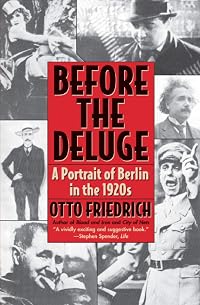
Before the Deluge: Portrait of Berlin in the 1920s, A
by Otto Friedrich
On This Page
Description
A fascinating portrait of the turbulent political, social, and cultural life of the city of Berlin in the 1920s.Tags
Recommendations



























Member Reviews
I first read Otto Friedrich's fascinating glimpse into post World War I Berlin in 1975. I have since returned to its pages many, many times. For, as its title promises, it is a portrait of Berlin that peeks into the music, science, film, theater, and literature of the era as well as the political clashes between Nazis and Communists. In many ways, it supplies a certain cultural heft to the more glitzy and glamorous vision of Berlin that appeared at about the same time as this book but on Broadway and in film, Cabaret. Fittingly, Friedrich's passage on Christopher Isherwood and Cabaret, then, is one of his best. As these lines from page 347 of my old Avon paperback edition give testimony:
. . . Isherwood succeeded, precisely by focusing show more his camera on the lost and rejected, in producing a matchless portrait of the city. But in transferring Ishwerwood's work to Broadway, the various creators of Cabaret decided that all the idiosyncratic characters of The Berlin Stories must become a series of types, and thus caricatures. Sally Bowles had to become a sprightly ingenue: Herr Issyvoo himself had to become a pink-cheeked American tenor named Clifford Bradshaw, and the tormented, self-destructive spirit of Berlin had to become a rousing chorus in which everyone sings, "Life is a cabaret".
Friedrich drew his portrait of the city and its people directly from the participants themselves. As such, because his work appeared 40 to 50 years after Berlin's cultural supernova, it today reads as if it were the visible remnants of some luminescent scroll of a bygone era whose own heat and vigor has long since failed. show less
. . . Isherwood succeeded, precisely by focusing show more his camera on the lost and rejected, in producing a matchless portrait of the city. But in transferring Ishwerwood's work to Broadway, the various creators of Cabaret decided that all the idiosyncratic characters of The Berlin Stories must become a series of types, and thus caricatures. Sally Bowles had to become a sprightly ingenue: Herr Issyvoo himself had to become a pink-cheeked American tenor named Clifford Bradshaw, and the tormented, self-destructive spirit of Berlin had to become a rousing chorus in which everyone sings, "Life is a cabaret".
Friedrich drew his portrait of the city and its people directly from the participants themselves. As such, because his work appeared 40 to 50 years after Berlin's cultural supernova, it today reads as if it were the visible remnants of some luminescent scroll of a bygone era whose own heat and vigor has long since failed. show less
There is a small possibility I will visit Berlin in the next year or so. It is hard to imagine the contrary Berlin of the 1920's. Beautiful girls dressed in flapper style, kicking it up in glitzy cabarets (a la Louise Brooks, also known as Lulu) against a backdrop of war, and poverty, and influenza ravaged misery. One war was over while another bubbled just below the surface, waiting to burst forth.
The 1920's was also a great period of scientific inquiry and wonderment. Britain and Germany had been on opposite sides of World War I, but astronomers were not concerned with that detail. Scientists on both sides were single-minded in their desire to study the eclipse. At the same time, the German government saw the benefit of using the new show more technology of moving pictures to show their propaganda films. Albert Einstein was in his prime.
The most fascinating thing about Before the Deluge is Friedrich's interviews with people who could remember the height of the 20's in Berlin. People who were aware events like if the Communists had voted in force, Marshall Paul Von Hindenburg would have never been elected to rule the German Republic. If the weather had been slightly better Hindenburg never would have appointed a young man named Adolf Hitler as Chancellor.... show less
The 1920's was also a great period of scientific inquiry and wonderment. Britain and Germany had been on opposite sides of World War I, but astronomers were not concerned with that detail. Scientists on both sides were single-minded in their desire to study the eclipse. At the same time, the German government saw the benefit of using the new show more technology of moving pictures to show their propaganda films. Albert Einstein was in his prime.
The most fascinating thing about Before the Deluge is Friedrich's interviews with people who could remember the height of the 20's in Berlin. People who were aware events like if the Communists had voted in force, Marshall Paul Von Hindenburg would have never been elected to rule the German Republic. If the weather had been slightly better Hindenburg never would have appointed a young man named Adolf Hitler as Chancellor.... show less
History that reads like an exciting novel, covering the Weimar Republic, 1918 to 1933. Within the structural confines of one chapter per year, Friedrich successfully interweaves all of the main players in art, politics, literature, music, theater - essentially all aspects of the culture - as his tale unfolds and comes to a devastating climax.
While it may not appeal to everyone, it's on my top ten favorite books list.
While it may not appeal to everyone, it's on my top ten favorite books list.
An interesting collection of anecdotes about Berlin during the Weimar Republic. The author devotes each chapter to a year, but really the book is arranged thematically, as he ties each year to some cultural, economic, or political aspect of Berlin life. There is lots of color here, from gruesome crime scenes and assassinations to tales of the lives of famous artists. But you have to overlook several weaknesses: the heavy foreshadowing implied in the title, uneven treatments when themes and years don't overlap evenly, and an irritating proclivity for dropping the names of the famous refugees the author interviewed in the early 1970s. Still, for the kind of manic urban energy that produces really cutting-edge art and really interesting show more history, Berlin in the 20s was the place to be and this book conveys a strong sense of that whirlwind. show less
This book chronicles the events of the 1920's that led to the rise of the Nazi state in Germany. It is the best source I have read not only about the social disruptions of that era, but also about the incredible cultural vibrancy of Berlin in the 1920's that was destroyed by the Nazi hegemony. Friedrich explains the reasons behind the terrible upheavals of the 20th century in a way that is clear and engaging.
1692 Before the Deluge: A Portrait of Berlin in the 1920's, by Otto Friedrich (read 4 Feb 1982) This is an account by a guy (now with Time magazine) of Berlin from 1918 to 1933. It is a very interesting book to read, though mainly derived from other books and personal interviews. It told me much I had forgotten, and much I never knew before. There is a chapter on each year from 1918 through 1933.
This is a well-reasearched book that recounts the events in Berlin in the heady days after WWI but before the rise of the Nazis.
Members
- Recently Added By
Lists

David Bowie's Top 100
97 works; 23 members

History
37 works; 1 member

David Bowie's List of Top 100 Books
94 works; 6 members
David Bowie’s Top 100 Favourite Reads
100 works; 3 members
Author Information

25+ Works 2,423 Members
Awards and Honors
Notable Lists
Common Knowledge
- Original publication date
- 1972
- People/Characters
- Friedrich Ebert; Adolf Hitler; Albert Einstein; Joseph Goebbels; Walther Rathenau; Bertolt Brecht (show all 7); Marlene Dietrich
- Important places
- Berlin, Germany; Weimar Republic
- Related movies
- Berlin: Symphony of a Great City (1927 | IMDb); Cabaret (1972 | IMDb); Menschen am Sonntag (1930 | IMDb)
- First words
- "Would you like me to show you?" the old man asks.
- Last words
- (Click to show. Warning: May contain spoilers.)"The German Revolution has begun!"
Classifications
- Genres
- History, Nonfiction, General Nonfiction
- DDC/MDS
- 943.15508 — History & geography History of Europe Central Europe: Germany, Austria, Switzerland, Czech, Poland, Hungary Northeastern Germany Brandenburg and Berlin Berlin Historical periods 1866-
- LCC
- DD880 .F75 — History of Europe, Asia, Africa and Oceania Germany History of Germany Local history and description Berlin
Statistics
- Members
- 531
- Popularity
- 56,524
- Reviews
- 9
- Rating
- (4.13)
- Languages
- Dutch, English, German, Portuguese
- Media
- Paper
- ISBNs
- 13
- ASINs
- 9