Below the Convergence: Voyages Toward Antarctica 1699-1839
by Alan Gurney
On This Page
Description
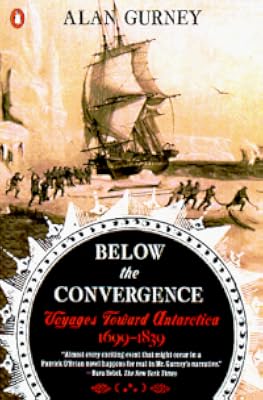
This wonderfully written book tells the story of British, American, and Russian expeditions, from the astronomer Edmond Halley's voyage in the Paramore in 1699 to the sealer John Balleny's 1839 voyage in the Eliza Scott, all in search of land, fur, or elephant seals. These were voyages for science, national prestige, and profit. Life was incredibly harsh: Crews had poor provisions and inadequate clothing and were constantly threatened by scurvy. Often they had to make their own charts as show more they sailed in the stormy waters of the Southern Ocean below the Convergence, that sea frontier marking the boundary between the freezing Antarctic waters and the warmer sub-Antarctic seas. These seamen were the first to discover and exploit a new continent, which was not the verdant southern land they imagined but an inhospitable expanse of rock and ice, ringed by pack ice and icebergs - Antarctica. show lessTags
Recommendations

























Member Reviews
A dense history of early voyages to the high south latitudes to determine if there was land and, if so, inhabitants and resources to be exploited. After a chapter on ancient and medieval propositions about what might be found, and chapters covering maritime reckoning, scurvy, the Antarctic convergence and the wildlife of the southern ocean, the author proceeds with vivid histories of trips by Halley, Cook, Bellingshausen, Weddell, Biscoe, Kemp and Belleny. There are also colorful but sad descriptions of the early-19th century discovery of massive seal colonies and their subsequent devastation over only a few years.
Anyone interested in the Antarctic should enjoy this. It fills a gap usually overlooked in favor of the famous explorers of show more the early-20th century and provides an intriguing look at what greatness there was in those who sailed into the void and made those later explorations possible. Personally, this book has led me to want to read about Halley and Cook, especially. What courage and vision (and maybe a bit of insanity) these men had. show less
Anyone interested in the Antarctic should enjoy this. It fills a gap usually overlooked in favor of the famous explorers of show more the early-20th century and provides an intriguing look at what greatness there was in those who sailed into the void and made those later explorations possible. Personally, this book has led me to want to read about Halley and Cook, especially. What courage and vision (and maybe a bit of insanity) these men had. show less
A good read, but the storytelling was not overly compelling. Excellent history.
One of my favorites. A good reminder that there is more to Antarctic exploration than Scott et al.
Ratings
Members
- Recently Added By
Lists

Polar exploration
54 works; 4 members
Author Information

3 Works 503 Members
Alan Gurney is a former yacht designer and photographer, and is now a writer living in Suffolk, England.
Common Knowledge
- Original publication date
- 1997
- Important places
- Antarctica
- Dedication
- An old tradition has it that those who have rounded Cape Horn under sail can take their after-dinner drink with one foot upon the table. And those who have sailed across the polar circles can drink with both feet upon the tab... (show all)le. This book is dedicated to the latter - past, present, and future.
- First words
- (Prologue) The source of the Nile, the possibility of a Northwest Passage from the Atlantic to the Indies, the existence of a huge southern continent - all, over the centuries, have exercised the speculations, imaginations, a... (show all)nd energies of countless geographers, cartographers, and explorers.
It is the fourth century B.C., and, in the shaded walkways of the Lyceum in Athens, Aristotle is strolling with his students and discussing what is so obvious to the intellectually curious - the spherical nature of the Earch,... (show all) as opposed to the flat-disc Earth of the ancient Homeric Greeks. - Last words
- (Click to show. Warning: May contain spoilers.)It was one to be followed, sixty years later, by the ships of the almost mythic figures of Antarctic exploration: Borchgrvink's Southern Cross; Scott's Discovery and Terra Nova; Shackleton's Nimrod and Aurora; and, the most extraordinary vessel of them all, Amundsen's Fram.
(Click to show. Warning: May contain spoilers.)(Epilogue) The seals and whales are returning, but the work of the bulldozers is irreversible. - Original language
- English US
Classifications
- Genres
- Nonfiction, Travel, History, General Nonfiction
- DDC/MDS
- 919.8 — History & geography Geography & travel Geography of and travel in Australasia, Pacific Ocean islands, Atlantic Ocean islands, Arctic islands, Antarctica and on extraterrestrial worlds Polar regions
- LCC
- G870 .G78 — Geography, Anthropology and Recreation Geography (General) Arctic and Antarctic regions
- BISAC
Statistics
- Members
- 160
- Popularity
- 205,141
- Reviews
- 3
- Rating
- (4.26)
- Languages
- English, Portuguese
- Media
- Paper
- ISBNs
- 5
- ASINs
- 1