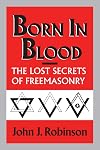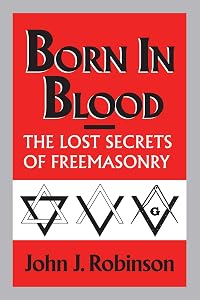
Born in Blood: The Lost Secrets of Freemasonry
by John J. Robinson
On This Page
Description
Its mysterious symbols and rituals had been used in secret for centuries before Freemasonry revealed itself in London in 1717. Once known, Freemasonry spread throughout the world and attracted kings, emperors, and statesmen to take its sacred oaths. But where had this powerful organization come from? What was it doing in those secret centuries before it rose from underground more than 270 years ago? And why was Freemasonry attacked with such intense hatred by the Roman Catholic church? This show more amazing detective story answers those questions and proves that the Knights Templar in Britain, fleeing arrest and torture by pope and king, formed a secret society of mutual protection that came to be called Freemasonry. Based on years of meticulous research, this book solves the last remaining mysteries of the Masons-their secret words, symbols, and allegories whose true meanings had been lost in antiquity. With a richly drawn background of the bloody battles, the opportunistic kings and scheming popes, the tortures and religious persecution throughout the Middle Ages, it is an important book that may require that we take a new look at the history of events leading to the Protestant Reformation. show lessTags
Recommendations

















Member Reviews
This is a very interesting book. Instead of the hyped-up conspiracy-theory potboiler I'd expected, Robinson presents a series of historical, religious, and linguistic data which strongly support the hypothesis that Freemasons emerged not from the Stone Masons guilds of the Middle Ages, but as a secret mutual protection society in the aftermath of the bloody destruction of the Knights Templar.
Robinson tells us that he didn't start out to investigate the roots of Freemasonry, but that various unanswered questions in the historical record, specifically those around the unexplained disappearances of some Templars, and the never-explained "Great Society" involved in the Peasants Revolt in England in 1381. The more he searched for answers, show more the more Freemasonry seemed the best explanation for the gaps in the historical records. Further, once he did start investigating Masonry, he found that puzzling terms and aspects of rituals were better explained when related to known information about Templar practices and language then they were by supposed links to a craft guild.
Throughout the book, Robinson is careful to never claim that he has found absolute proof of a connection. Ultimately there is no explicit evidence, only a pattern of data which can be reasonably interpreted certain ways. The Templar root of Freemasonry is presented as the most likely of a variety of hypotheses which could explain both the historical questions and some of the riddles within Masonry.
The only reason I gave this book four stars instead of five is that I thought he went into far too much detail regarding medieval history. The national and religious politics of the times are relevant to his case, but I think his own passion for that material (this project started out as more general historical research) prompted him to include a lot of information that wasn't actually relevant to the Templar-Freemason connection. Fortunately, he is an excellent writer, and even though there was a lot of unnecessary detail, it was (for the most part) interesting, and I feel like I learned a lot about the times.
I started this book feeling entirely comfortable with the idea of Freemasonry developing out of a medieval craft guild. I wasn't looking for any other "origin story." After reading this book, I'm far more inclined to consider the Templars the more likely founders. Ultimately, I don't think it matters. Hundreds of years of practice and evolution have resulted in Masonic Orders quite different from their original forms. The value of Freemasonry lies in its ability to transform lives in the present, not because of any particular quality of virtue of its source. But if someone is interested in that question, this is an excellent book to read. show less
Robinson tells us that he didn't start out to investigate the roots of Freemasonry, but that various unanswered questions in the historical record, specifically those around the unexplained disappearances of some Templars, and the never-explained "Great Society" involved in the Peasants Revolt in England in 1381. The more he searched for answers, show more the more Freemasonry seemed the best explanation for the gaps in the historical records. Further, once he did start investigating Masonry, he found that puzzling terms and aspects of rituals were better explained when related to known information about Templar practices and language then they were by supposed links to a craft guild.
Throughout the book, Robinson is careful to never claim that he has found absolute proof of a connection. Ultimately there is no explicit evidence, only a pattern of data which can be reasonably interpreted certain ways. The Templar root of Freemasonry is presented as the most likely of a variety of hypotheses which could explain both the historical questions and some of the riddles within Masonry.
The only reason I gave this book four stars instead of five is that I thought he went into far too much detail regarding medieval history. The national and religious politics of the times are relevant to his case, but I think his own passion for that material (this project started out as more general historical research) prompted him to include a lot of information that wasn't actually relevant to the Templar-Freemason connection. Fortunately, he is an excellent writer, and even though there was a lot of unnecessary detail, it was (for the most part) interesting, and I feel like I learned a lot about the times.
I started this book feeling entirely comfortable with the idea of Freemasonry developing out of a medieval craft guild. I wasn't looking for any other "origin story." After reading this book, I'm far more inclined to consider the Templars the more likely founders. Ultimately, I don't think it matters. Hundreds of years of practice and evolution have resulted in Masonic Orders quite different from their original forms. The value of Freemasonry lies in its ability to transform lives in the present, not because of any particular quality of virtue of its source. But if someone is interested in that question, this is an excellent book to read. show less
Very informative account of the history of the Freemasons since the Middle Ages. He ties it in with the Knights Templar and I later learned that it is a pretty bogus link, despite the Da Vinci Code and other books like that.
The three-star review is an average--it should get four stars for being well-researched and impartial and two stars for being just plain boring to read!
Should not be read by anyone thinking of joining Freemasonry until after they've joined.
I love history. This was pretty gruesome, though.
Não lido
Besproken in AQC, jrg.104, (1991),1992, pp.239 en 240:
“I had thought that masonic scholars, at least, had convincingly debunked the theory (more properly, legend) that Freemasonry had its origins in the mediaval Knights Templar. The legend persists, however, and seems to have an eternal fascination for non-masons…It is a great pity that this book cannot be wholeheartedly recommended for it performs one extremely valuable service for Freemasonry.The autor gives a devasteting critique of the late Stephan Knight’s The Brotherhood, Which caused so many problems for English Freemasonry in the 1980s…Read with care, and preferable after a reading of Peter Partner’s excellent study The Murdered Magicians, the Templars and their Myth, show more the autor has done a service to Freemasonry.” show less
“I had thought that masonic scholars, at least, had convincingly debunked the theory (more properly, legend) that Freemasonry had its origins in the mediaval Knights Templar. The legend persists, however, and seems to have an eternal fascination for non-masons…It is a great pity that this book cannot be wholeheartedly recommended for it performs one extremely valuable service for Freemasonry.The autor gives a devasteting critique of the late Stephan Knight’s The Brotherhood, Which caused so many problems for English Freemasonry in the 1980s…Read with care, and preferable after a reading of Peter Partner’s excellent study The Murdered Magicians, the Templars and their Myth, show more the autor has done a service to Freemasonry.” show less
Jul 25, 2021Dutch
Members
- Recently Added By
Published Reviews
Nema pitanja koje je pobudilo više živih rasprava od skupa poznatog kao masoni. Ova izvanredna studija otkriće vam potpuno novu perspektivu korena moderne masonerije i do sada nepoznate činjenice o poreklu mita, istorijskim okolnostima nastanka masonerije i nepoznate činjenice o povezanosti templara i masona. Bazirana na godinama metodičnog istraživanja, ova knjiga rešava poslednje show more preostale misterije masona - njihove tajne reči, simbole i alegorije čije se pravo značenje izgubilo u proslošti. show less
added by Sensei-CRS
Author Information

4+ Works 1,552 Members
Common Knowledge
- Canonical title
- Born in Blood: The Lost Secrets of Freemasonry
- Original title
- Born in Blood: The Lost Secrets of Freemasonry
- People/Characters
- Knights Templar; Freemasons
- Important events
- Peasants' Revolt (1381)
- Related movies
- The Freemasons (1995)
- Dedication
- To J. R. Wallin, Master Craftsman
Classifications
- Genres
- Nonfiction, History, General Nonfiction, Religion & Spirituality
- DDC/MDS
- 366.1 — Society, government, & culture Social problems and social services Clubs, Associations, Insurance Freemasonry
- LCC
- HS403 .R64 — Social sciences Societies: secret, benevolent, etc. Societies: secret, benevolent, etc. Freemasons
- BISAC
Statistics
- Members
- 645
- Popularity
- 45,158
- Reviews
- 7
- Rating
- (3.72)
- Languages
- 6 — Czech, English, French, Portuguese, Serbian, Spanish
- Media
- Paper, Audiobook, Ebook
- ISBNs
- 12
- ASINs
- 11