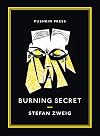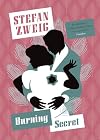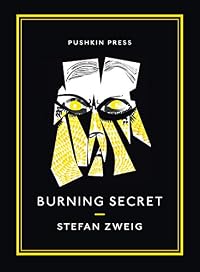
Burning Secret
by Stefan Zweig
On This Page
Description
While being treated for asthma at a country spa, an American diplomat's lonely 12-year-old son is befriended and infatuated by a suave, mysterious baron. During a story of his war experiences, the baron reveals the scar of a wound from an American soldier and thrusts a pin through it, saying "see--no feeling." Little does the boy realize that it is his turn to be wounded. But soon his adored friend heartlessly brushes him aside and turns his seductive attentions to his mother. The boy's show more jealousy and feelings of betrayal become uncontrollable. show lessTags
Recommendations












Member Reviews
The Book Report: Wet, drippy little Edgar, his bored, would-be glam mama Mathilde, and the louche horndog Count Otto meet in an Austrian mountain resort. Otto takes a fancy to Mathilde, since she's a visibly bored Jewess of a certain age. He decides he'll lay siege to her virtue via befriending little larva Edgar, who mistakes his overtures for real friendship because it's never occurred to him that adults lie, cheat, and steal in pursuit of sex. After revolting Count Otto thinks he's about to achieve the leg-over, he drops Edgar, and his troubles begin. Hell hath no fury, apparently, like a barely pubescent boy disappointed in love. What this nasty little child dreams up to do to the perfidious, selfish adults is really quite show more impressive! In the end, his life is completely changed, and one rather trembles at the path his future will take...*cue Horst Wessel*....
My Review: Peopled with deeply dislikable characters, and set in an anonymous vacation destination with no sense of permanence, it's a little hard to invest in the dramatis personae for a goodly stretch of time. I don't think I ever really did all the way. I don't care at all about anyone here, in that if each of them had fallen off an Alp I would've pursed my lips, tutted, and gone about my day.
But the story is a very involving one, paradoxically, because the nature of love comes in for a pretty thorough and fairly damning examination, one that would have seemed very risky for Jewish Zweig to conduct so openly in 1913, the year it was published. The love of mother for son, of son for mother, and mother for sex is explicitly explored. The love of any one of these people for anything is revealed in all its unglory as deeply selfish and terribly destructive, as my cynical heart believes love always to be. (Want to screw up a friendship? Fall in love with your friend! *bang* goes any hope of remaining on good terms...but I digress.)
A movie version of this novella, starring Faye Dunaway, appeared about 25 years ago. It wasn't very good. I am amazed at that, since Zweig's writing is so clear and simple that I'd think it was a shoo-in to have excellent dialogue come out of the characters' mouths. C'est la vie, as conventionally Francophile Mathilde would say...doubtless in a heavy Viennese accent.
So, okay, the point is: Recommended to Zweigers, cynics, and those with pubescent boys at home. Romantics, leave on shelf. "Life is Beautiful" and "La Traviata" fans, turn your backs upon. Multi-eyed, part-alien cyborgs, read and learn...this is what humans are *really* like, and it's not a terribly pretty picture. show less
My Review: Peopled with deeply dislikable characters, and set in an anonymous vacation destination with no sense of permanence, it's a little hard to invest in the dramatis personae for a goodly stretch of time. I don't think I ever really did all the way. I don't care at all about anyone here, in that if each of them had fallen off an Alp I would've pursed my lips, tutted, and gone about my day.
But the story is a very involving one, paradoxically, because the nature of love comes in for a pretty thorough and fairly damning examination, one that would have seemed very risky for Jewish Zweig to conduct so openly in 1913, the year it was published. The love of mother for son, of son for mother, and mother for sex is explicitly explored. The love of any one of these people for anything is revealed in all its unglory as deeply selfish and terribly destructive, as my cynical heart believes love always to be. (Want to screw up a friendship? Fall in love with your friend! *bang* goes any hope of remaining on good terms...but I digress.)
A movie version of this novella, starring Faye Dunaway, appeared about 25 years ago. It wasn't very good. I am amazed at that, since Zweig's writing is so clear and simple that I'd think it was a shoo-in to have excellent dialogue come out of the characters' mouths. C'est la vie, as conventionally Francophile Mathilde would say...doubtless in a heavy Viennese accent.
So, okay, the point is: Recommended to Zweigers, cynics, and those with pubescent boys at home. Romantics, leave on shelf. "Life is Beautiful" and "La Traviata" fans, turn your backs upon. Multi-eyed, part-alien cyborgs, read and learn...this is what humans are *really* like, and it's not a terribly pretty picture. show less
Over the past months I've read a number of Zweig's short stories and novellas and I've been struck by a common pattern. Zweig's settings and characters are almost invariably old-world Mitteleuropean but, on the other hand, the author's quasi-Freudian approach to analysing the conflicting emotions of his protagonists is very modern for its time. Zweig was writing against the backdrop of the rapidly changing world of the inter-war years and it seems that his books, with their internal friction between setting and style, reflect a feeling of flux, of being on the cusp of great upheavals, a tug-of-war between the old and the new.
"Burning Secret" is no exception. It tells of a member of the minor aristocracy, "the Baron", who is a guest at show more an Austrian hotel/sanatorium and who attempts to seduce a beautiful and seemingly well-off woman who is staying there with her twelve-year old son. The Baron at first successfully manipulates the son to get to the mother. The boy however soon realises that he is being used, and although he is still sexually innocent, he realises that the drama unfolding before him is part of a secret adult world to which he has not yet gained access. He spends the rest of the novella playing the "terzo incomodo", as the Italians say, getting a perverse kick out of thwarting the adults' attempts to spend time together.
The book is an often intense coming-of-age novella, a psychological study of an adolescent's roller-coaster of emotions and the mental turmoil which precedes young adulthood. Veteran translator Anthea Bell brilliantly conveys Zweig's highly-charged writing in this attractive Pushkin Collection edition. show less
"Burning Secret" is no exception. It tells of a member of the minor aristocracy, "the Baron", who is a guest at show more an Austrian hotel/sanatorium and who attempts to seduce a beautiful and seemingly well-off woman who is staying there with her twelve-year old son. The Baron at first successfully manipulates the son to get to the mother. The boy however soon realises that he is being used, and although he is still sexually innocent, he realises that the drama unfolding before him is part of a secret adult world to which he has not yet gained access. He spends the rest of the novella playing the "terzo incomodo", as the Italians say, getting a perverse kick out of thwarting the adults' attempts to spend time together.
The book is an often intense coming-of-age novella, a psychological study of an adolescent's roller-coaster of emotions and the mental turmoil which precedes young adulthood. Veteran translator Anthea Bell brilliantly conveys Zweig's highly-charged writing in this attractive Pushkin Collection edition. show less
This is the third of three beautiful little Pushkin Press editions of Stefan Zweig novellas that I found in the library. It is set in a hotel, a venue that Zweig seems especially fond of, probably because it allows for unexpected encounters. (Now I see how his writing inspired The Grand Budapest Hotel.) In contrast to the previous two novellas, [b:Chess Story|59151|Chess Story|Stefan Zweig|https://images.gr-assets.com/books/1386924796s/59151.jpg|57593] and [b:24 Hours In The Life Of A Woman|3255781|24 Hours In The Life Of A Woman|Stefan Zweig|https://images.gr-assets.com/books/1467767353s/3255781.jpg|1608134], this one is not narrated in retrospect by a third party. For most of it, the narrator is a twelve year old boy called Edgar who show more is staying in the hotel with his mother. A handsome Baron sets his sights on seducing Edgar’s mother and makes friends with the boy as a route to her. However, lonely Edgar’s intense delight at being befriended by an adult is matched only by his intense resentment when he is cast aside. The ‘burning secret’ of the title is obvious to the reader: the Baron is trying to convince Edgar’s mother to sleep with him and she is clearly tempted. However, Zweig’s use of Edgar’s point of view on events creates high tension and feels positively claustrophobic. No-one has explained the birds and the bees to this solitary boy, so he doesn’t understand the Baron’s aim, but he knows that something is deeply wrong. It’s a beautifully written little psychological drama. As with all Zweig’s writing, he is sympathetic to the woman trapped by her unhappy marriage yet aware that an affair could destroy her life, as well as the boy on the cusp of adolescence, disregarded by preoccupied adults. The final paragraphs got a little too Freudian, though. show less
Over the past months I've read a number of Zweig's short stories and novellas and I've been struck by a common pattern. Zweig's settings and characters are almost invariably old-world Mitteleuropean but, on the other hand, the author's quasi-Freudian approach to analysing the conflicting emotions of his protagonists is very modern for its time. Zweig was writing against the backdrop of the rapidly changing world of the inter-war years and it seems that his books, with their internal friction between setting and style, reflect a feeling of flux, of being on the cusp of great upheavals, a tug-of-war between the old and the new.
"Burning Secret" is no exception. It tells of a member of the minor aristocracy, "the Baron", who is a guest at show more an Austrian hotel/sanatorium and who attempts to seduce a beautiful and seemingly well-off woman who is staying there with her twelve-year old son. The Baron at first successfully manipulates the son to get to the mother. The boy however soon realises that he is being used, and although he is still sexually innocent, he realises that the drama unfolding before him is part of a secret adult world to which he has not yet gained access. He spends the rest of the novella playing the "terzo incomodo", as the Italians say, getting a perverse kick out of thwarting the adults' attempts to spend time together.
The book is an often intense coming-of-age novella, a psychological study of an adolescent's roller-coaster of emotions and the mental turmoil which precedes young adulthood. Veteran translator Anthea Bell brilliantly conveys Zweig's highly-charged writing in this attractive Pushkin Collection edition. show less
"Burning Secret" is no exception. It tells of a member of the minor aristocracy, "the Baron", who is a guest at show more an Austrian hotel/sanatorium and who attempts to seduce a beautiful and seemingly well-off woman who is staying there with her twelve-year old son. The Baron at first successfully manipulates the son to get to the mother. The boy however soon realises that he is being used, and although he is still sexually innocent, he realises that the drama unfolding before him is part of a secret adult world to which he has not yet gained access. He spends the rest of the novella playing the "terzo incomodo", as the Italians say, getting a perverse kick out of thwarting the adults' attempts to spend time together.
The book is an often intense coming-of-age novella, a psychological study of an adolescent's roller-coaster of emotions and the mental turmoil which precedes young adulthood. Veteran translator Anthea Bell brilliantly conveys Zweig's highly-charged writing in this attractive Pushkin Collection edition. show less
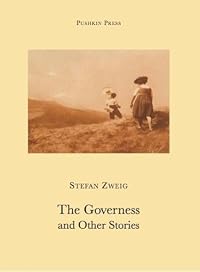
Five pretty powerful longish short stories.
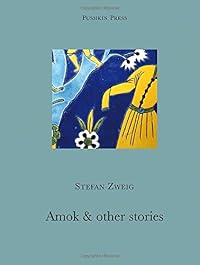
The title story tells of an experienced seducer on a boring holiday; he entertains himself by befriending a lonely twelve-year old boy, with the aim of getting to the mother through the son. As the child realises the man's overtures of friendship were nothing but a ploy, he sets out to ruin the developing relationship, which he barely understands...
The other four stories all have a theme of madness or obsession:
-The Royal Game tells of a chess match during a cruise. The main protagonist is a stolid world champion...but his rival developed a fixation with the intricacies of the game while in lengthy solitary confinement.
-Amok also takes place on a ship, where the narrator encounters a doctor show more returning home from the colonies, after a tragedy This was for me the weakest of the collection, not ringing true at all.
-Fear was a BRILLIANT evocation of a well to do wife facing blackmail and possible exposure from a meaningless liaison. The constant terror, temptation to confess...was wonderfully conjured up.
-Letter from an Unknown Woman, while a tearjerker was, again, very OTT. A woman writes to an author- we must assume from the letter that she's already dead- and recalls their (brief) shared history. She was the young daughter of neighbours, adoring him from afar; later they had a brief liaison, meaning everything to her, while he never gave her another thought. The sadness of someone's entire life given up to a pretty worthless human being, while he has no recollection of her...
Pretty gripping read. show less
The title story tells of an experienced seducer on a boring holiday; he entertains himself by befriending a lonely twelve-year old boy, with the aim of getting to the mother through the son. As the child realises the man's overtures of friendship were nothing but a ploy, he sets out to ruin the developing relationship, which he barely understands...
The other four stories all have a theme of madness or obsession:
-The Royal Game tells of a chess match during a cruise. The main protagonist is a stolid world champion...but his rival developed a fixation with the intricacies of the game while in lengthy solitary confinement.
-Amok also takes place on a ship, where the narrator encounters a doctor show more returning home from the colonies, after a tragedy This was for me the weakest of the collection, not ringing true at all.
-Fear was a BRILLIANT evocation of a well to do wife facing blackmail and possible exposure from a meaningless liaison. The constant terror, temptation to confess...was wonderfully conjured up.
-Letter from an Unknown Woman, while a tearjerker was, again, very OTT. A woman writes to an author- we must assume from the letter that she's already dead- and recalls their (brief) shared history. She was the young daughter of neighbours, adoring him from afar; later they had a brief liaison, meaning everything to her, while he never gave her another thought. The sadness of someone's entire life given up to a pretty worthless human being, while he has no recollection of her...
Pretty gripping read. show less
This story about an adult relationship observed from the perspective of an innocent but curious child is wonderful. The child's relationships with the adults in his life are examined too. Sweig is a great writer with an accessible style and sympathetic observations about his characters. Once started, it is hard to stop a Sweig story. My only issue is with the very last chapter which stretched credulity a little - surely someone would have gone out to search.
Really enjoyed this short one! Zweig was a fantastic writer, somehow in this story was able to make you feel sympathy for all three of the main characters, despite their different personalities and goals; an bon vivant serial seducer, a woman trapped in an unhappy and unfaithful marriage, and a pretty self absorbed immature pre teen.
Members
- Recently Added By
Lists

Las mejores obras literarias leídas en 2023 -- Excelentes (R. D.)
21 works; 1 member
Author Information

874+ Works 32,470 Members
Born in Vienna, the prolific Zweig was a poet in his early years. In the 1920s, he achieved fame with the many biographies he wrote of famous people including Balzac, Dostoevsky, Dickens and Freud. Erasmus with whom he closely identified, was the subject of a longer biography. He also wrote the novellas Amok (1922) and The Royal Game (1944). As show more Nazism spread, Zweig, a Jew, fled to the United States and then to Brazil. He hoped to start a new life there, but the haunting memory of Nazism, still undefeated, proved too much for him. He died with his wife in a suicide pact. (Bowker Author Biography) show less
Some Editions
Awards and Honors
Awards
Series
Belongs to Publisher Series
Work Relationships
Is contained in
Common Knowledge
- Canonical title
- Burning Secret
- Original title
- Brennendes Geheimnis
- Original publication date
- 1911
- People/Characters
- Edgar; The Baron
- Important places*
- Semmering, Austria; Austria
- Related movies
- Burning Secret (1988)
- First words
- The shrill whistle of the locomotive sounded; the train had reached Semmering.
- Last words
- (Click to show. Warning: May contain spoilers.)Then the child fell asleep and began to dream the deeper dream of his own life.
- Original language
- German
- Disambiguation notice
- Brennendes Geheimnis
*Some information comes from Common Knowledge in other languages. Click "Edit" for more information.
Classifications
- Genres
- Fiction and Literature, General Fiction
- DDC/MDS
- 833.912 — Literature & rhetoric German & related literatures German fiction 1900- 1900-1990 1900-1945
- LCC
- PT2653 .W42 .B713 — Language and Literature German, Dutch and Scandinavian literatures German literature Individual authors or works 1860/70-1960
- BISAC
Statistics
- Members
- 542
- Popularity
- 54,722
- Reviews
- 24
- Rating
- (3.85)
- Languages
- 14 — Arabic, Catalan, Danish, Dutch, English, Esperanto, Finnish, French, German, Hungarian, Italian, Portuguese, Spanish, Turkish
- Media
- Paper, Audiobook, Ebook
- ISBNs
- 64
- UPCs
- 1
- ASINs
- 22