On This Page
Description
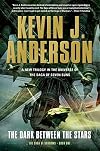
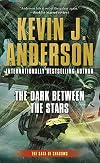
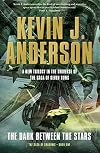
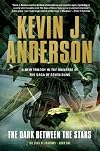
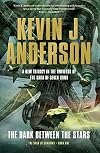
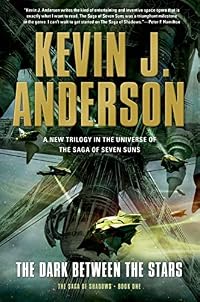
"Twenty years after the elemental conflict that nearly tore apart the cosmos in The Saga of Seven Suns, a new threat emerges from the darkness. The human race must set aside its own inner conflicts to rebuild their alliance with the Ildiran Empire for the survival of the galaxy. In Kevin J. Anderson's The Dark Between the Stars, galactic empires clash, elemental beings devastate whole planetary systems, and factions of humanity are pitted against each other. Heroes rise and enemies make show more their last stands in the climax of an epic tale seven years in the making. "-- show lessTags
Recommendations

Member Reviews
With a cast of dozens of characters, multiple plot threads, and a sprawling setting that spans an entire spiral arm of the galaxy, there are a number of words that can be used to describe this novel: Fat, flabby, ponderous, tedious, bland, and dull. There are some words that do not apply: Exciting, interesting, engaging, or good. Although The Dark Between the Stars is purportedly the beginning of The Saga of Shadows, it is actually the eighth book in a series, with the previous seven books making up the interminably overlong Saga of Seven Suns, meaning that a reader coming into this "new" series has to catch up on seven books worth of material to make heads or tales of what is going on in this book.
There are so many problems with this show more bloated and boring novel it is hard to know where to begin, but the most glaring issue is that The Dark Between the Stars clocks in at just under seven-hundred and forty pages in the mass market paperback edition, and that's about four hundred pages too many. This novel needed some rather extensive editing to winnow out the massive volumes of filler that reduces what should be a rip-roaring, fast-paced adventure to a plodding and mind-numbing grind. Entire chapters, entire characters, and entire plot-lines could have been excised from this volume and not only would doing so not have negatively affected the story in any meaningful way, the amputations would have dramatically improved the book.
The story is told via rotating viewpoints, with each chapter being told from the perspective of one or another of a couple dozen viewpoint characters. This results in a disjointed and chaotic book without any kind of central plot for the reader to hold on to and, paradoxically, no characters to care about. Each chapter tells a snippet of that character's story, and the perspective then shifts to a new character for the next chapter to tell another snippet of story. The end result of hopping from character to character is that the book has no narrative focus, and each of these substories meanders along in little disconnected vignettes, stopping for chapters at a time so that the book can wander off to drone on about the mostly meaningless doings of four, five, six, or more other characters before returning to pick up the thread it left hanging thirty or forty pages before. Plot threads are started, dropped for a hundred pages, and then picked up again. Or they are simply dropped and never returned to.
Rotating between characters can be a viable means of structuring a novel - George R.R. Martin and Harry Turtledove have done it successfully multiple times. But when those authors do it, they usually start with a plot and then branch out as the stories of individual characters develop. In The Dark Between the Stars, Anderson starts with a collection of unrelated chapters, and doesn't actually get around to providing something resembling an actual plot until about page two hundred. Even after the book has a vague facsimile of a plot, Anderson keeps wandering away from it for chapters on end to update the reader on some mostly irrelevant doings of a side character who is taking shore leave to go to his favorite restaurant, getting muddy in kelp fields, or cataloging asteroids. Time and again, the action of the book grinds to a halt just as it starts to pick up steam, dropping something promising in favor of more tedious triviality. The plot, such as it is, would probably be more interesting if the villain wasn't the wooden and dreary "Shana Rei", creatures made of entropy and shadow that have no goals other than to exterminate all life. It is somewhat fitting that the Shana Rei want to drain life out of the universe, because whenever they show up in the story, they drain what little life there is out of the story. Anderson even manages to make space battles against the Shana Rei dry and dull, which almost makes forgivable the fact that he breaks away in the middle of the action so that the reader can be regaled with the administrative doings of a medical research facility.
Having a story driven almost entirely by individual character sketches might possibly make for a decent book, provided that the characters were interesting and well-developed. Unfortunately, the characters Anderson creates are flat and boring caricatures that have no depth at all. Calling the characters in The Dark Between the Stars "cardboard cut outs" would imply they were two-dimensional, which is one dimension too many. Every character in the book is essentially the same except for one defining note that marks them as unique, and in some cases the "unique" element is just the job they have. Every character sounds the same, and most act the same as every other character in the book. Even the evil bug robot allied with the Shana Rei sounds exactly like all of the other characters in the book. As a result, it is nearly impossible to care about any of the characters, and nearly impossible to care about what happens to any of them. The characters are all so bland and the writing so colorless, that even when one drops entirely out of the narrative, it is all too easy to simply not notice their absence. With no real plot of consequence, and a collection of bland characters, nothing of real consequence in the story is ever really resolved, instead the story merely stops in media res, waiting for the next book in the series to be disgorged.
One element that makes so many of the characters feel the same is that they are all "special" in some way or another. If a character isn't a king or an emperor, they are the son or daughter of a king or emperor, or they are a former elected leader, or the child or grandchild of a former elected leader, or they are notably important in some other way. Even when a character at first seems to be just a pilot for a freight ship, a promising student, or a mechanic, they almost inevitably turn out to be politically connected via their family. The handful of people who are not politically connected are almost all villains: The self-made evil industrialist, the self-made evil workaholic and loyal sidekick to the evil industrialist, the self-made evil medical researcher, and her mysterious evil henchman. The real problem with this interlinked web of family and political connections is that it doesn't actually give the characters in it any kind of personality of their own. Shareen Fitzkellum isn't made any more of an interesting character because she's the granddaughter of Del Kellum, especially since Del's only personality trait is that he used to be the Speaker for the Roamer clans. The end result is a huge roster of people who are all more or less interchangeable, knitted together in a web of relationships that the reader simply has no reason to care about enough to keep straight.
This lack of characterization simply sucks the life out of any of the events that take place in the book. Early in the novel a lava mining operation on the moon Sheol suffers a catastrophe that we are told kills more than fifteen hundred people. Given that the catastrophe was predicted by one of the characters and the warnings were ignored by the evil industrialist, this seems like it is supposed to be a pivotal, character-defining moment. But even though he establishes dozens of characters in the novel, Anderson never bothered to do so for any of the lava mine workers, leaving entirely empty the emotional core that should have been at the heart of this sequence. Instead of providing the reader with a character to identify with who could experience the horror and terror of being buried alive in a container overwhelmed by lava and bringing home the weight of the disaster, we just get a number that is thrown around so much it becomes almost meaningless. The dead workers are an afterthought at best, and since it is clear that Anderson doesn't care about them at all, the reader doesn't either.
The world-building doesn't do the book any real favors either. Anderson has created a sprawling fictional world for his characters to live in, but it is clear that he had no real idea of how to put it together other than to throw everything and the kitchen sink into the mix. In an odd twist, the setting feels much more like a standard fantasy setting than a science fiction one, with fire elementals, water elementals, magical possession, magical intelligent trees that altered priests can talk to, magical healing "blood", space elves, and so on and so forth. One of the characters has a title that literally translates as "wizard-emperor". But Anderson also hits a pile of space opera tropes as well - space gypsies, free roaming space traders, royal guards armed with crystal weapons, space kings and princes, and more. The problem with this sort of blender style method of worldbuilding is that after piling trope upon cliche, the sum total that results is a rather generic and flavorless morass.
All of this might be salvageable if the writing was good. Unfortunately, it is not. I have seen reports that Anderson claims to have written 240,000 words of the novel in roughly two months, and it shows. Large chunks of the novel read like they were written by someone in a middle-school composition class with lines such as "[w]ith seven suns nearby, Ildira's perpetual day kept all shadows at bay". Despite the fact that the novel is ponderously long, many sections amount to hurried accounts of what went on, telling the reader what is happening rather than actually having the action unfold. After the Sheol lava mine disaster, the reader is told that several workers who were trapped managed to record messages before they died. We are told that some left messages for their families, some cursed the evil industrialist who had skimped on safety measures, and some seemed resigned to their fate. But that's the sum total of what the reader is told about these messages. Instead of giving some weight to the story by giving actual first-person messages to read full of anguish, anger, and fear, Anderson simply tells us the kinds of things that the workers recorded with no emotional content at all. This sort of flat and bland reporting of events happens over and over in the book, yielding a story that feels oddly rushed despite the book's substantial length, and at the same time making everything homogeneous and uninteresting.
Amidst the lifeless prose, Anderson does display a few odd linguistic quirks. One of the odder ones relates to a character named Rlinda whose personality traits are that she is fat, loves food, and has been married multiple times. There are several references made to Bebob, her "favorite ex-husband", which seems perfectly ordinary at first, until it is revealed that the reason Rlinda is no longer married to Bebob is that he died. Referring to a deceased husband as an "ex-husband" is possibly technically correct, but it is certainly a strange way to phrase the relationship between the two. There are other idiosyncratic stylings in the text: At one point a set of warnings that had turned out to be accurate are described as "Chicken Little" warnings, weapons are referred to as being spears in one passage and katanas in the next, and so on. These are the sort of minor oddities that one might expect from an author for whom English was not their first language, but seem like careless or even thoughtless incongruities in a book by a native author - caused perhaps by the fact that the book was drafted at the breakneck pace of approximately four thousand words a day. Writing at such a furious pace, it seems, imposes its own costs.
At one point in the novel a character with the simultaneously trite and ridiculous name Tom Rom eats what is described as a flavorless nutrient bar. This seems like an apt metaphor for The Dark Between the Stars, except that rather than being nutritious, the novel is junk food. It is just bland and flavorless junk food. Over the course of one hundred and thirty-nine chapters, a collection of one-dimensional characters in a generic space opera setting meander through an almost nonexistent plot, eventually arriving at an inconclusive and uninspiring ending. Granted, this book is the first in a trilogy, so one would expect some plot threads to be left hanging to be resolved in future volumes, but instead virtually everything is left hanging and the book simply stops rather than coming to any sort of conclusion. In short, this is a novel in which a cavalcade of fairly uninteresting characters drift through a thin plot until the book winds down to an unsatisfying conclusion.
This review has also been posted to my blog Dreaming About other Worlds. show less
There are so many problems with this show more bloated and boring novel it is hard to know where to begin, but the most glaring issue is that The Dark Between the Stars clocks in at just under seven-hundred and forty pages in the mass market paperback edition, and that's about four hundred pages too many. This novel needed some rather extensive editing to winnow out the massive volumes of filler that reduces what should be a rip-roaring, fast-paced adventure to a plodding and mind-numbing grind. Entire chapters, entire characters, and entire plot-lines could have been excised from this volume and not only would doing so not have negatively affected the story in any meaningful way, the amputations would have dramatically improved the book.
The story is told via rotating viewpoints, with each chapter being told from the perspective of one or another of a couple dozen viewpoint characters. This results in a disjointed and chaotic book without any kind of central plot for the reader to hold on to and, paradoxically, no characters to care about. Each chapter tells a snippet of that character's story, and the perspective then shifts to a new character for the next chapter to tell another snippet of story. The end result of hopping from character to character is that the book has no narrative focus, and each of these substories meanders along in little disconnected vignettes, stopping for chapters at a time so that the book can wander off to drone on about the mostly meaningless doings of four, five, six, or more other characters before returning to pick up the thread it left hanging thirty or forty pages before. Plot threads are started, dropped for a hundred pages, and then picked up again. Or they are simply dropped and never returned to.
Rotating between characters can be a viable means of structuring a novel - George R.R. Martin and Harry Turtledove have done it successfully multiple times. But when those authors do it, they usually start with a plot and then branch out as the stories of individual characters develop. In The Dark Between the Stars, Anderson starts with a collection of unrelated chapters, and doesn't actually get around to providing something resembling an actual plot until about page two hundred. Even after the book has a vague facsimile of a plot, Anderson keeps wandering away from it for chapters on end to update the reader on some mostly irrelevant doings of a side character who is taking shore leave to go to his favorite restaurant, getting muddy in kelp fields, or cataloging asteroids. Time and again, the action of the book grinds to a halt just as it starts to pick up steam, dropping something promising in favor of more tedious triviality. The plot, such as it is, would probably be more interesting if the villain wasn't the wooden and dreary "Shana Rei", creatures made of entropy and shadow that have no goals other than to exterminate all life. It is somewhat fitting that the Shana Rei want to drain life out of the universe, because whenever they show up in the story, they drain what little life there is out of the story. Anderson even manages to make space battles against the Shana Rei dry and dull, which almost makes forgivable the fact that he breaks away in the middle of the action so that the reader can be regaled with the administrative doings of a medical research facility.
Having a story driven almost entirely by individual character sketches might possibly make for a decent book, provided that the characters were interesting and well-developed. Unfortunately, the characters Anderson creates are flat and boring caricatures that have no depth at all. Calling the characters in The Dark Between the Stars "cardboard cut outs" would imply they were two-dimensional, which is one dimension too many. Every character in the book is essentially the same except for one defining note that marks them as unique, and in some cases the "unique" element is just the job they have. Every character sounds the same, and most act the same as every other character in the book. Even the evil bug robot allied with the Shana Rei sounds exactly like all of the other characters in the book. As a result, it is nearly impossible to care about any of the characters, and nearly impossible to care about what happens to any of them. The characters are all so bland and the writing so colorless, that even when one drops entirely out of the narrative, it is all too easy to simply not notice their absence. With no real plot of consequence, and a collection of bland characters, nothing of real consequence in the story is ever really resolved, instead the story merely stops in media res, waiting for the next book in the series to be disgorged.
One element that makes so many of the characters feel the same is that they are all "special" in some way or another. If a character isn't a king or an emperor, they are the son or daughter of a king or emperor, or they are a former elected leader, or the child or grandchild of a former elected leader, or they are notably important in some other way. Even when a character at first seems to be just a pilot for a freight ship, a promising student, or a mechanic, they almost inevitably turn out to be politically connected via their family. The handful of people who are not politically connected are almost all villains: The self-made evil industrialist, the self-made evil workaholic and loyal sidekick to the evil industrialist, the self-made evil medical researcher, and her mysterious evil henchman. The real problem with this interlinked web of family and political connections is that it doesn't actually give the characters in it any kind of personality of their own. Shareen Fitzkellum isn't made any more of an interesting character because she's the granddaughter of Del Kellum, especially since Del's only personality trait is that he used to be the Speaker for the Roamer clans. The end result is a huge roster of people who are all more or less interchangeable, knitted together in a web of relationships that the reader simply has no reason to care about enough to keep straight.
This lack of characterization simply sucks the life out of any of the events that take place in the book. Early in the novel a lava mining operation on the moon Sheol suffers a catastrophe that we are told kills more than fifteen hundred people. Given that the catastrophe was predicted by one of the characters and the warnings were ignored by the evil industrialist, this seems like it is supposed to be a pivotal, character-defining moment. But even though he establishes dozens of characters in the novel, Anderson never bothered to do so for any of the lava mine workers, leaving entirely empty the emotional core that should have been at the heart of this sequence. Instead of providing the reader with a character to identify with who could experience the horror and terror of being buried alive in a container overwhelmed by lava and bringing home the weight of the disaster, we just get a number that is thrown around so much it becomes almost meaningless. The dead workers are an afterthought at best, and since it is clear that Anderson doesn't care about them at all, the reader doesn't either.
The world-building doesn't do the book any real favors either. Anderson has created a sprawling fictional world for his characters to live in, but it is clear that he had no real idea of how to put it together other than to throw everything and the kitchen sink into the mix. In an odd twist, the setting feels much more like a standard fantasy setting than a science fiction one, with fire elementals, water elementals, magical possession, magical intelligent trees that altered priests can talk to, magical healing "blood", space elves, and so on and so forth. One of the characters has a title that literally translates as "wizard-emperor". But Anderson also hits a pile of space opera tropes as well - space gypsies, free roaming space traders, royal guards armed with crystal weapons, space kings and princes, and more. The problem with this sort of blender style method of worldbuilding is that after piling trope upon cliche, the sum total that results is a rather generic and flavorless morass.
All of this might be salvageable if the writing was good. Unfortunately, it is not. I have seen reports that Anderson claims to have written 240,000 words of the novel in roughly two months, and it shows. Large chunks of the novel read like they were written by someone in a middle-school composition class with lines such as "[w]ith seven suns nearby, Ildira's perpetual day kept all shadows at bay". Despite the fact that the novel is ponderously long, many sections amount to hurried accounts of what went on, telling the reader what is happening rather than actually having the action unfold. After the Sheol lava mine disaster, the reader is told that several workers who were trapped managed to record messages before they died. We are told that some left messages for their families, some cursed the evil industrialist who had skimped on safety measures, and some seemed resigned to their fate. But that's the sum total of what the reader is told about these messages. Instead of giving some weight to the story by giving actual first-person messages to read full of anguish, anger, and fear, Anderson simply tells us the kinds of things that the workers recorded with no emotional content at all. This sort of flat and bland reporting of events happens over and over in the book, yielding a story that feels oddly rushed despite the book's substantial length, and at the same time making everything homogeneous and uninteresting.
Amidst the lifeless prose, Anderson does display a few odd linguistic quirks. One of the odder ones relates to a character named Rlinda whose personality traits are that she is fat, loves food, and has been married multiple times. There are several references made to Bebob, her "favorite ex-husband", which seems perfectly ordinary at first, until it is revealed that the reason Rlinda is no longer married to Bebob is that he died. Referring to a deceased husband as an "ex-husband" is possibly technically correct, but it is certainly a strange way to phrase the relationship between the two. There are other idiosyncratic stylings in the text: At one point a set of warnings that had turned out to be accurate are described as "Chicken Little" warnings, weapons are referred to as being spears in one passage and katanas in the next, and so on. These are the sort of minor oddities that one might expect from an author for whom English was not their first language, but seem like careless or even thoughtless incongruities in a book by a native author - caused perhaps by the fact that the book was drafted at the breakneck pace of approximately four thousand words a day. Writing at such a furious pace, it seems, imposes its own costs.
At one point in the novel a character with the simultaneously trite and ridiculous name Tom Rom eats what is described as a flavorless nutrient bar. This seems like an apt metaphor for The Dark Between the Stars, except that rather than being nutritious, the novel is junk food. It is just bland and flavorless junk food. Over the course of one hundred and thirty-nine chapters, a collection of one-dimensional characters in a generic space opera setting meander through an almost nonexistent plot, eventually arriving at an inconclusive and uninspiring ending. Granted, this book is the first in a trilogy, so one would expect some plot threads to be left hanging to be resolved in future volumes, but instead virtually everything is left hanging and the book simply stops rather than coming to any sort of conclusion. In short, this is a novel in which a cavalcade of fairly uninteresting characters drift through a thin plot until the book winds down to an unsatisfying conclusion.
This review has also been posted to my blog Dreaming About other Worlds. show less
Great SciFi read. Just the kind I like with great plot and interesting characters.
Little hard to follow at first mainly because there are so many different actors in this drama but,
God love him, the author included a glossary which really helped me keep everyone straight.
This is a series book and I can't wait to read the next one.
Been a while since I've found a great SciFi book I haven't read, so happy to have found this one. Highly recommend it.
Little hard to follow at first mainly because there are so many different actors in this drama but,
God love him, the author included a glossary which really helped me keep everyone straight.
This is a series book and I can't wait to read the next one.
Been a while since I've found a great SciFi book I haven't read, so happy to have found this one. Highly recommend it.
I started this book because it was nominated for a Hugo award. The Dark Between the Stars is nothing remarkable. It sort of reminds me of one of those disaster movies from the 1970s. For over a hundred pages, nearly every chapter centers around a new character. I believe there are only 4 characters who show up more than once. There is not much action other than a martial spat and disagreement over the safety of a planet leading to one parent to abduct a child until page 114. Finally when there is a whiff of action, it is predictable. There is a search for new medical cures. Five "half-bred" children (by different fathers) are the result of series of rapes. The mother loves them equally save one son who wants to restore his father's show more place in history which makes his mother very uncomfortable because of the serial rapes she survived. These children will apparently be important in the story. There is a race that has telepathic abilities and legends of an evil darkness.
I decided to give up on page 150 because when I look at at all the books I really want to read, did not feel the need to invest the time. Anderson may have some good books out there but this one does not strike me as particularly good. I don't find the characters believable. There is weakness in Anderson's understanding of basic biology. For example, he has a character harvesting the royal jelly of the carcasses of a rotting insect species for medical research. What is the value of specimens that have been compromised by decay? He also seems to have only the crudest understanding of what is involved working for a company as a professional. I have no doubt he works hard but to me it looks like he wrote this book too quickly. I can see why this would be a guilty pleasure for some readers but not why it deserves an award. show less
I've finally got around to reading the last official entry to the 2015 Hugo Nominees and I'm caught in a conundrum.
I wanted to give this novel a thorough dissection, but only because it didn't leave me feeling like I'd just passed through something wonderful and grand. No beautiful metamorphosis of my soul or imagination, nor even a romp through a digestive track.
Instead, I find myself wanting to say that this tale was paid in homage to the old space-opera tales, notably Lensman. The other homages are a little more murky for me, strangely enough, because I'm reminded of Hyperion of twenty-six years ago which was, itself, a homage to other authors' imaginations.
There's nothing wrong with this, of course. Ideas are always stolen. As a show more novel of BFI's, this novel ought to sit up there with Ringworld or Rama or any number of comics like the ones I've enjoyed by Dan Abnet. Big Ideas are fun, and executed well, they overflow with a sense of wonder.
But there's still a catch.
The writing must be superlative.
I just don't think the writing was as good as it ought to be if it is going to be nominated for a Hugo. The writing is fine for pulp fiction. It's fine to get from point A to point B, but it just didn't grab me as so many novels have. It took me a full 2/3 of the novel before I felt like I was flowing with either the characters or the action, and that's because the grand space battle was finally beginning.
As for the cast of characters, I only started feeling kinship with them as they either died or got into supreme danger. Those who missed that ride were either an ex machina to resolve conflict or amp up the melodrama. I didn't feel like I was cheated, per se, because I already know that I'm going to have to read the books that follow in order to reap the real benefits, but as a standalone novel, it rests very heavily on events that have already passed or on those that will be. The action of the big NOW was sort of... well... Alderaan didn't explode.
Maybe I'm too harsh. I didn't dislike the novel. It was industrious and accomplished a lot.
Unfortunately, the writing didn't sparkle. The characters weren't awesome. The tension didn't aggravate. I actually wondered at various points if the big battles could have benefitted more from a horror perspective, full of hints and drama but no perfect reveals. Maybe so, but that wasn't the novel I read.
I've read a pretty decent amount of Mr. Anderson's novels, and this one is pretty much on par with them. It is a bit better than most, and a lot better than a few. It hearkens people back to some of the old grand space-opera days, and successfully so.
Unfortunately, This isn't my primary choice for the Hugo Award, and, worse, I'm not certain it really belongs as a nominee.
Brad K Horner's Blog show less
I wanted to give this novel a thorough dissection, but only because it didn't leave me feeling like I'd just passed through something wonderful and grand. No beautiful metamorphosis of my soul or imagination, nor even a romp through a digestive track.
Instead, I find myself wanting to say that this tale was paid in homage to the old space-opera tales, notably Lensman. The other homages are a little more murky for me, strangely enough, because I'm reminded of Hyperion of twenty-six years ago which was, itself, a homage to other authors' imaginations.
There's nothing wrong with this, of course. Ideas are always stolen. As a show more novel of BFI's, this novel ought to sit up there with Ringworld or Rama or any number of comics like the ones I've enjoyed by Dan Abnet. Big Ideas are fun, and executed well, they overflow with a sense of wonder.
But there's still a catch.
The writing must be superlative.
I just don't think the writing was as good as it ought to be if it is going to be nominated for a Hugo. The writing is fine for pulp fiction. It's fine to get from point A to point B, but it just didn't grab me as so many novels have. It took me a full 2/3 of the novel before I felt like I was flowing with either the characters or the action, and that's because the grand space battle was finally beginning.
As for the cast of characters, I only started feeling kinship with them as they either died or got into supreme danger. Those who missed that ride were either an ex machina to resolve conflict or amp up the melodrama. I didn't feel like I was cheated, per se, because I already know that I'm going to have to read the books that follow in order to reap the real benefits, but as a standalone novel, it rests very heavily on events that have already passed or on those that will be. The action of the big NOW was sort of... well... Alderaan didn't explode.
Maybe I'm too harsh. I didn't dislike the novel. It was industrious and accomplished a lot.
Unfortunately, the writing didn't sparkle. The characters weren't awesome. The tension didn't aggravate. I actually wondered at various points if the big battles could have benefitted more from a horror perspective, full of hints and drama but no perfect reveals. Maybe so, but that wasn't the novel I read.
I've read a pretty decent amount of Mr. Anderson's novels, and this one is pretty much on par with them. It is a bit better than most, and a lot better than a few. It hearkens people back to some of the old grand space-opera days, and successfully so.
Unfortunately, This isn't my primary choice for the Hugo Award, and, worse, I'm not certain it really belongs as a nominee.
Brad K Horner's Blog show less
So, this is book one of a series--a good place to start, right?
Except that this series is a successor to a previous series, The Saga of the Seven Suns. Of the many characters in this long book, most seem to have an extensive history from the prior series. This is probably a fine thing for those who read the previous series. For those of us who didn't, we don't get the benefit of that character development.
And there are a great many characters, nor do we spend much time with any of them. We're constantly jumping between characters and plotlines that don't necessarily have much apparent connection. Characterization is limited and rather cardboard, and common sense doesn't seem to play a large role in anyone's decision-making process. For show more instance, a character goes to great lengths to collect "royal jelly" from the decades-dead corpses of an insect species, for medical research. There's no apparent concern, or even apparent awareness, about the effects of biological decay on the usefulness of the jelly for research.
Between the constant jumping around, and the flimsy characterization, it's difficult to develop any empathy for any of the characters. I nearly succeeded with the father and son fleeing a planet that the father, with excellent grounds, believes is about to experience a major disaster. But, alas, we zip away from them, to multiple other characters and plotlines, and don't come back for quite a while. When we do, we zip away again fairly quickly.
The prose is pedestrian, and just to be absolutely clear: "Pedestrian" prose is not "transparent" prose. Transparent prose requires real skill and craft. The prose here is no more than adequate. It's certainly no compensation for diffuse and distracting plotting and barely-present character development.
I read this only because it's one of the Hugo Best Novel nominees for 2015. "Not nearly as bad as puppy nominees in other categories" is not adequate reason for being on the Hugo ballot.
I bought this book. show less
Except that this series is a successor to a previous series, The Saga of the Seven Suns. Of the many characters in this long book, most seem to have an extensive history from the prior series. This is probably a fine thing for those who read the previous series. For those of us who didn't, we don't get the benefit of that character development.
And there are a great many characters, nor do we spend much time with any of them. We're constantly jumping between characters and plotlines that don't necessarily have much apparent connection. Characterization is limited and rather cardboard, and common sense doesn't seem to play a large role in anyone's decision-making process. For show more instance, a character goes to great lengths to collect "royal jelly" from the decades-dead corpses of an insect species, for medical research. There's no apparent concern, or even apparent awareness, about the effects of biological decay on the usefulness of the jelly for research.
Between the constant jumping around, and the flimsy characterization, it's difficult to develop any empathy for any of the characters. I nearly succeeded with the father and son fleeing a planet that the father, with excellent grounds, believes is about to experience a major disaster. But, alas, we zip away from them, to multiple other characters and plotlines, and don't come back for quite a while. When we do, we zip away again fairly quickly.
The prose is pedestrian, and just to be absolutely clear: "Pedestrian" prose is not "transparent" prose. Transparent prose requires real skill and craft. The prose here is no more than adequate. It's certainly no compensation for diffuse and distracting plotting and barely-present character development.
I read this only because it's one of the Hugo Best Novel nominees for 2015. "Not nearly as bad as puppy nominees in other categories" is not adequate reason for being on the Hugo ballot.
I bought this book. show less
The book starts to get really interesting around page 400. The main problem with the book is that it has so many different POVs that have very short chapters that Kevin Anderson rewrites things over and over again from the characters point of view. The book is 784 pages long, but could easily be condensed if he focused more on less characters. Most characters are always interacting with the other, so there was very little reason why every character had to have their own POV. For me the worse part is that when it starts getting interesting, the book just ends. Even though this is part of a series, there should still be some sort of conclusion to the focus of the book.
I gave up on this book after trying to read it for almost a month. I did almost get to the halfway point, 46% to be exact. The switching between characters and plots/subplots every chapter finally defeated me. I gave up at the end of Chapter 59, and there had been approximately 30 viewpoint characters, each with mostly their own subplot, that do have some interconnection, maybe. But don't seem to have any attachment to the 'main plot' of Elemental Evil invading the galaxy, after being defeated millenia ago. At least, I THINK that may be the main plot… It only really started getting developed within the past few chapters, over 1/4 of the way through …)
Why did the roboticist/compy rehabilitator, when her marriage collapses because her show more husband had an affair with another woman and that lady got pregnant, run to the exTrade Minister/ now restauranteur / shipping company exec? How does that tie to the Roamer clan leaving all the rest? Or the Prince having an incurable disease? show less
Why did the roboticist/compy rehabilitator, when her marriage collapses because her show more husband had an affair with another woman and that lady got pregnant, run to the exTrade Minister/ now restauranteur / shipping company exec? How does that tie to the Roamer clan leaving all the rest? Or the Prince having an incurable disease? show less
Members
- Recently Added By
Author Information

461+ Works 86,179 Members
Kevin J. Anderson was born on March 27, 1962. Before becoming a full-time author, he worked in California for twelve years as a technical writer and editor at the Lawrence Livermore National Laboratory. His science fiction books include Resurrection, Inc., the Star Wars Jedi Academy Trilogy, the Young Jedi Knights series, Ground Zero, Ruins, show more Climbing Olympus, Blindfold, and The Dark Between the Stars. He has also written several books with Doug Beason including Ignition, Virtual Destruction, Fallout, and Ill Wind. (Bowker Author Biography) Kevin J. Anderson has written twenty seven bestsellers and has been nominated for the Nebula Award, the Bram Stoker Award, and the SFX Reader's Choice Award. He also holds the Guinness world record for "The Largest Single-Author Signing". (Publisher Provided) show less
Some Editions
Awards and Honors
Awards
Series


Belongs to Publisher Series
Science Fiction Book Club (5944)
Common Knowledge
- Canonical title
- The Dark Between the Stars
- Original publication date
- 2014
- First words
- He had to run, and he fled with the boy out into the dark spaces between the stars.
- Last words
- (Click to show. Warning: May contain spoilers.)We beg sanctuary from the creatures of darkness.
Classifications
Statistics
- Members
- 345
- Popularity
- 91,256
- Reviews
- 22
- Rating
- (3.07)
- Languages
- English
- Media
- Paper, Audiobook, Ebook
- ISBNs
- 11
- ASINs
- 4