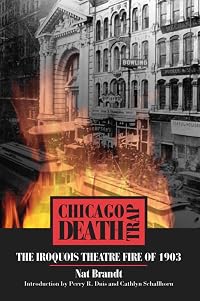
Chicago Death Trap: The Iroquois Theatre Fire of 1903
by Nat Brandt
On This Page
Description
On the afternoon of December 30, 1903, during a sold out matinee performance, a fire broke out in Chicago's Iroquois Theatre. In the short span of twenty minutes, more than six hundred people were asphyxiated, burned, or trampled to death in a panicked mob's failed attempt to escape. In ""Chicago Death Trap: The Iroquois Theatre Fire of 1903"", Nat Brandt provides a detailed chronicle of this horrific event to assess not only the titanic tragedy of the fire itself but also the municipal show more corruption and greed that kindled the flames beforehand and the political cover-ups hidden in the smoke and ash afterwards. Advertised as ""absolutely fireproof,"" the Iroquois was Chicago's most modern playhouse when it opened in the fall of 1903. With the approval of the city's building department, theater developers Harry J. Powers and William J. Davis opened the theater prematurely to take full advantage of the holiday crowds, ignoring flagrant safety violations in the process. The aftermath of the fire proved to be a study in the miscarriage of justice. Despite overwhelming evidence that the building was not complete, that fire safety laws were ignored, and that management had deliberately sealed off exits during the performance, no one was ever convicted or otherwise held accountable for the enormous loss of life. Lavishly illustrated and featuring an introduction by Chicago historians Perry R. Duis and Cathlyn Schallhorn, ""Chicago Death Trap: The Iroquois Theatre Fire of 1903"" is rich with vivid details about this horrific disaster, captivatingly presented in human terms without losing sight of the broader historical context. show lessTags
Recommendations
















Member Recommendations
Member Reviews
Chicago Death Trap tells the story of the 1903 Theater Fire, which caused the deaths of 602 patrons. The story is an interesting one, albeit terribly sad, and makes for an interesting history. This book does a good job explaining what happened and why, and includes the aftermath (or lack thereof) both in Chicago firecodes and throughout the world.
My major quibble with this book is that the early chapter provides a description of the layout of the theater, which is quite important to understanding the events of the tragedy, but doesn't include the blueprint or floorplan (or reference the ones that are included about 1/3 of the book later). I understand there are limits on printing but I feel it would have been invaluable to have that show more reference while reading those sections, and while I looked for it I couldn't find it until it was too late. (There was also a depressing lack of explanation of what a bascule lock is, given it's importance in the fire exits not opening. Here's what I could find: http://schlagelocks.wordpress.com/2009/03/04/the-extinction-of-the-bascule-lock/... show less
My major quibble with this book is that the early chapter provides a description of the layout of the theater, which is quite important to understanding the events of the tragedy, but doesn't include the blueprint or floorplan (or reference the ones that are included about 1/3 of the book later). I understand there are limits on printing but I feel it would have been invaluable to have that show more reference while reading those sections, and while I looked for it I couldn't find it until it was too late. (There was also a depressing lack of explanation of what a bascule lock is, given it's importance in the fire exits not opening. Here's what I could find: http://schlagelocks.wordpress.com/2009/03/04/the-extinction-of-the-bascule-lock/... show less
When the Iroquois Theatre opened in Chicago on November 23, 1903, it was intended to rival the greatest theaters in New York. The design was inspired by European architecture, the interior finishes were luxurious, and the theater was advertised as "absolutely fireproof". The city had been destroyed in the Great Chicago fire of 1871, and the city fire codes had been substantially updated in 1898. However, a number of individuals had noticed deficiencies in design, and the absence of fire protection features that were required for all places of assembly.
When fire broke out during a matinee performance on December 30 of that year, the theater was packed with several hundred people more than the occupancy permit allowed, with the audience show more dominated by women and children. The fire eventually claimed 602 lives, the largest loss of life ever in an American place of assembly. As is the case in most multiple-death fires, numerous violations of the fire codes existed.
Direct exits from the theater were covered by heavy curtains. The doors used complicated locks that were common in Europe but were not familiar to American theatergoers. In any case, those doors led to fire escapes that had not been completed. Indoor exits from the balcony levels were blocked by metal gates, padlocked in place to prevent any of the balcony occupants from moving down to more expensive seats. Theater employees had not been trained on emergency procedures. Some ushers refused to unlock the exit doors and the metal gates; others simply fled rather than assisting audience members to exit.
The stagehand who would normally operate the asbestos fire curtain was not on site, and other crew members were not sure how to operate the curtain. When someone finally did manage to release it, the curtain was blocked by a light fixture and failed to close completely. The curtain was not actually fireproof, and it was destroyed in the fire.
The required direct fire alarm connection to the fire department had not been installed, and more than 15 critical minutes passed before a stagehand walked to Fire Station 13 to report the fire. Automatic fire sprinklers had not been installed, and the required fire standpipes were not connected to a water supply. Fire/smoke vents above the stage had been wired shut.
A passerby opened a pair of tall doors at the back of the stage, allowing all but two members of the crew to escape, but the resulting backdraft sealed the fate of any audience members who had not already escaped.
Nat Brandt, the author of Chicago Death Trap, is a veteran journalist who had access to archival materials on theatrical history. Each chapter begins with a section of the Chicago fire code in effect at the time of the fire, but violated in the Iroquois. Much of the book is based on The Great Chicago Theater Disaster, published in 1904 by Marshall Everett. The inclusion of materials from Everett's book, including firsthand accounts and photos of some of the deceased, adds immediacy to the story. However, Brandt's account includes some inaccuracies in technical details of the fire and the fire department response. show less
When fire broke out during a matinee performance on December 30 of that year, the theater was packed with several hundred people more than the occupancy permit allowed, with the audience show more dominated by women and children. The fire eventually claimed 602 lives, the largest loss of life ever in an American place of assembly. As is the case in most multiple-death fires, numerous violations of the fire codes existed.
Direct exits from the theater were covered by heavy curtains. The doors used complicated locks that were common in Europe but were not familiar to American theatergoers. In any case, those doors led to fire escapes that had not been completed. Indoor exits from the balcony levels were blocked by metal gates, padlocked in place to prevent any of the balcony occupants from moving down to more expensive seats. Theater employees had not been trained on emergency procedures. Some ushers refused to unlock the exit doors and the metal gates; others simply fled rather than assisting audience members to exit.
The stagehand who would normally operate the asbestos fire curtain was not on site, and other crew members were not sure how to operate the curtain. When someone finally did manage to release it, the curtain was blocked by a light fixture and failed to close completely. The curtain was not actually fireproof, and it was destroyed in the fire.
The required direct fire alarm connection to the fire department had not been installed, and more than 15 critical minutes passed before a stagehand walked to Fire Station 13 to report the fire. Automatic fire sprinklers had not been installed, and the required fire standpipes were not connected to a water supply. Fire/smoke vents above the stage had been wired shut.
A passerby opened a pair of tall doors at the back of the stage, allowing all but two members of the crew to escape, but the resulting backdraft sealed the fate of any audience members who had not already escaped.
Nat Brandt, the author of Chicago Death Trap, is a veteran journalist who had access to archival materials on theatrical history. Each chapter begins with a section of the Chicago fire code in effect at the time of the fire, but violated in the Iroquois. Much of the book is based on The Great Chicago Theater Disaster, published in 1904 by Marshall Everett. The inclusion of materials from Everett's book, including firsthand accounts and photos of some of the deceased, adds immediacy to the story. However, Brandt's account includes some inaccuracies in technical details of the fire and the fire department response. show less
I found this very well written. I enjoyed it. A way to learn history and yet it was interesting. Very sad story. I learned something.
Ratings
Members
- Recently Added By
Lists

Disaster Books
74 works; 19 members

Accidents, Disasters, and Tragedies
175 works; 7 members

Chicago Books
87 works; 4 members
Author Information

15+ Works 384 Members
Veteran journalist Nat Brandt is the author of ten previous books. The former editor-in-chief of Publishers Weekly, Brandt was also an editor for The New York Times and managing editor of American Heritage. He is the creator of the PBS television series Crucible of the Millennium, for which he also served as head of research
Common Knowledge
- Canonical title
- Chicago Death Trap: The Iroquois Theatre Fire of 1903
- Original publication date
- 2003
- People/Characters
- Benjamin J Marshall (architect); Harry J Powers (co-owner); William J Davis (co-owner); Carter Henry Harrison (Chicago mayor); William H Musham (Chicago fire chief); William C Sallers (Iroquois Theatre fireman) (show all 7); Eddie Foy (actor)
- Important places
- Iroquois Theatre, Chicago, Illinois, USA; Chicago, Illinois, USA
- Important events
- Iroquois Theatre Fire (1903-12-30)
- Dedication
- To my grandchildren - Danielle, Gregory, Kristin, Kaileigh, Sonya, Gabriel, Adlai, and Lucian
- First words
- Eddie Foy was "coming home" to Chicago.
- Last words
- (Click to show. Warning: May contain spoilers.)His conclusion: "The theater was erected by one of the largest contracting firms in America in accordance with plan provided by a young and, as the layout shows, rather inexperienced architect, whose sacred duty should have been to prevent by all means the opening of a public building in an unfinished condition."
- Canonical DDC/MDS
- 977.311041
- Canonical LCC
- F548.5
Classifications
Statistics
- Members
- 88
- Popularity
- 359,767
- Reviews
- 3
- Rating
- (4.03)
- Languages
- English
- Media
- Paper, Audiobook, Ebook
- ISBNs
- 3
- ASINs
- 2