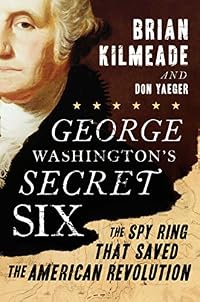
George Washington's Secret Six: The Spy Ring That Saved the American Revolution
by Brian Kilmeade (Author), Don Yaeger (Author)
On This Page
Description
When General George Washington beat a hasty retreat from New York City in August 1776, many thought the American Revolution might soon be over. Instead, Washington rallied--thanks in large part to a little-known, top-secret group called the Culper Spy Ring. Washington realized that he couldn't beat the British with military might, so he recruited a sophisticated and deeply secretive intelligence network to infiltrate New York. So carefully guarded were the members' identities that one spy's show more name was not uncovered until the twentieth century, and one remains unknown today. But by now, historians have discovered enough information about the ring's activities to piece together evidence that these six individuals turned the tide of the war. Here, these spies finally take their place among the pantheon of heroes of the American Revolution.--From publisher description. show lessTags
Recommendations




Member Reviews
I had been meaning to read this one for awhile, but there is nothing like necessity for pulling a book up from the middle of your TBR list. I needed to do a little research on spying techniques during the Revolution for my latest work.
George Washington's Secret Six is one of the "new style" history books that
crosses over from non-fiction into fiction. Not that the historical points are fiction, but that sometimes-unknowable dialogue, thoughts and actions are added. As you can tell from the review, I have mixed feelings about that. Would love to hear your thoughts.
Here's the review I posted on Amazon and GoodReads this morning:
George Washington's Secret Six is an engaging, easy read that tells the story of a little-known spy ring that show more was arguably essential to the American victory in the war for independence. If you would rather read about historical people and personalities than battle plans and troop movements, this is the book for you.
My only argument with the book is whether one could truly consider it non-fiction or whether it is more fictionalized fiction. There are references with descriptions given at the back of the book (although not footnoted within the text itself), and Kilmeade talks of meeting with the CIA' chief historian. All of which leads me to give the benefit of the doubt to the story-like telling of the narrative.
However, the amateur historian in me pauses a bit when dialogue and internal thoughts are given as factual. I remember one particular passage where during a meeting between Townsend and Woodhull the latter scratched at a bit of wax on a table and the former banged his fist on the same table making the candles jump. It's a passage as well written as any in a historical novel, but does it belong in non-fiction? I suppose those actions and the dialogue could have been constructed from memoirs of the individuals involved, but given their desire for secrecy, it's not likely that they would have included this level of detail.
I do not mean to sound overly critical. I would recommend this book to anyone and if it makes the reading of history more enjoyable, so much the better. If we just left it up to the dry tomes we were required to read in school, these brave men (and one woman) would be lost to us. Therefore, I am giving this one four stars.
On a side note: As a writer of historical fiction, I want to give a shout out to Tiffany Yecke Brooks who, given the acknowledgments, I suspect had a hand in the more fanciful parts of the story. You did indeed find a sweet spot, and I enjoyed them immensely. I hate to admit it, but I think Major Andre was my favorite character. show less
George Washington's Secret Six is one of the "new style" history books that
crosses over from non-fiction into fiction. Not that the historical points are fiction, but that sometimes-unknowable dialogue, thoughts and actions are added. As you can tell from the review, I have mixed feelings about that. Would love to hear your thoughts.
Here's the review I posted on Amazon and GoodReads this morning:
George Washington's Secret Six is an engaging, easy read that tells the story of a little-known spy ring that show more was arguably essential to the American victory in the war for independence. If you would rather read about historical people and personalities than battle plans and troop movements, this is the book for you.
My only argument with the book is whether one could truly consider it non-fiction or whether it is more fictionalized fiction. There are references with descriptions given at the back of the book (although not footnoted within the text itself), and Kilmeade talks of meeting with the CIA' chief historian. All of which leads me to give the benefit of the doubt to the story-like telling of the narrative.
However, the amateur historian in me pauses a bit when dialogue and internal thoughts are given as factual. I remember one particular passage where during a meeting between Townsend and Woodhull the latter scratched at a bit of wax on a table and the former banged his fist on the same table making the candles jump. It's a passage as well written as any in a historical novel, but does it belong in non-fiction? I suppose those actions and the dialogue could have been constructed from memoirs of the individuals involved, but given their desire for secrecy, it's not likely that they would have included this level of detail.
I do not mean to sound overly critical. I would recommend this book to anyone and if it makes the reading of history more enjoyable, so much the better. If we just left it up to the dry tomes we were required to read in school, these brave men (and one woman) would be lost to us. Therefore, I am giving this one four stars.
On a side note: As a writer of historical fiction, I want to give a shout out to Tiffany Yecke Brooks who, given the acknowledgments, I suspect had a hand in the more fanciful parts of the story. You did indeed find a sweet spot, and I enjoyed them immensely. I hate to admit it, but I think Major Andre was my favorite character. show less
I only made it through Chapter Four of this book. It was so full of hyperbole, misrepresentations, and downright inaccuracies that I was too infuriated to continue.
In my opinion, those who purport to convey “history” have a sacred trust, and I cannot understand why publishers let this kind of humbug see print.
Thus, this book became a “DNF” (did not finish) for me. (I started to keep a list of the passages in which the truth was distorted, misinterpreted, or just omitted, but after five pages of notes, I had had enough.)
I listened to the audio version of this book, read by Brian Kilmeade, who sounded as if he were enthusiastically reading fairy tales to kids. And maybe that was appropriate….
Evaluation: Maybe if you don’t show more know much early American history, you won’t even know that the information presented as fact is so inaccurate and objectionable. (It should be noted that the contortion of facts is all in the service of glorifying the American revolutionaries.) But I respect history, and I feel strongly about abusing it. I was outraged over this book. show less
In my opinion, those who purport to convey “history” have a sacred trust, and I cannot understand why publishers let this kind of humbug see print.
Thus, this book became a “DNF” (did not finish) for me. (I started to keep a list of the passages in which the truth was distorted, misinterpreted, or just omitted, but after five pages of notes, I had had enough.)
I listened to the audio version of this book, read by Brian Kilmeade, who sounded as if he were enthusiastically reading fairy tales to kids. And maybe that was appropriate….
Evaluation: Maybe if you don’t show more know much early American history, you won’t even know that the information presented as fact is so inaccurate and objectionable. (It should be noted that the contortion of facts is all in the service of glorifying the American revolutionaries.) But I respect history, and I feel strongly about abusing it. I was outraged over this book. show less
My Hamilton obsession turned into a Revolutionary War fixation. I ended up marathoning Turn on Netflix. So when this audiobook came through my hands at the bookdrop, I had to give it a go. I must admit that I did yell "HERCULES MULLIGAN!" and sing "Alexander Hamilton!" and shout out "Lafayette!" at all the appropriate places. I also found it enjoyable to see how much the television show took from reality. I enjoyed getting to know the real figures from history and their adventures. And now I finally found out why the ring was called Culper!
The book did a great job of delving into the identities and workings of the ring members. I had no idea about a lot of their exploits, including the counterfeiting ring exposure and helping to expose show more Benedict Arnold. I also loved to hear about Hamilton's role in that, as well as the fact that he decoded messages for Washington. I really enjoyed hearing about them developing techniques, figuring out how to expand the ring, and taking advantage of certain situations. It was honorable but tragic that some of the ring members were still labeled as loyalists after the war and couldn't tell anyone how they made the victory possible.
The reader, one of the authors, was okay as a reader. But he was always SUPER EXCITED ABOUT EVERY SENTENCE! It was a little hard to listen to for the whole book. It was kind of sweet how excited he was about the subject matter, though.
This was definitely a great read. show less
The book did a great job of delving into the identities and workings of the ring members. I had no idea about a lot of their exploits, including the counterfeiting ring exposure and helping to expose show more Benedict Arnold. I also loved to hear about Hamilton's role in that, as well as the fact that he decoded messages for Washington. I really enjoyed hearing about them developing techniques, figuring out how to expand the ring, and taking advantage of certain situations. It was honorable but tragic that some of the ring members were still labeled as loyalists after the war and couldn't tell anyone how they made the victory possible.
The reader, one of the authors, was okay as a reader. But he was always SUPER EXCITED ABOUT EVERY SENTENCE! It was a little hard to listen to for the whole book. It was kind of sweet how excited he was about the subject matter, though.
This was definitely a great read. show less
This is a juvenile adaptation of an adult nonfiction title. As I've mentioned in previous posts, when I'm looking for nonfiction, specifically history, I look for more nuanced titles. I feel that by the time kids are reaching middle school they should have a good basic grasp of facts and can start exploring more complete pictures of time periods; seeing the good and bad sides of famous people, understanding the many dark parts of our history, and finding the forgotten and unknown stories of people who have historically been left out of the record.
Realistically, I had fourth graders in book club that were confused about George Washington and Abraham Lincoln, so a little more focus on basic facts are probably warranted. At the same time, show more regardless of how much previous knowledge of an historical event or personage a reader has, I feel that ages 9-12, the age generally covered by "middle grade" is old enough to realize that nobody is perfect and to see both sides of various issues.
Also, I personally dislike any adulation of individuals and my immediate instinct is to point out all the things that they did wrong. I am a fun person to take long to political rallies or any kind of inspirational speech (not really). All of this is to say that the author's note prefacing the book, talking about the greatness of American and the "lofty standards" of George Washington immediately rubbed me the wrong way and did not predispose me to appreciate the book.
The book itself is a brisk retelling of the formation and work of the Culpepper spy ring. I have not read the original, but this felt as though they chopped the sentences down for a younger audience and hence it did not read smoothly for me. It also was a lot of descriptive writing and narrating of events without much action and it's a complex series of events that readers who are not fluent, or familiar with the history, will probably not be able to finish.
Factually, the book is accurate and the retelling serviceable. There are extensive resources, explanations of how the Culpepper spy ring affected both immediate and later history, timelines, index, etc.
Verdict: So, what would be my final verdict on this? From a personal viewpoint, I did not care for it. I found it rather dry reading and, as I said, was predisposed to dislike the authors' narrow focus. From a library standpoint, I have many readers in the 9-12 age range who are big war and history fans and will be able to read this more dense title; generally speaking, many families prefer this more narrow view of history with a somewhat limited and adulatory view of the Founding Fathers. So, while it's not my preference, it is something that my patrons will want and which will be of use in my library. I would recommend it as a supplementary title to a more diverse history collection, especially if you have readers interested in this particular aspect of the American Revolution.
ISBN: 9780425288986; Published January 2019 by Viking; Review copy provided by publisher; Donated to the library show less
Realistically, I had fourth graders in book club that were confused about George Washington and Abraham Lincoln, so a little more focus on basic facts are probably warranted. At the same time, show more regardless of how much previous knowledge of an historical event or personage a reader has, I feel that ages 9-12, the age generally covered by "middle grade" is old enough to realize that nobody is perfect and to see both sides of various issues.
Also, I personally dislike any adulation of individuals and my immediate instinct is to point out all the things that they did wrong. I am a fun person to take long to political rallies or any kind of inspirational speech (not really). All of this is to say that the author's note prefacing the book, talking about the greatness of American and the "lofty standards" of George Washington immediately rubbed me the wrong way and did not predispose me to appreciate the book.
The book itself is a brisk retelling of the formation and work of the Culpepper spy ring. I have not read the original, but this felt as though they chopped the sentences down for a younger audience and hence it did not read smoothly for me. It also was a lot of descriptive writing and narrating of events without much action and it's a complex series of events that readers who are not fluent, or familiar with the history, will probably not be able to finish.
Factually, the book is accurate and the retelling serviceable. There are extensive resources, explanations of how the Culpepper spy ring affected both immediate and later history, timelines, index, etc.
Verdict: So, what would be my final verdict on this? From a personal viewpoint, I did not care for it. I found it rather dry reading and, as I said, was predisposed to dislike the authors' narrow focus. From a library standpoint, I have many readers in the 9-12 age range who are big war and history fans and will be able to read this more dense title; generally speaking, many families prefer this more narrow view of history with a somewhat limited and adulatory view of the Founding Fathers. So, while it's not my preference, it is something that my patrons will want and which will be of use in my library. I would recommend it as a supplementary title to a more diverse history collection, especially if you have readers interested in this particular aspect of the American Revolution.
ISBN: 9780425288986; Published January 2019 by Viking; Review copy provided by publisher; Donated to the library show less
This is a popular history – no footnotes but a brief bibliography and index – and it’s tightly focused on the Culper Spy Ring operating in British occupied New York City. It covers much the same territory as Chapter Nine, “American Intelligence Activities Reach Maturity” of Kenneth A. Daigler’s Spies, Patriots, and Traitors. It even relies on the same histories of the Culper Spy Ring as Daigler: John Edwin Bakeless’s Turncoats, Traitors, and Heroes (1998), John A. Nagy’s Invisible Ink: Spycraft in the American Revolution (2010), and Morton Pennypacker’s General Washington’s Spies (1939).
That focus allows a couple of things missing from Daigler’s account: an in-depth profile of the six spies (well, five actually show more because the identity of No. 355, as she was known to Washington, is not definitively known), a greater sense of what it was like to live in occupied New York, and quotes from the correspondence of the spy ring.
Kilmeade and Yaeger, to make the story more vivid, provide dialogue at certain points based on written documents.
The remarkable thing about most of the members of the spy ring is that they sought – with one exception, no recognition after the war. Indeed, the identity of one, Robert Townsend, was not known until 1929 when some of his papers came in the possession of Pennypacker, and he matched Townsend’s handwriting to the agent Samuel Culper Jr correspondence in an archive of George Washington’s papers. Another remarkable thing about the Culper Spy Ring is that George Washington and the case officer who ran the ring, Benjamin Tallmadge, never knew the identity of most of the ring’s members. Out of justifiable fear and a firm sense of operational security, most of the ring insisted on concealing their identities from those further up in the intelligence chain.
As Daigler shows, the Culper Spy Ring were not Washington’s only assets in the city, but they were the most important and the sole focus of this book.
The story begins with Tallmadge, the man who proposed his friend Nathan Hale for his fatal mission, approaching another acquaintance of his, Abraham Woodhull, to recruit him as a spy. Woodhull was a farmer and smuggler with rebel sympathies. Living in Setauket, Long Island, frequent visits to his sister and her husband in New York City provided a cover for his trips. Sometime in 1778, Tallmadge met, probably in Connecticut, Woodhull, soon to be Samuel Culper in correspondence. Woodhull agreed to spy if his identity was known only to Tallmadge, and he was given the discretion to vet and recruit more agents to assist him – and their identities would not be revealed even to Tallmadge.
Woodhull’s first recruit was Caleb Brewster, an early sympathizer with the rebels and a smuggler as well. He was to serve as a courier of information from Long Island to Connecticut as well as provide his own observations. Samuel Roe, an innkeeper and friend of Brewster and neighbor of Woodhull, was recruited next. Townsend was recruited in 1779 by Woodhull. His motivations were not only anger at the thuggish behavior of British soldiers when quartering in his father’s home but also an early sympathy for the rebels. However, unlike his adventurous and boisterous brothers, Townsend’s physique and personality did not suit a conventional military life. But his position as a store owner near the harbor of New York and a clientele that included many British officers gave him desirable cover and access to information.
Seemingly sometime in 1779, Woodhull recruited No. 355, a female socialite who moved in circles that included many members of the British military. The final recruit, James Rivington, seems to have been recruited by Townsend in 1779. Rivington was a noted Loyalist who ran a coffee house frequented by British officers and was also a newspaper publisher and bookstore owner. Townsend even wrote mildly pro-Crown pieces for the paper.
One of the people Rivington knew, and probably No. 355 as well, was Major André, the British intelligence officer who went on a fatal mission to arrange Benedict Arnold’s defection. The book covers the Arnold-André affair in detail including the many screw ups on both sides. However, the book is a bit lacking on the Culper Spy Ring’s contributions to the detection of the plot other than that André was planning a trip west of the city, information given to Tallmadge.
A major success of the spy ring was foiling a major British attempt to flood the colonies with counterfeit money.
The book has a few asides on the unpleasant life of occupied New York City: crowded and unsanitary and full of plots. There is also a revealing letter from a British officer boasting of he and his comrades’ sexual assaults and predations on the local women.
The book seems to take the conventional position that Washington sincerely intended to attack New York City though Daigler’s history makes clear that was a closely held deception operation.
The book not only talks about the intricacies of the invisible ink used by the ring and their development of a book code but puts us in the heads of the spies. Their justifiable fear, at times, caused them to become inactive.
The book has a nice coda. Tallmadge made sure, when Washington’s forces went into the city after the British evacuation, that the safety of his agents was insured. Washington is said to have made a quite public visit to Rivington’s book store to save him from reprisals though he did not reveal his espionage activities. One report mentions the sound of money changing hands.
Washington did visit Roe’s inn. It is not known if any other members of the ring were there. Washington never said, and Roe was the only member of the ring that publicly talked about his spying. The identity of most of the rest was only discovered in the 20th century.
Actually, the identity of No. 355 was never discovered. The book speculates her espionage was discovered at some point – perhaps causing Townsend to temporarily withdraw from spying out of grief or fear – and that she was imprisoned on the prison hulk HMS Jersey where she and thousands of others died. However, they concede she may have survived the war undetected and was never jailed. Alexander Rose’s General Washington’s Spies: The Story of America’s First Spy Ring, referenced in the bibliography, identified her as Anna Strong, but this book offers no name for No. 355.
The book also has photos, portraits, and a map. Recommended as an effective, personal, and up close account of the Culper Spy Ring. show less
That focus allows a couple of things missing from Daigler’s account: an in-depth profile of the six spies (well, five actually show more because the identity of No. 355, as she was known to Washington, is not definitively known), a greater sense of what it was like to live in occupied New York, and quotes from the correspondence of the spy ring.
Kilmeade and Yaeger, to make the story more vivid, provide dialogue at certain points based on written documents.
The remarkable thing about most of the members of the spy ring is that they sought – with one exception, no recognition after the war. Indeed, the identity of one, Robert Townsend, was not known until 1929 when some of his papers came in the possession of Pennypacker, and he matched Townsend’s handwriting to the agent Samuel Culper Jr correspondence in an archive of George Washington’s papers. Another remarkable thing about the Culper Spy Ring is that George Washington and the case officer who ran the ring, Benjamin Tallmadge, never knew the identity of most of the ring’s members. Out of justifiable fear and a firm sense of operational security, most of the ring insisted on concealing their identities from those further up in the intelligence chain.
As Daigler shows, the Culper Spy Ring were not Washington’s only assets in the city, but they were the most important and the sole focus of this book.
The story begins with Tallmadge, the man who proposed his friend Nathan Hale for his fatal mission, approaching another acquaintance of his, Abraham Woodhull, to recruit him as a spy. Woodhull was a farmer and smuggler with rebel sympathies. Living in Setauket, Long Island, frequent visits to his sister and her husband in New York City provided a cover for his trips. Sometime in 1778, Tallmadge met, probably in Connecticut, Woodhull, soon to be Samuel Culper in correspondence. Woodhull agreed to spy if his identity was known only to Tallmadge, and he was given the discretion to vet and recruit more agents to assist him – and their identities would not be revealed even to Tallmadge.
Woodhull’s first recruit was Caleb Brewster, an early sympathizer with the rebels and a smuggler as well. He was to serve as a courier of information from Long Island to Connecticut as well as provide his own observations. Samuel Roe, an innkeeper and friend of Brewster and neighbor of Woodhull, was recruited next. Townsend was recruited in 1779 by Woodhull. His motivations were not only anger at the thuggish behavior of British soldiers when quartering in his father’s home but also an early sympathy for the rebels. However, unlike his adventurous and boisterous brothers, Townsend’s physique and personality did not suit a conventional military life. But his position as a store owner near the harbor of New York and a clientele that included many British officers gave him desirable cover and access to information.
Seemingly sometime in 1779, Woodhull recruited No. 355, a female socialite who moved in circles that included many members of the British military. The final recruit, James Rivington, seems to have been recruited by Townsend in 1779. Rivington was a noted Loyalist who ran a coffee house frequented by British officers and was also a newspaper publisher and bookstore owner. Townsend even wrote mildly pro-Crown pieces for the paper.
One of the people Rivington knew, and probably No. 355 as well, was Major André, the British intelligence officer who went on a fatal mission to arrange Benedict Arnold’s defection. The book covers the Arnold-André affair in detail including the many screw ups on both sides. However, the book is a bit lacking on the Culper Spy Ring’s contributions to the detection of the plot other than that André was planning a trip west of the city, information given to Tallmadge.
A major success of the spy ring was foiling a major British attempt to flood the colonies with counterfeit money.
The book has a few asides on the unpleasant life of occupied New York City: crowded and unsanitary and full of plots. There is also a revealing letter from a British officer boasting of he and his comrades’ sexual assaults and predations on the local women.
The book seems to take the conventional position that Washington sincerely intended to attack New York City though Daigler’s history makes clear that was a closely held deception operation.
The book not only talks about the intricacies of the invisible ink used by the ring and their development of a book code but puts us in the heads of the spies. Their justifiable fear, at times, caused them to become inactive.
The book has a nice coda. Tallmadge made sure, when Washington’s forces went into the city after the British evacuation, that the safety of his agents was insured. Washington is said to have made a quite public visit to Rivington’s book store to save him from reprisals though he did not reveal his espionage activities. One report mentions the sound of money changing hands.
Washington did visit Roe’s inn. It is not known if any other members of the ring were there. Washington never said, and Roe was the only member of the ring that publicly talked about his spying. The identity of most of the rest was only discovered in the 20th century.
Actually, the identity of No. 355 was never discovered. The book speculates her espionage was discovered at some point – perhaps causing Townsend to temporarily withdraw from spying out of grief or fear – and that she was imprisoned on the prison hulk HMS Jersey where she and thousands of others died. However, they concede she may have survived the war undetected and was never jailed. Alexander Rose’s General Washington’s Spies: The Story of America’s First Spy Ring, referenced in the bibliography, identified her as Anna Strong, but this book offers no name for No. 355.
The book also has photos, portraits, and a map. Recommended as an effective, personal, and up close account of the Culper Spy Ring. show less
This is an outstanding, concise, well-written look at George Washington's spy ring that he wisely set up and put into motion in his quest to re-take Manhattan from the British around the time of the signing of the Declaration Of Independence. The six brave souls who undertook this task really come alive in this heavily researched book, and the reader can really get a sense of how difficult it had to be to blend in as a Loyalist sympathizer secretly running info to Washington on British troop activities. Kilmeade does an excellent job compartmentalizing this espionage ring into the Revolutionary War, as well as portraying just how critical and brilliant Washington's schemes were. Of special interest is how the FBI and CIA today employ show more many of the methods created by these brave and pioneering individuals. Recommended for history buffs and all undergraduates... show less
Generally, I don't like reading historical books because they are often dry and not very descriptive. I can't get the old creative writing cliche of "show, not tell" out of my head when I read these books. I understand that it would be difficult to get into the gritty details, but more narrative would be a good idea. I think what most disappointed me about this book was the chapter names and taglines. When my coworker suggested this book, she described it as a spy thriller. However, the chapters are named things like "Failure on Long Island" or "The Traitor Escapes", then describe the failure or the escape in very little detail. It seems the writer did all he could to avoid any kind of drama or suspense in this book whatsoever.
I still show more think three stars in a good rating for this book because I'm judging it on the lens of 8th grade teacher. This book was very informative and interesting, and easy to read. It broke down several key battles and discussed strategies that I don't remember learning about in high school but think would have interested me. show less
I still show more think three stars in a good rating for this book because I'm judging it on the lens of 8th grade teacher. This book was very informative and interesting, and easy to read. It broke down several key battles and discussed strategies that I don't remember learning about in high school but think would have interested me. show less
Members
- Recently Added By
Lists

George Washington Books
12 works; 1 member

al.vick-parents books
301 works; 1 member
Author Information

Brian Kilmeade was born on May 7, 1964. He graduated from C. W. Post in Long Island, New York in 1986. He started his career in journalism as a freelance sports anchor and covered the NewYork/New Jersey Metro-Stars soccer team. He is the author of The Games Do Count: America's Best and Brightest on the Power of Sports, It's How You Play the Game, show more George Washington's Secret Six: The Spy Ring That Saved the American Revolution and Thomas Jefferson and the Tripoli Pirates: The Forgotten War That Changed American History, and Andrew Jackson and the Miracle of New Orleans: The Battle that Shaped America's Destiny. He is currently a co-host of Fox's morning show, Fox and Friends. (Bowker Author Biography) show less

Don Yaeger was an Associate Editor at Sports Illustrated magazine. He is the co-author of Under the Tarnished Dome: How Notre Dame Betrayed Its Ideals for Football Glory, Pros and Cons: The Criminals Who Play in the NFL, and George Washington's Secret Six: The Spy Ring That Saved the American Revolution, Thomas Jefferson and the Tripoli Pirates: show more The Forgotten War That Changed American History, and Andrew Jackson and the Miracle of New Orleans: The Battle that shaped America's destiny. (Bowker Author Biography) show less
Awards and Honors
Notable Lists
Work Relationships
Has as a student's study guide
Common Knowledge
- Canonical title
- George Washington's Secret Six: The Spy Ring That Saved the American Revolution
- Original publication date
- 2013
- People/Characters
- George Washington; Major Benjamin Tallmadge; Robert Townsend; Abraham Woodhull; Austin Roe; Caleb Brewster (show all 8); James Rivington; Agent 355
- Important places
- New York, New York, USA
- Important events
- American Revolution (1775 | 1783)
- Epigraph
- Washington did not really outfight the British,
he simply outspied us!
Major George Beckwith,
British Intelligence Officer 1782-1783 - Dedication
- This book is dedicated to my Fantastic Five—wife, Dawn; son, Bryan;
daughters, Kirstyn and Kaitlyn; and my incredible mom--who have heard
me talk about this story for years, spent countless hours researching it,
an... (show all)d urged me to write this book. Finally, it's done.
——————B.K.
Tiffany: You are a pro's pro, one of the best writers
I've ever worked with. I'm honored you're on my team.
——————D.Y. - First words
- Introduction
He was twenty-one years old and knew that in a matter of moments he would die. - Last words
- (Click to show. Warning: May contain spoilers.)George Washington wouldn't have wanted it any other way—after all, he preserved their letters among his belongings, and it is because of him that we know their story.
Classifications
Statistics
- Members
- 2,028
- Popularity
- 10,245
- Reviews
- 49
- Rating
- (3.62)
- Languages
- English, Korean
- Media
- Paper, Audiobook, Ebook
- ISBNs
- 22
- UPCs
- 1
- ASINs
- 14