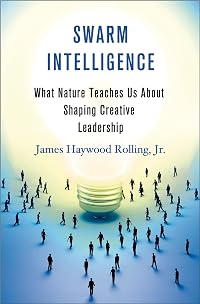
Swarm Intelligence: What Nature Teaches Us About Shaping Creative Leadership
by James Haywood Rolling
On This Page
Description
Companies and organizations everywhere cite creativity as the most desirable - and elusive - leadership quality of the future. Yet scores measuring creativity among American children have been on the wane for decades. A specialist in creative leadership, professor James Haywood Rolling, Jr. knows firsthand that the classroom is a key to either unlocking or blocking the critical imagination. He argues that today's schools, with their focus on rote learning and test-taking, work to show more stymiecreativity, leaving children cut off from their natural impulses and boxed in by low expectations. Drawing on cutting-edge research in the realms of biological swarm theory, systems theory, and complexity theory, Rolling shows why group collaboration and adaptive social networking make us both smarter and more creative, and how we can design education and workplace practices around these natural principles, instead of pushing a limited focus on individual achievement that serves neither children nor their future colleagues, managers and mentors. The surprising truth is that the future will be pioneered by the collective problem-solvers, makingSwarm Intelligence a must-read for business leaders, educators, and anyone else concerned with nurturing creative intelligence and innovative habits in today's youth. show lessTags
Recommendations





Member Reviews
When I first started this book, it seemed dense and academic, and I was hoping for a more accessibly written, Malcolm-Gladwell style book that boiled complicated ideas into memorable anecdotes. But as I delved into the book, I read with growing interest and excitement, because James Haywood Rollings Jr. has synthesized multiple complex ideas into a rich and powerful argument about the nature and purpose of human creativity.
At the risk of simplifying his message, the main point I took away was that creativity is the engine for human change and progress, and there is no such thing as individual creativity. Rather, creativity is a collective societal endeavor that multiplies and transmits human knowledge and progress, with art, design, show more and storytelling as some of its most powerful manifestations. When conditions in a culture are right, the collective creativity of that society surges forward and also enables the individual creative superstars to emerge (who are inevitably a product of their creative communities).
What are the ideal conditions for nurturing collective and individual creativity? Rolling turns to swarm behavior in nature as a guide. Swarm behavior occurs when vast numbers if individuals, acting in their own best interests, also end up acting in the collective's best interest. Think bees deciding where to build a nest, wildebeests running from predators, or a flock of starlings turning directions on a dime. Rolling identifies four laws of successful swarm behavior (as opposed to pathological behavior like groupthink or mass hysteria), which can be applied to human creativity:
1. Law of succession. The individual members of a swarm chase after those immediately ahead of them, resulting in new and changing leaders. In human creative terms, this means chasing after the new ideas, the new techniques, the mentors that inspire, the leaders of the field, to become an innovator, mentor, and leader in turn.
2. Law of Separation. The individual members separate themselves from those that are too close for comfort, which allows room for everyone to move forward. In creative terms, it means separating from the crowd to do something different and transformational.
3. Law of Alignment. Individual members align themselves with those in the crowd with whom they are most comfortable, which creates a group average that allows the entire group to move forward. Creatively, this can mean finding a cohort of like minded creatives who together develop an artistic movement, a political movement, or innovative business practices.
4. Law of Cohesion. The individual members cohere with those around the, so the entire group arrives at a goal at the same time. Creatively, the destination can be as small as a group of kids building an ad hoc dam of a stream, or as large as a personal computer revolution.
Rollins uses these insights and others to argue that public education has woefully underprepared people for being creative (and therefore successful in this interconnected age). He argues for a public education system that fosters creativity, by breaking down borders between the arts and sciences, that encourage self-directed learning (motivated by curiosity), and that do so in a way that brings everyone along. He obviously decries the standardized testing and rote learning that has resulted from the No Child Left Behind law that is the antithesis of creativity. show less
At the risk of simplifying his message, the main point I took away was that creativity is the engine for human change and progress, and there is no such thing as individual creativity. Rather, creativity is a collective societal endeavor that multiplies and transmits human knowledge and progress, with art, design, show more and storytelling as some of its most powerful manifestations. When conditions in a culture are right, the collective creativity of that society surges forward and also enables the individual creative superstars to emerge (who are inevitably a product of their creative communities).
What are the ideal conditions for nurturing collective and individual creativity? Rolling turns to swarm behavior in nature as a guide. Swarm behavior occurs when vast numbers if individuals, acting in their own best interests, also end up acting in the collective's best interest. Think bees deciding where to build a nest, wildebeests running from predators, or a flock of starlings turning directions on a dime. Rolling identifies four laws of successful swarm behavior (as opposed to pathological behavior like groupthink or mass hysteria), which can be applied to human creativity:
1. Law of succession. The individual members of a swarm chase after those immediately ahead of them, resulting in new and changing leaders. In human creative terms, this means chasing after the new ideas, the new techniques, the mentors that inspire, the leaders of the field, to become an innovator, mentor, and leader in turn.
2. Law of Separation. The individual members separate themselves from those that are too close for comfort, which allows room for everyone to move forward. In creative terms, it means separating from the crowd to do something different and transformational.
3. Law of Alignment. Individual members align themselves with those in the crowd with whom they are most comfortable, which creates a group average that allows the entire group to move forward. Creatively, this can mean finding a cohort of like minded creatives who together develop an artistic movement, a political movement, or innovative business practices.
4. Law of Cohesion. The individual members cohere with those around the, so the entire group arrives at a goal at the same time. Creatively, the destination can be as small as a group of kids building an ad hoc dam of a stream, or as large as a personal computer revolution.
Rollins uses these insights and others to argue that public education has woefully underprepared people for being creative (and therefore successful in this interconnected age). He argues for a public education system that fosters creativity, by breaking down borders between the arts and sciences, that encourage self-directed learning (motivated by curiosity), and that do so in a way that brings everyone along. He obviously decries the standardized testing and rote learning that has resulted from the No Child Left Behind law that is the antithesis of creativity. show less
 This review was written for LibraryThing Early Reviewers.
Presents some interesting ideas, but reads more like an academic textbook than a narrative meant for a general audience. I also found the subtitle rather misleading since there was virtually no relevant information regarding specific incidents of 'nature's teachings' other than a few offhand commonly known references to starling flight patterns and bee collaboration in hives. Overall, the book started off rather slowly, but worked up steam closer to the end (p 179 was a highlight for me). Bottom Line: It felt like it was heading towards something Gladwell-esque, but it just wasn't as fun or as insightful.
This review was written for LibraryThing Early Reviewers.This was a book that I read slowly, giving myself time to pause and think about the concepts as they were presented, and it's a book I'm sure I'll read again. The author draws on cutting-edge research to demonstrate how humans collaborate adaptively, just as swarms of other animals do. If anything, the human capacity for swarming behavior is much larger and more complex due to our ability to imagine. The question is: how do we facilitate the processes that lead to greater creativity in our endeavors? At a time when it has become clear that the most vibrant future for the human population worldwide rests upon people's ability to collaborate creatively with others, American children continue to decline in creative ability (as determined show more by testing). The author outlines ways in which the arts (sometimes called the humanities) can be used to rectify the problems engendered by rote learning and endless test-taking...and to jumpstart greater creativity and cooperation, traits that our working world has come to prize. (The section on how Finland has done this, with breathtaking results, is fascinating.)
But this is not just a book about how to restructure the way we teach our children...it is a book that explains how swarming works in other animals and in us, with clear illustrations and examples of the principles involved. It shows how these swarming principles foster not only individual creativity, but the creativity of groups, along the road to the building of superorganisms. It presents a list of habits we can all begin practicing to build our creativity...even as it debunks the myth that only a few of us are creative.
This is a book I would recommend to anyone and everyone, no matter what interests or goals that person might have. The subtitle may give the impression that this is a book about building leadership qualities--and it is--but it also builds an understanding that will facilitate changing our minds about what effective leadership really is.
I received this book for free through LibraryThings. Thanks! show less
But this is not just a book about how to restructure the way we teach our children...it is a book that explains how swarming works in other animals and in us, with clear illustrations and examples of the principles involved. It shows how these swarming principles foster not only individual creativity, but the creativity of groups, along the road to the building of superorganisms. It presents a list of habits we can all begin practicing to build our creativity...even as it debunks the myth that only a few of us are creative.
This is a book I would recommend to anyone and everyone, no matter what interests or goals that person might have. The subtitle may give the impression that this is a book about building leadership qualities--and it is--but it also builds an understanding that will facilitate changing our minds about what effective leadership really is.
I received this book for free through LibraryThings. Thanks! show less
This review was written for LibraryThing Early Reviewers."Swarm Intelligence" is a book about developing creativity. Author James Haywood Rolling, Jr. provides the reader with a new perspective on the origin of creativity. He sees creativity residing in the swarm—the social context within which one is embedded—rather than in individuals. Creativity is an emergent process that develops out of the interchanges between individuals and their social contexts, which may be families, work teams, classrooms, cultures, nations, etc. Rolling identifies the principles of how swarms in nature operate and then applies these principles to the development of creative action.
Rolling is an art educator and emphasizes the role of the arts in cultivating creative communities and individuals. Educators will show more benefit from Rolling’s explanation of how the convergence of behaviorism and scientific management in education has stifled the development of creativity in students and our society. Educators will find within the book concrete examples and ideas for cultivating student and staff creativity. Business people will also benefit from reading this book but will not find as many concrete examples for implementing the book’s principles within business settings.
The author’s writing style sometimes makes it difficult to understand what he is trying to convey. It is also not clear how some of the stories and examples included in the book relate to the author’s message. And do not expect a book on leadership even though the subtitle mentions creative leadership. Nonetheless, this is a book worth reading. Rolling provides a different viewpoint on the origins and development of creativity. He provides us with a creative perspective on creativity. show less
Rolling is an art educator and emphasizes the role of the arts in cultivating creative communities and individuals. Educators will show more benefit from Rolling’s explanation of how the convergence of behaviorism and scientific management in education has stifled the development of creativity in students and our society. Educators will find within the book concrete examples and ideas for cultivating student and staff creativity. Business people will also benefit from reading this book but will not find as many concrete examples for implementing the book’s principles within business settings.
The author’s writing style sometimes makes it difficult to understand what he is trying to convey. It is also not clear how some of the stories and examples included in the book relate to the author’s message. And do not expect a book on leadership even though the subtitle mentions creative leadership. Nonetheless, this is a book worth reading. Rolling provides a different viewpoint on the origins and development of creativity. He provides us with a creative perspective on creativity. show less
This review was written for LibraryThing Early Reviewers.Others have mentioned it, but what a huge omission to not include much of anything on leadership in a book that notes "creative leadership." I was really pleased to have been chosen to review this book as I'm interested in different theories on leadership and most appreciate the creative thinkers on my team at work. I'm really disappointed and didn't get at all what I'd been hoping for from this read. If you're looking for a leadership book - as I was - this one isn't it.
The amount of text on creativity at the beginning reads like it was recycled research from other work. In fact, the material on K-12 educators & schooling strengthens my belief that this is recycled work. My takeaway is that it is largely about collaborative creativity show more (especially within American primary schools).
I've nearly given up finishing this book, largely due to my disappointment in an arts education book marketed as a leadership book, but maybe even more due to his writing style. My impression is that it's unnecessarily cumbersome. Here's an example (p. 218; page chosen at random): "In order to rethink creativity as the feeding trough of our next best humanity, it is important to carefully consider the creation of narrative avenues in and out of the creative continuum. The threshold to this continuum is best penetrated by new stories. And new creative leaders become unmistakably apparent when we recognize our own lived experiences--or the allure of experiences that stir us fully awake and desirous--brought to life in their creative practices."
To me, this is an incredibly simple concept. Yet it is made so unclear with his particular style. Like many passages in the book, this is one that illustrates my frustrations. show less
The amount of text on creativity at the beginning reads like it was recycled research from other work. In fact, the material on K-12 educators & schooling strengthens my belief that this is recycled work. My takeaway is that it is largely about collaborative creativity show more (especially within American primary schools).
I've nearly given up finishing this book, largely due to my disappointment in an arts education book marketed as a leadership book, but maybe even more due to his writing style. My impression is that it's unnecessarily cumbersome. Here's an example (p. 218; page chosen at random): "In order to rethink creativity as the feeding trough of our next best humanity, it is important to carefully consider the creation of narrative avenues in and out of the creative continuum. The threshold to this continuum is best penetrated by new stories. And new creative leaders become unmistakably apparent when we recognize our own lived experiences--or the allure of experiences that stir us fully awake and desirous--brought to life in their creative practices."
To me, this is an incredibly simple concept. Yet it is made so unclear with his particular style. Like many passages in the book, this is one that illustrates my frustrations. show less
This review was written for LibraryThing Early Reviewers.This book overpromises and disappoints. It has some interesting ideas, but they are disorganized, drowned in excessively florid verbiage that at points becomes uninterpretable word salad. Plenty of largely irrelevant content is interspersed throughout the text.
In short, this book could be greatly improved by trimming down massive amounts of superfluous content, sharpening the concepts and distilling the main ideas into clear discourse.
In short, this book could be greatly improved by trimming down massive amounts of superfluous content, sharpening the concepts and distilling the main ideas into clear discourse.
This review was written for LibraryThing Early Reviewers.This book progresses thought and action around how to live and lead more creatively. While acknowledging the challenge of the task, Rolling begins the book by talking about definitions of creativity and how it may be measured. I feel like this gives body of the writing a good grounding and Rolling takes the reader through the connections between swarm behavior and collective development of creativity. Rollings outlines the reasons why creative leadership solutions to problems and leadership are sorely needed, but does not get bogged down with outlining our challenges. The pace of the book keeps moving and inspires further thought and action. A worthwhile read for educators, business people, and anyone who feels that they want to know show more how their creative expression might serve the world. show less
This review was written for LibraryThing Early Reviewers.Members
- Recently Added By
Author Information
1 Work 20 Members
Classifications
- Genres
- Nonfiction, Business, General Nonfiction, Technology, Science & Nature, Art & Design, Music
- DDC/MDS
- 658.4 — Applied science & technology Management & public relations General management Executive
- LCC
- HD53 .R65 — Social sciences Industries. Land use. Labor Industries. Land use. Labor Management. Industrial management
- BISAC
Statistics
- Members
- 20
- Popularity
- 1,277,371
- Reviews
- 10
- Rating
- (3.50)
- Languages
- English
- Media
- Paper, Ebook
- ISBNs
- 2