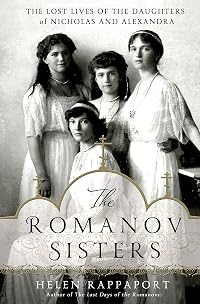
The Romanov Sisters: The Lost Lives of the Daughters of Nicholas and Alexandra
by Helen Rappaport
On This Page
Description
"They were the Princess Dianas of their day--perhaps the most photographed and talked about young royals of the early twentieth century. The four captivating Russian Grand Duchesses--Olga, Tatiana, Maria and Anastasia Romanov--were much admired for their happy dispositions, their looks, the clothes they wore and their privileged lifestyle. Over the years, the story of the four Romanov sisters and their tragic end in a basement at Ekaterinburg in 1918 has clouded our view of them, leading to show more a mass of sentimental and idealized hagiography. With this treasure trove of diaries and letters from the grand duchesses to their friends and family, we learn that they were intelligent, sensitive and perceptive witnesses to the dark turmoil within their immediate family and the ominous approach of the Russian Revolution, the nightmare that would sweep their world away, and them along with it. The Romanov Sisters sets out to capture the joy as well as the insecurities and poignancy of those young lives against the backdrop of the dying days of late Imperial Russia, World War I and the Russian Revolution. Rappaort aims to present a new and challenging take on the story, drawing extensively on previously unseen or unpublished letters, diaries and archival sources, as well as private collections. It is a book that will surprise people, even aficionados"-- show lessTags
Recommendations





Member Reviews
I have long been fascinated with the events that led up to the tragic murder of these young girls. This is a different view than most, since it focuses on the Grand Duchesses much more intensely than most histories of this time do. You cannot be a human being and not wonder at the state of mind of this family as it waited and hoped only to face such an ignoble end in a filthy basement room.
For those who were politically involved in the revolution, this might have seemed like the only solution...make it impossible for anyone of Romanov blood to ever claim the throne again...but from a human standpoint it reminds me of tales of the Holocaust in which you wonder how anyone could have so little humanity about them. Evidence is that these show more girls and even their father would have been no threat to the Bolsheviks. Not once after his abdication did Nicholas II attempt to rally anyone to fight against the surrender of the government of his behalf.
It is sad to read about the difficult lives these girls lived (often despite their privileged position in society), their quite, calm, accepting natures, and their simple naive personalities. It must have all seemed a bit surreal to them as it unraveled. I wonder if anyone I know could have handled that situation with the kind of courage and aplomb with which they did. I know I could not have.
To say you "enjoyed" such a morose read sounds almost perverse, but I am a lover of history and willing to look the evil side of it in the face when necessary. I think we can see this from such a different view point than those who were there at the time. Like so many bloody revolutions, this one brought the reign of Stalin and something far more evil than the Tsar the country had overthrown. You cannot help thinking of all the places along the road when Nicholas II might have bent and changed their fate, or when he might have been more astute and saved their lives. But, such is the sadness of history...it can never be changed. show less
For those who were politically involved in the revolution, this might have seemed like the only solution...make it impossible for anyone of Romanov blood to ever claim the throne again...but from a human standpoint it reminds me of tales of the Holocaust in which you wonder how anyone could have so little humanity about them. Evidence is that these show more girls and even their father would have been no threat to the Bolsheviks. Not once after his abdication did Nicholas II attempt to rally anyone to fight against the surrender of the government of his behalf.
It is sad to read about the difficult lives these girls lived (often despite their privileged position in society), their quite, calm, accepting natures, and their simple naive personalities. It must have all seemed a bit surreal to them as it unraveled. I wonder if anyone I know could have handled that situation with the kind of courage and aplomb with which they did. I know I could not have.
To say you "enjoyed" such a morose read sounds almost perverse, but I am a lover of history and willing to look the evil side of it in the face when necessary. I think we can see this from such a different view point than those who were there at the time. Like so many bloody revolutions, this one brought the reign of Stalin and something far more evil than the Tsar the country had overthrown. You cannot help thinking of all the places along the road when Nicholas II might have bent and changed their fate, or when he might have been more astute and saved their lives. But, such is the sadness of history...it can never be changed. show less
at times, the writing flowered into something cinematic...not on the tragic _Zhivago_ scale, but the quotidian, devastating intimacy of a lost Sofia Coppola mash-up: the homely insularity of _The Virgin Suicides_ in a_Marie Antoinette_ setting. I wished, throughout, that SCoppola would option this book; it might seem a retread, but--oh my stars--how I would love to see that movie.
(otherwise, I was, of course, dismayed by own interest, however pedestrian, in a royal family. in exile, evidently, Nicky read aloud _The Scarlet Pimpernel_, and really, if I have to choose, I'm def Team Death To The Aristos/Long Live The Republic...and then I remember that the brutality of the Reds ruined Marxism for everybody. the idea that we have to choose show more murder along with humane government is ridiculous/why we can't anything nice.) show less
(otherwise, I was, of course, dismayed by own interest, however pedestrian, in a royal family. in exile, evidently, Nicky read aloud _The Scarlet Pimpernel_, and really, if I have to choose, I'm def Team Death To The Aristos/Long Live The Republic...and then I remember that the brutality of the Reds ruined Marxism for everybody. the idea that we have to choose show more murder along with humane government is ridiculous/why we can't anything nice.) show less
It doesn't seem to matter how often I read books about the Romanovs-each time I get close to the end I dread it. I am completely willing to admit that I probably romanticize the Romanovs. There is no doubt Nicholas was (probably) an incompetent ruler, unable or unwilling to see past the end of his legacy, such as it was. However, this book simply broke my heart. The children, Olga, Tatiana, Maria, and Anastasia, as well as Alexei, were pure innocents. It's so troubling that they were killed the way they were. Again, not sure why that troubles me so, as opposed to the millions of people who were killed during World War I. I think it's easier to put a family into context than an entire generation of men, women, and children.
I mean, it's going to be downer- you have to know that going in. But at the same time it's kind of a wonderful portrait of a lost world, of a family and four girls stuck in the middle of a maelstrom they had nothing to do with. Tragic and very sad of course. Also fascinating and vivid and unforgettable. I think it would help to have a pretty solid grounding in the Russian Revolution to understand some of the why's around events like Rasputin's murder and the reasons why Nicholas II was so unpopular. Otherwise so good.
An excellent highly readable history of the last czar told through the lens of the Romanov daughters. It turns out (not surprisingly) that I did not know very much about the fall of Russian Imperial rule, and it is a fascinating story, in part because Nicholas and Alexandra turn out to be not fascinating at all. Alexandra is a whiny, humorless, hypochondriac with social anxiety, and Nicholas a good dad who mostly wants to be left alone. Fresh, educational and interesting all in one, I highly recommend the read.
One note, the narrator of the audiobook was a little irritating to me. Overall her reading was good, but she is very dramatic, and really pounds on "proper" pronunciation for non-English words. That would be okay, but she show more pronounces everything not in English with her version of a Russian accent...including Chinese and French words. It worked my last nerve. Also, when reciting correspondence in what I think was supposed to be a mournful voice, she does this moaning hoarse voice which sounds like she just had a really delicious orgasm. No insult to orgasms or to the vocal effects of same, but the word "hemophilia" should never sound like pillow talk. show less
One note, the narrator of the audiobook was a little irritating to me. Overall her reading was good, but she is very dramatic, and really pounds on "proper" pronunciation for non-English words. That would be okay, but she show more pronounces everything not in English with her version of a Russian accent...including Chinese and French words. It worked my last nerve. Also, when reciting correspondence in what I think was supposed to be a mournful voice, she does this moaning hoarse voice which sounds like she just had a really delicious orgasm. No insult to orgasms or to the vocal effects of same, but the word "hemophilia" should never sound like pillow talk. show less
The Romanov Sisters is a tale that draws you in and holds you breathless as it unfolds. Helen Rappaport tells us of the daughters of the last Tsar and Tsarina of Russia, Nicholas and Alexandra. These girls had distinct personalities under their matching big white hats and dresses, and Rappaport does a good job in separating those personalities and allowing us to get to know the girls on a personal level. Their idyllic family life comes to a screeching halt at the start of World War I, and the heart aches as we know the family's ultimate fate. In this book, the girls come alive as we get to know their daily routines, their hopes and dreams, disappointments, and the intimate world that they lived in. Recommended reading for any lovers of show more the Romanov genre. show less
Prepare to have your heart broken. Like everyone, I knew that the Russian Revolution of 1917 brought a violent end to the rule of the Romanov family and the tsars. I also knew the gruesome trivia that Tsaritsa Alexandra had family jewelry taken apart and the gems sewn into her daughters’ clothing. In July 1918, when the family was led to the tiny half-cellar room where they were shot, at first many of the bullets struck the gems and bounced away, giving the fleeting impression the girls were impervious to them.
Rappaport wrote about that last horrific scene in a previous book, Ekaterinburg: The Last Days of the Romanovs, and she may have wanted to spare us—and herself—from reliving it. In this book, she follows the family right up show more to its final hours, and I found myself reading more and more slowly, trying to delay the inevitable.
Olga, Tatiana, Maria, and Anastasia were 22, 21, 19, and 17 at the time of their deaths. The book follows the courtship and marriage of their parents, the births and childhoods, and their maturing to young women through remaining letters diaries, and reminiscences of friends and relatives at the time. The reader comes to know these intelligent, warm-hearted, and lively young women well, and their unnecessary death is devastating.
It’s perhaps inevitable to speculate about a happier outcome. What if Nicholas hadn’t unexpectedly become Tsar at the age of 26? What if he’d been a stronger, more experienced military and political leader, a more flexible one, receptive to the idea of constitutional monarchy? What if their mother had been less withdrawn, chronically ill, and mentally fragile and had fostered—rather than assumed—the love of the Russian people? What if heir Alexey hadn’t inherited the hemophilia gene? Would she not have fallen under the sway of the disreputable Grigory Rasputin?
Even without any of these circumstances, what if Nicholas and Alexandra had taken one of their many opportunities to leave Russia or at least send their daughters abroad? Eventually, even England’s King George V—determined to keep Soviet Russia as an ally in the war against Germany—withdrew his offer to provide his cousins safe haven.
They girls lives were closely sheltered, and they saw little of life as it existed outside their palaces or aboard the imperial yacht used for summer vacations. Alexandra often dressed them all in long white dresses, and that’s the picture most people had of them: remote, inviolate.
An exception arose during the War, when Alexandra, Olga, and Tatiana trained to be nurses. Alexandra couldn’t reliably fulfill these duties because of her health, but the older two—especially Tatiana—were tireless. They wrapped bandages, dressed wounds, assisted in surgery, cleaned instruments, and did everything they could to aid the wounded soldiers in their care, including raising funds for their hospitals. The two younger girls read to the wounded and wrote letters for them.
These soldiers, like everyone else who met them, repeatedly remarked how natural and unaffected the girls were, how curious they were about the lives of other people. They were not at all like what they expected Grand Duchesses to be or what their popular image was. Rappaport has written a well researched, engaging biography of these brief lives and a century-old crime. Maps and a more complete list of characters (though there is an index) would have been an enhancement. show less
Rappaport wrote about that last horrific scene in a previous book, Ekaterinburg: The Last Days of the Romanovs, and she may have wanted to spare us—and herself—from reliving it. In this book, she follows the family right up show more to its final hours, and I found myself reading more and more slowly, trying to delay the inevitable.
Olga, Tatiana, Maria, and Anastasia were 22, 21, 19, and 17 at the time of their deaths. The book follows the courtship and marriage of their parents, the births and childhoods, and their maturing to young women through remaining letters diaries, and reminiscences of friends and relatives at the time. The reader comes to know these intelligent, warm-hearted, and lively young women well, and their unnecessary death is devastating.
It’s perhaps inevitable to speculate about a happier outcome. What if Nicholas hadn’t unexpectedly become Tsar at the age of 26? What if he’d been a stronger, more experienced military and political leader, a more flexible one, receptive to the idea of constitutional monarchy? What if their mother had been less withdrawn, chronically ill, and mentally fragile and had fostered—rather than assumed—the love of the Russian people? What if heir Alexey hadn’t inherited the hemophilia gene? Would she not have fallen under the sway of the disreputable Grigory Rasputin?
Even without any of these circumstances, what if Nicholas and Alexandra had taken one of their many opportunities to leave Russia or at least send their daughters abroad? Eventually, even England’s King George V—determined to keep Soviet Russia as an ally in the war against Germany—withdrew his offer to provide his cousins safe haven.
They girls lives were closely sheltered, and they saw little of life as it existed outside their palaces or aboard the imperial yacht used for summer vacations. Alexandra often dressed them all in long white dresses, and that’s the picture most people had of them: remote, inviolate.
An exception arose during the War, when Alexandra, Olga, and Tatiana trained to be nurses. Alexandra couldn’t reliably fulfill these duties because of her health, but the older two—especially Tatiana—were tireless. They wrapped bandages, dressed wounds, assisted in surgery, cleaned instruments, and did everything they could to aid the wounded soldiers in their care, including raising funds for their hospitals. The two younger girls read to the wounded and wrote letters for them.
These soldiers, like everyone else who met them, repeatedly remarked how natural and unaffected the girls were, how curious they were about the lives of other people. They were not at all like what they expected Grand Duchesses to be or what their popular image was. Rappaport has written a well researched, engaging biography of these brief lives and a century-old crime. Maps and a more complete list of characters (though there is an index) would have been an enhancement. show less
Members
- Recently Added By
Lists

All Things Russia
459 works; 11 members

KayStJ's to-read list
1,616 works; 11 members

My TBR list
38 works; 1 member

Allie's List of Books I Want To Read
93 works; 1 member
Author Information

18+ Works 4,092 Members
Helen F. Rappaport was born in 1947 in Bromley. She is a British historian, author, and actress. She studied Russian at Leeds University where she was involved in the university theatre group and launched her acting career. After acting with the Leeds University theatre group she appeared in several television series including Crown Court, Love show more Hurts and The Bill. In the early nineties she became a copy editor for academic publishers Blackwell and OUP. She also contributed to historical and biographical reference works published by Cassell and Readers Digest. She became a full-time writer in 1998, writing three books including An Encyclopaedia of Women Social Reformers in 2001, with a foreword by Marian Wright Edelman. It won an award in 2002 from the American Library Association as an Outstanding Reference Source. Her 2008 book Ekaterinburg: The Last Days of the Romanovs received many positive reviews in both the UK and US where it became a bestseller. Her titles include: Joseph Stalin: A Biographical Companion, Conspirator: Lenin in Exile, Magnificent Obsession; Victoria, Albert and the Death that Changed the Monarchy, and Capturing the Light: The Birth of Photography. In 2014 her title, The Romanov Sisters: The Lost Lives of the Daughters of Nicholas and Alexandra made The New York Times Best Seller List. (Bowker Author Biography) show less
Some Editions
Awards and Honors
Awards
Distinctions
Common Knowledge
- Alternate titles
- Four sisters : the lost lives of the Romanov grand duchesses
- Original publication date
- 2014-06-03
- People/Characters
- Olga Nikolayevna Grand Duchess of Russia; Tatiana Nikolayevna Grand Duchess of Russia; Maria Nikolayevna Grand Duchess of Russia; Anastasia Nikolayevna Grand Duchess of Russia
- Important places
- Russian Empire
- Important events
- Russian Revolution; World War I (1914 | 1918)
- Dedication
- In memory of
Olga, Tatiana, Maria and Anastasia Romanova
four extraordinary young women - First words
- The day they sent the Romanovs away the Alexander Palace became forlorn and forgotten—a place of ghosts.
- Last words
- (Click to show. Warning: May contain spoilers.)It was another six years, however—and only after considerable and protracted legal wrangling—before the Russian Prosecutor General's office finally saw fit to rehabilitate Olga, Tatiana, Maria and Anastasia Romanova, their parents and brother, as "victims of political repressions".
- Original language
- English
- Canonical DDC/MDS
- 947.0830922
- Canonical LCC
- DK258.6
Classifications
- Genres
- History, Biography & Memoir, Nonfiction, General Nonfiction
- DDC/MDS
- 947.0830922 — History & geography History of Europe Eastern European Counties and Russia Russian & Slavic History by Period 1855- Nicholas II, 1894-1917
- LCC
- DK258.6 — History of Europe, Asia, Africa and Oceania Russia. Soviet Union. Former Soviet Republics – Poland History of Russia. Soviet Union. Former Soviet Republics History
- BISAC
Statistics
- Members
- 1,517
- Popularity
- 15,202
- Reviews
- 52
- Rating
- (4.02)
- Languages
- 7 — Dutch, English, Estonian, Italian, Polish, Portuguese, Spanish
- Media
- Paper, Audiobook, Ebook
- ISBNs
- 27
- UPCs
- 1
- ASINs
- 11