On This Page
Description
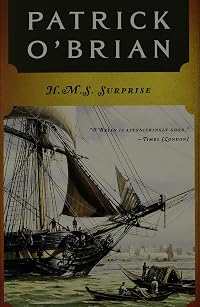
Third in the series of Aubrey-Maturin adventures, this book is set among the strange sights and smells of the Indian subcontinent, and in the distant waters ploughed by the ships of the East India Company. Aubrey is on the defensive, pitting wits and seamanship against an enemy enjoying overwhelming local superiority. But somewhere in the Indian Ocean lies the prize that could make him rich beyond his wildest dreams: the ships sent by Napoleon to attack the China Fleet...Tags
Recommendations









Member Recommendations

Member Reviews
The first book in the Aubrey Maturin series, Master and Commander, was intriguing but I often got tangled in nautical terminology. At the time I didn't know the difference between a mizzen mast and foremast. It took some time between but I admired the book enough to get the second entry, Post Captain. By then my shipman's vocabulary had improved and the series protagonists were familiar acquaintences. H.M.S. Surprise, this third in Patrick O'Brian's famed series, however, is the one I fell in love with. The characters are dear to me, the prose is now full and often gorgeous because of its specificity, and the stories are so engaging I just don't want them to end. Fortunately, I have 17 more volumes.
A solid entry into a solid series that, for all the acclaim sent its way, still hasn't yet filled my sails. HMS Surprise, the third book in Patrick O'Brian's Aubrey-Maturin series, does what O'Brian does well: it develops further the friendship between Jack Aubrey and Stephen Maturin, delivers a vivid and authentic depiction of life aboard a man-of-war during the Napoleonic era, and writes a mean sea battle.
The one real sea battle, however, comes at the end of the novel and is a tad anti-climactic; its presence highlights the imbalance in the novel. By the time it arrives we've spent a long time getting there, pushing easily but at a medium tempo through minor seaborne trials and land-based affairs (I've never cared for the show more Diana/Stephen romance – which has a predictable end here – nor the attention to Jack's fiancée and his debts). O'Brian's India lacks flavour and the episode with Canning felt a little too hasty to me. While this is certainly not bad storytelling, the book's weight and its stately pace can have the effect of exposing some of its plainer elements. The ambassador plotline proves to be merely a MacGuffin to get our characters into a theatre where they can have that sea battle, and it's a lot of pages to work through just for that. O'Brian can be credited for his erudition and literary-calibre writing, but HMS Surprise may be one occasion on which it would've been better just to write the adventure. show less
The one real sea battle, however, comes at the end of the novel and is a tad anti-climactic; its presence highlights the imbalance in the novel. By the time it arrives we've spent a long time getting there, pushing easily but at a medium tempo through minor seaborne trials and land-based affairs (I've never cared for the show more Diana/Stephen romance – which has a predictable end here – nor the attention to Jack's fiancée and his debts). O'Brian's India lacks flavour and the episode with Canning felt a little too hasty to me. While this is certainly not bad storytelling, the book's weight and its stately pace can have the effect of exposing some of its plainer elements. The ambassador plotline proves to be merely a MacGuffin to get our characters into a theatre where they can have that sea battle, and it's a lot of pages to work through just for that. O'Brian can be credited for his erudition and literary-calibre writing, but HMS Surprise may be one occasion on which it would've been better just to write the adventure. show less
Book number three in O'Brian's Napoleonic-era series featuring ship's captain Jack Aubrey and his friend and shipmate Dr. Stephen Maturin. Reading these books is always a bit of an odd experience for me, because, I have to admit, there are inevitably large-ish stretches where I have almost no idea what is going on, as I have no fluency whatsoever in Old Timey Nautical Speak. Which you'd think would be a big barrier to enjoyment, and yet I found this book, like Post Captain before it, strangely delightful. Much of that is because, whatever I may or may not understand, the characters always shine through, and I feel tremendous affection for them. Especially for Maturin, whose eccentricities and enthusiasms are utterly adorable, even if he show more can be a stubborn idiot about some things. And the relationship between the two is just heart-warming. It's difficult to imagine two more utterly different people, but despite all obstacles, their attachment to each other is steadfast and endearing.
There's also a wonderfully vivid sense of place here, especially when that place is aboard ship. Sometimes, I swear, I could almost taste the salt water. And then there's the sly, dry sense of humor, which probably makes the whole thing worth reading all by itself. You wouldn't expect this sort of book to be laugh-out-loud funny, but it often is.
Among other events, this particular installment features a trip to India, some continuing complications in affairs of the heart, and, of course, the inevitable skirmish with the French. Although as far as I'm concerned, they could pretty much sail around aimlessly, and I'd probably still be interested.
(I am kind of hoping poor Stephen gets to catch a break in the next installment, though, after the multiple kinds of abuse he suffers in this one. Or is that too much to ask?) show less
There's also a wonderfully vivid sense of place here, especially when that place is aboard ship. Sometimes, I swear, I could almost taste the salt water. And then there's the sly, dry sense of humor, which probably makes the whole thing worth reading all by itself. You wouldn't expect this sort of book to be laugh-out-loud funny, but it often is.
Among other events, this particular installment features a trip to India, some continuing complications in affairs of the heart, and, of course, the inevitable skirmish with the French. Although as far as I'm concerned, they could pretty much sail around aimlessly, and I'd probably still be interested.
(I am kind of hoping poor Stephen gets to catch a break in the next installment, though, after the multiple kinds of abuse he suffers in this one. Or is that too much to ask?) show less
Listened to the audio book (my third reading) narrated by the inimitable Patrick Tull.
I'd forgotten how much was crammed into this book. It's by and large the courtship of Jack and Sophie and Jack laying himself out so that he can pay off his debts and finally marry his love. There's also spy shenanigans as Maturin is captured and tortured at Port Mahon only to be rescued in a daring and dangerous cutting out by Jack and crew. (Only Captain Doutard escapes Jack's wrath; we'll hear from him in a later volume, I'm sure.) Aubrey is (finally) captured by bailiffs for debt and ends up, briefly, in a sponging house until an advance, authored by Stephen through Sir Joseph, gets him out again and gets him posted to the Surprise.
While rounding show more the Cape of Good Hope the Surprise hits a storm that O'Brian takes pages to resolve. I was dripping with cold sea water by the end of it. Just brilliant writing like you can find nowhere else.
The Surprise ferries an ailing old diplomat to India, and there we meet up with Diana, who has taken up house with the Jewish merchant Richard Canning, her lover. This about destroys Maturin, of course, and (eventually) Stephen ends up killing Canning in a pistol duel, himself being seriously injured. He operates on himself and successfully removes the bullet. (Sadly, Maturin is looked on as a kind of hero for 'killing the Jew'.) Diana is confused and doesn't know what she wants, and as always O'Brian draws a real, believable character in her with as much depth as Steven himself. She heads back toward England, but Jack refuses her passage on the Surprise. He doesn't like Diana, and she calls him out for it with a pretty harsh tongue-lashing, but Jack stands firm.
We also meet the lovely character Dil, a child of low or no caste that Stephen befriend, and who is eventually also killed because of the bracelet gifts Stephen bestows upon her. Here, O'Brian's writing is at it very best. The way he describes Dil, and her wonderfully quirky voice is so well done. Her cremation, supervised by Maturin, is heartbreaking.
Finally, Aubrey's defense of the East India Company's China Fleet is also as exciting and informational as you could want. Lots to learn here about how ships work in concert, and in comparing naval sailing to commercial. And Aubrey's old nemesis Linois from Master and Commander makes another appearance, this time as commodore of a small French fleet.
Jack meets up with Sophie in Madeira at long last, and he's made good on all his debts thanks to the generosity of the dead Canning. He can now be married.
This book has a little bit of everything in it. Some of the most memorable parts are the most emotionally intense. O'Brian also writes a compelling travel narrative: his descriptions of life in India are rich and deep, and not just the places and practices, but the people, too. Lots of characters appear and disappear, and of course the whole time he's expanding at the edges on the recurring people like Pullings, Bonden, Killick, and the rest of the crew. This book is something of a carnival confection for A-M lovers. It's all here, all the humor, the depth of character, the sea-going hardship, the exploration, the intrigue, and the big fleet actions.
Finally, the discovery of Testudo Aubreii closes the book. What could be better? show less
I'd forgotten how much was crammed into this book. It's by and large the courtship of Jack and Sophie and Jack laying himself out so that he can pay off his debts and finally marry his love. There's also spy shenanigans as Maturin is captured and tortured at Port Mahon only to be rescued in a daring and dangerous cutting out by Jack and crew. (Only Captain Doutard escapes Jack's wrath; we'll hear from him in a later volume, I'm sure.) Aubrey is (finally) captured by bailiffs for debt and ends up, briefly, in a sponging house until an advance, authored by Stephen through Sir Joseph, gets him out again and gets him posted to the Surprise.
While rounding show more the Cape of Good Hope the Surprise hits a storm that O'Brian takes pages to resolve. I was dripping with cold sea water by the end of it. Just brilliant writing like you can find nowhere else.
The Surprise ferries an ailing old diplomat to India, and there we meet up with Diana, who has taken up house with the Jewish merchant Richard Canning, her lover. This about destroys Maturin, of course, and (eventually) Stephen ends up killing Canning in a pistol duel, himself being seriously injured. He operates on himself and successfully removes the bullet. (Sadly, Maturin is looked on as a kind of hero for 'killing the Jew'.) Diana is confused and doesn't know what she wants, and as always O'Brian draws a real, believable character in her with as much depth as Steven himself. She heads back toward England, but Jack refuses her passage on the Surprise. He doesn't like Diana, and she calls him out for it with a pretty harsh tongue-lashing, but Jack stands firm.
We also meet the lovely character Dil, a child of low or no caste that Stephen befriend, and who is eventually also killed because of the bracelet gifts Stephen bestows upon her. Here, O'Brian's writing is at it very best. The way he describes Dil, and her wonderfully quirky voice is so well done. Her cremation, supervised by Maturin, is heartbreaking.
Finally, Aubrey's defense of the East India Company's China Fleet is also as exciting and informational as you could want. Lots to learn here about how ships work in concert, and in comparing naval sailing to commercial. And Aubrey's old nemesis Linois from Master and Commander makes another appearance, this time as commodore of a small French fleet.
Jack meets up with Sophie in Madeira at long last, and he's made good on all his debts thanks to the generosity of the dead Canning. He can now be married.
This book has a little bit of everything in it. Some of the most memorable parts are the most emotionally intense. O'Brian also writes a compelling travel narrative: his descriptions of life in India are rich and deep, and not just the places and practices, but the people, too. Lots of characters appear and disappear, and of course the whole time he's expanding at the edges on the recurring people like Pullings, Bonden, Killick, and the rest of the crew. This book is something of a carnival confection for A-M lovers. It's all here, all the humor, the depth of character, the sea-going hardship, the exploration, the intrigue, and the big fleet actions.
Finally, the discovery of Testudo Aubreii closes the book. What could be better? show less
H.M.S. Surprise begins almost immediately after Post Captain ended, with Captain Jack Aubrey's famous luck again failing him on land as his hard-won fortune slips away from him. In Patrick O'Brian's third story, Aubrey and Dr. Stephen Maturin must embark on a mission to the Far East to deliver an ambassador, meanwhile dealing with their respective relationships with Sophie Williams and Diana Villiers. O'Brian continues to demonstrate his mastery of the nautical genre, exploring the idea of the far east in early nineteenth century British thought. There are more examples of Aubrey's tactical brilliance and plenty of depictions of natural philosophy. I consider this book on par with the first novel and better than the second, in which show more Aubrey and Maturin spent far too much time on land (though this was necessary to show another aspect of naval life). show less
Patrick O'Brian's third Aubrey-Maturin volume is H.M.S. Surprise. As I read more of these I come to enjoy them more; this was my favorite of the series so far, as Aubrey and Maturin make their way to Kampong (by way of South America and India) carrying a royal governor, grappling with French squadrons, fickle females, and bureaucrats along the way. Maturin gets the best scenes, from his reaction to finding his pet sloth drunk on ship's grog ("Jack, you have debauched my sloth"), to his casual ordering up of an elephant in India, to his gruesome self-surgery following a battle wound.
O'Brian manages to keep his examinations of ship life and naval maneuvering from becoming overpowering, breathing life into his ships and their occupants show more without drowning the reader in details.
http://philobiblos.blogspot.com/2009/06/book-review-hms-surprise.html show less
O'Brian manages to keep his examinations of ship life and naval maneuvering from becoming overpowering, breathing life into his ships and their occupants show more without drowning the reader in details.
http://philobiblos.blogspot.com/2009/06/book-review-hms-surprise.html show less
The title is already an indication of it: after Patrick O’Brian went all Jane Austen on his readers in Post Captain, this third volume of his Aubrey-Maturin series returns to mostly naval matters. But even as it shifts focus back to the sea retains the human and social dimension that the previous novel introduced to the series, giving the two main characters James Aubrey and Stephen Maturin even more depth, and slowly turning them into what might very well be some of the most deeply realized characters in fiction this side of Ulysses (and, as a brief, totally-besides-the-point aside, nobody, but really nobody, not even Shakespeare does characters like James Joyce).
The series, then – to return to the subject of this review – show more continues to improve, and HMS Surprise is the best installment so far – it gets the balance between adventure and contemplation, between naval action and character description, between fighting and exploration just right, and even turns out to possess a well-wrought structure: While in the first two novels, O’Brian seemed satisfied to have his plot amble aimlessly wherever his whim took it, this time the novel is framed by two extended fighting sequences (both centered around Jack) at the beginning and the end (one on land, one on sea) while the middle part (mostly centered around Stephen) is given to exploration (something else O’Brian does exceptionally well and to which I will have to return in a later post), descriptions of life on sea and character development. Jack’s and Stephen’s affairs of the heart proceed in a nicely measured symmetry, constantly juxtaposing one with the other until, by the end of the novel, they find themselves at opposite ends of the happiness scale. After the rather amorphous preceding volumes it was really unexpected (I’m very tempted to say, it was a real surprise – if that wasn’t such a horrible, Aubrey-worthy pun) to find this one so perfectly poised, as if O’Brian just wanted to show that he was able to do it if he could be bothered.
But HMS Surprise is not just the structurally most refined but also the novel with by far the greatest emotional impact so far – not just because the narrative continues to follow the love affairs of our protagonists begun in Post Captain, but chiefly due to a certain episode Stephen encounters (about which I will not go into any detail to avoid spoilers) which ends in a devastating tragedy. The episode I am alluding to here is utterly heartbreaking, and it is here that the series first shows the emotional depths it is capable of plumbing. I suspect, however, that it will not have been the last time, now that Patrick O’Brian has shown here (and in some other events, also involving Stephen – who really has a very bad time in this novel) that he is not afraid of putting his protagonists through the wringer.
The novel ends on a note which a certain sense of closure to events, and with that and the careful symmetry in its structure, I couldn’t help but think that HMS Surprise might actually have been a good point to end the series as a trilogy. Thankfully, O’Brian didn’t but went on to add many, many more volumes which I’m quite excited about reading. show less
The series, then – to return to the subject of this review – show more continues to improve, and HMS Surprise is the best installment so far – it gets the balance between adventure and contemplation, between naval action and character description, between fighting and exploration just right, and even turns out to possess a well-wrought structure: While in the first two novels, O’Brian seemed satisfied to have his plot amble aimlessly wherever his whim took it, this time the novel is framed by two extended fighting sequences (both centered around Jack) at the beginning and the end (one on land, one on sea) while the middle part (mostly centered around Stephen) is given to exploration (something else O’Brian does exceptionally well and to which I will have to return in a later post), descriptions of life on sea and character development. Jack’s and Stephen’s affairs of the heart proceed in a nicely measured symmetry, constantly juxtaposing one with the other until, by the end of the novel, they find themselves at opposite ends of the happiness scale. After the rather amorphous preceding volumes it was really unexpected (I’m very tempted to say, it was a real surprise – if that wasn’t such a horrible, Aubrey-worthy pun) to find this one so perfectly poised, as if O’Brian just wanted to show that he was able to do it if he could be bothered.
But HMS Surprise is not just the structurally most refined but also the novel with by far the greatest emotional impact so far – not just because the narrative continues to follow the love affairs of our protagonists begun in Post Captain, but chiefly due to a certain episode Stephen encounters (about which I will not go into any detail to avoid spoilers) which ends in a devastating tragedy. The episode I am alluding to here is utterly heartbreaking, and it is here that the series first shows the emotional depths it is capable of plumbing. I suspect, however, that it will not have been the last time, now that Patrick O’Brian has shown here (and in some other events, also involving Stephen – who really has a very bad time in this novel) that he is not afraid of putting his protagonists through the wringer.
The novel ends on a note which a certain sense of closure to events, and with that and the careful symmetry in its structure, I couldn’t help but think that HMS Surprise might actually have been a good point to end the series as a trilogy. Thankfully, O’Brian didn’t but went on to add many, many more volumes which I’m quite excited about reading. show less
Members
- Recently Added By
Lists

Best Historical Fiction
620 works; 261 members

Folio Society
831 works; 53 members

Form line of battle - Best historical naval fiction
15 works; 2 members

One Book, Many Authors
441 works; 40 members

Best Historical Fiction authors
41 works; 9 members

Books Read in 2016
4,666 works; 197 members

Huxley's reading log 2017
45 works; 1 member

Books Read in 2018
4,360 works; 110 members
Talk Discussions
Past Discussions
***Group Read: H.M.S. Surprise by Patrick O'Brian in 75 Books Challenge for 2011 (April 2011)
Author Information

154+ Works 76,959 Members
Patrick O'Brian is the author of twenty volumes in the highly respected Aubrey/Maturin series of novels. (Publisher Provided) Patrick O'Brien was born in Ireland in 1914. His education included the Sorbonne. O'Brian has produced a variety of works, including biographies of Picasso and Sir Joseph Banks and translations of the novels and memoirs of show more Simone de Beauvoir, but he is best known for the creation of an unlikely pair of Napoleonic War-era heroes in the Aubrey-Maturin Series. British naval officer Jack Aubrey and Irish scholar and physician Stephen Maturin have been featured in more than a novels published in Great Britain (five of which have also appeared in America). He died on January 2, 2000. (Bowker Author Biography) show less
Some Editions
Series

Belongs to Publisher Series
Work Relationships
Common Knowledge
- Canonical title
- H.M.S. Surprise
- Original title
- H.M.S. Surprise
- Original publication date
- 1973
- People/Characters
- Jack Aubrey (Captain); Stephen Maturin (Doctor); Sophie Aubrey nèe Williams; Diana Villiers; Richard Canning; Preserved Killick (show all 19); Barrett Bonden; Tom Pullings (Lieutenant); William Babbington; Mrs. Williams; Dil (Bombay street urchin); Linois (Admiral); Testudo aubreii (a discovered tortoise); Lethargy (a sloth debauched); Sir Joseph Blaine; Lieutenant Nicolls; Mr. M'Alister (assistant surgeon); Mr. Stanhope (British envoy to Kampong); Mr. Atkins (secretary to Mr. Stanhope)
- Important places
- Mumbai, India (as Bombay); HMS Surprise; Kolkata, India (as Calcutta)
- Important events
- Age of Sail; Napoleonic Wars
- Epigraph
- [None]
- Dedication
- MARIAE LEMBI NOSTRI DUCI ET MAGISTRAE DO DEDICO
[ = I present and dedicate [this book] to Mary, the commander and mistress of our yacht] - First words
- 'But I put it to you, my lord, that prize-money is of essential importance to the Navy.'
Chapter one.
The trouble with writing about Patrick O'Brian's books is that they are so engrossing.
Arms and the man, by Charlton Heston. - Quotations
- 'Jack, you have debauched my sloth.'
"[Dr. Maturin] speaks languages like a walking Tower of Babel, all except ours. Dear Lord,' he said, laughing heartily, 'to this day I don't believe he knows the odds between port and starboard....' p. 40
... [M]ost of the frigate's people felt both past and future blur, dwindling almost into insignificance: an impression all the stronger since the Surprise was once more in a lonely sea, two thousand miles of dark blue ... (show all)water with never an island to break its perfect round: not the faintest smell of land even on the strongest breeze -- the ship was a world self-contained, swimming between two perpetually renewed horizons. Stronger still, because in these waters there was no eager impatience to see over the eastward rim: they sailed with no relation to an enemy, nor to any potential prize. The Dutch were bottled up; the French had disappeared; the Portuguese were friends. [223] - Last words
- (Click to show. Warning: May contain spoilers.)'Now I have but to run Sophie and my treasure home, and the future is pure Paradise.'
- Publisher's editor
- Lawrence, Starling
- Blurbers
- Symons, Julian; Burke, Helen Lucy; Lake, Sarah
- Original language
- English
Classifications
Statistics
- Members
- 4,600
- Popularity
- 3,155
- Reviews
- 68
- Rating
- (4.28)
- Languages
- 13 — Czech, Danish, Dutch, English, Finnish, French, German, Italian, Norwegian (Bokmål), Polish, Portuguese, Spanish, Swedish
- Media
- Paper, Audiobook, Ebook
- ISBNs
- 91
- ASINs
- 47