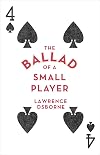
The Ballad of a Small Player
by Lawrence Osborne
On This Page
Description
As night falls on Macau and the neon signs that line the rain-slick streets come alive, Doyle - "Lord Doyle" to his fellow players - descends into his casino of choice to try his luck at the baccarat tables that are the anchor of his current existence. A corrupt English lawyer who has escaped prosecution by fleeing to the East, Doyle spends his nights drinking and gambling and his days sleeping off his excesses, continually haunted by his past. Taking refuge in a series of louche and dimly show more lit hotels, he watches his fortune rise and fall as the cards decide his fate. In a moment of crisis he meets Dao-Ming, an enigmatic Chinese woman who appears to be a denizen of the casinos just like himself, and seems to offer him salvation in the form of both money and love. But as Doyle attempts to make a rare and true connection, all that he accepts as reality seems to be slipping from his grasp. show lessTags
Recommendations









Member Reviews
Lord Doyle, as he is known in the casinos of Macau, is actually a lawyer on the run after embezzling a fortune. "It was too late to regret how I had turned out." He lives in hotels, plays baccarat and loses often. He likens it to "death by guillotine." "Everyone knows you're not a real player until you secretly prefer losing." "We laughed. I was the jolliest loser."
Doyle employs immense superstition, awareness, and interpretation of signs surrounding the game. Everything matters and indicates luck and its flow of good luck and bad luck. On the edge of losing everything, he keeps playing until he finally does. "It was just money, like fluids passing between animals."
A prostitute nurses him back to health, and he takes some of her savings show more to start all over. The tension is built into the story. It ebbs and flows as Doyle trolls casinos, wonders how to pay his growing hotel bill, and finally goes on a winning streak that hints at the supernatural. In a reversal of before, suddenly he can't lose. "I felt a cold, stable hatred toward the world and toward myself as I went down the carpet-padded corridor with one of my cases filled with about five hundred thousand."
Macau and the eastern mindset are beautifully drawn as well as the superstition and belief in the supernatural associated with gambling there - perhaps anywhere. show less
Doyle employs immense superstition, awareness, and interpretation of signs surrounding the game. Everything matters and indicates luck and its flow of good luck and bad luck. On the edge of losing everything, he keeps playing until he finally does. "It was just money, like fluids passing between animals."
A prostitute nurses him back to health, and he takes some of her savings show more to start all over. The tension is built into the story. It ebbs and flows as Doyle trolls casinos, wonders how to pay his growing hotel bill, and finally goes on a winning streak that hints at the supernatural. In a reversal of before, suddenly he can't lose. "I felt a cold, stable hatred toward the world and toward myself as I went down the carpet-padded corridor with one of my cases filled with about five hundred thousand."
Macau and the eastern mindset are beautifully drawn as well as the superstition and belief in the supernatural associated with gambling there - perhaps anywhere. show less
Even if I tried, I couldn't explain why this book captivated me the way it did. I began reading it the day it showed up in my mailbox and could barely put it down for the next two days until I finished it. It wasn't an entirely extraordinary book. The plot wasn't riveting or adventurous or suspenseful. The characters didn't exactly come off as witty or remarkable. But I honestly could not stop reading it. I had to know what would come next to this terribly sad man whose life was lived in ups and downs costing him millions of dollars. I guess what captivated me so much was the gamble that I was taking WITH the main character himself. I felt like I was there in that dingy, foreign casino, betting my entire life's worth and debating the show more outcome. The best parts, of course, as stated by the narrator himself, is the losing. The cathartic relief that comes with achieving your biggest fear of literally betting every dollar you have and then simply losing it. Those were the best, the most emotionally fulfilling parts of this novel.
This book did have a "supernatural" twist to it, of sorts, but it wasn't really portrayed as such. There was a very subtle ghostly touch to the narration that left you with an eerie feeling of something being there, but still remaining unsure if this was a ghost story or not.
All in all, I enjoyed this novel in a strange weird way. show less
This book did have a "supernatural" twist to it, of sorts, but it wasn't really portrayed as such. There was a very subtle ghostly touch to the narration that left you with an eerie feeling of something being there, but still remaining unsure if this was a ghost story or not.
All in all, I enjoyed this novel in a strange weird way. show less
 This review was written for LibraryThing Early Reviewers.
The Ballad of a Small Player (2014) is a novel of contemporary western China, in Macau’s gilded gambling casinos. “Lord” Doyle is an expatriate barrister from London. Doyle thinks of himself as a long term loser personality and an obsessive gambler against luck. The ironic title of Lord has been given to Doyle by the Chinese hotel and casinos staff because of his good suits, yellow gambling gloves, and “quai lo” (Caucasian) airs of royalty he maintains while losing more money than he wins. Wealth that Doyle embezzled and absconded with from London gives him immunity from overt scorn by the Chinese gamblers and staff. Doyle’s self-hatred is mitigated by his identification with Taoists’ concept of “preta” described in show more English as “Hungry Ghosts.” These poor souls are awaiting reincarnation to a better life existing indefinitely in the equivalent of Christian hell. The hungry ghosts are burdened by a tremendous appetite for food, drink, and other sensory pleasures that cannot be satisfied except during the seventh lunar month of the Chinese calendar. Doyle sees himself as a denizen of the casinos in his seventh month.
The novel is an interesting character study and maintains a consistently gloomy mood against a background of huge glitzy rooms. The depressive views of Doyle are symptomatic of what we call gambling “addiction” in the West. In the East, however, the Chinese call the predictable addictive behavior “luck,” that Doyle associates with the I Ching. Caught between two cultural views, Doyle plays a type of Baccarat that involves no player skill, only a turning of the cards and counting numbers. He casts his fate to the wind every night expecting to lose with no basis for his anticipation. Seeing himself as a loser, Doyle claims that once a loser always one. As an addict, Doyle is a hungry ghost who has selected specific self-destructive behaviors because of his immutable loser personality. Instead of the Western explanation that an addiction overcomes one, the Eastern description is that all past and present living factors (including guilt) have influenced one to pick his individual unreachable “pleasure.”
This is the second good novel of the Orient by Lawrence Osborne I have read. Hunters in the Dark will be published in January 2016. I give this novel my highest rating show less
The novel is an interesting character study and maintains a consistently gloomy mood against a background of huge glitzy rooms. The depressive views of Doyle are symptomatic of what we call gambling “addiction” in the West. In the East, however, the Chinese call the predictable addictive behavior “luck,” that Doyle associates with the I Ching. Caught between two cultural views, Doyle plays a type of Baccarat that involves no player skill, only a turning of the cards and counting numbers. He casts his fate to the wind every night expecting to lose with no basis for his anticipation. Seeing himself as a loser, Doyle claims that once a loser always one. As an addict, Doyle is a hungry ghost who has selected specific self-destructive behaviors because of his immutable loser personality. Instead of the Western explanation that an addiction overcomes one, the Eastern description is that all past and present living factors (including guilt) have influenced one to pick his individual unreachable “pleasure.”
This is the second good novel of the Orient by Lawrence Osborne I have read. Hunters in the Dark will be published in January 2016. I give this novel my highest rating show less
The Ballad of a Small Player
By Lawrence Osborne
Hogarth, 257 pgs
978-0-8041-3797-3
Submitted by the publisher
Rating: 4 of 5
Be careful what you wish for, for you may get it.
“Lord Doyle” (the Chinese may not know who he really is but he is under no illusions) is a British lawyer, dissolute gambler and fugitive from the law. Having fled Sussex a decade ago, he has adopted Macau, China as his playpen and money as his preferred toy. Also hookers. He is holed up in the Hotel Lisboa, reputed to be the world’s largest casino, with revenue of $7m a day. Doyle haunts the VIP rooms, minimum bet $10k, maximum $2m. He is not the only thing haunting those rooms.
In Lawrence Osborne's The Ballad of a Small Player, our hero is an addict, no doubt show more about it. Doyle’s hands sweat and his mouth goes dry; he feels dizzy; he feels like a “shaman.” This is dopamine flooding the system, folks. And guess what? It doesn’t really matter if he loses. He needs to lose as well as he needs to win. It’s the roller coaster (the “electric flow of my own irresponsibility”) his brain chemistry has been taught to require. The casino managers and employees revile him, are disgusted by this gwai lo, even as they rely on him and his ilk for their livelihoods. Punto banco baccarat is the drug of choice. I did not know from baccarat (“that slutty dirty queen of casino card games”) so please indulge me as I explain.
PBB is purely a game of chance; there is no skill involved. Each player (punto) is given two cards; add the values of those cards and the highest number wins. Cards two through nine are face value; the ten and the face cards are worth nothing; the ace is valued at one. If your score is higher than ten then you subtract ten (a modulo ten). If your two cards total less than five then you can request a third card. For example: the banco deals and your cards are a four and a 7; your score is one modulo ten because 4+7=11, which is greater than ten, so you subtract ten. The highest possible score in PBB is nine, a “natural.” Page 46:
“Punto banco baccarat is a struggle with the pure laws of chance. When you play it you are alone with your fate, and one is not often alone with one’s fate. When you play it your heart is in your mouth. Your pulse quickens to an unbearable pace. You feel that you are walking along the edge of the volcanic precipice made of sharp, hot rock cut as fine as a razor and capable of breaking with all the drama of glass. It is a game surrounded by threatening possibilities: instant death, which comes even quicker than it does with poker or roulette. That’s what I like about it. There’s no lingering illusion. Death by guillotine.”
Our story opens as Doyle loses yet again and allows himself to be picked up by a young woman at the baccarat table, Dao-Ming. She is lovely and a tad shy, not long out of her village. They share the night and Doyle finds himself rather touched by her simple ways, affected as he no longer thought possible. She feels the same way about him. He is supposed to call. Surprise! He doesn’t call. Instead he returns to the tables and manages to lose his last two chips. The Lord, intermittently suicidal, is sitting at the Hotel Intercontinental in Kowloon indulging in his last meal, which he cannot pay for, when a woman sits down at the table with him. It is a sophisticated, stylishly dressed and well-spoken Dao-Ming. She rescues him: pays his bill and spirits him away to her home at the top of a hill on Lamma. She nurses him and feeds him and restores him. Once restored our Lord Doyle, inescapably, begins to itch for the baccarat tables. So Dao-Ming makes his return possible and then disappears. Doyle embarks upon the longest, grandest most ridiculous winning streak anyone anywhere has ever seen. We’re talking millions. But guess what? It’s not enough. It’s not the point. The point is the roller coaster. And you can’t have a roller coaster if you never plunge. Page 228:
“Take the example of tossing coins. The outcomes of each toss of a coin are statistically independent and the chances of getting heads, for example, on each toss is always ½. The probability of getting two heads in two tosses is ¼, and so on. If a player tossed five heads in a row, the probability of which is only 1/32, the other player might assume, according to the fallacy, that a tails is “due” pretty soon. This is incorrect. The probability of flipping twenty-one heads in a row is, in fact, 1 in 2,097,152, but the probability of flipping a head having already flipped twenty times is, surprise surprise, still only ½.”
Lawrence Osborne has invented an original and intriguing character in the other-worldly Dao-Ming. She is a master blend of contradictions as she simultaneously offers up her physical self and slams down tight the grille barring her authentic ego. Lord Doyle, on the other hand, is not unique; no, he is all too common. Doyle is a sad case, pitiable, even tragic, and sometimes deranged, but he is never laughable. This is one of the myriad instances in which this author proves his skill: I cared about Doyle, even in his most abased moments when his addiction has him on the mat; even as he finally went about strategically, deliberately ruining himself. He believes that in his ruination what he truly needs will come back to him.
Lawrence Osborne is not just a master at creating complicated human beings, he also excels at immersing you in his environment. Osborne paints Macau and Hong Kong alive with his prose. You can hear the strident mobs in the pits; taste the oolong tea; see the garish pseudo-Roman circus décor of the casinos; smell the stench of the ubiquitous clouds of cheap cigarette smoke; feel the rain soaking your hair as you take the ferry to Hong Kong – it is monsoon season in the South China Sea. But here in the land of the I Ching there is also a sixth sense.
Are you superstitious? No? Are you sure? show less
By Lawrence Osborne
Hogarth, 257 pgs
978-0-8041-3797-3
Submitted by the publisher
Rating: 4 of 5
Be careful what you wish for, for you may get it.
“Lord Doyle” (the Chinese may not know who he really is but he is under no illusions) is a British lawyer, dissolute gambler and fugitive from the law. Having fled Sussex a decade ago, he has adopted Macau, China as his playpen and money as his preferred toy. Also hookers. He is holed up in the Hotel Lisboa, reputed to be the world’s largest casino, with revenue of $7m a day. Doyle haunts the VIP rooms, minimum bet $10k, maximum $2m. He is not the only thing haunting those rooms.
In Lawrence Osborne's The Ballad of a Small Player, our hero is an addict, no doubt show more about it. Doyle’s hands sweat and his mouth goes dry; he feels dizzy; he feels like a “shaman.” This is dopamine flooding the system, folks. And guess what? It doesn’t really matter if he loses. He needs to lose as well as he needs to win. It’s the roller coaster (the “electric flow of my own irresponsibility”) his brain chemistry has been taught to require. The casino managers and employees revile him, are disgusted by this gwai lo, even as they rely on him and his ilk for their livelihoods. Punto banco baccarat is the drug of choice. I did not know from baccarat (“that slutty dirty queen of casino card games”) so please indulge me as I explain.
PBB is purely a game of chance; there is no skill involved. Each player (punto) is given two cards; add the values of those cards and the highest number wins. Cards two through nine are face value; the ten and the face cards are worth nothing; the ace is valued at one. If your score is higher than ten then you subtract ten (a modulo ten). If your two cards total less than five then you can request a third card. For example: the banco deals and your cards are a four and a 7; your score is one modulo ten because 4+7=11, which is greater than ten, so you subtract ten. The highest possible score in PBB is nine, a “natural.” Page 46:
“Punto banco baccarat is a struggle with the pure laws of chance. When you play it you are alone with your fate, and one is not often alone with one’s fate. When you play it your heart is in your mouth. Your pulse quickens to an unbearable pace. You feel that you are walking along the edge of the volcanic precipice made of sharp, hot rock cut as fine as a razor and capable of breaking with all the drama of glass. It is a game surrounded by threatening possibilities: instant death, which comes even quicker than it does with poker or roulette. That’s what I like about it. There’s no lingering illusion. Death by guillotine.”
Our story opens as Doyle loses yet again and allows himself to be picked up by a young woman at the baccarat table, Dao-Ming. She is lovely and a tad shy, not long out of her village. They share the night and Doyle finds himself rather touched by her simple ways, affected as he no longer thought possible. She feels the same way about him. He is supposed to call. Surprise! He doesn’t call. Instead he returns to the tables and manages to lose his last two chips. The Lord, intermittently suicidal, is sitting at the Hotel Intercontinental in Kowloon indulging in his last meal, which he cannot pay for, when a woman sits down at the table with him. It is a sophisticated, stylishly dressed and well-spoken Dao-Ming. She rescues him: pays his bill and spirits him away to her home at the top of a hill on Lamma. She nurses him and feeds him and restores him. Once restored our Lord Doyle, inescapably, begins to itch for the baccarat tables. So Dao-Ming makes his return possible and then disappears. Doyle embarks upon the longest, grandest most ridiculous winning streak anyone anywhere has ever seen. We’re talking millions. But guess what? It’s not enough. It’s not the point. The point is the roller coaster. And you can’t have a roller coaster if you never plunge. Page 228:
“Take the example of tossing coins. The outcomes of each toss of a coin are statistically independent and the chances of getting heads, for example, on each toss is always ½. The probability of getting two heads in two tosses is ¼, and so on. If a player tossed five heads in a row, the probability of which is only 1/32, the other player might assume, according to the fallacy, that a tails is “due” pretty soon. This is incorrect. The probability of flipping twenty-one heads in a row is, in fact, 1 in 2,097,152, but the probability of flipping a head having already flipped twenty times is, surprise surprise, still only ½.”
Lawrence Osborne has invented an original and intriguing character in the other-worldly Dao-Ming. She is a master blend of contradictions as she simultaneously offers up her physical self and slams down tight the grille barring her authentic ego. Lord Doyle, on the other hand, is not unique; no, he is all too common. Doyle is a sad case, pitiable, even tragic, and sometimes deranged, but he is never laughable. This is one of the myriad instances in which this author proves his skill: I cared about Doyle, even in his most abased moments when his addiction has him on the mat; even as he finally went about strategically, deliberately ruining himself. He believes that in his ruination what he truly needs will come back to him.
Lawrence Osborne is not just a master at creating complicated human beings, he also excels at immersing you in his environment. Osborne paints Macau and Hong Kong alive with his prose. You can hear the strident mobs in the pits; taste the oolong tea; see the garish pseudo-Roman circus décor of the casinos; smell the stench of the ubiquitous clouds of cheap cigarette smoke; feel the rain soaking your hair as you take the ferry to Hong Kong – it is monsoon season in the South China Sea. But here in the land of the I Ching there is also a sixth sense.
Are you superstitious? No? Are you sure? show less
a different sort of read, a curious voice; the author is both lyrical and staccato at once. i found myself often bowled over by the beautiful sadness, the exciting hopelessness of the phrasing. this may play into the very act of gambling, to which our hero, "lord doyle" is beautifully, sadly addicted. the cosmopolitan world of a high roller is given a noir oriental twist in the golds and reds and tawdry cheap glitz of some chinese city we don't get the name of til halfway through the book, indeed time and place and name are illusory, even.... there's really only the gambling. he meets Dao Ming, a reluctant escort, forgets her and is reunited by strange coincidence in a scene that really shimmers between one world in the book and show more another. it's a surprise because other than the profundity of the matter-of-fact sadness, there is no hint previous that the author will do this kind of thing, a little later we waver between a kind of magical realism or layers within the story in which we aren't sure what's real. the rest of the novel takes further unexpected turns, ends curiously lovely and dreamlike, but with lots of questions. show less
This review was written for LibraryThing Early Reviewers.The topic, a British lawyer who embezzled his client's money and fled to Macau where there is really nothing to do except gamble at the casinos, didn't sound like something I would be interested in, but in fact it was mesmerizing! Several interesting themes in the book, but I found the Chinese view of gambling and Luck fascinating. Also his relationship with the ghost-like girlfriend. My only complaint might be the ending, which leave too much for the reader to interpret. Does he die? was it all imagined? I would have liked more explanation. Very confident writing style by Lawrence Osborne.
This review was written for LibraryThing Early Reviewers.The story of a fugitive British lawyer turned professional gambler and his travails in Macau/Hong Kong. A hazy, heavy lidded feel to the book that perfectly matches the setting and pulls the reader in. The pacing isn't fast and the descriptions are not overly complex but the language and characters are perfect in the setting that Osborne has created. While there is not really a character to "like" in the book, both the major and minor characters and believable and quite well-drawn. I enjoyed the the book and the use of Chinese cultural and social structure is well done. One doesn't expect much in the beginning but is compelled and then drawn in to the flow of the narrative. Very enjoyable and encourages me to read more from Osborne.
This review was written for LibraryThing Early Reviewers.Members
- Recently Added By
Lists

Folio Prize 2015 Longlist
79 works; 2 members

The Hive Recommends
62 works; 2 members
Author Information

23+ Works 2,198 Members
Awards and Honors
Common Knowledge
- Canonical title
- The Ballad of a Small Player
- Original publication date
- 2014
- Epigraph
- Faustus: How comes it then that thou art out of hell?
Mephistopheles: Why this is hell, nor am I out of it. -Christopher Marlowe - First words
- At midnight on Mondays, or a little after, I arrive at the Greek Mythology in Taipa, where I play on those nights when I have nowhere else to do, when I am tired of Fernando's and the Clube Militar and the little brothel hote... (show all)ls on Republica. I like it there because there are no Chinese TV stars and because they know me. -Chapter 1
- Canonical DDC/MDS
- 823.914
- Canonical LCC
- PR6065.S23
Classifications
Statistics
- Members
- 159
- Popularity
- 206,107
- Reviews
- 22
- Rating
- (3.57)
- Languages
- English, Italian, Polish, Spanish
- Media
- Paper, Ebook
- ISBNs
- 11
- ASINs
- 5