
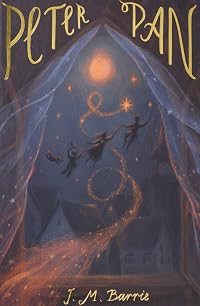
Peter Pan in Kensington Gardens / Peter and Wendy
by J. M. Barrie
On This Page
Description
Magical Peter Pan comes to the night nursery of the Darling children, teaches them to fly, and then takes them through the sky to Never-Never Land. After many adventures the story reaches its climax as Peter and the children do battle with Captain Hook and his band.Tags
Recommendations





Member Reviews
"'You see, Wendy, when the first baby laughed for the first time, its laugh broke into a thousand piecs, and they all went skipping about, and that was the beginning of fairies.'"
I had, sadly, never before experienced the true Peter Pan. Only the Disneyfied version. Which I always enjoyed, I mean, who doesn't love the frivolous forever-child and the jealous little pixie fairy? But of course, we all know Disney's track record for authenticity.
"'Tink,' said Peter amiably, 'this lady says she wishes you were her fairy.'
Tinker Bell answered insolently.
'What does she say, Peter?'
He had to translate. 'She is not very polite. She says you are a great ugly girl, and that she is my fairy.'
He tried to argue with Tink. 'You know you can't be my show more fairy, Tink, because I am an gentleman and you are a lady.'
To this Tink replied in these words, 'You silly ass,' and disappeared into the bathroom. 'She is quite a common fairy,' Peter explained apologetically, 'she is called Tinker Bell because she mends the pots and kettles.'"
I had no idea that the real Tink was such a terrible little wretch! She's so mean and her language! In a children's story! There were times I would have liked to be able to reach in and swat her for the stuff she did. Even still, she also was managed to be rather entertaining. I mean, imagine, a pretty little fairy, whose catch-phrase appears to be "silly ass"! It made me laugh every time.
"For a moment the circle of light was broken, and something gave Peter a loving little pinch.
'Then tell her,' Wendy begged, 'to put out her light.'
'She can't put it out. That is about the only thing fairies can't do. It just goes out of itself when she falls asleep, same as the stars.'
'Then tell her to sleep at once,' John almost ordered.
'She can't sleep except when she's sleepy. It is the only other thing fairies can't do.'
'Seems to me,' growled John, 'these are the only two things worth doing.'
Here he got a pinch, but not a loving one."
So while I was a little displeased at just how selfish Peter and Tink were, I thought the story was a lot of fun. It's more random chapters of his/their time in Neverland than an actual chronological story, but it's whimsical adventure (and a bit darker than Disney would have you believe), with both lovely sweet notions (such as the first quote) and thoroughly amusing laugh-out-loud bits (such as the other quotes) and the ending was perfectly done.
Then we have Peter's original book, Peter Pan in Kensington Gardens. He made his first appearance in Barrie's adult novel [The Little White Bird] in 1902, and then starred in the play of Peter Pan, or The Boy Who Wouldn't Grow Up in 1904. But Barrie didn't turn the play into a novel until 1911 (then titled Peter and Wendy), while he wrote about Kensington Gardens in 1906.
"He would not eat worms or insects (which thy thought very silly of him), so they brought him bread in their beaks. Thus, when you cry out, 'Greedy! Greedy!' to the bird that flies away with the big crust, you know now that you ought not to do this, for he is very likely taking it to Peter Pan."
I actually liked this one better than the other. There's a couple things that contributed to this. One, there was no terribly naughty Tink, and Peter was far more innocent (he's merely 7 days old) so more pleasant. Two, there were no prior experiences with it so no discrepancies between childhood enjoyment and actual story. And then, it is an entirely different story, unique and completely fresh, with all sorts of delightful entertaining tidbits. Plus there are more like two or three stories overlapping and intertwining amongst each other and they're all a bit silly and amusing and fun. I would strongly recommend reading this one!
"'O Tony,' she would say with awful respect, 'but the fairies will be so angry!'
'I dare say,' replied Tony carelessly.
'Perhaps,' she said, thrilling, 'Peter Pan will give you a sail in his boat!'
'I shall make him,' replied Tony; no wonder she was proud of him.
But they should not have talked so loudly, for one day they were overheard by a fairy who had been gathering skeleton leaves, from which the little people weave their summer curtains, and after that Tony was a marked boy. They loosened the rails before he sat on them, so that down he came on the back of his head; they tripped him up by catching his bootlace, and bribed the ducks to sink his boat. Nearly all the nasty accidents you meet with in the Gardens occur because the fairies have taken an ill-will to you, and so it behoves you to be careful what you say about them."
I really liked both these books, and I'd definitely recommend them to everyone, of all ages. Especially if you find a copy with the nice original illustrations! show less
I had, sadly, never before experienced the true Peter Pan. Only the Disneyfied version. Which I always enjoyed, I mean, who doesn't love the frivolous forever-child and the jealous little pixie fairy? But of course, we all know Disney's track record for authenticity.
"'Tink,' said Peter amiably, 'this lady says she wishes you were her fairy.'
Tinker Bell answered insolently.
'What does she say, Peter?'
He had to translate. 'She is not very polite. She says you are a great ugly girl, and that she is my fairy.'
He tried to argue with Tink. 'You know you can't be my show more fairy, Tink, because I am an gentleman and you are a lady.'
To this Tink replied in these words, 'You silly ass,' and disappeared into the bathroom. 'She is quite a common fairy,' Peter explained apologetically, 'she is called Tinker Bell because she mends the pots and kettles.'"
I had no idea that the real Tink was such a terrible little wretch! She's so mean and her language! In a children's story! There were times I would have liked to be able to reach in and swat her for the stuff she did. Even still, she also was managed to be rather entertaining. I mean, imagine, a pretty little fairy, whose catch-phrase appears to be "silly ass"! It made me laugh every time.
"For a moment the circle of light was broken, and something gave Peter a loving little pinch.
'Then tell her,' Wendy begged, 'to put out her light.'
'She can't put it out. That is about the only thing fairies can't do. It just goes out of itself when she falls asleep, same as the stars.'
'Then tell her to sleep at once,' John almost ordered.
'She can't sleep except when she's sleepy. It is the only other thing fairies can't do.'
'Seems to me,' growled John, 'these are the only two things worth doing.'
Here he got a pinch, but not a loving one."
So while I was a little displeased at just how selfish Peter and Tink were, I thought the story was a lot of fun. It's more random chapters of his/their time in Neverland than an actual chronological story, but it's whimsical adventure (and a bit darker than Disney would have you believe), with both lovely sweet notions (such as the first quote) and thoroughly amusing laugh-out-loud bits (such as the other quotes) and the ending was perfectly done.
Then we have Peter's original book, Peter Pan in Kensington Gardens. He made his first appearance in Barrie's adult novel [The Little White Bird] in 1902, and then starred in the play of Peter Pan, or The Boy Who Wouldn't Grow Up in 1904. But Barrie didn't turn the play into a novel until 1911 (then titled Peter and Wendy), while he wrote about Kensington Gardens in 1906.
"He would not eat worms or insects (which thy thought very silly of him), so they brought him bread in their beaks. Thus, when you cry out, 'Greedy! Greedy!' to the bird that flies away with the big crust, you know now that you ought not to do this, for he is very likely taking it to Peter Pan."
I actually liked this one better than the other. There's a couple things that contributed to this. One, there was no terribly naughty Tink, and Peter was far more innocent (he's merely 7 days old) so more pleasant. Two, there were no prior experiences with it so no discrepancies between childhood enjoyment and actual story. And then, it is an entirely different story, unique and completely fresh, with all sorts of delightful entertaining tidbits. Plus there are more like two or three stories overlapping and intertwining amongst each other and they're all a bit silly and amusing and fun. I would strongly recommend reading this one!
"'O Tony,' she would say with awful respect, 'but the fairies will be so angry!'
'I dare say,' replied Tony carelessly.
'Perhaps,' she said, thrilling, 'Peter Pan will give you a sail in his boat!'
'I shall make him,' replied Tony; no wonder she was proud of him.
But they should not have talked so loudly, for one day they were overheard by a fairy who had been gathering skeleton leaves, from which the little people weave their summer curtains, and after that Tony was a marked boy. They loosened the rails before he sat on them, so that down he came on the back of his head; they tripped him up by catching his bootlace, and bribed the ducks to sink his boat. Nearly all the nasty accidents you meet with in the Gardens occur because the fairies have taken an ill-will to you, and so it behoves you to be careful what you say about them."
I really liked both these books, and I'd definitely recommend them to everyone, of all ages. Especially if you find a copy with the nice original illustrations! show less
I read this a long time ago as a little girl (10 years old, I think), but having just read it again, I find that it's even richer and much funnier than I remember!
Of course, it's a good story, but it also presents a satirical critique of Victorian culture in several respects, including, the Darlings' attempt to keep up the appearance of middle-class comfort by keeping a governess, but saving money because the governess is a dog, Nana. Victorian gender roles also find themselves coming under Barrie's satirical gun.
But I'll say no more--you must find it all out for yourself. And you'll be glad you did.
Of course, it's a good story, but it also presents a satirical critique of Victorian culture in several respects, including, the Darlings' attempt to keep up the appearance of middle-class comfort by keeping a governess, but saving money because the governess is a dog, Nana. Victorian gender roles also find themselves coming under Barrie's satirical gun.
But I'll say no more--you must find it all out for yourself. And you'll be glad you did.
Like the best children's books, especially children's fantasies (meant in its most expansive definition), much darker and thornier than the versions everyone remembers. The novel is even a couple steps darker and more poignant than the play, with a would-be murderous Tinker Bell (two words, okay?!), Wendy getting seriously confused over whether she's a child or adult, the constant description of youth as "gay, innocent and heartless", the mass death of most of the Indians, and the incredible callousness of Peter as time starts to pass. Barrie knew that the passage into adulthood was necessarily tragic -- but not doing so would be heartbreaking in its own right -- and he didn't downplay that for one second.Not to say this is show more unremittingly dark; it's constantly witty and the narrator is friendly, sometimes the consequences you expect are hilariously smaller and more like pretend-play than you might have been waiting for, and there's some great parody of other "Boys' Books" material in there.If anything, though, it's an amazing companion to The Neverending Story: a really cool look at the way imagination works on the mechanical level, and why we should bother, and what about it we should keep an eye on. And in the meantime giving us characters we can hope and fear and cry for. show less
I found that Barrie had a very different voice than I had imagined. I had always loved the story of Peter Pan when I was younger, and at 17, I finally decided to buy it and read it properly. Barrie's voice is actually quite cynical, and I really enjoyed it. It was laced with the slightly crude British humour that I've always adored from any author that can do it right. I also discovered that Peter Pan (Specifically Peter in Kensington Gardens) was much more morbid than I'd first thought. It is actually, on a deep level, a much darker story than it seems, and I thoroughly enjoyed reading it. And there were times when I truly found myself growing emotional over the view of childhood, and the loss of it. Very well done - I'm really happy show more that I picked up the book to read it! show less
When I started reading this book I thought I would love it. It turned out to bore me a lot.
I thought neverland would be a magical place where you'd want to go back again and again. But London seemed rather cozier and less deadly (children killing pirates?).
Peter isn't a hero, he's just very selfish boy.
This book made me believe that Peter Pan is only famous because of Disney. It's very well written and full of creative sillyness, but the fights against the pirates are long and boring and got me sleeping a couple of times.
I thought neverland would be a magical place where you'd want to go back again and again. But London seemed rather cozier and less deadly (children killing pirates?).
Peter isn't a hero, he's just very selfish boy.
This book made me believe that Peter Pan is only famous because of Disney. It's very well written and full of creative sillyness, but the fights against the pirates are long and boring and got me sleeping a couple of times.
This book contains both the classic story "Peter Pan" and the story "Peter Pan in Kensington Gardens." Though I have read "Peter Pan" before and thoroughly enjoyed it, for some reason in this reading, I came away with a sense of sadness at the end of the story. This may be due to the fact that Peter Pan does not stay with Wendy, and often times forgets to come back to visit her, but also to the fact that we are reminded that we must all grow up and lose our innocence. I feel that many of us often look back on our childhood and think about how much simpler it was, and wish we could go back to that time. But we grow up, and life goes on.
The characters in "Peter Pan" are so unforgettable. Who can ever forget the sassy little Tinker Bell, show more the conniving Captain Hook, or the simple Smee? Even though they have their faults, you find yourself sympathizing with them and liking them.
I did not find the second story, "Peter in Kensington Gardens" nearly as interesting as "Peter Pan." It is a story about Peter when he is just a toddler, and how he came to live in Kensington Gardens, and learns how to survive from the birds and the fairies. It starts out with Peter flying away from home, but then he forgets how to fly. Perhaps that is why in "Peter Pan" he tells Wendy that we all know how to fly, but we forget how because we "are no longer gay and innocent."
One line that really stood out for me in this story was: "There is almost nothing that has such a keen sense of fun as a fallen leaf." When you think about a leaf in autumn and how it sails about and tumbles along, you can almost feel the fun. Maybe we should all sometimes just pretend to be a fallen leaf. show less
The characters in "Peter Pan" are so unforgettable. Who can ever forget the sassy little Tinker Bell, show more the conniving Captain Hook, or the simple Smee? Even though they have their faults, you find yourself sympathizing with them and liking them.
I did not find the second story, "Peter in Kensington Gardens" nearly as interesting as "Peter Pan." It is a story about Peter when he is just a toddler, and how he came to live in Kensington Gardens, and learns how to survive from the birds and the fairies. It starts out with Peter flying away from home, but then he forgets how to fly. Perhaps that is why in "Peter Pan" he tells Wendy that we all know how to fly, but we forget how because we "are no longer gay and innocent."
One line that really stood out for me in this story was: "There is almost nothing that has such a keen sense of fun as a fallen leaf." When you think about a leaf in autumn and how it sails about and tumbles along, you can almost feel the fun. Maybe we should all sometimes just pretend to be a fallen leaf. show less
Peter and Wendy was slightly traumatizing, and Peter Pan in Kensington Gardens became incredibly depressing.
Members
- Recently Added By
Author Information

439+ Works 31,613 Members
James Matthew Barrie, the creator of Peter Pan, was born on May 9, 1860, in Kirriemuir, Angus, Scotland. His idyllic boyhood was shattered by his brother's death when Barrie was six. His own grief and that of his mother influenced the rest of his life. Through his work, he sought to recapture the carefree joy of his first six years. Barrie came to show more London as a freelance writer in 1885. His early fiction, Auld Licht Idylls (1888) and A Window in Thrums (1889), were inspired by his youth in Kirriemuir. After publishing a biography of his mother Margaret Ogilvy and the autobiographical novel Sentimental Tommy, about a boy living in a dream world (1896), he concentrated on writing plays. The Admirable Crichton (1902), the story of a butler who becomes king of a desert island, helped to establish Barrie's reputation as a playwright. Meanwhile, he began to relive his childhood by telling the first Peter Pan stories to the sons of his friend, Sylvia Llewellyn Davies. The play Peter Pan was first performed in 1904 and published as a novel seven years later. Its imaginative drama, featuring the eternal boy's triumph over the grownup Captain Hook, idealizes childhood and underscores adults' inability to regain it. These resonant themes made it a classic of world literature. Barrie's later work shows his increasingly cynical view of adulthood, particularly in Dear Brutus (1917). Often considered his finest play, it concerns nine men and women whose caprices destroy a miraculous opportunity to relive their lives. Barrie married the former Mary Ansell in 1894. They divorced in 1909, never having any children. Barrie died in London on June 19, 1937. (Bowker Author Biography) show less
Series
Belongs to Publisher Series
Corticelli [Mursia] (36)
Work Relationships
Is contained in
Common Knowledge
- Canonical title
- Peter Pan in Kensington Gardens / Peter and Wendy
- Original title
- Peter Pan in Kensington Gardens; Peter and Wendy
- Original publication date
- 1906/1911
- Disambiguation notice
- Please note that some editions, namely Wordsworth 1853261203 and Borders 1587261022, although most often not noted in the title, contain both "Peter Pan" as well as "Peter Pan in Kensington Gardens"! Please don't separate!
Classifications
Statistics
- Members
- 1,640
- Popularity
- 13,669
- Reviews
- 13
- Rating
- (4.09)
- Languages
- English, Italian, Japanese, Spanish
- Media
- Paper, Ebook
- ISBNs
- 31
- UPCs
- 1
- ASINs
- 12