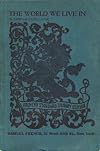
The World We Live In (The Insect Comedy)
by Josef Čapek, Karel Capek
On This Page
Description
Unlike many other plays by ?apek, 'The White Plague' is pervaded not by hope with a little nihilism, but with anguish and fear for what the future would hold. Written in the late 1930s, shortly before the Munich Agreement delivered much of Czechoslovakia into Nazi control, 'The White Plague' tells the story of a dictatorship which is overcome by an illness it is powerless to control. It was first performed in 1937.Tags
Recommendations





















Member Reviews
Karel and Josef Capek’s The Insect Play is one of the pair’s best known and well-received collaborations. Also known as The Insect Comedy, The World We Live In, and From Insect Life, the play was published in its original Czech in 1921 as Ze zivota hmyzu. The play was first performed at the National Theatre in Brno, Czechoslovakia, on March 8, 1922 (some sources say February), running for about one hundred nights. The Insect Play made its American debut later in 1922, and its London premiere the following year. The play has been performed only intermittently since that time because of the demanding staging it requires.
The brothers Capek began work on the play in 1920. Their first collaboration after an eight-year hiatus, it would show more also be one of their last. The Insect Play was a combination of many forms, including fable, revue, and satire. All but a few of the characters are insects that are anthropomorphized (given human qualities). The brothers commented on human society in their place and time period (Czechoslovakia in the post-World War I era) via these insects. Many critics believe that the Capeks were inspired by other animal plays and short stories, including Jean Henri Fabré’s La vie des insects (The life of insects) and Souvenirs entomologiques, and a story by Russian author Vsevolod Garsin, What Never Happened. Though The Insect Play has been problematic for critics from the beginning, many have found much to praise over the years. As Lucia Mauro of the Chicago Sun-Times wrote, when commenting on a 1999 production of the play, ‘‘their keen observations of the life cycle and poignant visions of war’s futility remain relevant to this day.
[http://www.enotes.com/insect-play/] show less
The brothers Capek began work on the play in 1920. Their first collaboration after an eight-year hiatus, it would show more also be one of their last. The Insect Play was a combination of many forms, including fable, revue, and satire. All but a few of the characters are insects that are anthropomorphized (given human qualities). The brothers commented on human society in their place and time period (Czechoslovakia in the post-World War I era) via these insects. Many critics believe that the Capeks were inspired by other animal plays and short stories, including Jean Henri Fabré’s La vie des insects (The life of insects) and Souvenirs entomologiques, and a story by Russian author Vsevolod Garsin, What Never Happened. Though The Insect Play has been problematic for critics from the beginning, many have found much to praise over the years. As Lucia Mauro of the Chicago Sun-Times wrote, when commenting on a 1999 production of the play, ‘‘their keen observations of the life cycle and poignant visions of war’s futility remain relevant to this day.
[http://www.enotes.com/insect-play/] show less
Ratings
Members
- Recently Added By
Lists

Next Plays / 2025
352 works; 1 member
Author Information

65+ Works 452 Members

255+ Works 7,168 Members
Karel Capek is best known abroad for his plays, but at home he is also revered as an accomplished novelist, short-story writer, essayist, and writer of political articles. His bitingly satirical novel The War with the Newts (1936) reveals his understanding of the possible consequences of scientific advance. The novel Krakatit (1924), about an show more explosive that could destroy the world, foreshadows the feared potential of a nuclear disaster. In his numerous short stories he depicts the problems of modern life and common people in a humorous and whimsically philosophical fashion. The plays of Karel Capek presage the Theater of the Absurd. R.U.R. (Rossum's Universal Robots) (1921) was a satire on the machine age. He created the word robot from the Czech noun robota, meaning "work" for the human-made automatons who in that play took over the world, leaving only one human being alive. The Insect Comedy (1921), whose characters are insects, is an ironic fantasy on human weakness. The Makropoulos Secret (1923), later used as the basis for Leos Janacek's opera, was an experimental piece that questioned whether immortality is really desirable. All the plays have been produced successfully in New York. Most deal satirically with the modern machine age or with war. Underlying all his work, though, is a faith in humanity, truth, justice, and democracy, which has made him one of the most beloved of all Czech writers. (Bowker Author Biography) show less
Some Editions
Work Relationships
Is contained in
Common Knowledge
- Original title
- Ze zivota hmyzu
- Alternate titles
- The Life of the Insects; 'And So Ad Infinitum' : (The Life of the Insects) : An Entomological Review in Three Acts, a Prologue and an Epilogue (The Life of the Insects)
- Original publication date
- 1923
- Related movies
- The Insect Play (1939 | IMDb); BBC Sunday-Night Theatre:The Insect Play (1950 | s1e22 | IMDb); BBC Sunday-Night Play:Twentieth Century Theatre: The Insect Play (1960 | s1e25 | IMDb)
Classifications
- Genre
- Fiction and Literature
- DDC/MDS
- 891.8625 — Literature & rhetoric Literatures of other languages East Indo-European and Celtic literatures West and South Slavic languages (Bulgarian, Slovene, Polish, Czech, Slovak, Serbo-Croatian, and Macedonian) Czech Czech drama 1900–1989
- LCC
- PG5038 .C3 .W6 — Language and Literature Slavic languages and literatures. Baltic languages. Albanian language Slavic. Baltic. Albanian Slavic Czech
Statistics
- Members
- 41
- Popularity
- 717,759
- Reviews
- 1
- Rating
- (4.75)
- Languages
- Czech, English
- Media
- Paper
- ISBNs
- 5
- ASINs
- 5