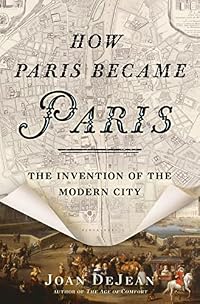
How Paris Became Paris: The Invention of the Modern City
by Joan DeJean
On This Page
Description
In this compelling portrait of a city in transition, Joan DeJean shows that by 1700 Paris had become the capital that would transform forever our conception of the city and of urban life.Tags
Recommendations






















Member Reviews
This was an academic book, but it was rather short for an academic book. It had 226 pages of reading and another 50 pages of end notes and bibliography. It covered the development of Paris from the reign of Henri IV to the end of the reign of Louis XIV. I learned a great deal about the history of Paris at this time and also learned many other things about Paris and the development of cities. Paris was the first city to develop a postal system. The first to have public transportation. It was the first city to ask the public to participate in city planning. The book also covered social and cultural developments of the era and laid some convincing groundwork for the idea that the French Revolution of 1789 was really only an extension of show more the leveling of French society that had occurred during the previous 150 years. There were chapters on the royal building projects of the years 1600 - 1789 and this included the housing developments, the building of what we now call the Ile de la Citie, the creation of public parks, public shopping areas, and the Pont Neuf. There was even a chapter on how all of this building was financed. This chapter was very enlightening, as it turns out that very little of the building was financed with public money. This book explained how the French developed their financial system and how this system contributed to the problems that the French monarchy faced throughout the 18th century. At the same time, the financial system created a very socially mobile society, with commoners able to enter the ranks of the very wealthy and become part of the aristocracy. France during the 17th and 18th century was a very socially mobile place. Much more so than I had thought it was. It was this mobility that, along with the financial system, directly lead to the political problems that manifested itself in 1789. The author takes the position that the Paris of these centuries was a great social and cultural leveler with the free mixing of people of all classes that encouraged democratizing ideas. There are chapters on the development of financiers, the freedom of women to move around and mix in with society, and a great chapter on the development of shopping, in the modern sense of the word, and the infrastructure needed to support shopping, the arcades and covered malls and the rudiments of department stores. Very interesting book. Now I need to go see Paris. show less
The major takeaway for me from this book is that many of the Parisian features I always attributed to Baron Hausmann in the time of Napoleon III were much-older. Wide, straight boulevards, green public spaces, harmonious exteriors of entire neighborhoods? Those were transformations of the 17th century. The main innovation Hausmann brought to the table when he initiated similar projects is that his methods of achieving them were much more disruptive of what had gone before and dislocated many more inhabitants.
Joan DeJean is in love with Paris and shares that love with us in this book. The subtitle indicates one reason: This is where what we think of as the modern city was invented. A modern city is where large numbers of people from show more different social and economic strata mingle in public spaces, where goods, services, and ideas circulate with stunning velocity, throwing off creative sparks.
A city is also a place where the poor can experience poverty in a crushing way hardly imaginable in traditional, rural society. While DeJean might concede this, it is not something she focusses on. For that side of the Parisian experience through the ages, Alistair Horne’s Seven Ages of Paris is a counterbalance to this book.
Dispassionately, DeJean traces how the wars of Louis XIV played a role in creating Paris as we know it. By expanding the borders of France and making them defensible, he was able to order the removal of Paris’s medieval walls. This newly-freed area was used to create a ring of boulevards around the city, wide, tree-lined spaces amenable to walking. This development even lies behind the word “boulevard,” taken from an old form of our “bulwark.”
Another way in which war helped make Paris as we know it is that, while war is a terrible machine for wealth-destruction, there is one group for whom it has the opposite effect. They are those who can arrange to provide a sovereign with the means to quickly raise and equip vast armies, at interest, of course. The French even created a new word to denote the few individuals who could do this: “financier.” The proceeds enabled them to rise from often humble origins to gather fortunes that eclipsed those of the traditional aristocracy. The imposing urban palaces they built for themselves, the “hôtels,” set the model for Parisian residential architecture. DeJean accepts all this in a matter-of-fact, even admiring way that seems to ignore the effect that the incessant wars of the Sun King had on the rest of the population of France and its neighbors.
Two of the Parisian features DeJean admires most, however, predate this time and were the initiative of Louis XIV’s grandfather, Henri IV. They are the Pont Neuf and the Place Royale, now known as the Place de Vosges. Both were unprecedented in the western world. The former connected the right and left banks of the Seine, as well as the Île-de-la-Cité (the oldest kernel of Paris) with a stone bridge (the city’s few older bridges were of wood), wide enough to allow new, wider vehicles to cross at the same time in both directions. Even more innovative was the provision of raised sidewalks for pedestrians, interspersed with balconies jutting out over the river that invited passers-by to linger and take in the sights. Paris became a city with contradictory impulses: it was now possible to hurry from place to place (“faire des cours” was a neologism of the time) and yet to slow down and take one’s time, producing that well-known creature of Paris, the “flâneur.”
And where better to linger than in that other innovation, the Place Royale, a large public square surrounded on all four sides by mixed-use buildings (residences above shops) with a royally-decreed uniform facade.
These two innovations, argues DeJean, put Paris on the path to become the kind of city not seen before in Europe. I’m convinced, but I found the term she chose to describe them and other features such as private residences that follow, “monuments,” idiosyncratic. None of these were erected as memorials. They exist not to commemorate the past, but to enrich life in the present.
My other quibble with this book is that the writing is repetitive. DeJean often introduces a fact to illustrate a point; then a few pages later reintroduces the fact. At other times, she writes paragraphs in which the same thought is repeated three times, only varying the formulation. It’s as if she had an English teacher in school who insisted that a paragraph must treat one point but may not consist of only one sentence.
The book contains many images that are in the full sense of the word illustrations, demonstrating features DeJean describes in the text. Strangely, however, they are often introduced with the phrase, “this image... .,” at times denoting an illustration that follows on the next page. I had the sense that I was reading the transcription of a lecture that had been illustrated with slides. The oral nature of a lecture might explain my other quibbles with the prose.
In the end, though, this is a minor complaint and didn’t bother me as much as the author’s seeming indifference to the cost of war (she might feel differently had Hitler had his way and dynamited all the sights of Paris as the Wehrmacht withdrew). Like DeJean, I love Paris, an exciting urban space that rewards repeated visits and exploration. Her book helped me understand why this is so. show less
Joan DeJean is in love with Paris and shares that love with us in this book. The subtitle indicates one reason: This is where what we think of as the modern city was invented. A modern city is where large numbers of people from show more different social and economic strata mingle in public spaces, where goods, services, and ideas circulate with stunning velocity, throwing off creative sparks.
A city is also a place where the poor can experience poverty in a crushing way hardly imaginable in traditional, rural society. While DeJean might concede this, it is not something she focusses on. For that side of the Parisian experience through the ages, Alistair Horne’s Seven Ages of Paris is a counterbalance to this book.
Dispassionately, DeJean traces how the wars of Louis XIV played a role in creating Paris as we know it. By expanding the borders of France and making them defensible, he was able to order the removal of Paris’s medieval walls. This newly-freed area was used to create a ring of boulevards around the city, wide, tree-lined spaces amenable to walking. This development even lies behind the word “boulevard,” taken from an old form of our “bulwark.”
Another way in which war helped make Paris as we know it is that, while war is a terrible machine for wealth-destruction, there is one group for whom it has the opposite effect. They are those who can arrange to provide a sovereign with the means to quickly raise and equip vast armies, at interest, of course. The French even created a new word to denote the few individuals who could do this: “financier.” The proceeds enabled them to rise from often humble origins to gather fortunes that eclipsed those of the traditional aristocracy. The imposing urban palaces they built for themselves, the “hôtels,” set the model for Parisian residential architecture. DeJean accepts all this in a matter-of-fact, even admiring way that seems to ignore the effect that the incessant wars of the Sun King had on the rest of the population of France and its neighbors.
Two of the Parisian features DeJean admires most, however, predate this time and were the initiative of Louis XIV’s grandfather, Henri IV. They are the Pont Neuf and the Place Royale, now known as the Place de Vosges. Both were unprecedented in the western world. The former connected the right and left banks of the Seine, as well as the Île-de-la-Cité (the oldest kernel of Paris) with a stone bridge (the city’s few older bridges were of wood), wide enough to allow new, wider vehicles to cross at the same time in both directions. Even more innovative was the provision of raised sidewalks for pedestrians, interspersed with balconies jutting out over the river that invited passers-by to linger and take in the sights. Paris became a city with contradictory impulses: it was now possible to hurry from place to place (“faire des cours” was a neologism of the time) and yet to slow down and take one’s time, producing that well-known creature of Paris, the “flâneur.”
And where better to linger than in that other innovation, the Place Royale, a large public square surrounded on all four sides by mixed-use buildings (residences above shops) with a royally-decreed uniform facade.
These two innovations, argues DeJean, put Paris on the path to become the kind of city not seen before in Europe. I’m convinced, but I found the term she chose to describe them and other features such as private residences that follow, “monuments,” idiosyncratic. None of these were erected as memorials. They exist not to commemorate the past, but to enrich life in the present.
My other quibble with this book is that the writing is repetitive. DeJean often introduces a fact to illustrate a point; then a few pages later reintroduces the fact. At other times, she writes paragraphs in which the same thought is repeated three times, only varying the formulation. It’s as if she had an English teacher in school who insisted that a paragraph must treat one point but may not consist of only one sentence.
The book contains many images that are in the full sense of the word illustrations, demonstrating features DeJean describes in the text. Strangely, however, they are often introduced with the phrase, “this image... .,” at times denoting an illustration that follows on the next page. I had the sense that I was reading the transcription of a lecture that had been illustrated with slides. The oral nature of a lecture might explain my other quibbles with the prose.
In the end, though, this is a minor complaint and didn’t bother me as much as the author’s seeming indifference to the cost of war (she might feel differently had Hitler had his way and dynamited all the sights of Paris as the Wehrmacht withdrew). Like DeJean, I love Paris, an exciting urban space that rewards repeated visits and exploration. Her book helped me understand why this is so. show less
Renaissance Paris, Ouates et Tous
A history of Paris from the late 17th to the mid-18th centuries, the reigns of the "Sun King" Louis XIV and his son, the beloved Louis XV, who saw to completion his father's dream of the capital. Their efforts and internal forces both economic and cultural led Paris from just another European city, not particularly different from or indeed secondary to London, Florence or Berlin, into the capital of the known world in everything from the arts and sciences to finance to fashion, and the model for and envy of the British colonial American cities of Boston, New York and Charleston. Each chapter explores a different aspect of this century-long development, with one devoted to the Pont Neuf and how it show more revolutionized modern thinking of city projects, another to the introduction of street lamps at night (thus creating the reputation as the "City of Lights"), and yet another to the clustered-together boutique shops and wares peddlers which foreran today's shopping malls. Author Joan DeJean has a clear love for France and the city of Paris in specific, a love which can often be blind. For instance, there is not one single reference to the antisemitic undertones in the mistrust of the newly-created financiers and other nouveau riches. That aside, there are lessons to be learned here even in the 21st century, especially for urban planners, who can look to the creation of public parks and transportation and how they contributed to making Paris what it would become. Numerous illustrations, including six pages of color plates, graphically depict how life in Paris was viewed by contemporaries and how rapidly and dramatically that life changed, which gives the history a pulse. In 2024, all eyes were again on the great city, with the protests in June against President Emmanuel Macron's administration reflecting the global populist zeitgeist months after March's widely popular passage of a constitutional amendment enshrining reproductive rights had made a case for institutionalism, the bubbling up of global political conflicts at the Summer Olympics in July and August, and the reopening of the Notre-Dame Cathedral after it had been nearly destroyed in a devastating April 2019 fire. This book provides a good overview of how Paris became worthy of such international attention in the first place. show less
A history of Paris from the late 17th to the mid-18th centuries, the reigns of the "Sun King" Louis XIV and his son, the beloved Louis XV, who saw to completion his father's dream of the capital. Their efforts and internal forces both economic and cultural led Paris from just another European city, not particularly different from or indeed secondary to London, Florence or Berlin, into the capital of the known world in everything from the arts and sciences to finance to fashion, and the model for and envy of the British colonial American cities of Boston, New York and Charleston. Each chapter explores a different aspect of this century-long development, with one devoted to the Pont Neuf and how it show more revolutionized modern thinking of city projects, another to the introduction of street lamps at night (thus creating the reputation as the "City of Lights"), and yet another to the clustered-together boutique shops and wares peddlers which foreran today's shopping malls. Author Joan DeJean has a clear love for France and the city of Paris in specific, a love which can often be blind. For instance, there is not one single reference to the antisemitic undertones in the mistrust of the newly-created financiers and other nouveau riches. That aside, there are lessons to be learned here even in the 21st century, especially for urban planners, who can look to the creation of public parks and transportation and how they contributed to making Paris what it would become. Numerous illustrations, including six pages of color plates, graphically depict how life in Paris was viewed by contemporaries and how rapidly and dramatically that life changed, which gives the history a pulse. In 2024, all eyes were again on the great city, with the protests in June against President Emmanuel Macron's administration reflecting the global populist zeitgeist months after March's widely popular passage of a constitutional amendment enshrining reproductive rights had made a case for institutionalism, the bubbling up of global political conflicts at the Summer Olympics in July and August, and the reopening of the Notre-Dame Cathedral after it had been nearly destroyed in a devastating April 2019 fire. This book provides a good overview of how Paris became worthy of such international attention in the first place. show less
An intriguing and insightful account of the famed city of lights and how it came to be. The prose is tightly written and weaves itself in through facts and illustrations. A good effort and a good show.
I recommend it.
I recommend it.
A lot more readable than I expected. Yes, some parts are a bit dry, but when you are talking about dates, people, buildings etc, it's impossible to not get a little bit dry sometimes.
Overall very interesting, very well written, and also entertaining.
Overall very interesting, very well written, and also entertaining.
A lot more readable than I expected. Yes, some parts are a bit dry, but when you are talking about dates, people, buildings etc, it's impossible to not get a little bit dry sometimes.
Overall very interesting, very well written, and also entertaining.
Overall very interesting, very well written, and also entertaining.
A lot more readable than I expected. Yes, some parts are a bit dry, but when you are talking about dates, people, buildings etc, it's impossible to not get a little bit dry sometimes.
Overall very interesting, very well written, and also entertaining.
Overall very interesting, very well written, and also entertaining.
Members
- Recently Added By
Lists

Paris, City of Lights
103 works; 17 members

Books Read in 2021
5,361 works; 113 members
Author Information
16+ Works 860 Members
Joan DeJean is Trustee Professor at the University of Pennsylvania. She is the author of ten books on French literature, history, and material culture, including most recently The Age of Comfort: When Paris Discovered Casual-and the Modern Home Began and The Essence of Style: How the French Invented High Fashion, Fine Food, Chic Cafes, Style, show more Sophistication, and Glamour. She lives in Philadelphia and, when in Paris, on the street where the number 4 bus began service on July 5, 1662. show less
Awards and Honors
Awards
Common Knowledge
- Canonical title
- How Paris Became Paris: The Invention of the Modern City
- Alternate titles
- How Paris Became Paris
- Original publication date
- 2014-03-04
- Important places
- Paris, France; France
- Dedication
- In memory of Fannie DeJean Genin (1924 - 2012), who never made it to Paris but would have loved it.
- First words
- The invention of Paris began with a bridge.
- Last words
- (Click to show. Warning: May contain spoilers.)Paris caused urban planners to invent what a city could be, and it caused visitors to dream of what a city might be.
Classifications
- Genres
- History, Nonfiction, General Nonfiction, Art & Design, Travel
- DDC/MDS
- 944.361033 — History & geography History of Europe France and Monaco Champagne; Ile de France; Lorraine Île-de-France Paris
- LCC
- DC729 .D39 — History of Europe, Asia, Africa and Oceania France – Andorra – Monaco History of France Local history and description Paris
- BISAC
Statistics
- Members
- 294
- Popularity
- 108,094
- Reviews
- 7
- Rating
- (3.74)
- Languages
- English
- Media
- Paper, Audiobook, Ebook
- ISBNs
- 3
- ASINs
- 2