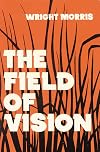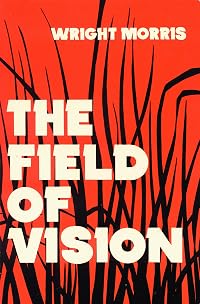
The Field of Vision
by Wright Morris
On This Page
Description
"Wright Morris seems to me the most important novelist of the American middle generation. Through a large body of work -which, unaccountably, has yet to receive the wide attention it deserves-Mr. Morris has adhered to standards which we have come to identify as those of the most serious literary art. His novel The Field of Vision brilliantly climaxes his most richly creative period. It is a work of permanent significance and relevance to those who cannot be content with less than a full show more effort to cope with the symbolic possibilities of the human condition at the present time."-John W. Aldridge show lessTags
Recommendations





























Member Reviews
3194. The Field of Vision, by Wright Morris (read May 10, 1999) This book won the 1957 National Book Award, and I am sort of "doing" those winners. Reading this brought to 25 the number of winners I've read. This I found an odd book, heavy with weird flashbacks and shifting points of view. I suppose it all means a lot, but it said little to me. I suppose I should reread it to try to make more meaningful its message, but I did not enjoy it enuf to do so.
Ratings
Members
- Recently Added By
Published Reviews
ThingScore 50
Except for Hemingway’s The Sun Also Rises, no one seems to remember novels about bullfights. Perhaps Hemingway’s late Romantic view of the gelded war-fighter versus the potent matador—so elemental, so asqueroso—lingers in the mind more than the comparatively domestic problems of a group of Midwesterners on holiday in Mexico, witnessing a quasi-comic killing of a bull, doused with show more Pepsi-Cola (now there’s a metaphor for American vantage-points), and harkening back to their own impotence. show less
added by Shortride
Lists

National Book Award - Fiction
78 works; 10 members
Author Information

56+ Works 1,489 Members
Early in his career, Wright Morris was called by Mark Schorer "probably the most original young novelist writing in the United States." In 1968 Leon Howard wrote: "Wright Morris has been the most consistently original of American novelists for a quarter of a century." Since then, the University of Nebraska Press has brought out new editions of his show more first 17 novels. Although both critical and popular appreciation of his work continues to grow slowly, there is a general consensus that he ranks high among contemporary American novelists. Born in Central City, Nebraska, the Lone Tree of his fiction, Morris attended Pomona College in California and had an academic career chiefly at San Francisco State University until his retirement in 1975. Nebraska and California have provided the main settings for his work, but he has traveled widely here and abroad, and some of his best novels relate the picaresque odysseys made by engaging characters. For instance, his first novel, My Uncle Dudley (1942), is a fictionalized account of a trip to California with his father that motherless Morris made as a youth. When almost 30 years later Morris wrote about another east-to-west journey in Fire Sermon (1971), in which an old man and a boy encounter three young hippies, Granville Hicks called the book "simon-pure, dyed-in-the-wool honest-to-God Wright Morris of the very highest grade" (N.Y. Times). The Field of Vision (1956), which deals with "innocents abroad in Mexico," won the National Book Award for fiction in 1957 and ranks behind only Ceremony in Lone Tree (1960) as his most successful novel.Ceremony involves four generations at a family reunion as Morris ingeniously reconciles the past, present, and future in a story that avoids both nostalgia and the disillusionment of the you-can't-go-home-again theme that appears quite often in his other fiction. Critics attempting to define Morris's originality have emphasized his distinctive style---a Faulkner-like ability to draw characters that come alive as individuals, his cross-country Americanness, and a strong sense of place that may owe something to Morris's considerable gifts as a photographer. Morris's fine feeling for the conjunction of time and place is evident in his several books of photographs with text: The Inhabitants (1946), The Home Place (1948), God's Country and My People (1968), Photographs and Words, and Picture America (1982). Other nonfiction includes a collection of essays on contemporary social and political problems---A Bill of Rites, a Bill of Wrongs, a Bill of Goods (1967)---and two widely praised volumes of criticism---The Territory Ahead: Critical Iinterpretations in American Literature (1958) and Earthly Delights, Unearthly Adornments: American Writers as Image Makers. Two volumes of personal memoirs are Will's Boy (1981) and Solo: An American Dreamer in Europe, 1933--1934 (1983). (Bowker Author Biography) Writer and photographer Wright Morris was born in Central City, Nebraska on January 6, 1910. He was an English professor at San Francisco State College from 1963 - 1975. He wrote novels and photo-text books, which juxtapose photographs with fictional text. He won numerous awards including the 1956 National Book Award for The Field of Vision and the 1981 American Book Award for Fiction for Plains Song: For Female Voices. He died on April 25, 1998. (Bowker Author Biography) show less
Awards and Honors
Awards
Common Knowledge
- Canonical title
- The Field of Vision
- Original publication date
- 1956
- Publisher's editor
- Gross, Gerald
Classifications
Statistics
- Members
- 101
- Popularity
- 319,609
- Reviews
- 1
- Rating
- (3.36)
- Languages
- English, French
- Media
- Paper, Ebook
- ISBNs
- 7
- ASINs
- 6