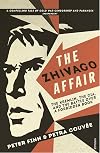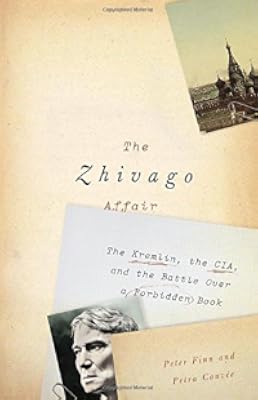
The Zhivago Affair: The Kremlin, the CIA, and the Battle Over a Forbidden Book
by Peter Finn (Author), Petra Couvée (Author)
On This Page
Description
Drawing on newly declassified files, this is the story of how a book forbidden in the Soviet Union became a secret CIA weapon in the ideological battle between East and West. In May 1956, an Italian publishing scout paid a visit to Russia's greatest living poet, Boris Pasternak. He left carrying the manuscript of Pasternak's first and only novel, entrusted to him with these words: "This is Doctor Zhivago. May it make its way around the world." Pasternak believed his novel would never be show more published in the Soviet Union, where the authorities regarded it as irredeemable--but he thought it stood a chance in the West and, indeed, it was widely published in translation. Then the CIA smuggled a Russian-language edition into the Soviet Union. Copies were sold on the black market and passed surreptitiously from friend to friend, and Pasternak found himself in no small trouble. But his funeral in 1960 was attended by thousands of admirers who defied their government in order to bid him farewell. The example he set launched the great tradition of the Soviet writer-dissident.--From publisher description. show lessTags
Recommendations








Member Reviews
"Books are different from all other propaganda media," wrote the CIA chief of covert action, "primarily because one single book can significantly change the reader's attitude and action to an extent unmatched by the impact of any other single medium...that is, of course, not true of all books at all times and with all readers -- but it is true significantly often enough to make books the most important weapon of strategic (long-range) propaganda."
This is the true story of how the CIA used the novel Dr. Zhivago as a weapon in the cold-war fight for the hearts and minds of Russian citizens. In fact, the CIA had a "book program" which smuggled hundreds of titles into eastern bloc countries. So, beyond all the politics, beyond the biography show more of Boris Pasternak, this book is also a testament to the power of literature.
The book is well written, almost reading like a spy novel at times. We see what life was like in Stalinist Russia and how important the Cold War was to the U.S. We see the life of Boris Pasternak, including the open affair he carried on and the pressure placed on him to renounce the Nobel Prize for Literature. show less
This is the true story of how the CIA used the novel Dr. Zhivago as a weapon in the cold-war fight for the hearts and minds of Russian citizens. In fact, the CIA had a "book program" which smuggled hundreds of titles into eastern bloc countries. So, beyond all the politics, beyond the biography show more of Boris Pasternak, this book is also a testament to the power of literature.
The book is well written, almost reading like a spy novel at times. We see what life was like in Stalinist Russia and how important the Cold War was to the U.S. We see the life of Boris Pasternak, including the open affair he carried on and the pressure placed on him to renounce the Nobel Prize for Literature. show less
I understand how and why sub-titles are selected by book publishers - they need a "hook" to capture potential buyers attention, so make things sound very exciting. But often, if I feel a book failed to live up the the publishers implied promise, I'm more disappointed in a book than I might have been otherwise. That's certainly true in the case of "The Zhivago Affair" The Kremlin, the CIA, and the Battle over a Forbidden Book".
It definitely was NOT an action book / spy story. I found it to be a rather dry story of the troubles Pasternak had in getting his book, Doctor Zhivago, past the soviet censors and published in the Soviet Union during the era of the Cold War. Perhaps the Soviet censors felt it didn't glorify the homeland enough. show more In any case, the only was Pasternak could have the book published was to allow it to be smuggled out of the U.S.S.R into Italy. Having it published in the West, however, only led to political difficulties for him in his homeland. So the book is more biographical and any CIA involvement was almost incidental. What the book does describe is what life in the USSR may have been like for artists and authors during the cold war, and in that regard, it's fairly interesting. show less
It definitely was NOT an action book / spy story. I found it to be a rather dry story of the troubles Pasternak had in getting his book, Doctor Zhivago, past the soviet censors and published in the Soviet Union during the era of the Cold War. Perhaps the Soviet censors felt it didn't glorify the homeland enough. show more In any case, the only was Pasternak could have the book published was to allow it to be smuggled out of the U.S.S.R into Italy. Having it published in the West, however, only led to political difficulties for him in his homeland. So the book is more biographical and any CIA involvement was almost incidental. What the book does describe is what life in the USSR may have been like for artists and authors during the cold war, and in that regard, it's fairly interesting. show less
Most of us know of CIA wrongdoings but few have heard of its Special Collections Division which was specifically designed during the Cold War to obtain and publish books that spoke against ideologically repressive regimes. These books would then be published in the language of the books’ authors, and smuggled back into the countries of the authors. During the Cold War, the CIA learned Boris Pasternak’s “Dr. Zhivago” original Russian manuscript was being translated into Italian in anticipation of being published in Italy. The CIA obtained the manuscript, had it published in Russian, then smuggled it into Russia through various means. Pasternak suffered repression as punishment but kept his life, and “Dr. Zhivago” went on to show more be recognized as a literary masterpiece. You’ll need to have read “Dr. Zhivago” to understand the reasons behind the virulent response of Soviet authorities. show less
The Book That Came In From the Cold
Review of the Vintage paperback edition (April 2015) of the original Pantheon hardcover edition (June 2014)
I enjoyed the fictionalized version of The Zhivago Affair in Lara Prescott's The Secrets We Kept (Sept. 2019) earlier this year and wanted to read more of the real-life story. Prescott superimposed her original fictional story of intrigues within the CIA on the actual story of Boris Pasternak and the publication of [book:Doctor Zhivago|130440]. Prescott's achievement is somewhat diminished in hindsight as a considerable amount of her book is simply retelling the story from this 2014 investigative work.
Although The Zhivago Affair trumpets about the release of declassified CIA files, it does seem show more like the co-authors learned more of the story from retired players who spoke under conditions of anonymity and from the more forthcoming Netherlands' Binnenlandse Veiligheidsdienst (BVD) (National Intelligence and Security Agency) who also participated in the Zhivago publication campaign.
I still found the whole story to be fascinating and the amount of research done by coauthors Peter Finn and Petra Couvée was quite extraordinary. show less
Review of the Vintage paperback edition (April 2015) of the original Pantheon hardcover edition (June 2014)
I enjoyed the fictionalized version of The Zhivago Affair in Lara Prescott's The Secrets We Kept (Sept. 2019) earlier this year and wanted to read more of the real-life story. Prescott superimposed her original fictional story of intrigues within the CIA on the actual story of Boris Pasternak and the publication of [book:Doctor Zhivago|130440]. Prescott's achievement is somewhat diminished in hindsight as a considerable amount of her book is simply retelling the story from this 2014 investigative work.
Although The Zhivago Affair trumpets about the release of declassified CIA files, it does seem show more like the co-authors learned more of the story from retired players who spoke under conditions of anonymity and from the more forthcoming Netherlands' Binnenlandse Veiligheidsdienst (BVD) (National Intelligence and Security Agency) who also participated in the Zhivago publication campaign.
I still found the whole story to be fascinating and the amount of research done by coauthors Peter Finn and Petra Couvée was quite extraordinary. show less
Best book I have read this year. An amazing story of how Pasternak's masterpiece was smuggled out of the Soviet Union by an Italian communist to be published in Italy. Adding to the layers of intrigue is how the CIA sponsored editions to be smuggled back into the Soviet Union where Dr. Zhivago was a source of controversy from its publication in 1958 into the post-Cold War era. Once highly regarded as a poet, Pasternak was harassed and persecuted by the Soviet government following the publication of this - his only novel. Like a novel itself, Finn delivers a quality work that captures the drama of Cold War era tensions against the backdrop of the literary landscape . If you have any interest at all in Russian history and literature, move show more this to the top of your reading list. show less
After reading Dr. Zhivago as well as Pasternak’s two autobiographical sketches* and also Olga Ivinskaya’s account** of their life together and the events surrounding the publication - or not - of Dr. Zhivago and the 1958 Nobel prize award, I received this book as a present. It was published in 2014 and the authors quote extensively publications and archive sources that have become available since the demise of the USSR (they are listed). What could it reveal that would be new to me?
Its main subject is, as the title indicates, the politics around the publication and subsequent Nobel prize award. I skimmed over details of P’s life and events I already knew - they had to be included for readers unfamiliar with these ; the two show more questions I was interested in are (i) why was P spared by Stalin and (ii) the extend of CIA involvement in publication and Nobel Prize award.
We will never know the answer to the first of course, only contemporary opinions and speculations. New to me was P’s commemoration in Literaturnaya Gazeta 17.11.1932 with words that could be taken as premonition of Stalin’s wife committing suicide; Stalin is likely to have read this. The émigré scholar M. Koryakov expressed the thought that, as a result, „P without realising it, entered the personal life of Stalin as a ‘Holy fool’ (37) and that in 1949 when there were plans to arrest him, Stalin was supposed to have said: “Leave him, he’s a cloud dweller.“ (67) Interesting! The authors don’t mention, although, in my view, it should have been mentioned, Ivinskaya writing: ‘I believe that between Stalin and Pasternak there was a remarkable, silent duel.’ (A Captive of Time,145).
As to the involvement of the CIA: newly accessible archive material allowed to record this in detail. The CIA set up the printing of a Russian language edition in the Netherlands (rather than in the US) and distribution by any means possible to Soviet citizens, taking great care that its involvement should not be traceable. No lobbying of the Nobel committee is recorded; it was superfluous. There was no need for the CIA to actively engage in anything but freely distribute copies to Russian visitors to the West. The suppression of the book in the Soviet Union caused damage to its cultural diplomacy among allied and non-aligned countries, India being the most important (190f). Khrushchev, later, after his fall, regretted that the book was not published in the USSR: „We caused much harm to the Soviet Union.“ he is quoted to have said (256, 265).
Detailed Notes on sources and an Index are provided. But what fool is responsible for the header that repeats on every single page the authors names and the book-title? In case you forget what you are reading? Chapter headings would make more sense.
Judging by the large amount of sources given, the authors have done a thoroughly researched account of the events surrounding the books publication and Nobel prize award to Pasternak. For anybody interested in all the details it is indispensable; for most who have read Dr. Zhivago and are curious to know just a little more about the events surrounding its publication I would rather recommend the lively written witness account by Olga Ivinskaya, Pasternak’s partner during those years. (VII-22)
* https://www.librarything.com/work/195131/book/103521953 , https://www.librarything.com/work/613414/book/211438106
** Olga Ivinskaya: A Captive of Time: My Years with Pasternak (https://www.librarything.com/review/215697297) show less
Its main subject is, as the title indicates, the politics around the publication and subsequent Nobel prize award. I skimmed over details of P’s life and events I already knew - they had to be included for readers unfamiliar with these ; the two show more questions I was interested in are (i) why was P spared by Stalin and (ii) the extend of CIA involvement in publication and Nobel Prize award.
We will never know the answer to the first of course, only contemporary opinions and speculations. New to me was P’s commemoration in Literaturnaya Gazeta 17.11.1932 with words that could be taken as premonition of Stalin’s wife committing suicide; Stalin is likely to have read this. The émigré scholar M. Koryakov expressed the thought that, as a result, „P without realising it, entered the personal life of Stalin as a ‘Holy fool’ (37) and that in 1949 when there were plans to arrest him, Stalin was supposed to have said: “Leave him, he’s a cloud dweller.“ (67) Interesting! The authors don’t mention, although, in my view, it should have been mentioned, Ivinskaya writing: ‘I believe that between Stalin and Pasternak there was a remarkable, silent duel.’ (A Captive of Time,145).
As to the involvement of the CIA: newly accessible archive material allowed to record this in detail. The CIA set up the printing of a Russian language edition in the Netherlands (rather than in the US) and distribution by any means possible to Soviet citizens, taking great care that its involvement should not be traceable. No lobbying of the Nobel committee is recorded; it was superfluous. There was no need for the CIA to actively engage in anything but freely distribute copies to Russian visitors to the West. The suppression of the book in the Soviet Union caused damage to its cultural diplomacy among allied and non-aligned countries, India being the most important (190f). Khrushchev, later, after his fall, regretted that the book was not published in the USSR: „We caused much harm to the Soviet Union.“ he is quoted to have said (256, 265).
Detailed Notes on sources and an Index are provided. But what fool is responsible for the header that repeats on every single page the authors names and the book-title? In case you forget what you are reading? Chapter headings would make more sense.
Judging by the large amount of sources given, the authors have done a thoroughly researched account of the events surrounding the books publication and Nobel prize award to Pasternak. For anybody interested in all the details it is indispensable; for most who have read Dr. Zhivago and are curious to know just a little more about the events surrounding its publication I would rather recommend the lively written witness account by Olga Ivinskaya, Pasternak’s partner during those years. (VII-22)
* https://www.librarything.com/work/195131/book/103521953 , https://www.librarything.com/work/613414/book/211438106
** Olga Ivinskaya: A Captive of Time: My Years with Pasternak (https://www.librarything.com/review/215697297) show less
I listened to this book which was read by the inestimable Simon Vance. In fact, the fact that Simon Vance was the narrator was the main reason for choosing this audiobook. I wonder how long he had to practise to correctly pronounce some of the difficult Russian names and places.
This is the story of the publication of Dr. Zhivago by Boris Pasternak. Pasternak was a well-known poet and translator in the USSR when he decided to write the novel which would become Dr. Zhivago. Suddenly, because of the less than favourable treatment of the Communist revolution in the book, Pasternak became a reviled writer who was exiled from the Union of Soviet Writers. Pasternak managed to send a copy of the manuscript to an Italian publisher. The USSR show more forbade publication outside of the country until after a book was published inside Russia. However, it had been made clear that Dr. Zhivago would never be published in Russia under the present regime so Pasternak authorized the Italian publisher to have it translated and published. The CIA managed to get a copy of the manuscript and arranged to have copies printed by a Dutch printer for distribution at the Brussels World Fair. They thought that if the forbidden book made it into the USSR it would destabilize the Communist country. In 1958 Pasternak was awarded the Nobel Prize for literature but he succumbed to pressure from the government and refused it. Pasternak earned royalties from the sales of Dr. Zhivago world-wide but he wasn't able officially to bring it into the USSR. He arranged with his Italian publisher to have some money from the royalties converted into rubles and have it smuggled in. His mistress and her daughter were later charged for abetting in this but Pasternak died before he could profit very much. After glasnost Dr. Zhivago became officially available in the country and Pasternak even graced a postage stamp.
This was a fascinating tale of the machinations of both the USSR and the USA during the Cold War era. Great reading for anyone who has read Dr. Zhivago and for history buffs. show less
This is the story of the publication of Dr. Zhivago by Boris Pasternak. Pasternak was a well-known poet and translator in the USSR when he decided to write the novel which would become Dr. Zhivago. Suddenly, because of the less than favourable treatment of the Communist revolution in the book, Pasternak became a reviled writer who was exiled from the Union of Soviet Writers. Pasternak managed to send a copy of the manuscript to an Italian publisher. The USSR show more forbade publication outside of the country until after a book was published inside Russia. However, it had been made clear that Dr. Zhivago would never be published in Russia under the present regime so Pasternak authorized the Italian publisher to have it translated and published. The CIA managed to get a copy of the manuscript and arranged to have copies printed by a Dutch printer for distribution at the Brussels World Fair. They thought that if the forbidden book made it into the USSR it would destabilize the Communist country. In 1958 Pasternak was awarded the Nobel Prize for literature but he succumbed to pressure from the government and refused it. Pasternak earned royalties from the sales of Dr. Zhivago world-wide but he wasn't able officially to bring it into the USSR. He arranged with his Italian publisher to have some money from the royalties converted into rubles and have it smuggled in. His mistress and her daughter were later charged for abetting in this but Pasternak died before he could profit very much. After glasnost Dr. Zhivago became officially available in the country and Pasternak even graced a postage stamp.
This was a fascinating tale of the machinations of both the USSR and the USA during the Cold War era. Great reading for anyone who has read Dr. Zhivago and for history buffs. show less
Members
- Recently Added By
Lists

Women of Intelligence
27 works; 1 member
Author Information


Some Editions
Awards and Honors
Awards
Distinctions
Common Knowledge
- Canonical title*
- L'affaire Jivago. Le Kremlin, la CIA et la bataille autour d'un livre interdit
- Original title
- The Zhivago affair : the Kremlin, the CIA, and the battle over a forbidden book
- Original publication date
- 2014 (1e édition originale américaine, e Knopf Doubleday Group, a division of Random House, LLC) (1e édition originale américaine, e Knopf Doubleday Group, a division of Random House, LLC); 2015-04-16 (1e traduction et édition française, Document, Michel Lafon) (1e traduction et édition française, Document, Michel Lafon)
- People/Characters
- Boris Pasternak; Giangiacomo Feltrinelli; Olga Ivinskaya; Anders Österling; Jorge Amado; Isaiah Berlin (show all 26); Anna Akhmatova; Isaak Babel; Nikoloz Baratashvili; Italo Calvino; Albert Camus; Lydia Chukovskaya; Korney Chukovsky; Sergio d’Angelo; Yuli Daniel; Dwight D. Eisenhower; Konstantin Fedin; John Foster Dulles; Alexander Gladkov; Maxim Gorky; Graham Greene; Vasili Grossman; Ernest Hemingway; Aldous Huxley; James Joyce; Nikita Khrushchev
- Important places
- USSR
- Important events
- Cold War
- Dedication
- For Nora FitzGerald, and other children, Rachel, Liam, David, and Ria and For Koos Couvee and Paula van
Rossen - First words
- On May 20, 1956, two men took the suburban electric train from Moscow's Kiev station to the village of Peredelkino, a thirty-minute ride southwest of the city.
- Quotations
- "Books are different from all other propaganda media," wrote the CIA chief of covert action, "primarily because one single book can significantly change the reader's attitude and action to an extent unmatched by the impact of... (show all) any other single medium...that is, of course, not true of all books at all times and with all readers -- but it is true significantly often enough to make books the most important weapon of strategic (long-range) propaganda."
To Pasternak from Judas: 'I only betrayed Jesus, but you -- you betrayed the whole of Russia.' - Last words
- (Click to show. Warning: May contain spoilers.)The young people who stayed late reciting Pasternak's poetry on the day of his burial kept coming back, and year after year, new faces and generations continued to recite the lines from his poem "Hamlet": Yet the order of the acts is planned / And the end of the way inescapable. / I am alone; all drowns in the Pharisees' hypocrisy. / To love you life is not as simple as to cross a field.
- Original language*
- Anglais (Etats-Unis) (Etats-Unis)
- Canonical DDC/MDS
- 891.7342
- Canonical LCC
- PG3476.P27
*Some information comes from Common Knowledge in other languages. Click "Edit" for more information.
Classifications
- Genres
- Literature Studies and Criticism, Nonfiction
- DDC/MDS
- 891.7342 — Literature & rhetoric Literatures of other languages East Indo-European and Celtic literatures Russian and East Slavic languages Russian fiction USSR 1917–1991 Early 20th century 1917–1945
- LCC
- PG3476 .P27 — Language and Literature Slavic languages and literatures. Baltic languages. Albanian language Slavic. Baltic. Albanian Russian literature Individual authors and works 1917-1960
- BISAC
Statistics
- Members
- 337
- Popularity
- 94,184
- Reviews
- 22
- Rating
- (3.80)
- Languages
- 6 — Dutch, English, French, German, Croatian, Spanish
- Media
- Paper, Audiobook, Ebook
- ISBNs
- 19
- ASINs
- 4