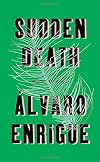
Sudden Death
by Álvaro Enrigue
On This Page
Description
A 1599 Roman tennis match between the Italian painter Caravaggio and the Spanish poet Quevedo represents the way the world changed in their times, in a novel that goes from the execution of Anne Boleyn to Mexico after the conquest.Tags
Recommendations











Member Reviews
Carlo Borromeo annihilated the Renaissance by turning torture into the only way to practice Christianity. He was declared a saint the instant he died. Vasco de Quiroga saved a whole world single-handedly and died in 1565, and the process of his canonization has yet to begin. I don't know what this book is about. I know that as I wrote it I was angry because the bad guys always win. Maybe all books are written simply because in every game the bad guys have the advantage and that is too much to bear.
Describing what Alvaro Enrigue's odd novel is about is a thankless task. After all, when the author himself admits to not knowing what the book is about, how can the hapless reader (and I was very hapless) hope to write a tidy review? Sudden show more Death is structured around a sixteenth century tennis game between the Spanish poet Francisco de Quevedo and the Italian artist Caravaggio. The novel ranges back and forth in time, from Hernán Cortés and the conquest of the Aztec kingdom to the Renaissance, amplified by comments and asides from the author, himself. There are tidbits on the history of tennis, a ton of history unfamiliar to this American reader and character studies of de Quevedo and Caravaggio. It's all very fabulous and unsettling.
It took me a while to settle into the rhythms and frenetic pace of this novel, but once I was there, I enjoyed it tremendously. It's a profane and heretical romp that leaves no historical figure unscathed. I had no doubt of Enrique's fierce wit or deep knowledge of the people and times he was writing about.
The popes of the Counter-Reformation were serious men, intent on their work, with little trace of worldliness. They put people to death in volume, preferably slowly and before an audience, but always after a trial. They were thoroughly nepotistic and they trafficked in influence as readily as one wipes one's nose on a cold day, but they had good reason: only family could be trusted, because if a pope left a flank exposed, any subordinate would slit his throat without trial. They had no mistresses or children; they wore sackcloth under their vestments; they smelled bad. They were great builders and tirelessly checked to see that not a single breast appeared in a single painting in any house of worship. They believed in what they did. show less
Describing what Alvaro Enrigue's odd novel is about is a thankless task. After all, when the author himself admits to not knowing what the book is about, how can the hapless reader (and I was very hapless) hope to write a tidy review? Sudden show more Death is structured around a sixteenth century tennis game between the Spanish poet Francisco de Quevedo and the Italian artist Caravaggio. The novel ranges back and forth in time, from Hernán Cortés and the conquest of the Aztec kingdom to the Renaissance, amplified by comments and asides from the author, himself. There are tidbits on the history of tennis, a ton of history unfamiliar to this American reader and character studies of de Quevedo and Caravaggio. It's all very fabulous and unsettling.
It took me a while to settle into the rhythms and frenetic pace of this novel, but once I was there, I enjoyed it tremendously. It's a profane and heretical romp that leaves no historical figure unscathed. I had no doubt of Enrique's fierce wit or deep knowledge of the people and times he was writing about.
The popes of the Counter-Reformation were serious men, intent on their work, with little trace of worldliness. They put people to death in volume, preferably slowly and before an audience, but always after a trial. They were thoroughly nepotistic and they trafficked in influence as readily as one wipes one's nose on a cold day, but they had good reason: only family could be trusted, because if a pope left a flank exposed, any subordinate would slit his throat without trial. They had no mistresses or children; they wore sackcloth under their vestments; they smelled bad. They were great builders and tirelessly checked to see that not a single breast appeared in a single painting in any house of worship. They believed in what they did. show less
La historia es una teoría del mundo actual.
The central motif of Sudden Death is a tennis match between Caravaggio and Francisco de Quevedo, performed as a quasi-duel resulting from a drunken homoerotic passo falso. Sudden Death presents a meditation on the end of the Renaissance, the Counter-Reformation (represented by Caravaggio's use of prostitutes to model the Magdalene in chiaroscuro), and the murder of Cuauhtémoc by Cortés (whose granddaughter married Quevedo’s associate, the 3rd Duke of Osuna). At the cusp of a complicated century, “the men who finally got their way were certain that they were breaking something they wouldn’t be able to put back together again.” Enrigue blurs the baroque and the postmodern in a kind of show more creation-myth; books, he says, are machines for understanding the way in which we name the world. A beautiful, brilliant novel. (Much credit to Natasha Wimmer for the translation). show less
The central motif of Sudden Death is a tennis match between Caravaggio and Francisco de Quevedo, performed as a quasi-duel resulting from a drunken homoerotic passo falso. Sudden Death presents a meditation on the end of the Renaissance, the Counter-Reformation (represented by Caravaggio's use of prostitutes to model the Magdalene in chiaroscuro), and the murder of Cuauhtémoc by Cortés (whose granddaughter married Quevedo’s associate, the 3rd Duke of Osuna). At the cusp of a complicated century, “the men who finally got their way were certain that they were breaking something they wouldn’t be able to put back together again.” Enrigue blurs the baroque and the postmodern in a kind of show more creation-myth; books, he says, are machines for understanding the way in which we name the world. A beautiful, brilliant novel. (Much credit to Natasha Wimmer for the translation). show less
This is a fanciful, inventive novel by Mexican writer Alvaro Enrigue about the twin seismic events in Western history of the Counter Reformation that sought to crush Protestantism under the weight of Inquisition and expulsion and the destruction of the Aztec Empire by Hernan Cortes and creation of New Spain which brought new wealth to Europe. The narrative mostly jumps back and forth between two scenarios. First is a whimsically rendered tennis grudge match played between the Italian artist Caravaggio and the Spanish poet Quevedo. Much is made over the rules of early versions of tennis, the differences in the composition of the balls, as well as the symbolic (and invented) detail of four tennis balls filled with the hair of Anne Boleyn, show more shorn just before her execution. Second is the progress of Cortes and his relationship with Montezuma, whose world he is about to destroy. The tone of almost all of this is deceptively light, often played for laughs. But the veil is often pulled back, the smile shown to be the grin of a death's head. For both focus also spins out from the tennis game to show us that nobles and religious figures who sponsor and support both artists--and those figures' forebears--men who can at the same time appreciate a revolutionary use of lighting in a painting and condemn thousands and thousands of people to death via the headman's axe and the pyre. The Aztec culture is identified as tyrannical and murderous, and the conflict between Cortes and Montezuma as resulting in a sea of misery and blood. With all that being true, how to reflect accurately how delightful a reading experience I found this? Let's go back to the start and speak of a novel fanciful, inventive slyly humorous and inventive. show less
Rome, 1599. The painter Caravaggio and the poet Francisco de Quevedo are playing three sets of real tennis as a result of a challenge issued for reasons neither can quite recall, which must have had something to do with the number of bottles of grappa consumed last night. Their seconds are a well-known Pisan mathematician(!) and the Duke of Osuna, respectively, and the spectators in the gallery include some Roman low-life figures who have served as models for Caravaggio's most famous canvases.
That's the sort of premise for an historical novel that is hard to resist in anyone's hands, and it only gets more intriguing when we discover that Enrigue is not only telling us about the match and the players, but also brings in a lot of show more background about the cultural history of ball-games (there are a lot of balls in this book: knowing the way Spanish idiom works, you can be sure that not all of them are going to be the sort used in games) and a parallel story about Hernan Cortés and the conquest of Mexico. And a few other things...
This isn't a book you can sum up easily, and Enrigue clearly doesn't want it to be something you can reduce to a single key idea. The idea he playfully suggests when he asks himself what the book is all about, some 3/4 of the way in, is that history is all about the bad guys winning, but I don't think we're meant to take this as limiting. In many ways, the book reminded me of the Cuban writer Alejo Carpentier and his theory that the baroque way of seeing the world was only made possible by European contact with America: Enrigue also wants us to see the possible Mexican influences on Caravaggio's painting (and remind us that the Mexicans also had their own ball-game rituals...).
Fun, and definitely a book to keep your mind agile, which I really enjoyed despite my normal antipathy to ball games of all kinds. I suspect that the real-life Quevedo, combative though he was, would have been somewhat averse to ball games too, with his notorious short sight and bad leg. But that's probably something we have to allow Enrigue under the heading of poetic licence.
I'm the sort of person who has trouble remembering the rules of modern lawn tennis; 16th century real tennis is infinitely more confusing, especially since the usual terminology of the game as played at Hampton Court or in Merton Street is mostly derived from obsolete French words, not always a good basis for following blow-by-blow descriptions in Spanish, but that doesn't really seem to matter much. This isn't a book about who wins and who loses, at that level. show less
That's the sort of premise for an historical novel that is hard to resist in anyone's hands, and it only gets more intriguing when we discover that Enrigue is not only telling us about the match and the players, but also brings in a lot of show more background about the cultural history of ball-games (there are a lot of balls in this book: knowing the way Spanish idiom works, you can be sure that not all of them are going to be the sort used in games) and a parallel story about Hernan Cortés and the conquest of Mexico. And a few other things...
This isn't a book you can sum up easily, and Enrigue clearly doesn't want it to be something you can reduce to a single key idea. The idea he playfully suggests when he asks himself what the book is all about, some 3/4 of the way in, is that history is all about the bad guys winning, but I don't think we're meant to take this as limiting. In many ways, the book reminded me of the Cuban writer Alejo Carpentier and his theory that the baroque way of seeing the world was only made possible by European contact with America: Enrigue also wants us to see the possible Mexican influences on Caravaggio's painting (and remind us that the Mexicans also had their own ball-game rituals...).
Fun, and definitely a book to keep your mind agile, which I really enjoyed despite my normal antipathy to ball games of all kinds. I suspect that the real-life Quevedo, combative though he was, would have been somewhat averse to ball games too, with his notorious short sight and bad leg. But that's probably something we have to allow Enrigue under the heading of poetic licence.
I'm the sort of person who has trouble remembering the rules of modern lawn tennis; 16th century real tennis is infinitely more confusing, especially since the usual terminology of the game as played at Hampton Court or in Merton Street is mostly derived from obsolete French words, not always a good basis for following blow-by-blow descriptions in Spanish, but that doesn't really seem to matter much. This isn't a book about who wins and who loses, at that level. show less
The book has an interesting take on what history is, and the stories that define it. I loved the author's lively and intriguing characterization of Caravaggio, and how he didn't shy away from the violent and sexual aspects that make him such a compelling person to meditate on. The weaving of the various storylines and interspersions of the author's process of writing, rather than being too experimental or annoying to me (which is often the case), was self-aware and novel. I just loved how unpretentious it was for such pretentious concepts.
After reading "You Dreamed of Empires," I thought that a book about tennis in Renaissance Italy sounded like a big change of subject for Enrigue, but it turns out that this book is also about Cortez. Like his previous book, this is also a reflection on what history is and what history means and what people who write history are doing.
This book ties together several very disparate historical stories: Hernan Cortez in Mexico, a tennis game played by Caravaggio, the death of Anne Boleyn, and Papal politics. The big theme that ties all of these together is.... balls. Sometimes in the literal sense of tennis balls (Anne Boleyn's hair was used to make tennis balls!), sometimes in the metaphorical sense (chutzpah), and sometimes in the show more crassly literal sense of testicles.
Interspersed through the narrative are some very frank chapters where the author bluntly discusses what he is doing, or copies emails sent between him and his editor. At one point, Enrigue even says:
"As I write, I don't know what this book is about. It's not exactly about a tennis match. Nor is it a book about the slow and mysterious integration of America into what we call "The Western world" -- an outrageous misapprehension, since from the American perspective, Europe is the East. Maybe it's just a book about how to write a book; maybe that's what all books are about. A book with a lot of back-and-forth, like a game of tennis....I don't know what this book is about. I know that as I wrote it I was angry because the bad guys always win. Maybe all books are written simply because in every game the bad guys have the advantage and that is too much to bear."
As a historian and a fiction writer, I love thinking about the relationship between history and fiction, and about what writers are doing when they tell stories, true or not. I love watching writers play with history, as Enrigue did in You Dreamed of Empires and as he does here. (Fans of Laurent Binet will enjoy Enrigue.) However, I found this to be a very difficult book to follow. This is mostly because there are a lot of characters for a relatively short book, and some of the characters only exist briefly, and it's a lot of names to keep straight. Enrigue complicates this a lot by using various nicknames for people. The tennis match that is the excuse for all of the other storytelling here is particularly confusing, because Enrigue variously refers to the players as the Italian, the Lombard, the Spaniard, the Poet, and likewise has multiple names for the people watching and moderating the game, so that I got really really confused about who everyone was.
Despite that, I really appreciate Enrigue's brilliance in admitting that he doesn't know what his book is about, but still providing some coherence and challenging the reader to find the threads that connect all the stories.
Balls. It's all about balls. show less
This book ties together several very disparate historical stories: Hernan Cortez in Mexico, a tennis game played by Caravaggio, the death of Anne Boleyn, and Papal politics. The big theme that ties all of these together is.... balls. Sometimes in the literal sense of tennis balls (Anne Boleyn's hair was used to make tennis balls!), sometimes in the metaphorical sense (chutzpah), and sometimes in the show more crassly literal sense of testicles.
Interspersed through the narrative are some very frank chapters where the author bluntly discusses what he is doing, or copies emails sent between him and his editor. At one point, Enrigue even says:
"As I write, I don't know what this book is about. It's not exactly about a tennis match. Nor is it a book about the slow and mysterious integration of America into what we call "The Western world" -- an outrageous misapprehension, since from the American perspective, Europe is the East. Maybe it's just a book about how to write a book; maybe that's what all books are about. A book with a lot of back-and-forth, like a game of tennis....I don't know what this book is about. I know that as I wrote it I was angry because the bad guys always win. Maybe all books are written simply because in every game the bad guys have the advantage and that is too much to bear."
As a historian and a fiction writer, I love thinking about the relationship between history and fiction, and about what writers are doing when they tell stories, true or not. I love watching writers play with history, as Enrigue did in You Dreamed of Empires and as he does here. (Fans of Laurent Binet will enjoy Enrigue.) However, I found this to be a very difficult book to follow. This is mostly because there are a lot of characters for a relatively short book, and some of the characters only exist briefly, and it's a lot of names to keep straight. Enrigue complicates this a lot by using various nicknames for people. The tennis match that is the excuse for all of the other storytelling here is particularly confusing, because Enrigue variously refers to the players as the Italian, the Lombard, the Spaniard, the Poet, and likewise has multiple names for the people watching and moderating the game, so that I got really really confused about who everyone was.
Despite that, I really appreciate Enrigue's brilliance in admitting that he doesn't know what his book is about, but still providing some coherence and challenging the reader to find the threads that connect all the stories.
Balls. It's all about balls. show less
Enrique's novel is rude, raucous, ribald while being sensitive and scholarly. The story focuses on a duel in the form of a tennis match between the Italian artist, Caravaggio, and the Spanish poet, Quevedo, in 1599. This brings in to play The Counter Reformation, the execution of Anne Boleyn and then having her hair wrapped within the tennis ball, Hernan Cortes conquest of Mexico, Thomas More's Utopia affecting Mexico and how this replays in Europe, the struggles between Spain, France, England, and the Papacy, the Council of Trent, the early history of tennis and the author getting the script to his editor. The sex is graphic and gritty and full ranging. The reader must deal with the to and fro of the deadly tennis match but also how show more all these chaotic human happenings are, also present on court, making for an exhilarating whole.
This is a brilliantly written, well paced, story with a lively worldly sense of humor and history.
Quotes: (Page 42) “Lying on the ground, at the mercy of the soldier who was to perform the execution, the point of the sword pricking his neck, Rombaud wept. 'I understand' , said Minister Chabot, 'that Anne Boleyn, a woman and a princess, didn't shed a single tear the day you dispatched her as she lay helpless; if you give me the fourth ball', he added,
' I'll let you go', and he motioned for the executioner to withdraw his sword.”
(page 132) “The loss must have been hard for Caravaggio: he didn't paint Fillide Melandroni after this arrest, and she was far and a way his most spectacular model: not just a figure of exceptional beauty, but a collaborator with the gift of a unique dramatic sense---she is also Saint Catherine of Alexandria in the monumental work retained by del Monte, which today can be seen in the Thyssen-Bornenisza collection in Madrid.”
(pg174) “As I've noted, Hernan Cortes was always in over his head, not least in the life he was fated to lead.”
(pg.204) “It isn't a book about Caravaggio or Quevedo, though Caravaggio and Quevedo are in the book, as are Cortes and Cuauhtemoc, and Galileo and Pius IV. Gigantic individuals facing off. All fucking, getting drunk, gambling in the void. Novels demolish monuments because all novels, even the more chaste are a tiny bit pornographic.”
(pg. 205) “I was angry because the bad guys always win. Maybe all books are written simply because in every game the bad guys have the advantage and that is too much to bear.” show less
This is a brilliantly written, well paced, story with a lively worldly sense of humor and history.
Quotes: (Page 42) “Lying on the ground, at the mercy of the soldier who was to perform the execution, the point of the sword pricking his neck, Rombaud wept. 'I understand' , said Minister Chabot, 'that Anne Boleyn, a woman and a princess, didn't shed a single tear the day you dispatched her as she lay helpless; if you give me the fourth ball', he added,
' I'll let you go', and he motioned for the executioner to withdraw his sword.”
(page 132) “The loss must have been hard for Caravaggio: he didn't paint Fillide Melandroni after this arrest, and she was far and a way his most spectacular model: not just a figure of exceptional beauty, but a collaborator with the gift of a unique dramatic sense---she is also Saint Catherine of Alexandria in the monumental work retained by del Monte, which today can be seen in the Thyssen-Bornenisza collection in Madrid.”
(pg174) “As I've noted, Hernan Cortes was always in over his head, not least in the life he was fated to lead.”
(pg.204) “It isn't a book about Caravaggio or Quevedo, though Caravaggio and Quevedo are in the book, as are Cortes and Cuauhtemoc, and Galileo and Pius IV. Gigantic individuals facing off. All fucking, getting drunk, gambling in the void. Novels demolish monuments because all novels, even the more chaste are a tiny bit pornographic.”
(pg. 205) “I was angry because the bad guys always win. Maybe all books are written simply because in every game the bad guys have the advantage and that is too much to bear.” show less
Members
- Recently Added By
Lists

2017 Tournament of Books
18 works; 18 members

Pleasant Surprises: Books That Exceeded Our Expectations
418 works; 143 members

Not the NYT list of top 100 21st century books
100 works; 6 members

Books Read in 2025
4,091 works; 97 members
Author Information

12+ Works 1,416 Members
Some Editions
Awards and Honors
Awards
Distinctions
Notable Lists
Common Knowledge
- Canonical title
- Sudden Death
- Original title
- Muerte súbita
- Original publication date
- 2013 (original Spanish) (original Spanish); 2016 (English: Wimmer) (English: Wimmer)
- People/Characters
- Caravaggio; Francisco de Quevedo; Galileo Galilei; Hernán Cortés
- Important places
- Mexico
- Original language
- Spanish
Classifications
- Genres
- Fiction and Literature, General Fiction, Historical Fiction
- DDC/MDS
- 863.64 — Literature & rhetoric Spanish Literature Spanish fiction 20th Century 1945-2000
- LCC
- PQ6705 .N63 .M8413 — Language and Literature French, Italian, Spanish and Portuguese literatures Spanish literature Individual authors, 2001-
- BISAC
Statistics
- Members
- 546
- Popularity
- 54,472
- Reviews
- 26
- Rating
- (3.70)
- Languages
- 8 — Danish, English, French, German, Italian, Portuguese (Portugal), Spanish, Swedish
- Media
- Paper, Audiobook, Ebook
- ISBNs
- 24
- ASINs
- 4