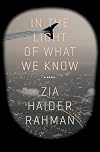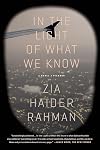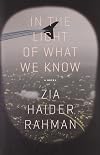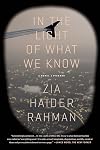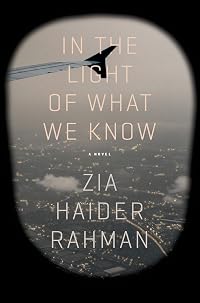
In the Light of What We Know
by Zia Haider Rahman
On This Page
Description
"A bold, epic debut novel set during the war and financial crisis that defined the beginning of our century. An investment banker approaching forty, his career collapsing and his marriage unraveling, receives a surprise visitor at his West London town house. Confronting the disheveled figure of a South Asian male carrying a backpack, the banker recognizes a long-lost college friend, a mathematics prodigy who disappeared many years earlier under mysterious circumstances. The friend has show more resurfaced with a confession of unsettling power. Zia Haider Rahman takes us on a journey of exhilarating scope, ranging over Kabul, London, New York, Islamabad, Oxford, Princeton, and Sylhet, and dealing with love, belonging, finance, cognitive science, and war. Its framework is an age-old story: the friendship of two men and the betrayal of one by the other, both of them desperate in their different ways to climb clear of their wrong beginnings. Set against the breaking of nations and beneath the clouds of economic recession, the novel chronicles the lives of people carrying unshakable legacies of class, culture, and faith as they struggle to tame their futures. In the Light of What We Know is by turns tender, intimate, and panoramic, telescoping the great upheavals of our young century into a first novel of rare ambition and profundity. "-- show lessTags
Recommendations









Member Reviews
So what do we really know? Rather, since we have found ourselves here in this macrocosm of intricate criss-crossing paths, each promising a surprise at some point, all our life, each and every second, what we can ultimately claim to know? Take the most obvious mundane thing you can imagine. Take time, for instance. Ask the first person you meet, what he or she understands about time. Can anyone disagree that she would be as clueless as any five-year old? Or take memory; is it an image of past reflected in the present? or can it be best described as fragment of the past? But then what is past and what is present? How can we so neatly, and concretely speak about past, present and future? Why do we need these temporal images? Why do we show more trust our memories at one time and doubt at other instances? Are they a necessity? But what kind of necessity? Or take love, for instance? What makes us love someone? Is it the person or is it the idea of the person we fall in and out of love? Is it about a struggle to find meaning in life? But then what is meaning? Do we have a choice to give meanings, to decipher the codec of life? Compress it to be decompressed by someone else? Can we find beauty in all of this algorithmic sort of compression-decompression, and call it love?
There are so many questions. In fact, there are only questions that matter. Providing answers would be the end of it all, the end of life, the end of us; and had Zia Haider Rahman, in this beautifully crafted début novel even tried to provide any answers, this would not have been such an acclaimed work.
Having said that, its not for the fainthearted who can't gather energy to climb the big novels like Brothers Karamazov, Ulysses or Moby Dick. Of course, this one doesn't fall in the same league since the psychological portrait is quite limited due to the smaller canvas and minimum plot, Rahman ends up being equally ambitious as Dostoevsky, Joyce or Melville, as he tries to provide the reader with one of the longest quotes from the book of life. Epistemology, ontology, choice, mathematics, quantum physics, subcontinent, the empire, 1971, 9/11, and finally the narrator narrating a conversation, he is himself part of. In the end, extremely ambitious and quite well-done.
A novel, all the genuine readers imagining themselves as writers would love to write, but only one or two can finally end up achieving it in every other decade show less
There are so many questions. In fact, there are only questions that matter. Providing answers would be the end of it all, the end of life, the end of us; and had Zia Haider Rahman, in this beautifully crafted début novel even tried to provide any answers, this would not have been such an acclaimed work.
Having said that, its not for the fainthearted who can't gather energy to climb the big novels like Brothers Karamazov, Ulysses or Moby Dick. Of course, this one doesn't fall in the same league since the psychological portrait is quite limited due to the smaller canvas and minimum plot, Rahman ends up being equally ambitious as Dostoevsky, Joyce or Melville, as he tries to provide the reader with one of the longest quotes from the book of life. Epistemology, ontology, choice, mathematics, quantum physics, subcontinent, the empire, 1971, 9/11, and finally the narrator narrating a conversation, he is himself part of. In the end, extremely ambitious and quite well-done.
A novel, all the genuine readers imagining themselves as writers would love to write, but only one or two can finally end up achieving it in every other decade show less
After a week of reading at a particularly ravenous pace, I fancied a novel that could not be speed-read. [b:In the Light of What We Know|17934468|In the Light of What We Know|Zia Haider Rahman|https://i.gr-assets.com/images/S/compressed.photo.goodreads.com/books/1372677492l/17934468._SY75_.jpg|25142330] was ideally suited to this, as it is erudite to the point of stodginess. The narrative is structured as a conversation between two old friends, meandering around incidents in their lives and important international milestones, particularly 9/11, the US invasion of Afghanistan, and the 2007/8 financial crisis. Even the narrator has his limits, though:
There are no speech marks throughout. This both adds to the sense of closely observing a long conversation between friends and leads to confusion about who is speaking. The latter certainly emphasises the unreliability of the narration – the reader knows that Zafar is telling his friend only parts of his story, but also that the narrator’s perspective shapes his reporting of what Zafar said, did, and wrote. Despite being 550 pages long and packed with carefully described incidents, this is a remarkably ambiguous novel. Zafar remains a mystery to the narrator and the reader, while the narrator is scarcely less enigmatic himself. There is certainly a sense that you can learn a lot of detail about someone’s life without understanding them at all, as it’s impossible to say whether what you’ve been told is actually significant. Zafar and the narrator gloss over events that would be the plot focus of a different novel. Indeed, the plot is not the point at all as the novel is concerned with big social and philosophical themes: wealth, class, privilege, freedom, love, duty, ambition, and the search for meaning in life.
Although the preceding paragraphs don’t really constitute a recommendation, I did enjoy [b:In the Light of What We Know|17934468|In the Light of What We Know|Zia Haider Rahman|https://i.gr-assets.com/images/S/compressed.photo.goodreads.com/books/1372677492l/17934468._SY75_.jpg|25142330] thanks to the beautiful and often insightful writing:
Always running through the conversation between Zafar and the narrator is the frustration of any communication: how to effectively convey the subjectivity of your own experience?
This drama of the mind is what the book is trying to convey, or at least demonstrate the difficulty of conveying. The text is full of quotations from and references to books, films, aphorisms, research, etc as these are amongst the tools we use to attempt explanations of our perspectives to others. However, this perpetual quoting at each other can be a little exasperating for the reader. It often seems to obscure rather than elucidate something, again emphasising the unreliability of the narrator, of Zafar, and of consciousness in general. [b:In the Light of What We Know|17934468|In the Light of What We Know|Zia Haider Rahman|https://i.gr-assets.com/images/S/compressed.photo.goodreads.com/books/1372677492l/17934468._SY75_.jpg|25142330] also contains one of the best descriptions I’ve ever found of the flow state:
The short interview with the author included in the back of the paperback edition I read goes into the themes and context for the novel. Zia Haider Rahman’s comments are thoughtful and definitely added to my appreciation. That said, I wouldn’t unequivocally recommend [b:In the Light of What We Know|17934468|In the Light of What We Know|Zia Haider Rahman|https://i.gr-assets.com/images/S/compressed.photo.goodreads.com/books/1372677492l/17934468._SY75_.jpg|25142330] as some may find the meandering philosophical reflections, jigsaw of plot fragments, and exceedingly verbose protagonists trying. It rewards patience, but not with catharsis. show less
Zafar moved on to an explanation of Godel’s Incompleteness Theorem, but this took usshow more
along yet another digression carrying us further afield. He did not, in fact, lose his thread and, in due course, he returned to his story of meeting the Hampton-Wyverns and then the narrative of events in Afghanistan (in fact there was only ever just one thread, winding in ways that are now apparent). Even so, I am inclined to skip over the account concerning Godel’s Incompleteness Theorem, a digression too far, which should not be taken as an indication of anything other than my own need to keep a grip on the twisting and turning of Zafar’s discussion, the ranging back and forth.
In 2000, how many people know what sub-prime mortgages were? He asked me.
Hang on! How did we get to mortgages? I responded.
Zafar simply repeated the question.
There are no speech marks throughout. This both adds to the sense of closely observing a long conversation between friends and leads to confusion about who is speaking. The latter certainly emphasises the unreliability of the narration – the reader knows that Zafar is telling his friend only parts of his story, but also that the narrator’s perspective shapes his reporting of what Zafar said, did, and wrote. Despite being 550 pages long and packed with carefully described incidents, this is a remarkably ambiguous novel. Zafar remains a mystery to the narrator and the reader, while the narrator is scarcely less enigmatic himself. There is certainly a sense that you can learn a lot of detail about someone’s life without understanding them at all, as it’s impossible to say whether what you’ve been told is actually significant. Zafar and the narrator gloss over events that would be the plot focus of a different novel. Indeed, the plot is not the point at all as the novel is concerned with big social and philosophical themes: wealth, class, privilege, freedom, love, duty, ambition, and the search for meaning in life.
Although the preceding paragraphs don’t really constitute a recommendation, I did enjoy [b:In the Light of What We Know|17934468|In the Light of What We Know|Zia Haider Rahman|https://i.gr-assets.com/images/S/compressed.photo.goodreads.com/books/1372677492l/17934468._SY75_.jpg|25142330] thanks to the beautiful and often insightful writing:
I have always felt that choice is a rarity in life, that it lies in wait in the crevices of time, to surprise us when we seem to have the least room to manoeuvre. The grand architecture of our time on earth bears no choice at all, no trace of will, free or otherwise. Without our will we are born and against it we die. We do not choose our mothers, any more than they choose the children that they bear. We do not choose the circumstances of our parents, the home and inheritance, the unearned talents, or the circumstances of our formative infant years when our brains congeal into a steady state, and our neural pathways set us on the course of our lives. Most of the time, we heed unwritten rules. They may be rules of culture and conditioning, patterns imprinted on the tender firmament of youth, or they may be the rules knotted into our brains, woven with DNA by our biological parents, but they are all still rules, by which we live, by which we are governed. That notion of choice as we move through the world, the free will that we claim so proudly, is only the reflection of the body’s foregone direction, an image in the distorting mirror of ego, a trick of the light.
Always running through the conversation between Zafar and the narrator is the frustration of any communication: how to effectively convey the subjectivity of your own experience?
Look, said Zafar. It was he who now showed exasperation. I don’t know how to get anywhere close to my own life, he said. My drama, like everyone’s, goes on upstairs, in the head. And I don’t think you can write the drama of the mind. All you have are the things people do. It’s always about what they do, and yet the mind if where the battles take place, the tragedies and comedies that rule the day. So we fall back on metaphors.
This drama of the mind is what the book is trying to convey, or at least demonstrate the difficulty of conveying. The text is full of quotations from and references to books, films, aphorisms, research, etc as these are amongst the tools we use to attempt explanations of our perspectives to others. However, this perpetual quoting at each other can be a little exasperating for the reader. It often seems to obscure rather than elucidate something, again emphasising the unreliability of the narrator, of Zafar, and of consciousness in general. [b:In the Light of What We Know|17934468|In the Light of What We Know|Zia Haider Rahman|https://i.gr-assets.com/images/S/compressed.photo.goodreads.com/books/1372677492l/17934468._SY75_.jpg|25142330] also contains one of the best descriptions I’ve ever found of the flow state:
It was only in those periods of concentration, when the self is abnegated and the mind and the subject are fused and all thought is governed by the matter at hand, determined by it, as if it is not you that engages the subject, the work, but the work itself requisitioning the tools of your mind for its inherent purpose – it was during those periods that ironically I felt most in control, that gave me the whole of time – before, after, and during – an aspect of will.
The short interview with the author included in the back of the paperback edition I read goes into the themes and context for the novel. Zia Haider Rahman’s comments are thoughtful and definitely added to my appreciation. That said, I wouldn’t unequivocally recommend [b:In the Light of What We Know|17934468|In the Light of What We Know|Zia Haider Rahman|https://i.gr-assets.com/images/S/compressed.photo.goodreads.com/books/1372677492l/17934468._SY75_.jpg|25142330] as some may find the meandering philosophical reflections, jigsaw of plot fragments, and exceedingly verbose protagonists trying. It rewards patience, but not with catharsis. show less
Extraordinary. There is much to unpack in this novel which touches upon wide-ranging themes regarding the human condition: class, ethics, the shifting nature of friendship and perhaps, most importantly, the power of self-delusion. It offers a withering depiction of how very intelligent people are subject to the same failings as those who lack their discernment, education, and experience. Readers stimulated by a driving plot will not fancy this book; those who delight in a good cipher will be dazzled. The two most significant plot points occur off the page though their consequences shape and reverberate through the whole. That is harder to pull off than it sounds, but Haider Raman executes this bit of structural sleight of hand show more brilliantly. It's the sort of book that begs immediate rereading and rereading at some remove. Each passage has revealed for me new layers and nuances. show less
It’s always nice to learn a thing or two from a novel, don’t you think? This is one of the self-referential lines of In the Light of What We Know and indeed it is nice. I, however, already knew (or at least knew about) many of those things sprinkled throughout this novel, and not only because I majored in Mathematics. Writing always happens in the context of a community with the requisite assumptions about what needs explanation and what is well known to all. This is a novel that is about about different communities rubbing up against each other.
Another self-referential passage has the narrator suggesting to Zafar, the British subject of Bangladeshi origin, that he write a book. Zafar quotes Naipaul saying,Indian literature written show more in English is astonishing since it is written by one people about those people for another people to read.
This is a book that is constantly reviewing itself and most often doing so better than any reviewers coming afterwards. Everything is examined and then the examination is examined. The distance thus created blunts the emotions so it is no surprise that it lead to Zafar being hospitalized for pathological boredom.
The emotion he needs to blunt so badly is rage.
What did I learn? The term "cognitive load," was new to me. And, though I'd thought I'd already known what a credit default swap is, Rahman's explanation clarified it and suggested why it was so called. I didn't learn about axolotls, or more accurately, I did but have already forgotten most of the details. I also learned about the political situation in Afghanistan, the child-rearing practices of Bangladesh, the casual and not so casual racism that confronts South Asians in the West, that an exile is a refugee with a library, how people love and yet betray each other. I learned tha Waugh said a novel is "experience transformed," which is yet another self-reference alluding to the common backgrounds of Zafar,the unnamed narrator, and Rahman and letting the reader wonder about the difference between what is true and what is false.
Learning is entertaining, like surfing the internet, but like the self-reference, it functions more defensively than as information. The discussion of axolotls is how Zafar escapes from having to justify why he won't write a book. The book is ultimately about escape. One reads fiction as an escape and here we are reading about Zafar trying to find to what community he belongs, which side he's on (the preoccupation of everyone in Afghanistan) and who is on his side. But in the end there is no escape and he belongs nowhere. he certainly doesn't belong in the narrator's attic writing a book.
Meanwhile we get self-reference self referenced as we are told about Godel's incompleteness theorem, a theorem about theorems which is proven by turning mathematics into a description of itself. Every mathematical statement is given a numerical value (Godel-numbered) and the meta-statement about whether mathematics is inconsistent becomes a theorem within mathematics itself, only one whose proof would blow up mathematics, like a suicide bomber.
As an aside (the novel is full of asides so let me have my own here) I predict that Godel's Incompleteness Theorem will soon be overtaking Heisenberg's Uncertainty Principle as the most misused scientific borrowing to serve as a literary metaphor. "Heisenberg" is now better known as a character in Breaking Bad. (Breaking Bad is one of the pop-cultural references in the novel, too.)
Meanwhile, the novel meanders leisurely and confuses us about who is speaking, Zafar, the narrator, or the author himself whose experience has been transformed. With further self-reference, the narrator complains that Zafar is telling his story with too many digressions and Zafar reassures him that he's getting there. When we finally do get to his rage, the narrator tells him it's OK to omit that part of the story, leaving us to deduce what actually happened. (And if that's not enough, the narrator tells us that the story Zafar told him has been told in other than the original order in which Zafar presented it to him.)
If there's a moral to the story, it's that we are kept from seeing the truth because we can't help seeing everything in the light of what we already know, and that there is no way to get around this bias. "We take much for granted, much that is granted by others, and we’re told to do as we’re told, and we agree. And we must agree.” “the only answers each of us hears are to the questions we are capable of asking.”
Math is the most far reaching attempt to remove the personal point of view. When you know something is true in it, it is independent of the the opinions of others. Mathematics is what's left when you remove the real world from science, and Godel has proved it problematic, but that rubs off on the physical universe since we understand it through mathematics.
No matter how much we try to pull ourselves out of our biases, we are doomed to failure. I easily fell into taking an Eastern point of view, only to fall into the trap of trusting Suleiman over the American, Crane. That I was set up to make this mistake is no excuse.
If I had to name the bias that Rahman doesn't see, it's his attitude toward women. The novel badly fails the Bechdel test. Even if Emily is taken, not as a person, but as a metaphor for the West, women are just props in men's stories. Rahman reverses the cliche with the West, through Emily being inscrutable but we're still left with the cliche of the inscrutable woman. show less
Another self-referential passage has the narrator suggesting to Zafar, the British subject of Bangladeshi origin, that he write a book. Zafar quotes Naipaul saying,Indian literature written show more in English is astonishing since it is written by one people about those people for another people to read.
This is a book that is constantly reviewing itself and most often doing so better than any reviewers coming afterwards. Everything is examined and then the examination is examined. The distance thus created blunts the emotions so it is no surprise that it lead to Zafar being hospitalized for pathological boredom.
The emotion he needs to blunt so badly is rage.
What did I learn? The term "cognitive load," was new to me. And, though I'd thought I'd already known what a credit default swap is, Rahman's explanation clarified it and suggested why it was so called. I didn't learn about axolotls, or more accurately, I did but have already forgotten most of the details. I also learned about the political situation in Afghanistan, the child-rearing practices of Bangladesh, the casual and not so casual racism that confronts South Asians in the West, that an exile is a refugee with a library, how people love and yet betray each other. I learned tha Waugh said a novel is "experience transformed," which is yet another self-reference alluding to the common backgrounds of Zafar,the unnamed narrator, and Rahman and letting the reader wonder about the difference between what is true and what is false.
Learning is entertaining, like surfing the internet, but like the self-reference, it functions more defensively than as information. The discussion of axolotls is how Zafar escapes from having to justify why he won't write a book. The book is ultimately about escape. One reads fiction as an escape and here we are reading about Zafar trying to find to what community he belongs, which side he's on (the preoccupation of everyone in Afghanistan) and who is on his side. But in the end there is no escape and he belongs nowhere. he certainly doesn't belong in the narrator's attic writing a book.
Meanwhile we get self-reference self referenced as we are told about Godel's incompleteness theorem, a theorem about theorems which is proven by turning mathematics into a description of itself. Every mathematical statement is given a numerical value (Godel-numbered) and the meta-statement about whether mathematics is inconsistent becomes a theorem within mathematics itself, only one whose proof would blow up mathematics, like a suicide bomber.
As an aside (the novel is full of asides so let me have my own here) I predict that Godel's Incompleteness Theorem will soon be overtaking Heisenberg's Uncertainty Principle as the most misused scientific borrowing to serve as a literary metaphor. "Heisenberg" is now better known as a character in Breaking Bad. (Breaking Bad is one of the pop-cultural references in the novel, too.)
Meanwhile, the novel meanders leisurely and confuses us about who is speaking, Zafar, the narrator, or the author himself whose experience has been transformed. With further self-reference, the narrator complains that Zafar is telling his story with too many digressions and Zafar reassures him that he's getting there. When we finally do get to his rage, the narrator tells him it's OK to omit that part of the story, leaving us to deduce what actually happened. (And if that's not enough, the narrator tells us that the story Zafar told him has been told in other than the original order in which Zafar presented it to him.)
If there's a moral to the story, it's that we are kept from seeing the truth because we can't help seeing everything in the light of what we already know, and that there is no way to get around this bias. "We take much for granted, much that is granted by others, and we’re told to do as we’re told, and we agree. And we must agree.” “the only answers each of us hears are to the questions we are capable of asking.”
Math is the most far reaching attempt to remove the personal point of view. When you know something is true in it, it is independent of the the opinions of others. Mathematics is what's left when you remove the real world from science, and Godel has proved it problematic, but that rubs off on the physical universe since we understand it through mathematics.
No matter how much we try to pull ourselves out of our biases, we are doomed to failure. I easily fell into taking an Eastern point of view, only to fall into the trap of trusting Suleiman over the American, Crane. That I was set up to make this mistake is no excuse.
If I had to name the bias that Rahman doesn't see, it's his attitude toward women. The novel badly fails the Bechdel test. Even if Emily is taken, not as a person, but as a metaphor for the West, women are just props in men's stories. Rahman reverses the cliche with the West, through Emily being inscrutable but we're still left with the cliche of the inscrutable woman. show less
In the light of what we know by Zia Haider Rahman is a novel of a Bangladeshi boy who becomes an Oxford graduate, international human rights lawyer and eventually an all round rightfully grumpy, disillusioned and deservingly guilt-tripped human being. His amanuensis is a wealthy merchant banker of a Pakistani family with his own ambivalence and guilty secrets. The post colonial repercussions from Bangladesh and Pakistan reverberate even into the lives of these intelligent, empathetic human beings who have participated in the GFC and reconstruction of Afghanistan.
The novel contains mathematical musings, the derivatives fiasco of the global financial crisis and lots of literary references. But it's all about class, clash of culture, show more wealth, greed and oppression and personal responsibility. I learned a lot, loved so much of it, but the twining of personal guilt to make a point about post-colonial human rights abuses made me grumpy and I feel a bit guilty for thinking the novel's structure was too ambitious. Because wow! There is so much to appreciate.
I haven't read W.G. Sebald's The Rings of Saturn but I have read Middlemarch and Midnight's Children and that is very much what the novel is like, except so much more contemporary. At times though, I was wondering what Rahman would have thought of the buzz around Piketty's Capital in the Twenty-First Century. Read it, read it, read it. show less
The novel contains mathematical musings, the derivatives fiasco of the global financial crisis and lots of literary references. But it's all about class, clash of culture, show more wealth, greed and oppression and personal responsibility. I learned a lot, loved so much of it, but the twining of personal guilt to make a point about post-colonial human rights abuses made me grumpy and I feel a bit guilty for thinking the novel's structure was too ambitious. Because wow! There is so much to appreciate.
I haven't read W.G. Sebald's The Rings of Saturn but I have read Middlemarch and Midnight's Children and that is very much what the novel is like, except so much more contemporary. At times though, I was wondering what Rahman would have thought of the buzz around Piketty's Capital in the Twenty-First Century. Read it, read it, read it. show less
Plodding plot, burdensome backstory weigh down In Light of What We Know
I’m not a very smart guy.
At least not compared to Zia Haider Rahman, author of In Light of What We Know.
I dropped out of journalism school because I got a job on a newspaper – hey, I thought if I could get a job on a newspaper before graduating just think of all the tuition I'd save, right?
Anyhow, this is a review about Zia Haider Rahman’s novel, not my autobiography.
Smart is what Rahman is – first class honours at Balliol Oxford, then on to Munich and back to finish at Cambridge and Yale, sort of the academic grand slam.
This is his first novel and as one would suspect for a guy that smart – did I say he also worked as a investment banker at Goldman Sachs show more in New York – that would likely make him rich as well as smart.
Back to the novel, his first one, it’s a huge hit. Well, what would you expect from a super rich, super smart guy except his first novel would be a best seller?
In Rahman’s novel, the protagonist has an unexpected visit from an old friend, Zafar. It’s been a long time with no contact. The guy’s a wreck, obviously been through a lot. Our hero naturally takes him in and as Zafar recovers over the next few weeks he tells him what he’s been up to.
Pretty ordinary set up, certainly not what I’d call a dramatic hook, but then like I said I’m not very smart and Rahman, well…
The title of Rahman’s book’s appropriate since In Light of What We Know tells the reader everything there is to know about Zafar; how the narrator and he met and their college days, Zafar’s upbringing in the UK, his return to his homeland of Bangladesh for a few years when he was a boy, how he met his wife, the social status of his wife’s family, plus a whole lot more with only the occasional, very slight nudge to move the plot forward.
The reader also learns similar information about the protagonist including lots of philosophical and mathematical ramblings with a few pages thrown in on how maps of the globe misrepresent the size and proximity of the continents.
All I wanted was more details about Zafar’s journey, but no, Rahman is stingy with plot details and even a hint of his friend’s story is burdened with pages of personal, philosophical and cultural perspectives.
I get it that this information may be necessary for context, but of the one hundred and sixteen pages I managed to struggle through ninety percent of it was backstory. Because I didn’t persevere beyond this point I’m in the dark as to whether all this history was necessary, but in light of what I read I decided to abandon In Light of What We Know.
This, of course, cannot be the novel’s fault after all it was awarded the James Tait Memorial Prize, Britian's oldest literary award. Perhaps if I would have finished my education I might have enjoyed Rahman’s novel more, or even a little bit, but who am I kidding. Obviously someone who dropped out of community college can’t begin to comprehend the subtleties and nuances of a novel written by a guy with honors from Oxford, Yale, and Cambridge.
I’m hoping he’ll dumb down his next novel for the likes of me. show less
I’m not a very smart guy.
At least not compared to Zia Haider Rahman, author of In Light of What We Know.
I dropped out of journalism school because I got a job on a newspaper – hey, I thought if I could get a job on a newspaper before graduating just think of all the tuition I'd save, right?
Anyhow, this is a review about Zia Haider Rahman’s novel, not my autobiography.
Smart is what Rahman is – first class honours at Balliol Oxford, then on to Munich and back to finish at Cambridge and Yale, sort of the academic grand slam.
This is his first novel and as one would suspect for a guy that smart – did I say he also worked as a investment banker at Goldman Sachs show more in New York – that would likely make him rich as well as smart.
Back to the novel, his first one, it’s a huge hit. Well, what would you expect from a super rich, super smart guy except his first novel would be a best seller?
In Rahman’s novel, the protagonist has an unexpected visit from an old friend, Zafar. It’s been a long time with no contact. The guy’s a wreck, obviously been through a lot. Our hero naturally takes him in and as Zafar recovers over the next few weeks he tells him what he’s been up to.
Pretty ordinary set up, certainly not what I’d call a dramatic hook, but then like I said I’m not very smart and Rahman, well…
The title of Rahman’s book’s appropriate since In Light of What We Know tells the reader everything there is to know about Zafar; how the narrator and he met and their college days, Zafar’s upbringing in the UK, his return to his homeland of Bangladesh for a few years when he was a boy, how he met his wife, the social status of his wife’s family, plus a whole lot more with only the occasional, very slight nudge to move the plot forward.
The reader also learns similar information about the protagonist including lots of philosophical and mathematical ramblings with a few pages thrown in on how maps of the globe misrepresent the size and proximity of the continents.
All I wanted was more details about Zafar’s journey, but no, Rahman is stingy with plot details and even a hint of his friend’s story is burdened with pages of personal, philosophical and cultural perspectives.
I get it that this information may be necessary for context, but of the one hundred and sixteen pages I managed to struggle through ninety percent of it was backstory. Because I didn’t persevere beyond this point I’m in the dark as to whether all this history was necessary, but in light of what I read I decided to abandon In Light of What We Know.
This, of course, cannot be the novel’s fault after all it was awarded the James Tait Memorial Prize, Britian's oldest literary award. Perhaps if I would have finished my education I might have enjoyed Rahman’s novel more, or even a little bit, but who am I kidding. Obviously someone who dropped out of community college can’t begin to comprehend the subtleties and nuances of a novel written by a guy with honors from Oxford, Yale, and Cambridge.
I’m hoping he’ll dumb down his next novel for the likes of me. show less
What a book! It's about .... everything! Mathematics, History, Politics, Economics, Banking, Migration, Development, Friendship, Social classes, Marriage, Books, .... and about yourself. And yes, all in capitals because it is not just about all these themes, it's so profound, so documented, so impressive.
How much documentation did the author went through? How many books did he read? How wise must one be to come to the insights he shares with us in this book. All the themes of our modern times are put together which gives us lots and lots to think about.
This is the downside of the book for me, if there is one: you want to stop reading every page and Google a lot of things you've just been reading. So it takes some time to get through show more the + 500 pages. But it's not annoying, it's intriguing. The endless combinations of strategies by politicians, development workers, their mutual influence and the reasons behind it all, or the absence of reasons, i did learn a lot. It feels like non-fiction, the love story in the book reminds you that it is a novel.
Then why not 5 stars? Because for me the final development of the plot is too far fetched, i just didn't believe it. This was in big contrast to the well elaborated passages where the 2 protagonists overlook their life and mainly the storyteller in the book reflects in such an intensive way on his life that i felt seriously invited by some passages to do the same and ask myself: what do i really want?
But hey, read this book!
Final warning: you might never again think the same about some stuff! show less
How much documentation did the author went through? How many books did he read? How wise must one be to come to the insights he shares with us in this book. All the themes of our modern times are put together which gives us lots and lots to think about.
This is the downside of the book for me, if there is one: you want to stop reading every page and Google a lot of things you've just been reading. So it takes some time to get through show more the + 500 pages. But it's not annoying, it's intriguing. The endless combinations of strategies by politicians, development workers, their mutual influence and the reasons behind it all, or the absence of reasons, i did learn a lot. It feels like non-fiction, the love story in the book reminds you that it is a novel.
Then why not 5 stars? Because for me the final development of the plot is too far fetched, i just didn't believe it. This was in big contrast to the well elaborated passages where the 2 protagonists overlook their life and mainly the storyteller in the book reflects in such an intensive way on his life that i felt seriously invited by some passages to do the same and ask myself: what do i really want?
But hey, read this book!
Final warning: you might never again think the same about some stuff! show less
Members
- Recently Added By
Published Reviews
ThingScore 100
Lists

Dublin Literary Award Longlist 2016
148 works; 4 members

Kirkus Reviews Best Fiction of 2014
100 works; 7 members

Folio Prize 2015 Longlist
79 works; 2 members
Author Information

3 Works 577 Members
Zia Haider Rahman was born in Bangladesh. His debut novel, In the Light of What We Know, will be featured at the Dunedin Writers And Readers Festival in May 2015. This title also won the James Tait Black Prizes for fiction in 2015. (Bowker Author Biography)
Awards and Honors
Awards
Distinctions
Common Knowledge
- Canonical title
- In the Light of What We Know
- Original title
- In the Light of What We Know
- Original publication date
- 2014
- People/Characters
- Zafar; Emily; Meena
- Important places
- Pakistan; Afghanistan; Bangladesh
- Epigraph
- Our concern with history, so Hilary's thesis ran, is a concern with preformed images already imprinted on our brains, images at which we keep staring while the truth lies elsewhere, away from it all, somewhere as yet undiscov... (show all)ered.
-W G Sebald, 'Austerlitz' - Dedication
- To Lily
- First words
- In the early hours of one September morning in 2008, there appeared o the doorstep of our home in South Kensington a brown-skinned man, haggard and gaunt, the ridges of his cheekbones set above an unkempt beard.
- Last words
- (Click to show. Warning: May contain spoilers.)When I look at this picture, I see two people undeterred by time, walking and talking, bumping against each other, as they discuss the things that matter to them and why they matter.
Classifications
Statistics
- Members
- 572
- Popularity
- 51,606
- Reviews
- 19
- Rating
- (3.83)
- Languages
- 7 — Bengali, Dutch, English, French, German, Greek, Italian
- Media
- Paper, Audiobook, Ebook
- ISBNs
- 27
- UPCs
- 1
- ASINs
- 7