On This Page
Description
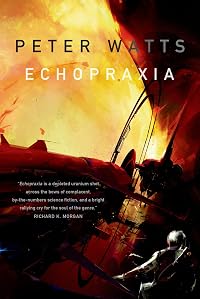
Echopraxia: Booktrack Edition adds an immersive musical soundtrack to your audiobook listening experience! It's the eve of the twenty-second century: a world where the dearly departed send postcards back from Heaven and evangelicals make scientific breakthroughs by speaking in tongues; where genetically engineered vampires solve problems intractable to baseline humans. And it's all under surveillance by an alien presence. Daniel Bruks is a field biologist in a world where biology has turned show more computational. He's turned his back on humanity, but awakens one night to find himself at the center of a storm that will turn all of history inside-out. He's trapped on a ship bound for the center of the solar system. A vampire and its entourage of zombie bodyguards lurk in the shadows behind. And dead ahead, a handful of rapture-stricken monks takes them all to a meeting with something they will only call The Angels of the Asteroids. show lessTags
Recommendations













Member Reviews
My brain is stuffed. Like Blindsight, Echopraxia is a big concept book. I swear that Watts must own stock in Wikipedia and Merriam-Webster. I found myself at both many times. Watts never treats his readers as idiots, depending upon them to grasp the basics, while he expands upon the ideas in context. The book's afterward is bonus reading.
Bruks is an excellent stand-in for the audience. He's certainly not like Colonel Keaton, who is as impenetrable as he was in The Colonel. Bruks is a throwback to us—Old-fashioned normies, who must struggle through the day, scurrying about, kinda dumb, yet tenacious. Like a roach.
I enjoyed the hell out of Echopraxia, and I'm glad that I didn't let my experience with The Colonel ruin it. A satisfying, show more top-pick, 5-star read. show less
Bruks is an excellent stand-in for the audience. He's certainly not like Colonel Keaton, who is as impenetrable as he was in The Colonel. Bruks is a throwback to us—Old-fashioned normies, who must struggle through the day, scurrying about, kinda dumb, yet tenacious. Like a roach.
I enjoyed the hell out of Echopraxia, and I'm glad that I didn't let my experience with The Colonel ruin it. A satisfying, show more top-pick, 5-star read. show less
Watts deviously piggy-backs on the ideas of Blindsight all the way to the sun, then leaps off on a bungee cord for a dive back down the gravity well. That doesn't make sense. Daniel Bruks, a biologist studying animals in the desert, is caught up in a battle between a vampire and her zombies and a hive-mind of cognitively-adapted monks who use a tornado to defend themselves. After the fight, a truce, but the common run of humanity are terrified by the glimpses afforded by the battle into how far these creatures have moved beyond them, and Bruks finds himself in space, headed sunward to the Icarus, which powers a significant portion of the Earth, and is also the last link to the Theseus, lost out in the Oort Cloud. Compared to the show more augmented and advanced minds around him, Daniel is a roach, but that's not an insult, that's a realistic assessment of his chances of survival.
Hard hard sci fi. Big ideas that takes the obsolescence of the idea of free will completely for granted and works on from there. Survival in a universe where consciousness is a side effect is what's at stake. What exactly we might end might end up as if we survive is a whole other thing. show less
Hard hard sci fi. Big ideas that takes the obsolescence of the idea of free will completely for granted and works on from there. Survival in a universe where consciousness is a side effect is what's at stake. What exactly we might end might end up as if we survive is a whole other thing. show less
Echopraxia is a difficult book for me to evaluate because Blindsight is probably my favorite modern science-fiction novel, and it is impossible not to compare the two.
First, the positive: Watts still overflows with brilliant ideas, and the writing remains razor sharp. There are passages and concepts here that only he could have written. But the flip side is that many of these ideas feel almost randomly strung together. Unlike Blindsight, this book lacks narrative discipline, veering from one speculation to another.
The other issue is that many of the ideas drift too far into speculation for me to consider this truly hard SF. Of course, everyone defines hard science fiction differently, but for me its brilliance lies in taking physics and show more neuroscience that we are reasonably grounded in, and bending them in ways that are surprising yet still feel inevitable in hindsight. Blindsight lived right at the edge of that bend; Echopraxia, unfortunately, snaps. To be fair, Watts himself acknowledges in the endnotes that he took substantial risks with the ideas here. For me, many of those risks did not pay off.
One final issue I had — and this is a broader sci-fi pet peeve — is the reliance on highly improbable coincidences. I had thought Watts would be above that. In Blindsight, it was completely clear why Siri Keaton had to be the protagonist. Here, the central arc of Dan Bruks often feels driven by random events rather than narrative necessity. At times, it almost feels as though the main reason Bruks is the protagonist is that Watts wanted himself at the center of his story.
I would still rate the book a 7/10 because the underlying ideas are often fascinating. But that is also what makes it disappointing: the bones of this book felt capable of supporting a 9/10 novel before gradually devolving into something much less focused. show less
First, the positive: Watts still overflows with brilliant ideas, and the writing remains razor sharp. There are passages and concepts here that only he could have written. But the flip side is that many of these ideas feel almost randomly strung together. Unlike Blindsight, this book lacks narrative discipline, veering from one speculation to another.
The other issue is that many of the ideas drift too far into speculation for me to consider this truly hard SF. Of course, everyone defines hard science fiction differently, but for me its brilliance lies in taking physics and show more neuroscience that we are reasonably grounded in, and bending them in ways that are surprising yet still feel inevitable in hindsight. Blindsight lived right at the edge of that bend; Echopraxia, unfortunately, snaps. To be fair, Watts himself acknowledges in the endnotes that he took substantial risks with the ideas here. For me, many of those risks did not pay off.
One final issue I had — and this is a broader sci-fi pet peeve — is the reliance on highly improbable coincidences. I had thought Watts would be above that. In Blindsight, it was completely clear why Siri Keaton had to be the protagonist. Here, the central arc of Dan Bruks often feels driven by random events rather than narrative necessity. At times, it almost feels as though the main reason Bruks is the protagonist is that Watts wanted himself at the center of his story.
I would still rate the book a 7/10 because the underlying ideas are often fascinating. But that is also what makes it disappointing: the bones of this book felt capable of supporting a 9/10 novel before gradually devolving into something much less focused. show less
The novel is surprisingly easy to place in the taxonomy of great science fiction. Of course, to do so, one must first place Blindsight in it's proper place. It was a philosophical discussion on consciousness. Echopraxia, follows it's predecessor's conclusions, necessary story extrapolations, but it takes a sharp right turn when it brings up its primary philosophical mode. We put down consciousness for a moment, and pick up the discussion on free will. It might help to know the definition of the title: The involuntary repetition or imitation of another person's actions.
I loved the old topic. I rather prayed that it would continue, and it did in a lesser capacity. But instead of blowing my conscious mind again, we came along on a show more Hard-Sci-Fi ride that bumped me about on a God trip.
Wait! Wait, you might say. Is this a lovecraftian mashup with hard sf? Nope. Then is it an unintelligent social-dynamic exploration thing? Nope, not at all. Then what is it?
It's an exploration of how biology wires us to look for god, and how that expression manifests in all the new subspecies of human, and it happens in some of the most surprising of ways. Why do his absolutely friggin' fantastic portrayals of vampires believe in God? They're so smart that we've enslaved them to play the stock market or work out the hoariest of mathematical calculations. They glitch when they see right angles, unless they're put on a drug cycle, but more than anything, they're the most frightening thing from humanity's past, and the reasons are constantly renewed.
Seriously. I'm in awe. Vampires are so damn unpredictable, and it's worse because they can fly ahead with so many strange mental predictors to play everyone out in real life as if we're just pawns in chess. You think you've heard this tale? Try again. These aren't any kind of vampire I've ever seen. Try describing an autistic savant as an ultimate predator and you might have a slight inkling, but believe me, these vamps are better. They're hardly one or two dimensional, and they definitely don't match up with anything remotely social.
If they can see ahead so far as to play with all our destinies, then we've got just a small part of this novel revealed. Unfortunately for us, every species likes to play god, and let's not forget the alien species that still makes me shiver in delight and awe.
For a novel that devotes so much attention to free will, I rarely had a feeling that I had any during the reading of it.
I think I play a game with novels that most of us play to a more or less greater degree. I enjoy trying to parse out the plot well before the official reveals. For this novel, I really tried. Unfortunately, I was consistently left floundering because my brain had short-circuited in much the same ways that the characters did, as well. We are wired this way. We see the tiger in the bush, whether or not the tiger is really there. We draw eyes on the wall and immediately extrapolate a deity that watches over us. I get it. And I love how these quasi-post-singularity humans mess with their own programming along the spectrum, to greater or lesser successes in warding off the tiger.
Even aliens have to deal with the tiger. You know what I mean, you Kipling readers. It's all about eat or be eaten, even when you're discussing God.
The one thing I love the most about the novel is the main character. It was a severe departure from Blindsight, because he isn't one of the many strangenesses that came out of humanity's evolution. He is an honest baseline human surrounded by others who are smarter, faster, and more adaptable than him. I won't get into his story because it's quite fun in the novel, but suffice to say, it's worth it.
Is this a worthy successor to Blindsight?
That's an excellent question. I truly loved Blindsight, and most of that was due in particular to the main topic at hand. Echopraxia, by contrast, is up against a very, very long tradition of writers who have all tried to tackle the same question. I did particularly enjoy how Peter Watts gave credit to Dune, which was an excellent example of the same.
On the balance, Echopraxia is a fantastic standalone novel. As a direct sequel, there are a few solid connection points, but it doesn't need or beg for true resolution from Blindsight.
If I try to balance the two novels together, Blindsight's weight will knock Echopraxia off the scale. It only suffers in direct comparison, but by itself it rocks.
Do I recommend the novel? Hell yes. Great action, great characters, excellent suspense, and (again) fanfuckingtastic aliens. show less
I loved the old topic. I rather prayed that it would continue, and it did in a lesser capacity. But instead of blowing my conscious mind again, we came along on a show more Hard-Sci-Fi ride that bumped me about on a God trip.
Wait! Wait, you might say. Is this a lovecraftian mashup with hard sf? Nope. Then is it an unintelligent social-dynamic exploration thing? Nope, not at all. Then what is it?
It's an exploration of how biology wires us to look for god, and how that expression manifests in all the new subspecies of human, and it happens in some of the most surprising of ways. Why do his absolutely friggin' fantastic portrayals of vampires believe in God? They're so smart that we've enslaved them to play the stock market or work out the hoariest of mathematical calculations. They glitch when they see right angles, unless they're put on a drug cycle, but more than anything, they're the most frightening thing from humanity's past, and the reasons are constantly renewed.
Seriously. I'm in awe. Vampires are so damn unpredictable, and it's worse because they can fly ahead with so many strange mental predictors to play everyone out in real life as if we're just pawns in chess. You think you've heard this tale? Try again. These aren't any kind of vampire I've ever seen. Try describing an autistic savant as an ultimate predator and you might have a slight inkling, but believe me, these vamps are better. They're hardly one or two dimensional, and they definitely don't match up with anything remotely social.
If they can see ahead so far as to play with all our destinies, then we've got just a small part of this novel revealed. Unfortunately for us, every species likes to play god, and let's not forget the alien species that still makes me shiver in delight and awe.
For a novel that devotes so much attention to free will, I rarely had a feeling that I had any during the reading of it.
I think I play a game with novels that most of us play to a more or less greater degree. I enjoy trying to parse out the plot well before the official reveals. For this novel, I really tried. Unfortunately, I was consistently left floundering because my brain had short-circuited in much the same ways that the characters did, as well. We are wired this way. We see the tiger in the bush, whether or not the tiger is really there. We draw eyes on the wall and immediately extrapolate a deity that watches over us. I get it. And I love how these quasi-post-singularity humans mess with their own programming along the spectrum, to greater or lesser successes in warding off the tiger.
Even aliens have to deal with the tiger. You know what I mean, you Kipling readers. It's all about eat or be eaten, even when you're discussing God.
The one thing I love the most about the novel is the main character. It was a severe departure from Blindsight, because he isn't one of the many strangenesses that came out of humanity's evolution. He is an honest baseline human surrounded by others who are smarter, faster, and more adaptable than him. I won't get into his story because it's quite fun in the novel, but suffice to say, it's worth it.
Is this a worthy successor to Blindsight?
That's an excellent question. I truly loved Blindsight, and most of that was due in particular to the main topic at hand. Echopraxia, by contrast, is up against a very, very long tradition of writers who have all tried to tackle the same question. I did particularly enjoy how Peter Watts gave credit to Dune, which was an excellent example of the same.
On the balance, Echopraxia is a fantastic standalone novel. As a direct sequel, there are a few solid connection points, but it doesn't need or beg for true resolution from Blindsight.
If I try to balance the two novels together, Blindsight's weight will knock Echopraxia off the scale. It only suffers in direct comparison, but by itself it rocks.
Do I recommend the novel? Hell yes. Great action, great characters, excellent suspense, and (again) fanfuckingtastic aliens. show less
Like a lot of people I've been wondering how Watts would top the bracing existential adventure that was "Blindsight" and, at least for me, "Echopraxia" just falls a little bit short. The problem might be one of definition, as Watts is taking you to the brink of a real singularity of consciousness, where humanity as it has been is about to be left behind, and my response, as one of those obsolescent meatbots, is why should I care? Don't get me wrong, I can quite easily believe that Humanity is too stupid and limited in the aggregate to survive, but in the time we have left I have better things to do than to beat myself up over the coming denouement; Watts is a tougher soul than I and I do respect him for it.
It's Peter Watts and it was well-written and I finished it, so it got three stars. But:
1. too much of the book was scientific exposition about random studies he took out of context to support some of the book's more outlandish ideas. I really didn't need late-21st-century characters soliloquizing to each other about cutting-edge psychological theories from the end of the 20th century. I'm pretty sure by then we'll have made some progress that resolves some of the faux-contradictions he discusses.
2. Bruks is a jerk. Why is he a jerk? We have his pseudo-dead wife theorizing at the end that he's a jerk because he's a coward but he wants to be brave, and ugh. I don't buy it, and even if I did, he's *still* a jerk. If the only way you have show more of dealing with your fear is being randomly cruel to people who are trying to help you, you can just go to hell.
3. I enjoyed Blindsight, but that was in spite of the vampires, not because of them. In Echopraxia, I just could not deal with the vampires. I don't know why or what changed but every time Valerie floated around terrifying people, I just rolled my eyes. The addition of zombies did not help.
4. The book opens with a quote about how, if you reach the peak of one mountain and realize that there is another higher mountain to climb, the only way to do that is by heading back down into the valley. It's pretty clearly intended to say that if humans ever encountered a more advanced alien civilization, we'd have to become stupider before we could begin to advance towards their superior form of intelligence, which Watts posits as being non-sentient (consciousness, he argues, just gets in the way--we'd be better off without it, like ants or bees, which he assumes without evidence do not have individual consciousness). So he sets up a novel in which various groups of humans try, through various means, becoming more intelligent by subverting their individual consciousness in favour of greater intelligence through non-sentience. This, in the spirit of the original quote, means "entering the valley" or becoming stupider, so of course all of these augmented experimental humans die and the one regular human--who just happens to be a straight white scientist dude, totally coincidentally--is the only one to survive. Wish fulfillment, much?
Science Fiction authors, hear my plea: we are full up on stories about how the underqualified, aimless, antisocial straight white guys with a horrible secret in their past somehow accidentally out-think and out-survive all of the more qualified, smarter, nicer, more successful women/minorities/surgically augmented super-geniuses. It's not credible and as a fiction trend it's really fucking annoying. You used to assume that of course the straight white guys were automatically better than everyone so of course they would win in the end; now that this is no longer an option, you have us trying to believe that even when they're *worse* than everyone they *still* win in the end.
5. It's NOT hard science fiction. At all. Anything that has vampires and zombies in space is pure fantasy. He just sprinkles in some dialogue references to scientific studies he doesn't understand.
Casey, I'm blaming you. :p show less
1. too much of the book was scientific exposition about random studies he took out of context to support some of the book's more outlandish ideas. I really didn't need late-21st-century characters soliloquizing to each other about cutting-edge psychological theories from the end of the 20th century. I'm pretty sure by then we'll have made some progress that resolves some of the faux-contradictions he discusses.
2. Bruks is a jerk. Why is he a jerk? We have his pseudo-dead wife theorizing at the end that he's a jerk because he's a coward but he wants to be brave, and ugh. I don't buy it, and even if I did, he's *still* a jerk. If the only way you have show more of dealing with your fear is being randomly cruel to people who are trying to help you, you can just go to hell.
3. I enjoyed Blindsight, but that was in spite of the vampires, not because of them. In Echopraxia, I just could not deal with the vampires. I don't know why or what changed but every time Valerie floated around terrifying people, I just rolled my eyes. The addition of zombies did not help.
4. The book opens with a quote about how, if you reach the peak of one mountain and realize that there is another higher mountain to climb, the only way to do that is by heading back down into the valley. It's pretty clearly intended to say that if humans ever encountered a more advanced alien civilization, we'd have to become stupider before we could begin to advance towards their superior form of intelligence, which Watts posits as being non-sentient (consciousness, he argues, just gets in the way--we'd be better off without it, like ants or bees, which he assumes without evidence do not have individual consciousness). So he sets up a novel in which various groups of humans try, through various means, becoming more intelligent by subverting their individual consciousness in favour of greater intelligence through non-sentience. This, in the spirit of the original quote, means "entering the valley" or becoming stupider, so of course all of these augmented experimental humans die and the one regular human--who just happens to be a straight white scientist dude, totally coincidentally--is the only one to survive. Wish fulfillment, much?
Science Fiction authors, hear my plea: we are full up on stories about how the underqualified, aimless, antisocial straight white guys with a horrible secret in their past somehow accidentally out-think and out-survive all of the more qualified, smarter, nicer, more successful women/minorities/surgically augmented super-geniuses. It's not credible and as a fiction trend it's really fucking annoying. You used to assume that of course the straight white guys were automatically better than everyone so of course they would win in the end; now that this is no longer an option, you have us trying to believe that even when they're *worse* than everyone they *still* win in the end.
5. It's NOT hard science fiction. At all. Anything that has vampires and zombies in space is pure fantasy. He just sprinkles in some dialogue references to scientific studies he doesn't understand.
Casey, I'm blaming you. :p show less
I started reading this while I was sick, which was a terrible mistake, because I can barely keep up with Peter Watts on a good day. Once I was on top of things, though, it was a great book - and, frankly, less depressing than Blindsight. I don't know if I'm less insecure about free will than consciousness, or if it was just that I liked the characters better (maybe a little of both?) but this seemed generally a little more upbeat.
Members
- Recently Added By
Published Reviews
A paranoid tale that would make Philip K. Dick proud, told in a literary style that should seduce readers who don't typically enjoy science fiction. ... Watts' nihilistic meditation on evolution and adaptation is by turns disturbing and gorgeous, with a biologist's understanding of nature's indifference. ... This scientifically literate thriller's tight prose and plot create an existential show more uneasiness that lingers long after the book's end. show less
added by libron
Lists

It's the end of the world as we know it!
90 works; 23 members

Schisms in transhumanity - SF
34 works; 1 member

Books Read in 2026
2,141 works; 70 members
Author Information

47+ Works 8,785 Members
Peter Watts is a reformed marine biologist whom Canada's Globe and Mail has proclaimed "one of the very best hard-SF writers alive"
Some Editions
Awards and Honors
Series

Belongs to Publisher Series
AD ASTRA (2023)
Work Relationships
Is contained in
Common Knowledge
- Canonical title*
- Échopraxie
- Original title
- Echopraxia
- Original publication date
- 2014-08
- Dedication
- For the BUG.
Who saved my life. - Quotations
- Fifty thousand years ago there were these three guys spread out across the plain and they each heard something rustling in the grass. The first one thought it was a tiger, and he ran like hell, and it was a tiger but the guy ... (show all)got away. The second one thought the rustling was a tiger and he ran like hell, but it was only the wind and his friends all laughed at him for being such a chickenshit. But the third guy thought it was only the wind, so he shrugged it off and the tiger had him for dinner. And the same thing happened a million times across ten thousand generations - and after a while everyone was seeing tigers in the grass even when there weren't any tigers, because even chickenshits have more kids than corpses do. And from those humble beginnings we learn to see faces in the clouds and portents in the stars, to see agency in randomness, because natural selection favours the paranoid. Even here in the 21st century we can make people more honest just by scribbling a pair of eyes on the wall with a Sharpie. Even now we are wired to believe that unseen things are watching us.
- Blurbers
- Morgan, Richard K.; Schroeder, Karl; Bear, Elizabeth; Stross, Charles; Robinson, Spider
- Original language*
- Anglais canadien
*Some information comes from Common Knowledge in other languages. Click "Edit" for more information.
Classifications
Statistics
- Members
- 837
- Popularity
- 32,964
- Reviews
- 33
- Rating
- (3.73)
- Languages
- English, French, German, Polish
- Media
- Paper, Audiobook, Ebook
- ISBNs
- 21
- ASINs
- 8