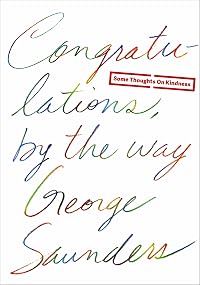
Congratulations, by the way: Some Thoughts on Kindness
by George Saunders
On This Page
Description
NEW YORK TIMES BESTSELLER • This inspiring meditation on kindness from the author of Lincoln in the Bardo is based on his popular commencement address.Three months after George Saunders gave a graduation address at Syracuse University, a transcript of that speech was posted on the website of The New York Times, where its simple, uplifting message struck a deep chord. Within days, it had been shared more than one million times. Why? Because Saunders’s words tap into a desire in all show more of us to lead kinder, more fulfilling lives. Powerful, funny, and wise, Congratulations, by the way is an inspiring message from one of today’s most influential and original writers.
Praise for Congratulations, by the way
“As slender as a psalm, and as heavy.”—The New York Times
“The graduating college senior in your life probably just wants money. But if you want to impart some heartfelt, plainspoken wisdom in addition to a check, you can't do much better than [Congratulations, by the way].”—Entertainment Weekly
“The loving selflessness that [George Saunders] advises and the interconnectedness that he recognizes couldn’t be purer or simpler—or more challenging.”—Kirkus Reviews
“Warm and tender.”—Publishers Weekly. show less
Tags
Recommendations









Member Reviews
Well, 21st century, we now officially have a replacement for Kurt Vonnegut, in the genius of George Saunders. I've loved him since I came across the jolt of Civilwarland in Bad Decline over a decade ago at my boyfriend's apartment -- and knew that I'd have to keep both the book and the boyfriend, not least because of the boyfriend's extraordinary good taste. Saunders, like Vonnegut, shows us the absurd and the ugly about ourselves as humans -- and then offers us exquisitely lovely, birdsong redemption, shows us the "better angels of our nature."
Love love love.
Love love love.
Simple, sweet, and very very short.
The ebook has this weird two-page-chapter thing going on, where one page of every chapter is a starfield image. I'm sure in the print version it was lovely, but in the ebook it was kind of clunky. I knocked off a star for this presentation issue.
"Err on the side of kindness" is in general very good advice.
However, if you have become accustomed to people mistreating each other as a matter of course, and the mistreaters feeling entitled to "kindness" in the form of eternal forgiveness without complaint or question, of allowing the mistreatment to continue, of pretending that it's not happening and everything is normal--then please, please, please: make sure you know what kindness is before you use this show more message as a justification to allow people to mistreat you for the rest of your life.
Those of you who have never had the opportunity to develop this kind of a perspective will undoubtedly find this take puzzling. How could anyone be confused by this? you may wonder. Believe me, when someone allows a person to treat them poorly forever without complaint, without leaving, they are phrasing it to themselves (as it has many times been phrased to them, trust me) as kindness. Or as love.
Kindness and love are not eternal acts of self-destructive Giving, tossed endlessly into an infinite black hole of Take, with only hurt escaping from the event horizon. That's Stockholm Syndrome. You don't need that. Find a person, a group, or a thing to use all that kindness and love on that is capable of appreciating it, or at least of improving in the acceptance of it. Children, for instance. People in hospitals. Neighbourhood parks. Book clubs. Fundraising drives. Not abusers.
Or to put it this way: Go find an online version of the Five Factor/OCEAN personality test. If you score very high on Agreeableness, maybe don't worry so much about adding more kindness to your life.
This highly personal and idiosyncratic caveat aside: yes, it's a lovely book, and a lovely idea, written well. More kindness is a good thing. show less
The ebook has this weird two-page-chapter thing going on, where one page of every chapter is a starfield image. I'm sure in the print version it was lovely, but in the ebook it was kind of clunky. I knocked off a star for this presentation issue.
"Err on the side of kindness" is in general very good advice.
However, if you have become accustomed to people mistreating each other as a matter of course, and the mistreaters feeling entitled to "kindness" in the form of eternal forgiveness without complaint or question, of allowing the mistreatment to continue, of pretending that it's not happening and everything is normal--then please, please, please: make sure you know what kindness is before you use this show more message as a justification to allow people to mistreat you for the rest of your life.
Those of you who have never had the opportunity to develop this kind of a perspective will undoubtedly find this take puzzling. How could anyone be confused by this? you may wonder. Believe me, when someone allows a person to treat them poorly forever without complaint, without leaving, they are phrasing it to themselves (as it has many times been phrased to them, trust me) as kindness. Or as love.
Kindness and love are not eternal acts of self-destructive Giving, tossed endlessly into an infinite black hole of Take, with only hurt escaping from the event horizon. That's Stockholm Syndrome. You don't need that. Find a person, a group, or a thing to use all that kindness and love on that is capable of appreciating it, or at least of improving in the acceptance of it. Children, for instance. People in hospitals. Neighbourhood parks. Book clubs. Fundraising drives. Not abusers.
Or to put it this way: Go find an online version of the Five Factor/OCEAN personality test. If you score very high on Agreeableness, maybe don't worry so much about adding more kindness to your life.
This highly personal and idiosyncratic caveat aside: yes, it's a lovely book, and a lovely idea, written well. More kindness is a good thing. show less
This is a bound and published edition of Saunders' commencement speech at Syracuse University in 2013. You could certainly complain that it's not really a "book", that it was originally published in the New York Times, and that it is very brief.
But it's worth reading.
What advice do you give to graduating students? Often it's about how to succeed in the world -- e.g., find something you love to do and do it. And there have been memorable commencement speeches of that type. Some go beyond that, e.g., the speech that Steve Jobs gave to graduating Stanford students in 2005.
Saunders gives a very simple message -- be kind.
He asks himself what he regrets in his own life, from the vantage point of decades that the students he is talking to show more haven't experienced yet. And the thing that he identifies is his indifference toward a girl in his school when he was young. He wasn't mean to her, but he ignored her when she needed kindness.
I can certainly think of the missed opportunities in my life when I wasn't kind to someone -- it would have taken so little. My life won't be any the less for having missed that last jump shot in the final seconds of a basketball game. It will be less for having turned away from someone who I could have helped have a better life. Few of us can say that we've kept the right balance of self-interest and kindness.
I've read criticisms of Saunders' speech, that he ignores the material difficulties facing students who graduate from college today, with poor employment opportunities and often carrying heavy college loan debts on into their distant futures. I would imagine those things weigh more heavily on their minds than whether or not they are kind persons. But Saunders' message is one from a vantage point he knows is decidedly not that of his audience but one he feels they could profit from -- it is better to decide what matters in your life before you are looking back on it.
I'd give the book 5 stars for content, but I'm giving it 4 as a "product" -- the speech itself is (and should be) available for free in a number of places, including video. I bought the book because . . . well, I buy George Saunders' books. I do like the idea that others have mentioned, of giving the book as a gift. show less
But it's worth reading.
What advice do you give to graduating students? Often it's about how to succeed in the world -- e.g., find something you love to do and do it. And there have been memorable commencement speeches of that type. Some go beyond that, e.g., the speech that Steve Jobs gave to graduating Stanford students in 2005.
Saunders gives a very simple message -- be kind.
He asks himself what he regrets in his own life, from the vantage point of decades that the students he is talking to show more haven't experienced yet. And the thing that he identifies is his indifference toward a girl in his school when he was young. He wasn't mean to her, but he ignored her when she needed kindness.
I can certainly think of the missed opportunities in my life when I wasn't kind to someone -- it would have taken so little. My life won't be any the less for having missed that last jump shot in the final seconds of a basketball game. It will be less for having turned away from someone who I could have helped have a better life. Few of us can say that we've kept the right balance of self-interest and kindness.
I've read criticisms of Saunders' speech, that he ignores the material difficulties facing students who graduate from college today, with poor employment opportunities and often carrying heavy college loan debts on into their distant futures. I would imagine those things weigh more heavily on their minds than whether or not they are kind persons. But Saunders' message is one from a vantage point he knows is decidedly not that of his audience but one he feels they could profit from -- it is better to decide what matters in your life before you are looking back on it.
I'd give the book 5 stars for content, but I'm giving it 4 as a "product" -- the speech itself is (and should be) available for free in a number of places, including video. I bought the book because . . . well, I buy George Saunders' books. I do like the idea that others have mentioned, of giving the book as a gift. show less
Let's be honest. This is a commencement speech, a few thousand words at best, so stretching it out into a book is a reach. Except that it is perfect as a gift to remind a graduate, a loved one, or one's self what is truly important. George Saunders shares his personal insight on how our most missed opportunities in life are not ones wherein we might have gained more wealth or glory, but when we might have done an active kindness for someone and, instead, remained complacent.
It takes fifteen minutes to read, and a lifetime to feel like you're getting it right. That's how the most pithy and powerful wisdom works: easy to absorb, challenging to enact. I am grateful for the reminder from one of my new favorite writers. It's the perfect show more book to buy for someone else...or buy for oneself and then pass it along, hoping it goes through many hands and pierces many hearts on its journey. show less
It takes fifteen minutes to read, and a lifetime to feel like you're getting it right. That's how the most pithy and powerful wisdom works: easy to absorb, challenging to enact. I am grateful for the reminder from one of my new favorite writers. It's the perfect show more book to buy for someone else...or buy for oneself and then pass it along, hoping it goes through many hands and pierces many hearts on its journey. show less
This appears to be a Commencement Address. It is short and sweet and to the point. Build your life to maximize being kind. Excellent advice!
Ok, it's really too short of a book to legitimately count toward my reading challenge, but that's about accomplisment and this is all about kindness. "Err in the direction of kindness..." I was reminded of the scene from Vonnegut's God Bless You, Mr. Rosewater in which the main character, baptizing twins, says, "There's only one rule that I know of, babies--: God damn it, you've got to be kind." Indeed.
Absolutely, stunningly brilliant. Short, to the point and oh so meaningful. I had to hold back tears while reading this. Just sent one to all of my children and my mom. What a great life lesson!
Members
- Recently Added By
Author Information

50+ Works 25,490 Members
George Saunders is the author of CivilWarLand in Bad Decline and Pastoralia. (Publisher Provided) George Saunders was born in Amarillo, Texas on December 2, 1958. He received a bachelor's degree in geophysical engineering and a master's degree in creative writing from Syracuse University. He is a professor at Syracuse University and a writer of show more short stories, essays, novellas, and children's books. He won the National Magazine Award for fiction in 1994, 1996, 2000, and 2004 His books include CivilWarLand in Bad Decline, Pastoralia, The Very Persistent Gappers of Frip, The Brief and Frightening Reign of Phil, In Persuasion Nation, and Tenth of December: Stories, which won the inaugural Folio Prize in 2014. His debut novel, Lincoln in the Bardo, received the Man Booker Prize in 2017. (Bowker Author Biography) show less
Awards and Honors
Notable Lists
Common Knowledge
- Original publication date
- 2014
Classifications
Statistics
- Members
- 483
- Popularity
- 62,566
- Reviews
- 23
- Rating
- (3.84)
- Languages
- 6 — Dutch, English, French, German, Italian, Spanish
- Media
- Paper, Audiobook, Ebook
- ISBNs
- 19
- ASINs
- 6