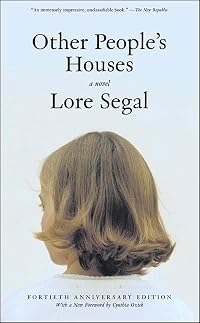
Other People's Houses
by Lore Segal
On This Page
Description
With a foreword by Cynthia Ozick, this semiautobiographical novel of a Jewish girl forced away from home in the face of Nazi persecution is an extraordinary tale of fortitude and survivalOn a December night in 1938, a ten-year-old girl named Lore is put on the Kindertransport, a train carrying hundreds of Jewish children out of Austria to safety from Hitler's increasingly alarming oppression. Temporarily housed at the Dover Court Camp on England's east coast, Lore will find herself living show more in other people's houses for the next seven years: the Orthodox Levines, the Hoopers, the working-class Grimsleys, and the wealthy Miss Douglas and Mrs. Dillon.
Charged with the task of asking "the English people" to get her parents out of Austria, Lore discovers in herself an impassioned writer. In letters to potential sponsors, she details the horrors happening back at home; in those to her parents, she notes the mannerisms and reactions of the new families around her as she valiantly tries to master their language. And the closer the world comes to a new war, the more resolute Lore becomes to survive.
As powerful now as when it was first released fifty years ago, Other People's Houses is a poignant tale about the creation of a new life in the face of hopelessness and fear—a hallmark of the postwar immigration experience. show less
Tags
Recommendations























Member Recommendations

Member Reviews
I really feel humble to write this review for an autobiographical memoir by an award-winning author who was nominated for the Pullitzer Prize in 2008. Then I console myself with the idea that I am an ordinary reader with limited knowledge of literature and creative writing. It is kind of a relief, since it allows me to use a creative freedom in my review for which I do not have to apologize!
Other People's Houses deals with a ten-year old Jewish girl's life after Hitler came into power and Jewish people were removed from society in Europe. Jewish children were ostracized, isolated, threatened, bullied and assaulted. No more non-Jewish friends. They were barred from parks, theaters and schools. Teachers refused to teach them. Parents were show more stripped from their citizenship and jobs.
From the foreword by Cynthia Ozick:
" In 1938 a particular noisy special train from Vienna--it carried the frenetic atmosphere of a school bus--was stopped in Germany to be checked for contraband. The passengers fell silent with fear, as if each one secretly suspected herself of being a smuggler. Then the signal was given to pass on, and all at once the cars began to vibrate with singing and cheers, just as though school holiday had suddenly been declared. And, in a macabre way, so it had, since all the passengers were Jewish schoolchildren, and all of them had been expelled--from school, from home, from country. Their excursion was names the Children's Transport (the parents were to follow later), but it might more accurately have been called Children's Pilgrimage. For some--those who embarked in Holland--it was a delayed pilgrimage to the death camps. For the rest--among them Lore Groszmann Segal, the author of these memoirs, then ten years old--it was a pilgrimage towards joyless England and the disabilities of exile, and, more poignantly, toward a permanent sense of being human contraband."
Lore Groszmann remembered the first ten years of her life in Austria, the following ten years in England, three years as a young woman in the Dominican Republic and then New York. From a bitterly cold December night, 1938 to the 1st of May 1951 was the period she had to survive until their permit to enter the USA was granted.
The memoir is written with an honesty and humbleness, commemorating the life of an only child who had to be sent off on the Children's Train from Austria to England, not knowing if she will ever see her family again.
In the preface of the book, the author explains the tone of her memoir:
" I am at pains to draw no facile conclusions--and all conclusions seem facile to me. If I want to trace the present from the occurrences of the past I must do it in the manner of the novelist. I posit myself as protagonist in the autobiographical action. Who emerges?
A tough enough old bird, of the species survivor, naturlized not in North America so much as in Manhattan, on Riverside Drive. Leaving home and parents gave strength at a cost. I remember knowing I should be crying like the little girl in the train across from me, but I kept thinking, "Wow! I'm off to England"-- a survival trick with a price tag. Cut yourself off, at ten years, from feelings that can't otherwise be mastered, and it takes decades to become reattached. My father died in 1945, but tears did not come until 1968, when David, my American husband, insisted I owed myself a return to my childhood. I cried the whole week in Vienna, and all over the Austrian Alps."
The engaging tale described the mental tools she had to develop to survive on her own being moved from one foster home to the next. She became accustomed to the class system in England, by being moved from the wealthy family of a Jewish furniture manufacturer in Liverpool - an Orthodox family who spoke Yiddish, which she couldn't understand or identify with at all, to a railroad stoker and his family, a milkman's family and the upper class of Guilford where her mother later would work as a maid. She would be living with five different families: There were the Levines, the Willoughbys, The Grinsleys, and finally Miss Douglas and Mrs. Dillon
Her mainstay was the contact she maintained with her parents through letters. Each letter had an uncertain destination in Austria. Making friends was a challenge. She was overbearing and demanding, but mostly misunderstood by grown-ups who did not realize the urgency and scope of the horror of Eugenics and the Holocaust playing itself out in Europe. While she tried to assimilate into a new country, new language, new culture, she relentlessly campaigned for exit visas for her parents. Her father, formerly a senior accountant at a bank, and her mother, a qualified music teacher and housewife, eventually acquired work visas as domestic workers. It was the only option available to them.
Her experiences and thoughts, as a foster child, which she wrote down in a purple notebook at the time, would become Other People's Houses. It was first published in 1964. These valuable notes and memories enabled the author to remain true to the young girl's emotional intelligence in that period of her life. The honesty in the book validates the experience. For instance, as a young girl, unable to fully comprehend the minds of adults, she pushed her dad to fall, subconsciously expressing her feelings of anger and hopelessness against him for being unable to take care of her and her hardworking mother in England. Her cruelty towards her grandmother when she destroyed the latter's illusions and admiration of Liberace on the black and white television set in their two-room apartment in New York, takes some courage to admit! Even her cruelty towards a fellow Kindertransport friend is explained in detail.
This is a story of immigration and assimilation. Of finding new social bonds within challenging circumstances. The story of a lonely little girl who translated pain, guilt, grief, agony, stress and constant fear into suppressed anger, arrogance, ungratefulness, often rudeness and stubbornness. It made her unlikable. Although her parents were able to escape to England, they were not allowed, as domestics, to accommodate her into their lives. Domestics were not allowed to have their children living with them.
It is unsure why this book is called a semiautobiographical novel. It just doesn't fit a factual memoir, written in the first person (the author does explain in the preface why she wrote it this way, though). Her relationships with her family, their journeys to safety, and their new lives in England, the Dominican Republic and eventually America, was very well written. She had to live with a grandma who had one aim in life and that was to insult the entire world, beginning in the family, rippling out to neighbors and strangers. Grandma targeted the individual members of humanity one by one, everywhere she landed up.
Lore had to face the disappointment in her hero, uncle Paul, who never could find his groove. She had to discover love in unexpected places, often misconstrued and misunderstood. It would take her many years of experiences, to finally figure it out. She herself had to close up emotionally to protect herself against the hurt of strangers. She learnt as a young girl not to trust.
The picturesque prose kept me riveted to the book. I did not expect a story with a beginning, a middle and an end with drama worming through the tale. But the author's narrative skill painted a perfect landscape of displaced people who had to re-align themselves into humanity. She told the story so well, that it became one of the best memoirs I have ever read.
The documentary film "Into The Arms Of Strangers" , winner of the Academy Award for Documentary Feature in 2000, visually enhances this book. Both Lore and her mother Franzi, who lived to the ripe old age of 100, was interviewed for this documentary. It is recommended to everyone interested in this story! In fact, when I closed the book and thought about the review, I sat for long while thinking about this little girl. It encouraged me to read more about the Kindertransport. Watching the documentary had the tears rolling down my face. Everybody simply need to watch it!
An estimated sixty million people died in the deadliest military conflict in history. Which means that 54 million people died during the Second World War, trying to stop Hitler's expansionism and his continuing killing of more than the already 6 million Jewish people. In the same period spanning between 1934 to well into the 1950s, another thirty million Chinese people lost their lives due to starvation under the Mau regime. How can you not cry, thinking about the horror of it all? I was thinking about the parents who have sent their children into battle, including millions of non-Jewish people, who ultimately paid the price for freedom for all. My dad went to the same war, fighting on the British side, and came home a totally different, almost unrecognizable person. I was born many years later and was told his story when I was a young woman.
The book is so well-written, however, it is a pity that there were so many gaps left in it. Some experiences never made a full circle. It was just left hanging. It is neither acceptable in a memoir, nor a novel, IMHO.
For instance: the little girl, who became a strong survivor, had one wish, and that was to make friends, be accepted, understood and loved. Although she did not express love in any form in the book, it is evident in her treatment of the people she cared about. She found it difficult to connect to young men, although she wanted to get married and have children. Some of her colorful, notorious romantic experiences are described in the book. But the man she would ultimately marry just fleetingly graced the tale, without any explanation of how they met, or how the relationship culminated into marriage. Her quest for romance is a sub plot in the story, and creates an expectation with the reader. It was just left hanging sterile out to dry in this particular instance. I haven't read the author's other books, but from reading a biography of her life, it seems as though all her books, written for adults, must be read to get the full picture. Her writing is also influenced by the magic realism which was started by Garcia Marquez. It became the axle of her writing adventures.
The book ends where she is financially barely surviving as a some sort of painter of graphic designs, after working as a receptionist and a filing clerk before that. In a sense there is little evidence of any joie de vivre displayed in the book. A cold, emotionally devoid cynism, intentional or unintentional, winds its way through the entire story. Readers who do not appreciate direct,frank, almost blatant, honesty, will find some of the protagonist's actions offensive. For others, it might be refreshing. I loved it.
The story concludes with a young woman disappearing into mediocrity. It doesn't make sense for a girl who had too much shutzpah to let it happen! But then again, it is based on reality. Personally, I would have preferred the inclusion of her later accomplishments as a teacher at various universities. She won several literary awards. The book could have celebrated the spirit of a survivor and a fighter. It would have validated the little girl who had to survive on her own and made it. The book could have been so much more. However, the title says it all. It was the first phase of a displaced person's life who were forced to become part of the furniture in other people's cultures, beliefs, homes and lives. Therefore, the tale concludes where she ends this period of her life.
The story was well-focused and the economical use of words eliminated any possibility of word-dumping. I still would have loved to know if Lore loved flowers, or became enchanted by a rainbow, or ever bonded with a pet. Was there anything that balanced out the challenges she had to endure? Which positive factors, impressions or experiences completed her persona? Was there just not room for it in the book, or was it absent in her life? Which part of her young life inspired her positively; which memories did she left behind. Did she ever experienced happiness? Which elements of her new adopted country was embraced or appreciated? Was there anything she appreciated in other cultures?
Nevertheless, this was still a magical literary experience. A wonderful, endearing, excellent piece of writing. What a joy!
RECOMMENDED!
This was Lore Segal's first novel and brought her international acclaim.
The book was provided by Open Road Media through Netgalley for review. Thank you very much for this wonderful experience. show less
Other People's Houses deals with a ten-year old Jewish girl's life after Hitler came into power and Jewish people were removed from society in Europe. Jewish children were ostracized, isolated, threatened, bullied and assaulted. No more non-Jewish friends. They were barred from parks, theaters and schools. Teachers refused to teach them. Parents were show more stripped from their citizenship and jobs.
From the foreword by Cynthia Ozick:
" In 1938 a particular noisy special train from Vienna--it carried the frenetic atmosphere of a school bus--was stopped in Germany to be checked for contraband. The passengers fell silent with fear, as if each one secretly suspected herself of being a smuggler. Then the signal was given to pass on, and all at once the cars began to vibrate with singing and cheers, just as though school holiday had suddenly been declared. And, in a macabre way, so it had, since all the passengers were Jewish schoolchildren, and all of them had been expelled--from school, from home, from country. Their excursion was names the Children's Transport (the parents were to follow later), but it might more accurately have been called Children's Pilgrimage. For some--those who embarked in Holland--it was a delayed pilgrimage to the death camps. For the rest--among them Lore Groszmann Segal, the author of these memoirs, then ten years old--it was a pilgrimage towards joyless England and the disabilities of exile, and, more poignantly, toward a permanent sense of being human contraband."
Lore Groszmann remembered the first ten years of her life in Austria, the following ten years in England, three years as a young woman in the Dominican Republic and then New York. From a bitterly cold December night, 1938 to the 1st of May 1951 was the period she had to survive until their permit to enter the USA was granted.
The memoir is written with an honesty and humbleness, commemorating the life of an only child who had to be sent off on the Children's Train from Austria to England, not knowing if she will ever see her family again.
In the preface of the book, the author explains the tone of her memoir:
" I am at pains to draw no facile conclusions--and all conclusions seem facile to me. If I want to trace the present from the occurrences of the past I must do it in the manner of the novelist. I posit myself as protagonist in the autobiographical action. Who emerges?
A tough enough old bird, of the species survivor, naturlized not in North America so much as in Manhattan, on Riverside Drive. Leaving home and parents gave strength at a cost. I remember knowing I should be crying like the little girl in the train across from me, but I kept thinking, "Wow! I'm off to England"-- a survival trick with a price tag. Cut yourself off, at ten years, from feelings that can't otherwise be mastered, and it takes decades to become reattached. My father died in 1945, but tears did not come until 1968, when David, my American husband, insisted I owed myself a return to my childhood. I cried the whole week in Vienna, and all over the Austrian Alps."
The engaging tale described the mental tools she had to develop to survive on her own being moved from one foster home to the next. She became accustomed to the class system in England, by being moved from the wealthy family of a Jewish furniture manufacturer in Liverpool - an Orthodox family who spoke Yiddish, which she couldn't understand or identify with at all, to a railroad stoker and his family, a milkman's family and the upper class of Guilford where her mother later would work as a maid. She would be living with five different families: There were the Levines, the Willoughbys, The Grinsleys, and finally Miss Douglas and Mrs. Dillon
Her mainstay was the contact she maintained with her parents through letters. Each letter had an uncertain destination in Austria. Making friends was a challenge. She was overbearing and demanding, but mostly misunderstood by grown-ups who did not realize the urgency and scope of the horror of Eugenics and the Holocaust playing itself out in Europe. While she tried to assimilate into a new country, new language, new culture, she relentlessly campaigned for exit visas for her parents. Her father, formerly a senior accountant at a bank, and her mother, a qualified music teacher and housewife, eventually acquired work visas as domestic workers. It was the only option available to them.
Her experiences and thoughts, as a foster child, which she wrote down in a purple notebook at the time, would become Other People's Houses. It was first published in 1964. These valuable notes and memories enabled the author to remain true to the young girl's emotional intelligence in that period of her life. The honesty in the book validates the experience. For instance, as a young girl, unable to fully comprehend the minds of adults, she pushed her dad to fall, subconsciously expressing her feelings of anger and hopelessness against him for being unable to take care of her and her hardworking mother in England. Her cruelty towards her grandmother when she destroyed the latter's illusions and admiration of Liberace on the black and white television set in their two-room apartment in New York, takes some courage to admit! Even her cruelty towards a fellow Kindertransport friend is explained in detail.
This is a story of immigration and assimilation. Of finding new social bonds within challenging circumstances. The story of a lonely little girl who translated pain, guilt, grief, agony, stress and constant fear into suppressed anger, arrogance, ungratefulness, often rudeness and stubbornness. It made her unlikable. Although her parents were able to escape to England, they were not allowed, as domestics, to accommodate her into their lives. Domestics were not allowed to have their children living with them.
It is unsure why this book is called a semiautobiographical novel. It just doesn't fit a factual memoir, written in the first person (the author does explain in the preface why she wrote it this way, though). Her relationships with her family, their journeys to safety, and their new lives in England, the Dominican Republic and eventually America, was very well written. She had to live with a grandma who had one aim in life and that was to insult the entire world, beginning in the family, rippling out to neighbors and strangers. Grandma targeted the individual members of humanity one by one, everywhere she landed up.
Lore had to face the disappointment in her hero, uncle Paul, who never could find his groove. She had to discover love in unexpected places, often misconstrued and misunderstood. It would take her many years of experiences, to finally figure it out. She herself had to close up emotionally to protect herself against the hurt of strangers. She learnt as a young girl not to trust.
The picturesque prose kept me riveted to the book. I did not expect a story with a beginning, a middle and an end with drama worming through the tale. But the author's narrative skill painted a perfect landscape of displaced people who had to re-align themselves into humanity. She told the story so well, that it became one of the best memoirs I have ever read.
The documentary film "Into The Arms Of Strangers" , winner of the Academy Award for Documentary Feature in 2000, visually enhances this book. Both Lore and her mother Franzi, who lived to the ripe old age of 100, was interviewed for this documentary. It is recommended to everyone interested in this story! In fact, when I closed the book and thought about the review, I sat for long while thinking about this little girl. It encouraged me to read more about the Kindertransport. Watching the documentary had the tears rolling down my face. Everybody simply need to watch it!
An estimated sixty million people died in the deadliest military conflict in history. Which means that 54 million people died during the Second World War, trying to stop Hitler's expansionism and his continuing killing of more than the already 6 million Jewish people. In the same period spanning between 1934 to well into the 1950s, another thirty million Chinese people lost their lives due to starvation under the Mau regime. How can you not cry, thinking about the horror of it all? I was thinking about the parents who have sent their children into battle, including millions of non-Jewish people, who ultimately paid the price for freedom for all. My dad went to the same war, fighting on the British side, and came home a totally different, almost unrecognizable person. I was born many years later and was told his story when I was a young woman.
The book is so well-written, however, it is a pity that there were so many gaps left in it. Some experiences never made a full circle. It was just left hanging. It is neither acceptable in a memoir, nor a novel, IMHO.
For instance: the little girl, who became a strong survivor, had one wish, and that was to make friends, be accepted, understood and loved. Although she did not express love in any form in the book, it is evident in her treatment of the people she cared about. She found it difficult to connect to young men, although she wanted to get married and have children. Some of her colorful, notorious romantic experiences are described in the book. But the man she would ultimately marry just fleetingly graced the tale, without any explanation of how they met, or how the relationship culminated into marriage. Her quest for romance is a sub plot in the story, and creates an expectation with the reader. It was just left hanging sterile out to dry in this particular instance. I haven't read the author's other books, but from reading a biography of her life, it seems as though all her books, written for adults, must be read to get the full picture. Her writing is also influenced by the magic realism which was started by Garcia Marquez. It became the axle of her writing adventures.
The book ends where she is financially barely surviving as a some sort of painter of graphic designs, after working as a receptionist and a filing clerk before that. In a sense there is little evidence of any joie de vivre displayed in the book. A cold, emotionally devoid cynism, intentional or unintentional, winds its way through the entire story. Readers who do not appreciate direct,frank, almost blatant, honesty, will find some of the protagonist's actions offensive. For others, it might be refreshing. I loved it.
The story concludes with a young woman disappearing into mediocrity. It doesn't make sense for a girl who had too much shutzpah to let it happen! But then again, it is based on reality. Personally, I would have preferred the inclusion of her later accomplishments as a teacher at various universities. She won several literary awards. The book could have celebrated the spirit of a survivor and a fighter. It would have validated the little girl who had to survive on her own and made it. The book could have been so much more. However, the title says it all. It was the first phase of a displaced person's life who were forced to become part of the furniture in other people's cultures, beliefs, homes and lives. Therefore, the tale concludes where she ends this period of her life.
The story was well-focused and the economical use of words eliminated any possibility of word-dumping. I still would have loved to know if Lore loved flowers, or became enchanted by a rainbow, or ever bonded with a pet. Was there anything that balanced out the challenges she had to endure? Which positive factors, impressions or experiences completed her persona? Was there just not room for it in the book, or was it absent in her life? Which part of her young life inspired her positively; which memories did she left behind. Did she ever experienced happiness? Which elements of her new adopted country was embraced or appreciated? Was there anything she appreciated in other cultures?
Nevertheless, this was still a magical literary experience. A wonderful, endearing, excellent piece of writing. What a joy!
RECOMMENDED!
This was Lore Segal's first novel and brought her international acclaim.
The book was provided by Open Road Media through Netgalley for review. Thank you very much for this wonderful experience. show less
This book went on far too long; it really should have ended when the war did, or at least when the author left England for the Dominican Republic. Instead it continued for like 125 pages more, with stories of teaching English, conflicts with the author's mother, encounters with other expatriates, etc etc etc. And on top of that, the book ends very abruptly, basically: "So my grandma died and I got married to this one dude I haven't mentioned before now, and we have a couple of kids. The End." Lore Segal sounds like an immensely ordinary woman who, Kindertransport aside, lead an immensely ordinary (and therefore boring) life.
A searing recreation of a childhood of dislocation and loss. The story is told (mostly) from the child's pov (from age 10 up into her 20s), but always with honesty and lack of sentimentality. Segal was a kindertransport child, living the war years and beyond in England; then in the Dominican Republic; and finally in America. Coincidentally, her year of birth (1928) and her year of death (2024) are the same as my mother's.
another very interesting book read on my ipad. Probably read many years ago and worth re-reading. segal speaks of her life in many different locations and eventually her marriage and motherhood are just mentioned. she always knew she wanted to write, and finally she is able to do that. this is autofiction. segal possessed strong ideas and shared them, frequently hurting the feelings of others. interested in reading more of her to see if she becomes more sensitive to others. even her close relationship with her uncle paul was not permanent.
Ik had hoge verwachtingen van dit boek, maar het viel me een beetje tegen. De schrijfstijl van Mevr. Segal ligt mij niet zo, denk ik.
Het onderwerp is wel interessant dus heb ik het netjes uitgelezen.
Lore is een jong Joods in Oostenrijk wonend meisje tijdens de opkomt van Hitler. Haar ouders regelen voor haar dat ze mee mag op een van de eerste kindertransporten waarmee ze uiteindelijk bij verschillende families in Engeland wordt ondergebracht. Lore is een vreemd kind. Ze heeft zo haar eigen opvattingen en dat botst best vaak met de pleegouders. Zodat ze telkens van gezin naar gezin gaat. Haar ouders volgen haar redelijk snel en krijgen werk en onderdak door als huishoudster en butler aan de slag te gaan. In feite horen zij ook bij de show more gegoede klasse toen ze nog in Oostenrijk woonden, maar om aan geld te komen, moeten ze wel werk doen dat ze niet gewend zijn. Lore's vader is nogal ziekelijk en spreekt geen woord Engels. Lore en haar moeder doen dat wel.
Het verhaal volgt Lore van haar tiende tot eind tienerjaren. show less
Het onderwerp is wel interessant dus heb ik het netjes uitgelezen.
Lore is een jong Joods in Oostenrijk wonend meisje tijdens de opkomt van Hitler. Haar ouders regelen voor haar dat ze mee mag op een van de eerste kindertransporten waarmee ze uiteindelijk bij verschillende families in Engeland wordt ondergebracht. Lore is een vreemd kind. Ze heeft zo haar eigen opvattingen en dat botst best vaak met de pleegouders. Zodat ze telkens van gezin naar gezin gaat. Haar ouders volgen haar redelijk snel en krijgen werk en onderdak door als huishoudster en butler aan de slag te gaan. In feite horen zij ook bij de show more gegoede klasse toen ze nog in Oostenrijk woonden, maar om aan geld te komen, moeten ze wel werk doen dat ze niet gewend zijn. Lore's vader is nogal ziekelijk en spreekt geen woord Engels. Lore en haar moeder doen dat wel.
Het verhaal volgt Lore van haar tiende tot eind tienerjaren. show less
Jul 26, 2025Dutch
Ratings
Members
- Recently Added By
Lists

Jewish Books
367 works; 24 members

Books Read in 2025
4,128 works; 98 members

Books Read in 2026
2,052 works; 68 members
Author Information

23+ Works 1,693 Members
Lore Segal is a writer, educator, and reviewer. She was born in Vienna, Austria, on March 8, 1928. Segal earned her B.A. in English from Bedford College, University of London, in 1948. Segal taught writing and English at Columbia University, Princeton University, Sarah Lawrence College, Bennington College, the University of Illinois, and The Ohio show more State University. She has published short stories, articles, and reviews in such periodicals as Partisan Review, The New Yorker, New Republic, and the New York Times Book Review. Segal also wrote fiction for both children and adults. Segal received grants from the Council of Arts and Humanities and the National Endowment for the Arts. She was a Guggenheim fellow in 1965-66 and received the Academy of Arts and Letters Award in 1986. Her book, Shakespeare's Kitchen, was a finalist for the Pulitzer Prize in 2008. (Bowker Author Biography) show less
Some Editions
Awards and Honors
Common Knowledge
- Canonical title
- Other People's Houses
- Original title
- Other People's Houses
- Original publication date
- 1964
- People/Characters*
- Lore Segal-Groszmann; mevrouw Levine; meneer Levine; Sarah Levine (jongste dochter); David Segal (man Lore); oom Paul Steiner (broer moeder Lore) (show all 48); Franzi Groszmann (moeder Lore); Poldi (dienstmeisje familie); Igo Groszmann (vader Lore); tante Trude (nicht vader Lore); oom Hans (man Trude); Kari Gold (vrienden ouders Lore); Gerti Gold (vrienden ouders Lore); Mitzi K. (winkelmeisje opa Lore); Liesel (vriendin Paul); Dolf (vriend Paul); Joszi (opa Lore vader Franzi); Erwin (neef Lore); tante Gusti Löwi; oom Eugen; Annie (dienstmeisje); tante Essie; Helene Rubichek (ander vluchtelingetje); Anton Rubichek (vader Helene); Reuben Levine (vader Sarah); Renate (vriendinnetje Lore); Meneer Willoughby; Mevrouw Willoughby; Elizabeth Willoughby (hun dochter); Joanne Willoughby (hun dochter); Stephen Willoughby (hun zoon); Mevrouw MacGuire; Gwenda Hooper; Mevrouw Hooper (moeder Gwenda en Dawn); Meneer Fred Hooper (vader Gwenda en Dawn); Albert (geadopteerd door de Hoopers); Dawn Hooper; Mevrouw Grimsley; Meneer Grimsley; Mevrouw Mary Dillon (vluchtelingencomité | ); Juffrouw Hanna Douglas; Milly (dienstmeisje bij Dillon-Douglas); Bromley (tuinman bij Dillon-Douglas); Mevrouw MacKenzie; Mevrouw Hubert; Dokter Adler; Lizzi Bauer (vriendin Lore); Professor Schmeidig
- Important places*
- Fischamend, Oostenrijk; Liverpool, England, UK; Illford, Kent, UK; Mellbridge, Uk; Allchester, UK
- Important events*
- WO II
- Dedication
- For my mother, Franzi
- First words
- "Did you read this, Igo?" my Uncle Paul asked at dinner in the autumn of 1937. "Another speech and Hitler can put Austria in his pocket. I know the university; it's ninety per cent Nazi."
- Last words*
- (Click to show. Warning: May contain spoilers.)Die nacht meerde het schip aan in Guadeloupe, waar de Litouwse student van boord ging, en drie dagen later zette ik zelf voet aan wal in de Nieuwe Wereld.
- Original language*
- Engels US
*Some information comes from Common Knowledge in other languages. Click "Edit" for more information.
Classifications
Statistics
- Members
- 167
- Popularity
- 195,316
- Reviews
- 5
- Rating
- (3.95)
- Languages
- Dutch, English, German, Spanish
- Media
- Paper, Ebook
- ISBNs
- 14
- ASINs
- 4