Pioneer Women: Voices from the Kansas Frontier
by Joanna L. Stratton
On This Page
Description
These accounts of the daily lives of Kansas pioneer women are selected from 800 memoirs collected by the author's great-grandmother.Tags
Recommendations
















Member Reviews
Since I've been so busy catching up with yard work, I feel like I've been reading this old book forever, but it was so good it was worth the time. It was published in 1981, authored by Joanna L. Stratton, with an introduction by Arthur M. Schlesinger, Jr.
Stratton used a collection of journals and letters from women who homesteaded in Kansas prior to the Civil War, and some memoirs from their daughters to tell what their life on the homestead was like. That's what makes the book so fascinating. As Stratton writes, "This is an unusual history of the frontier, for it is written through the eyes and the words of the women who lived it." One limitation is that these memoirs were written only by white homesteading women simply because the show more experiences of Indian and black women of the time, as well as the saloon girls and other marginal residents, were not recorded anywhere. It is also the story of those who stayed, rather than including those who returned east for whatever reason.
And there were plenty of reasons. Crop failure due to weather or locusts or stampedes. Hungry wolves lunging at the door and windows lured by the smell of food in the cabin or dugout or soddy. Horrible loneliness, especially when the husband had to go away for supplies or work and the wife was left alone or with small children, and the closest neighbors were a mile or more away. Curious Indians who walked in unannounced and looked at everything, sometimes taking food. They didn't have any concept of ownership so they didn't know they were doing anything wrong.
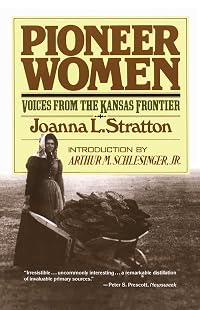
Their days were filled with hard work that I doubt many of us would stand. For instance, the cover photo shows a woman with a wheelbarrow full of buffalo chips (hardened manure) that they burned for cooking and heating since there were so few trees on the prairie. Water had to be hauled from streams, animals cared for, and in all kinds of weather. Childbirth alone in a sod house was a normal event.
Despite the distance between homes, people helped each other. They joined together particularly during the time known as "Bleeding Kansas" when proslavery folks and abolitionists fought violent battles, and Quantrill's Raiders made incursions into Kansas from Missouri, drinking and killing indiscriminately. That terrifying time made the earlier years look easy by comparison.
This book is such an eye-opener about the life of those women and children it makes me wonder how anyone survived without going crazy. I'm in awe of their courage and stamina. This is good reading and I recommend it. show less
Stratton used a collection of journals and letters from women who homesteaded in Kansas prior to the Civil War, and some memoirs from their daughters to tell what their life on the homestead was like. That's what makes the book so fascinating. As Stratton writes, "This is an unusual history of the frontier, for it is written through the eyes and the words of the women who lived it." One limitation is that these memoirs were written only by white homesteading women simply because the show more experiences of Indian and black women of the time, as well as the saloon girls and other marginal residents, were not recorded anywhere. It is also the story of those who stayed, rather than including those who returned east for whatever reason.
And there were plenty of reasons. Crop failure due to weather or locusts or stampedes. Hungry wolves lunging at the door and windows lured by the smell of food in the cabin or dugout or soddy. Horrible loneliness, especially when the husband had to go away for supplies or work and the wife was left alone or with small children, and the closest neighbors were a mile or more away. Curious Indians who walked in unannounced and looked at everything, sometimes taking food. They didn't have any concept of ownership so they didn't know they were doing anything wrong.
Their days were filled with hard work that I doubt many of us would stand. For instance, the cover photo shows a woman with a wheelbarrow full of buffalo chips (hardened manure) that they burned for cooking and heating since there were so few trees on the prairie. Water had to be hauled from streams, animals cared for, and in all kinds of weather. Childbirth alone in a sod house was a normal event.
Despite the distance between homes, people helped each other. They joined together particularly during the time known as "Bleeding Kansas" when proslavery folks and abolitionists fought violent battles, and Quantrill's Raiders made incursions into Kansas from Missouri, drinking and killing indiscriminately. That terrifying time made the earlier years look easy by comparison.
This book is such an eye-opener about the life of those women and children it makes me wonder how anyone survived without going crazy. I'm in awe of their courage and stamina. This is good reading and I recommend it. show less
This was a wonderful collection of accounts written by the women who played an integral part in settling Kansas. These women worked side by side with their husbands while raising a passel of children. There were no Wal-Marts back then so most everything was made by hand including all their clothing and the soap they washed it with. They rarely complained about the hard work, but the loneliness was hard to bear. The pictures showed them in their "Sunday best" but it's no wonder that nobody was smiling.
It made me tired just to read these vignettes of backbreaking work to raise a crop only to have it wiped out by a hailstorm or other freak of nature. The grasshopper scourge in the mid-1800s would have been the worst thing for me to bear. show more Not only did they eat all the crops but they invaded their homes as well. *Shudder* This is history at its finest sharing the human side of misery rather than just stating the facts of what happened. show less
It made me tired just to read these vignettes of backbreaking work to raise a crop only to have it wiped out by a hailstorm or other freak of nature. The grasshopper scourge in the mid-1800s would have been the worst thing for me to bear. show more Not only did they eat all the crops but they invaded their homes as well. *Shudder* This is history at its finest sharing the human side of misery rather than just stating the facts of what happened. show less
I've seldom thought that being a pioneer or homesteader would have been an interesting life, but the stories of these women were fascinating. That they were able to write about their experiences must have helped them deal with their difficult lives.
I was so impressed at the way Joanna Stratton wove all of the various notes into a cohesive and interesting story of life for women pioneers in Kansas. I learned so much from this book. When I got to the end and saw the enormous amount of data that had to be sifted, measured and molded into a wonderful book.
What a fabulous book, compiling many first hand accounts written by actual Kansas Pioneer women into a very readable book.
Pioneer women is well organized into distinct sections so that the diverse stories of the settlers could be brought together into a cohesive story. The chapters focus on different aspects of the pioneer life, from the houses, to a pioneer childhood, to the effects of the Civil War. All of the information is based on the first hand accounts in the Lilla Day Monroe Collection of Pioneer Stories.
I would highly recommend this book to anyone who is interested in the pioneer life.
Pioneer women is well organized into distinct sections so that the diverse stories of the settlers could be brought together into a cohesive story. The chapters focus on different aspects of the pioneer life, from the houses, to a pioneer childhood, to the effects of the Civil War. All of the information is based on the first hand accounts in the Lilla Day Monroe Collection of Pioneer Stories.
I would highly recommend this book to anyone who is interested in the pioneer life.
3634. Pioneer Women: Voices from the Kansas Frontier, by Joanna L. Stratton (read Oct 5, 2002) This is a 1981 book based on accounts written by Kansas pioneer women in the early 20th century. The accounts of their times in the 1860s and 1870s were of much interest. The grasshopper accounts seem incredible. But overall the book is not too successful.
Memories from Pioneer Women that helped turn Kansas into a State. They remember everyday life, hardships, housekeeping, schooling, and family.
Members
- Recently Added By
Lists

Books Set in Kansas
19 works; 7 members
Author Information

1+ Work 1,029 Members
All Editions
Awards and Honors
Distinctions
Work Relationships
Common Knowledge
- Original title
- Pioneer Women: Voices from the Kansas Frontier
- Alternate titles
- Voices from the Kansas Frontier
- Original publication date
- 1981
- People/Characters
- Olympia Brown; John Brown, abolitionist; Carry A. Nation (Carrie A. Nation)
- Important places
- Kansas, USA; Kansas Territory, USA
- Important events
- Kansas Blizzard (1886); Homestead Act (1862); Rocky Mountain Locust Plague (Albert's Swarm | 1875); Quantrill's Raid on Lawrence, Kansas; Battle of Osawatomie (1856); Women's Suffrage (USA)
- Epigraph
- Ad Astra per Aspera
To the Stars Through the Wilderness
- Kansas State Motto - Dedication
- To my great-grandmother for her independence. To my grandmother for her wisdom. To my mother for her strength.
- First words
- They called it "the Great American Desert."
- Original language
- English US
Classifications
- Genres
- History, Nonfiction, General Nonfiction, Sexuality and Gender Studies, Biography & Memoir
- DDC/MDS
- 305.4209781 — Society, government, & culture Social sciences, sociology & anthropology Social group - Age, Gender, Ethnicity Women Social role and status of women Standard subdivisions History, geographic treatment, biography North America
- LCC
- HQ1438 .K2 .S77 — Social sciences The family. Marriage, Women and Sexuality The Family. Marriage. Women Women. Feminism
- BISAC
Statistics
- Members
- 1,030
- Popularity
- 25,161
- Reviews
- 11
- Rating
- (4.15)
- Languages
- English, German
- Media
- Paper, Ebook
- ISBNs
- 6
- ASINs
- 8