On This Page
Description
"Fletcher Christian, second-in-command of the Bounty, struggles to find a permanent refuge for the people under his charge after overthrowing the captain of the ship and setting him adrift in the launch boat."Tags
Recommendations






















Member Reviews
https://nwhyte.livejournal.com/2927397.html
Pitcairn's Island, unlike the other two volumes, has no narrator, apart from the last three chapters which are told by Alexander Smith aka John Adams. Of the fifteen men (nine English and six Tahitians) who landed at Pitcairn in 1789, he was the only survivor when the island was eventually discovered by the American ship Topaz in 1808; Smith/Adams himself gave several different accounts of what had happened during the remaining two decades of his life, and one of the women who moved there in 1789 eventually returned to Tahiti and gave her own account. It's a messy story of violence, alcoholism, and sexual confusion, in an earthly paradise - Pitcairn has the natural resources to support a couple show more of hundred inhabitants, but even so the small settlement disintegrated fatally.
Nordhoff and Hall dramatise some parts - Fletcher Christian here lives for a few agonising days after the inevitable killing starts, whereas most historical accounts agree that he was one of the first to die - and undersell others - I would very much like someone to write the story from the Tahitian women's perspective, given that they outnumbered the men by three to one after the first spate of killings, and by twelve to one from 1800 when the second last mutineer died. It's also striking that the society was a very young one - Fletcher Christian was 24 when the mutiny took place, and 28 when he was killed; the other mutineers (and presumably the Tahitian men and women they brought with them to Pitcairn) must have been mostly the same age or even younger. Nordhoff and Hall fall back on the clichés of the veteran tars, the unsophisticated "Indians" or "Maori", and their statesmanlike leader, rather than the possible truth of the confused young men and women in an extraordinary situation. But the moment of discovery of the island by the Topaz is particularly well done, and is almost worth the read in itself. show less
Pitcairn's Island, unlike the other two volumes, has no narrator, apart from the last three chapters which are told by Alexander Smith aka John Adams. Of the fifteen men (nine English and six Tahitians) who landed at Pitcairn in 1789, he was the only survivor when the island was eventually discovered by the American ship Topaz in 1808; Smith/Adams himself gave several different accounts of what had happened during the remaining two decades of his life, and one of the women who moved there in 1789 eventually returned to Tahiti and gave her own account. It's a messy story of violence, alcoholism, and sexual confusion, in an earthly paradise - Pitcairn has the natural resources to support a couple show more of hundred inhabitants, but even so the small settlement disintegrated fatally.
Nordhoff and Hall dramatise some parts - Fletcher Christian here lives for a few agonising days after the inevitable killing starts, whereas most historical accounts agree that he was one of the first to die - and undersell others - I would very much like someone to write the story from the Tahitian women's perspective, given that they outnumbered the men by three to one after the first spate of killings, and by twelve to one from 1800 when the second last mutineer died. It's also striking that the society was a very young one - Fletcher Christian was 24 when the mutiny took place, and 28 when he was killed; the other mutineers (and presumably the Tahitian men and women they brought with them to Pitcairn) must have been mostly the same age or even younger. Nordhoff and Hall fall back on the clichés of the veteran tars, the unsophisticated "Indians" or "Maori", and their statesmanlike leader, rather than the possible truth of the confused young men and women in an extraordinary situation. But the moment of discovery of the island by the Topaz is particularly well done, and is almost worth the read in itself. show less
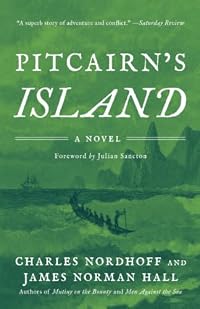
Pitcairn's Island follows the mutineers of the Bounty as they take refuge on the loneliest island in the Pacific.
In the annals of seafaring there is no more fascinating account of South Seas adventure than Pitcairn's Island. The novel unfolds a tale of desperation, profligacy, and betrayal as it chronicles the fate of Fletcher Christian, his fellow mutineers aboard H.M.S. Bounty, and a handful of Tahitians, who together take refuge on the loneliest island in the Pacific. Living undiscovered for eighteen years, the settlers of Pitcairn establish a primitive but thriving community whose peace is ultimately shattered by a struggle of bitter vengeance.
In the annals of seafaring there is no more fascinating account of South Seas adventure than Pitcairn's Island. The novel unfolds a tale of desperation, profligacy, and betrayal as it chronicles the fate of Fletcher Christian, his fellow mutineers aboard H.M.S. Bounty, and a handful of Tahitians, who together take refuge on the loneliest island in the Pacific. Living undiscovered for eighteen years, the settlers of Pitcairn establish a primitive but thriving community whose peace is ultimately shattered by a struggle of bitter vengeance.
Pitcairn's Island is the most ambitious of the three books in the Bounty Trilogy. In fact, it is likely the most ambitious book Nordhoff and Hall ever undertook. In relating the story of the Bounty mutineers' escape and exile, the authors dispense with earlier perspectives and their wide epic sweeps. Whereas Mutiny on the Bounty described the voyage from England to Tahiti and the sailors' rebellion against Captain Bligh and did so from the point of view of Midshipman Roger Byam and Men Against the Sea told of Bligh and the rest of the loyal crew members' 3600 nautical miles sail in an open launch to Timor and did so from the perspective of the ship's doctor, Thomas Ledward, Pitcairn's Island mostly tells things from the third person. show more The latter novel also has all its action take place on a small, almost forgotten island in the far regions of the South Seas.
The result is a novel that pursues the study of its characters in a much more psychologically detailed manner. The lush island surrounded by ferocious seas also serves as a pressure cooker of sorts that eventually reveals the inhabitants of the island in all their petty jealousies, uncontrolled anger, drunkenness, and revenge. It results in a civil war, leaving a devastated community forever scarred with the memories of debauchery and murder.
Then, as the civil war comes to a close, the novel abruptly shifts to a flashback. The time moves from 1794 to 1808, and the last third of the story is told from the first person narration of the last surviving seaman, Alex Smith. The repentant Smith brings us back to the initial form of storytelling narration that existed in the first two books of the trilogy. And at book's end it provides us with a somber and elegiac close that will forever have those readers who themselves lust after clear mellow nights on the South Seas looking to the same skies that Smith did. Perhaps looking for their own redemption and escape. show less
The result is a novel that pursues the study of its characters in a much more psychologically detailed manner. The lush island surrounded by ferocious seas also serves as a pressure cooker of sorts that eventually reveals the inhabitants of the island in all their petty jealousies, uncontrolled anger, drunkenness, and revenge. It results in a civil war, leaving a devastated community forever scarred with the memories of debauchery and murder.
Then, as the civil war comes to a close, the novel abruptly shifts to a flashback. The time moves from 1794 to 1808, and the last third of the story is told from the first person narration of the last surviving seaman, Alex Smith. The repentant Smith brings us back to the initial form of storytelling narration that existed in the first two books of the trilogy. And at book's end it provides us with a somber and elegiac close that will forever have those readers who themselves lust after clear mellow nights on the South Seas looking to the same skies that Smith did. Perhaps looking for their own redemption and escape. show less
This is like a British parlor mystery. You know the form, the lights go out, there is a scream, the lights come on, there was a murder, and who spend the rest of the book guessing who did it. Only one difference here, you start with fifteen men, set them in idyllic tropical isle, the lights go out over ten years, and you are left wondering which one (yes, only ONE) will be left alive.
I found this to be the most boring book of the Bounty trilogy by far. Few characters here to like. Very little suspense Recommended only for the obsessive types who have to finish every series of books they start.
I found this to be the most boring book of the Bounty trilogy by far. Few characters here to like. Very little suspense Recommended only for the obsessive types who have to finish every series of books they start.
I found this one hard to get through....it's an entire book of people making the wrong choice every time there is a decision to be made. It brings out the ugliest, most evil side of men (and it's just men, as the women are much more civilized) and it makes it an unpleasant read.
i don't know if i totally believe the narrator.
263. Pitcairn's Island, by Charles Nordhoff and James Norman Hall (read 19 June 1946) My comment on this book in my diary (which only had an inch of space for the day), was "A very good book. They really did an excellent job on this book."
Members
- Recently Added By
Lists

Best Books of 1926-1935
403 works; 10 members
Author Information

19+ Works 3,883 Members

47+ Works 4,293 Members
James Norman Hall, 1887 - 1951 James Norman Hall was born at Colfax, Iowa. He attended public schools in Colfax, and entered Grinnell College, Iowa, graduating in 1910. From 1910 to 1914 he was a social worker in Boston, working for Society for the Prevention of Cruelty to Children. At the outbreak of World War I, Hall joined the British Army. He show more served in the 9th Battalion Royal Fusiliers, taking part in the Battle of Loos. His war memoirs were published in 1916 under the title Kitcher's Mob and High Adventure. Hall re-enlisted in 1916 as a member of the Lafayette Flying Corps. During those years, he met Charles Nordhoff, a pilot serving in the same corps. When Hall and Nordhoff received an advance from Harper's to write travel articles, they moved to Tahiti. In 1921 their travel book Faery Lands of the South Seas was published. Eventually they parted ways, with Hall continuing with travel books and Nordhoff publishing novels. In 1929 Nordhoff's and Hall's jointly written book about flying, Falcons of France was published. Hall suggested the team start to write Mutiny on the Bounty in 1932, and ended up a trilogy that included Men against the Sea in 1933 and Pitcairn's Island in 1934. Nordhoff and Hall published six more coauthored novels, although the last three were largely composed by Hall. Several of these books were filmed. In his later years, Hall wrote children stories about Dr. Dogbody, a peg-legged old sailor, travel essays, narrative poems, and an collection of short stories. In 1950, Hall returned to the United States to accept an honorary doctorate from Grinnell University. He died the next year in Tahiti in 1951. His posthumously published memoirs, My Island Home, appeared in 1952. (Bowker Author Biography) show less
Series

Belongs to Publisher Series
Pocket Books (50191)
Work Relationships
Is contained in
Has the adaptation
Common Knowledge
- Canonical title
- Pitcairn's island
- Original title
- Pitcairn's island
- Original publication date
- 1934
- People/Characters
- Fletcher Christian
- Important places
- Pitcairn Island
- Dedication
- To Ellery Sedgwick
- First words
- On a day late in December, in the year 1789, while the earth turned steadily on its course, a moment came when the sunlight illuminated San Roque, easternmost cape of the three Americas.
- Last words
- (Click to show. Warning: May contain spoilers.)At length he rose and turned away, slowly descending the steep northern slope of the crag to the path which led to the settlement.
- Original language
- English
Classifications
- Genres
- Fiction and Literature, General Fiction, Historical Fiction
- DDC/MDS
- 813.52 — Literature & rhetoric American literature in English American fiction in English 1900-1999 1900-1945
- LCC
- PS3527 .O437 .P5 — Language and Literature American literature American literature Individual authors 1900-1960
- BISAC
Statistics
- Members
- 318
- Popularity
- 99,741
- Reviews
- 9
- Rating
- (4.01)
- Languages
- 6 — Danish, English, French, Norwegian (Bokmål), Spanish, Swedish
- Media
- Paper, Audiobook, Ebook
- ISBNs
- 18
- ASINs
- 29