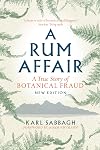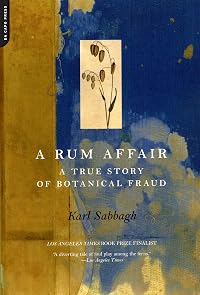
A Rum Affair: A True Story of Botanical Fraud
by Karl Sabbagh
On This Page
Description
In the 1940s, the eminent British botanist John Heslop Harrison proposed a controversial theory: that vegetation on the islands off the west coast of Scotland had survived the last Ice Age. His premise flew in the face of what most botanists believed - that no plants had survived the 10,000-year period of extreme cold. But Heslop Harrison had proof - the plants and grasses found on the isle of Rum.Harrison didn't anticipate, however, an amateur botanist called John Raven, who boldly show more questioned whether these grasses were truly indigenous to the area, or whether they had been transported there. This is the story of what happened when a tenacious amateur set out to find out the truth, and how he uncovered a most extraordinary fraud. show lessTags
Recommendations



















Member Reviews
Recommended to me by a botanist friend, this is about more than plants. I would recommend this to anyone who looks to science for definitive truth.
The majority of the book is devoted to his search for the real facts about a questionable report of a species in an unexpected location. The presence of plants is used by other scientific disciplines, e.g. to indicate climate changes, and archeological dating.
A non-botanist need not worry about not understanding specialized terms. Sabbagh admits he didn't know how to tell most plants apart, and describes his impression of the sedges in question as "stalks of grass with little blobby clusters of seeds at the top." (p.98) What he knew how to do was to analyze the events and relationships to show more come up with a likely explanation.
Part of his research was to go beyond the botanical coverup to understand why a respected scientist would make up results. He came across C.P. Snow's book "The Affair", which dealt with alleged fraud at a Cambridge College. That led him to do more research for scientists who were out to prove their theory, or their new technique, that they passionately believed was right. Sabbagh provides 3 such instances, selected from many more he found in his research: biofeedback, the structure of auxin (a plant hormone), and fossil finds which would change our theory of earth's development. I was quite interested in the question of biofeedback because that is an alternative health technique that I've considered using. And while Sabbagh doesn't say it has been proven as completely ineffective, he did find reports that a particular application was based on rigged data.
Why is this important now? Our society has recently facing a number of crises which need sound science to help us determine how to proceed: Covid transmission and treatment, how much climate change is affected by human/social actions, and (surprisingly, still) some school districts are want creationism taught instead of evolution. There are people invested in their theories (which should really be called hypotheses) on opposing sides of these topics. Scientists sometimes have vested interest (i.e. financial rewards) for promoting and 'proving' they are right. And us non-citizens have to sort through the popular media hyperbole to try to determine what we need to do. Chapter 8 presents some indicators to look for in evaluating the veracity of scientific reports; e.g. they will get a respected scientist to identify a specimen and then use them as a reference to prove their finding even tho the scientist was not confirming the location of the find. This book also reveals the hesitancy of professionals in exposing fraud.
This book was first recommended to me about 15 years ago. I delayed reading it because I thought it had to do with British colonial sugar cane plantations. How wrong I was! Don't make my mistake. Give your brain some training in analytical thinking by reading this book instead of listening to more slanted rants. show less
The majority of the book is devoted to his search for the real facts about a questionable report of a species in an unexpected location. The presence of plants is used by other scientific disciplines, e.g. to indicate climate changes, and archeological dating.
A non-botanist need not worry about not understanding specialized terms. Sabbagh admits he didn't know how to tell most plants apart, and describes his impression of the sedges in question as "stalks of grass with little blobby clusters of seeds at the top." (p.98) What he knew how to do was to analyze the events and relationships to show more come up with a likely explanation.
Part of his research was to go beyond the botanical coverup to understand why a respected scientist would make up results. He came across C.P. Snow's book "The Affair", which dealt with alleged fraud at a Cambridge College. That led him to do more research for scientists who were out to prove their theory, or their new technique, that they passionately believed was right. Sabbagh provides 3 such instances, selected from many more he found in his research: biofeedback, the structure of auxin (a plant hormone), and fossil finds which would change our theory of earth's development. I was quite interested in the question of biofeedback because that is an alternative health technique that I've considered using. And while Sabbagh doesn't say it has been proven as completely ineffective, he did find reports that a particular application was based on rigged data.
Why is this important now? Our society has recently facing a number of crises which need sound science to help us determine how to proceed: Covid transmission and treatment, how much climate change is affected by human/social actions, and (surprisingly, still) some school districts are want creationism taught instead of evolution. There are people invested in their theories (which should really be called hypotheses) on opposing sides of these topics. Scientists sometimes have vested interest (i.e. financial rewards) for promoting and 'proving' they are right. And us non-citizens have to sort through the popular media hyperbole to try to determine what we need to do. Chapter 8 presents some indicators to look for in evaluating the veracity of scientific reports; e.g. they will get a respected scientist to identify a specimen and then use them as a reference to prove their finding even tho the scientist was not confirming the location of the find. This book also reveals the hesitancy of professionals in exposing fraud.
This book was first recommended to me about 15 years ago. I delayed reading it because I thought it had to do with British colonial sugar cane plantations. How wrong I was! Don't make my mistake. Give your brain some training in analytical thinking by reading this book instead of listening to more slanted rants. show less
A gripping tale of botanical fraud, and one which prompted me to make a three-day trip to the island described, which was one of the most fascinating experiences I've had in my life. Sabbagh does a remarkable job outlining this complicated story.
Sabbagh tries as hard as he can to make 1940’s British botany lurid and exciting. While those looking for more intrigue in their plant plagiarism may go elsewhere, Sabbagh very competently lays out the whole sordid saga. J.W. Heslop Harrison goes to the Isle of Rum, allegedly plants and then “discovers” new grasses on the island; John Raven is sent on a mission to prove him fraudulent. With all the principal characters dead, the author goes sedge sleuthing and tries to remain neutral. A very quick, readable tale.
http://lifelongdewey.wordpress.com/2012/09/02/580-a-rum-affair-by-karl-sabbagh/
http://lifelongdewey.wordpress.com/2012/09/02/580-a-rum-affair-by-karl-sabbagh/
LA Times Book Prize Finalist
good reviews. I found it interesting about scientists lying about their work but it was too long
good reviews. I found it interesting about scientists lying about their work but it was too long
Ratings
Members
- Recently Added By
Published Reviews
ThingScore 100
"...punning title sets the reader up for a breezy ride...starts out by treating this material as something of a lark. Holy moly, folks, we've got a full-blown case of sedge fraud here...Yet by the time the comedy has run its course, Heslop Harrison has become an almost tragic figure.
added by juniperSun
Author Information

22+ Works 1,041 Members
Karl Sabbagh is a British writer, journalist, and television producer. The author of several books, including A Rum Affair, The Riemann Hypothesis, and Power into Art, he lives in England
Awards and Honors
Awards
Common Knowledge
- Original publication date
- 1999
- People/Characters
- John Heslop Harrison
- Important places
- Rùm, Highland, Scotland, UK (as Rum, Hebrides)
- First words
- Every year, King's College, Cambridge, sends out its annual report to graduates of the college.
- Quotations
- As a result of the Clearances, the eighteenth- and nineteenth- century "ethnic cleansing" of areas of Scotland by landowners, the island has been sparsely populated for 150 years or more. (p.92)
He is relying on the sort of arguments we might use if a polar bear had been reported in the Sahara. Armed with a knowledge of the preferred climate, diet, and habitat of polar bears, you don't need to have scoured the entire... (show all) nine million square kilometers of desert to be fairly sure that there are no polar bears there, however impeccable the credentials of the person who claimed to see one. (p.100)
...the auxin story...shows how little the published accounts of scientific research really convey of the reasons behind the results of that research... (p.179)
...the problem with Lamarckism...is as if a sentence in a recipe for scones that says, "add salt and cheese," had had some letters changed randomly so that it then says, miraculously, "add sugar and raisins," producing a diff... (show all)erent but equally delicious type of scone. It would be far more likely to read, "Adg selb tnd lhuece," and leave the cook thoroughly confused. (p.199)
At the time of his researches, when less was known about the detailed mechanisms of genetics and geology, it might charitably be said that his ideas were actually as valid as anyone else's, relying on interpretation and infer... (show all)ence from incomplete data. (p.202) - Last words
- (Click to show. Warning: May contain spoilers.)And perhaps that's where we should leave the professor--accomplished fraud or distinguished scientist, probably both--sitting, ambiguous as ever, in front of a roaring fire in the White House on Rum.
Classifications
Statistics
- Members
- 187
- Popularity
- 174,972
- Reviews
- 4
- Rating
- (3.67)
- Languages
- English
- Media
- Paper, Ebook
- ISBNs
- 8
- ASINs
- 1