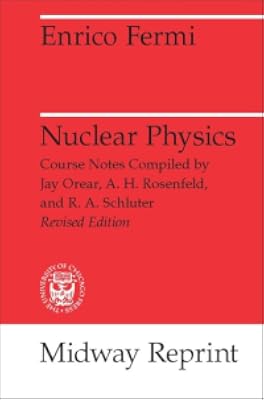
Nuclear Physics: A Course Given by Enrico Fermi at the University of Chicago
by Enrico Fermi
On This Page
Description
This volume presents, with some amplification, the notes on the lectures on nuclear physics given by Enrico Fermi at the University of Chicago in 1949. "The compilers of this publication may be warmly congratulated. . . . The scope of this course is amazing: within 240 pages it ranges from the general properties of atomic nuclei and nuclear forces to mesons and cosmic rays, and includes an account of fission and elementary pile theory. . . . The course addresses itself to experimenters show more rather than to specialists in nuclear theory, although the latter will also greatly profit from its study on account of the sound emphasis laid everywhere on the experimental approach to problems. . . . There is a copious supply of problems."--Proceedings of the Physical Society "Only a relatively few students are privileged to attend Professor Fermi's brilliant lectures at the University of Chicago; it is therefore a distinct contribution to the followers of nuclear science that his lecture material has been systematically organized in a publication and made available to a much wider audience."--Nucelonics show lessTags
Recommendations
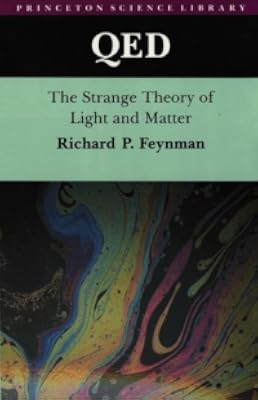
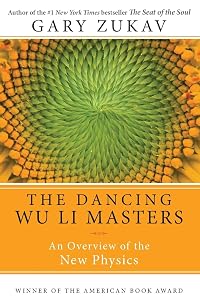

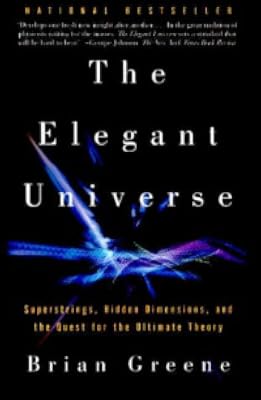
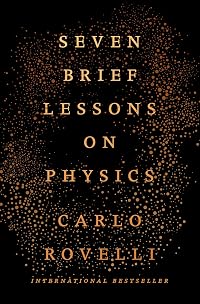



Members
- Recently Added By
Author Information

20 Works 579 Members
Born in Rome, Italy, Enrico Fermi was primarily self-taught. At the age of 17, he had already acquired a thorough understanding of classical physics. With his friend Enrico Persico, Fermi performed experiments, using handmade apparatus and thus obtaining an excellent grasp of experimental physics. He trained in Pisa, Gottingen, and Leiden, working show more with leading figures in the new quantum mechanics. He received his Ph.D. at the University of Pisa in 1922 and returned to Rome in 1926, where he spent several years working on the statistical mechanics of particles and wrote the first textbook on modern physics to be published in Italy. In 1934 Fermi began a series of experiments producing new radioactive isotopes by neutron bombardment. This was the work for which he was awarded a Nobel Prize in 1938. After the prize ceremony, Fermi did not return to Italy, because of the Fascist regime, but emigrated with his wife and two children to the United States. As part of the atomic bomb effort, Fermi directed the design and construction of the first nuclear reactor at the University of Chicago, which began operating in December 1942. He spent the next two years with Arthur H. Compton leading the American team that constructed the first atomic bomb. Fermi was one of the few modern physicists to excel in both theory and experiment. His accomplishments were foundation points for many branches of physics, including studies of the statistics of particles obeying the exclusion principle, quantum electrodynamics, beta-decay, artificial radioactivity, pion-nucleon collision, and nuclear chain reactions. Fermi died of cancer in 1954. The next year the newly discovered element with atomic number 100 was named fermium in his honor. (Bowker Author Biography) show less
Classifications
Statistics
- Members
- 23
- Popularity
- 1,078,343
- Languages
- English
- Media
- Paper
- ISBNs
- 1
- ASINs
- 1