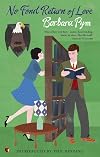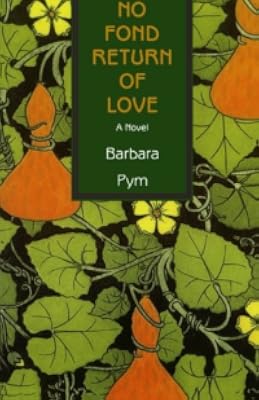
No Fond Return of Love
by Barbara Pym 
On This Page
Description
Three lonely people come together in this poignant, witty novel of star-crossed romance from the New York Times-bestselling author of Jane and Prudence. After being jilted by her fiancé, Dulcie Mainwaring despairs of ever finding true love. For a distraction, she goes to a publishing conference, where she meets Viola Dace, a dramatic woman who refuses to live without romance, as well as Aylwin Forbes, an editor whom Viola adores. The fact that Aylwin is married doesn't stop Viola. When show more her amorous pursuit prompts Aylwin's wife to leave him, the academic heartthrob is wide open to Viola's romantic attentions. That is, until Dulcie's eighteen-year-old niece moves in with Viola, and the young girl soon catches Aylwin's roving eye. Set in London in the early 1960s, No Fond Return of Love is a delightful comedy of manners that comes full circle as Dulcie discovers a love as unexpected as it is liberating. show lessTags
Recommendations





















Member Recommendations


Member Reviews
I wouldn't like to read too many of her books in one go, but Barbara Pym is always delightful to come back to after a long absence. This one has all the characteristic elements: spinster aunts, book-indexing, London suburbia, vicars, jumble sales, evensong, and private hotels in Devon. There is a very English focus on the small details of life: in terms of the plot, there should be a great love story along the lines of Persuasion going on, but in practice, Dulcie (and the reader) seem to be much more focussed on the process, the practical business of stalking her man, than on the man himself. Whether or not they get together at the end of the book becomes almost an irrelevant detail: we're much more interested in the china donkey from show more the jumble sale.
You often hear words like "cosy" and "comfortable" used about Pym's novels, but there's more going on here than comfort-reading. There's a campness underlying the narrative - Firbank in sensible shoes, perhaps. Pym keeps reminding us with little touches how truly bizarre the ordinary can be (the Brazilian diplomat next door secretly trying on his kilt...). show less
You often hear words like "cosy" and "comfortable" used about Pym's novels, but there's more going on here than comfort-reading. There's a campness underlying the narrative - Firbank in sensible shoes, perhaps. Pym keeps reminding us with little touches how truly bizarre the ordinary can be (the Brazilian diplomat next door secretly trying on his kilt...). show less
I started reading Barbara Pym's No Fond Return last week, but put it aside in favour of another book - any book, quite frankly. Jilly Cooper and Philip Larkin can only be flattering a fellow author when they claim that Pym is comparable to, or indeed better than, Jane Austen. That could only be the case for people who prefer reading about middle-aged, middle class spinsters in 1950s England, over the timeless wit and insight of Austen's limited oeuvre. Pym's characters and observations are merely out of date.
Dulcie Mainwaring is a bored, lonely, twittery spinster, who meets a similarly desperate old maid called Viola Dace at a conference. Dulcie has recently been 'released' from an engagement to a man called Maurice, and Viola is show more stalking Aylwin Forbes, an academic writer who once gave her a kiss out of pity. Dulcie and Viola meet Aylwin at the conference and immediately latch onto him. hoping that he will make one of them 'respectable' by bestowing the very great honour of marriage on the nearest available female. Dulcie finds out that Aylwin has a brother who is a vicar, and actually stakes out his church in the hope of acquainting herself with the Forbes family, and then she moves onto his mother's seaside hotel. Dulcie and Viola camp out there, researching his background and hunting around the graveyard for his father's headstone! Of course, Dulcie's determined interest is all for naught, because Aylwin - like most pathetic middle-aged men - has his eye on her nineteen year old niece, Laurel. (*shudder*) And this isn't Regency England, this is the late 1950s - 'in these pushing, jostling days of the so-called equality of the sexes'. Somehow the thought that Dulcie is willing to settle for a man who, like Edmund in Mansfield Park, turns to her on the rebound is a thoroughly depressing ending to a ridiculous story.
Am I supposed to care about this sad specimen of womanhood, who stalks men like prey, in the hope that someone - anyone - will marry her? And the abstract philosophising and pretentious dialogue that fills novels like this - saying 'one' in place of 'I' or 'you', and using the word 'rather!' with a straight face. I hope that middle class idiots like Dulcie and Viola are by now confined to early twentieth century fiction by the likes of Christie, Priestley and Pym, because they are too stupid to live. 'One feels a sense of one's own inadequacy, somehow, almost unworthiness,' said Dulcie thoughtfully. 'But then life is often cruel in small ways, isn't it. Not exactly nature red in tooth and claw, though one does sometimes feel ... And what will you have for pudding today?' Like fingernails down a blackboard.
Dreadfully sorry, Pym fans, but I don't think characters like Dulcie have anything useful to say in this day and age. show less
Dulcie Mainwaring is a bored, lonely, twittery spinster, who meets a similarly desperate old maid called Viola Dace at a conference. Dulcie has recently been 'released' from an engagement to a man called Maurice, and Viola is show more stalking Aylwin Forbes, an academic writer who once gave her a kiss out of pity. Dulcie and Viola meet Aylwin at the conference and immediately latch onto him. hoping that he will make one of them 'respectable' by bestowing the very great honour of marriage on the nearest available female. Dulcie finds out that Aylwin has a brother who is a vicar, and actually stakes out his church in the hope of acquainting herself with the Forbes family, and then she moves onto his mother's seaside hotel. Dulcie and Viola camp out there, researching his background and hunting around the graveyard for his father's headstone! Of course, Dulcie's determined interest is all for naught, because Aylwin - like most pathetic middle-aged men - has his eye on her nineteen year old niece, Laurel. (*shudder*) And this isn't Regency England, this is the late 1950s - 'in these pushing, jostling days of the so-called equality of the sexes'. Somehow the thought that Dulcie is willing to settle for a man who, like Edmund in Mansfield Park, turns to her on the rebound is a thoroughly depressing ending to a ridiculous story.
Am I supposed to care about this sad specimen of womanhood, who stalks men like prey, in the hope that someone - anyone - will marry her? And the abstract philosophising and pretentious dialogue that fills novels like this - saying 'one' in place of 'I' or 'you', and using the word 'rather!' with a straight face. I hope that middle class idiots like Dulcie and Viola are by now confined to early twentieth century fiction by the likes of Christie, Priestley and Pym, because they are too stupid to live. 'One feels a sense of one's own inadequacy, somehow, almost unworthiness,' said Dulcie thoughtfully. 'But then life is often cruel in small ways, isn't it. Not exactly nature red in tooth and claw, though one does sometimes feel ... And what will you have for pudding today?' Like fingernails down a blackboard.
Dreadfully sorry, Pym fans, but I don't think characters like Dulcie have anything useful to say in this day and age. show less
This is such a fascinating character study about a bunch of people oddly coming together. Dulcie ends up being the connection for them all in a way, and her behavior throughout is both disconcerting and hilarious (was stalking a verb in 1961?). I think I’m most thrown off by the very end as it’s both a perfect unknown, and yet I’m thinking it’s really the worst possible outcome if what I think will happen actually does. I can’t remember my feelings about it when I first read it almost fifteen years ago, but now I’m very much “oh no Dulcie”.
I'm glad this wasn't the first Pym I read, otherwise I would not have gone on to read more Pym and would have missed reading the others that I found charming with a slightly bittersweet taste like a good cup of English tea without milk.
Instead of a subtle and slow-paced book that you sink into and it sinks into you, like Excellent Women and Quartet in Autumn, I would describe this one as mildly "zany," or mildly "madcap," words often used to describe a certain type of movie from the 60s and 70s. And like those movies, the characters in this 1961 novel could be played by a plethora of B-movie actors.
Gosh, I keep thinking specifically of the movie, It's a Mad Mad Mad Mad World. No Fond Return of Love is like that but less zany with short show more touches of madcap. Like that movie, there are a whole bunch of characters that are "characters" but the novel's star is Miss Dulce Mainwaring who is similar to Pym's other "excellent women." The story is told in alternating points of view with Miss Mainwaring being the more sympathetic (actually I found her often more pitiful than sympathetic) and it is her's that is the opening and closing story-line.
Everyone is motivated by a single goal. Not a buried treasure under a big "W," these men and women are all hoping to find the big "L," Love. Well, maybe it's a lower case "l" since most are searching for their own superficial, low-grade angst-driven definition of love. The women live their single lives outwardly brave but with the unspoken whimpering hope to cure loneliness and find a bigger life's purpose. In the case of the male characters, their hope is for that special female to round out their self-images, or lusts, or both. Mind you, this is early 60s, early or pre Sexual Revolution and Feminism movement.
As the title states the hopes of both sexes are often met with, not surprisingly, no fond return. By the end of the novel, a few lucky ones do ultimately, if not find love exactly, they find a match that is both more and less than they deserve.
I can see the value of this novel in context at the time it was written, but I'm not sure it has aged as well as her other works that cover similar ground. Or, maybe, it could be re-discovered much later with new found appreciation. Right now it's possible that it is at that awkward age of a novel as being too old-fashioned but not old-fashioned enough. Didn't something like that happen to Jane Austen's work too?
Anyway, I am undaunted. I'll still keep an eye out for more Pym even though this one is a 2 star "meh" from me. Coincidentally or not, it's the same rating I would give to It's a Mad Mad Mad Mad World. show less
Instead of a subtle and slow-paced book that you sink into and it sinks into you, like Excellent Women and Quartet in Autumn, I would describe this one as mildly "zany," or mildly "madcap," words often used to describe a certain type of movie from the 60s and 70s. And like those movies, the characters in this 1961 novel could be played by a plethora of B-movie actors.
Gosh, I keep thinking specifically of the movie, It's a Mad Mad Mad Mad World. No Fond Return of Love is like that but less zany with short show more touches of madcap. Like that movie, there are a whole bunch of characters that are "characters" but the novel's star is Miss Dulce Mainwaring who is similar to Pym's other "excellent women." The story is told in alternating points of view with Miss Mainwaring being the more sympathetic (actually I found her often more pitiful than sympathetic) and it is her's that is the opening and closing story-line.
Everyone is motivated by a single goal. Not a buried treasure under a big "W," these men and women are all hoping to find the big "L," Love. Well, maybe it's a lower case "l" since most are searching for their own superficial, low-grade angst-driven definition of love. The women live their single lives outwardly brave but with the unspoken whimpering hope to cure loneliness and find a bigger life's purpose. In the case of the male characters, their hope is for that special female to round out their self-images, or lusts, or both. Mind you, this is early 60s, early or pre Sexual Revolution and Feminism movement.
As the title states the hopes of both sexes are often met with, not surprisingly, no fond return. By the end of the novel, a few lucky ones do ultimately, if not find love exactly, they find a match that is both more and less than they deserve.
I can see the value of this novel in context at the time it was written, but I'm not sure it has aged as well as her other works that cover similar ground. Or, maybe, it could be re-discovered much later with new found appreciation. Right now it's possible that it is at that awkward age of a novel as being too old-fashioned but not old-fashioned enough. Didn't something like that happen to Jane Austen's work too?
Anyway, I am undaunted. I'll still keep an eye out for more Pym even though this one is a 2 star "meh" from me. Coincidentally or not, it's the same rating I would give to It's a Mad Mad Mad Mad World. show less
There are various ways of mending a broken heart, but perhaps going to a learned conference is one of the more unusual. (p. 1)
How can you not love a book that opens with a sentence like that? Dulcie Mainwaring works as an "indexer," preparing indices for scholarly texts. After her fiance breaks off their engagement, she attends a weekend conference for those in similar professions. There she meets Viola Dace, an older single woman like Dulcie. Viola has done indexing work for conference lecturer Aylwin Forbes, an association with romantic overtones that may or may not have been a catalyst for the recent breakup of Aylwin's marriage. Dulcie develops a bit of a crush on Aylwin, although he is barely aware of her existence. After the show more conference she keeps in touch with Viola, who later moves in with Dulcie after difficulties with her landlord. Their shared fascination with Aylwin, and the love of facts and detail that make them good indexers, lead them to investigate details of Aylwin's life and even spy on him a little bit. They discover he has a brother who's a vicar, and attend services at the brother's church. Dulcie visits Aylwin's neighborhood and finds herself at a jumble sale hosted by Aylwin's wife and mother-in-law. It sounds psychopathic, but it's actually a brilliant comedy of manners at which Barbara Pym excels.
Pym is also masterful at combining humor, irony, and pathos. Here, Dulcie observes her sister Charlotte, who is living vicariously through her 18-year-old daughter Laurel's independent life in London:
It was rather sad, Dulcie thought, that an apparently happily married woman should confess to a secret hankering for such a life. And yet, stealing a glance at her brother-in-law, at that moment preoccupied with classifying a pile of Masai warriors' spears and shields left to the local museum by a retired colonial servant, she could appreciate that perhaps a desire for escape was not so surprising. (p. 112)
Pym's characters are often middle-aged single women who, while not feminists, are competent and sensible. The women are usually in control of their own lives and events -- no helpless doormats here -- and things usually work out well in the end. As No Fond Return of Love progresses, the lives of Dulcie, Viola, Aylwin and other characters intertwine in delightful ways and the ending is most satisfying. Barbara Pym's books are excellent comfort reads best taken curled up in a blanket with a nice cup of tea. show less
How can you not love a book that opens with a sentence like that? Dulcie Mainwaring works as an "indexer," preparing indices for scholarly texts. After her fiance breaks off their engagement, she attends a weekend conference for those in similar professions. There she meets Viola Dace, an older single woman like Dulcie. Viola has done indexing work for conference lecturer Aylwin Forbes, an association with romantic overtones that may or may not have been a catalyst for the recent breakup of Aylwin's marriage. Dulcie develops a bit of a crush on Aylwin, although he is barely aware of her existence. After the show more conference she keeps in touch with Viola, who later moves in with Dulcie after difficulties with her landlord. Their shared fascination with Aylwin, and the love of facts and detail that make them good indexers, lead them to investigate details of Aylwin's life and even spy on him a little bit. They discover he has a brother who's a vicar, and attend services at the brother's church. Dulcie visits Aylwin's neighborhood and finds herself at a jumble sale hosted by Aylwin's wife and mother-in-law. It sounds psychopathic, but it's actually a brilliant comedy of manners at which Barbara Pym excels.
Pym is also masterful at combining humor, irony, and pathos. Here, Dulcie observes her sister Charlotte, who is living vicariously through her 18-year-old daughter Laurel's independent life in London:
It was rather sad, Dulcie thought, that an apparently happily married woman should confess to a secret hankering for such a life. And yet, stealing a glance at her brother-in-law, at that moment preoccupied with classifying a pile of Masai warriors' spears and shields left to the local museum by a retired colonial servant, she could appreciate that perhaps a desire for escape was not so surprising. (p. 112)
Pym's characters are often middle-aged single women who, while not feminists, are competent and sensible. The women are usually in control of their own lives and events -- no helpless doormats here -- and things usually work out well in the end. As No Fond Return of Love progresses, the lives of Dulcie, Viola, Aylwin and other characters intertwine in delightful ways and the ending is most satisfying. Barbara Pym's books are excellent comfort reads best taken curled up in a blanket with a nice cup of tea. show less
I love Barbara Pym and this book was as well written and slyly humorous as her other novels. However, I did not enjoy it as much as I have enjoyed her other books. The slightly unbelievable stalking plot just seemed rather silly. To me the actions of Dulcie and Viola in trying to research Aylwin Forbes's life (attend services at his brother's church! go to his estranged wife's jumble sale! stay at his mother's creepy hotel just to see what his childhood was like!) felt borderline unhinged. I thought these odd actions might have some logical repercussions that would tie together at the end, but that didn't happen at all. The whole thing just felt a little insane and not consistent with the psychologically insightful writing I expect from show more Pym. show less
Dulcie and Viola meet at a weekend conference for people involved in the peripheral aspects of writing, such as researching and indexing an author's work. Neither really likes the other but circumstances throw them together, and then they find that they share an interest in stalking a mutual acquaintance, good-looking author Aylwin Forbes.
Pym's novels are hard to put a label to; they have comical aspects and funny characters, but they have some sadness. They aren't romance novels, but the ones I've read so far feature lonely women trying to find someone. I really liked noticing about halfway through the book that, though Viola sulks around most people to the point that her own parents don't enjoy her company, she perks right up when an show more eligible man is around. show less
Pym's novels are hard to put a label to; they have comical aspects and funny characters, but they have some sadness. They aren't romance novels, but the ones I've read so far feature lonely women trying to find someone. I really liked noticing about halfway through the book that, though Viola sulks around most people to the point that her own parents don't enjoy her company, she perks right up when an show more eligible man is around. show less
Members
- Recently Added By
Published Reviews
Barbara Pym is an idiosyncratic writer and those who are already addicts (and I choose the word deliberately) need only to be told that No fond return of love is the mixture as before, as sweet and sour as ever. The publisher's blurb quotes a phrase which is used more than once in the book. Indexers and bibliographers are referred to as those who work on the'dustier fringes of the academic show more world'. This is typical of the way Barbara Pym gently denigrates and pokes fun at all her characters, most of whom have middleclass or clerical backgrounds. Catty she may be but her claws are sheathed and one can feel affection behind the irony. Her style of writing is wry and muted and she is admittedly an acquired taste. For 14 years she was largely neglected; many people thought she was dead. Between 1950 and 1961 she had written six ironic, witty novels, but, though well reviewed, they were never widely read. show less
added by KayCliff
Lists

Top Five Books of 2013
1,562 works; 721 members

Favourite Virago Modern Classics
183 works; 38 members

Top Five Books of 2018
802 works; 265 members

Books Read in 2018
4,360 works; 110 members

Books Read in 2021
5,361 works; 113 members
Talk Discussions
Past Discussions
Barbara Pym centenary: No Fond Return of Love and Quartet in Autumn in Virago Modern Classics (July 2013)
Author Information

27+ Works 14,771 Members
Novelist Barbara Pym was born in Shropshire and educated at Oxford University. An editor of Africa, an anthropological review, for many years, she published her first novel, Some Tame Gazelle, in 1950. Since then, a number of popular works have been published. Often compared with the works of Jane Austen in both manner and subject, Pym's novels show more are apparently guileless evocations of the foibles of aging and isolated characters. She has a sure, if understated, sense of her characters' psychology and of their unintentionally comic revelations about themselves and their futile lives. After the publication of No Fond Return of Love (1961), all her books were out of print until she was cited, coincidentally by both David Cecil and Philip Larkin, as among the most underestimated novelists of the 20th century. She subsequently completed two successful novels, The Sweet Dove Died (1978) and Quartet in Autumn (1978), the latter a comic-pathetic study of two men and two women in their sixties who work in the same office but lead separate, lonely lives outside. Many of her earlier books have since been reprinted, including Excellent Women (1952) and A Glass of Blessings (1958), both perceptive psychological studies of aging women taken advantage of by others. A posthumous novel, A Few Green Leaves (1980), is a superb comedy of provincial village life. (Bowker Author Biography) show less
Barbara Pym has a Legacy Library. Legacy libraries are the personal libraries of famous readers, entered by LibraryThing members from the Legacy Libraries group.
Some Editions
Series
Belongs to Publisher Series
Virago Modern Classics (536)
Work Relationships
Common Knowledge
- Original publication date
- 1961
- People/Characters
- Viola Dace; Aylwin Forbes; Dulcie Mainwaring; Father Tulliver
- Important places
- London, England, UK
- Dedication
- To Hazel Holt
- First words
- There are various ways of mending a broken heart, but perhaps going to a learned conference is one of the more unusual.
- Quotations
- ‘Research, with a good-looking man,’ Miss Foy went on. ‘That’s an enviable lot. What was the subject of your research?’
‘Oh, just an obscure eighteenth-century poet,’ said Viola quickly.
‘You wer... (show all)e lucky to find one so obscure that not even the Americans had “done” him,’ commented Miss Foy dryly. ‘It’s quite serious, this shortage of obscure poets.’
‘Perhaps the time will come when one may be permitted to do research into the lives of ordinary people,’ said Dulcie, ‘people who have no claim to fame whatsoever.’
‘Ah, that’ll be the day!’ said Miss Foy jovially. - Last words
- (Click to show. Warning: May contain spoilers.)He took a mauve sugared almond out of a bag and sucked it thoughtfully, wondering what, if anything, he had missed.
- Blurbers
- Hazzard, Shirley; Betjeman, John
Classifications
Statistics
- Members
- 984
- Popularity
- 26,728
- Reviews
- 28
- Rating
- (3.92)
- Languages
- 5 — English, French, German, Italian, Spanish
- Media
- Paper, Audiobook, Ebook
- ISBNs
- 39
- ASINs
- 16